 Skip to content
Texas Estates Code Section 352.002 allows a 5% commission on qualifying cash actually received or paid out, capped at 5% of the estate's gross fair market value, and it isn't an automatic fee on every asset. The rule is based on cash movement during administration, not on the estate's headline value.
A grieving family may discover this confusion when a parent's home, investment accounts, insurance policies, and other property appear to make up a substantial estate. The person named executor may assume the law entitles them to 5% of everything. Other heirs may hear that number and worry that the executor is taking an unreasonable share.
Texas law is more precise. Section 352.002 creates a statutory commission for qualifying administration work, but the commission base excludes important categories, and a probate court can reduce or deny payment when the representative fails to meet fiduciary duties. Understanding that distinction early can prevent an accounting disagreement from becoming a family lawsuit.
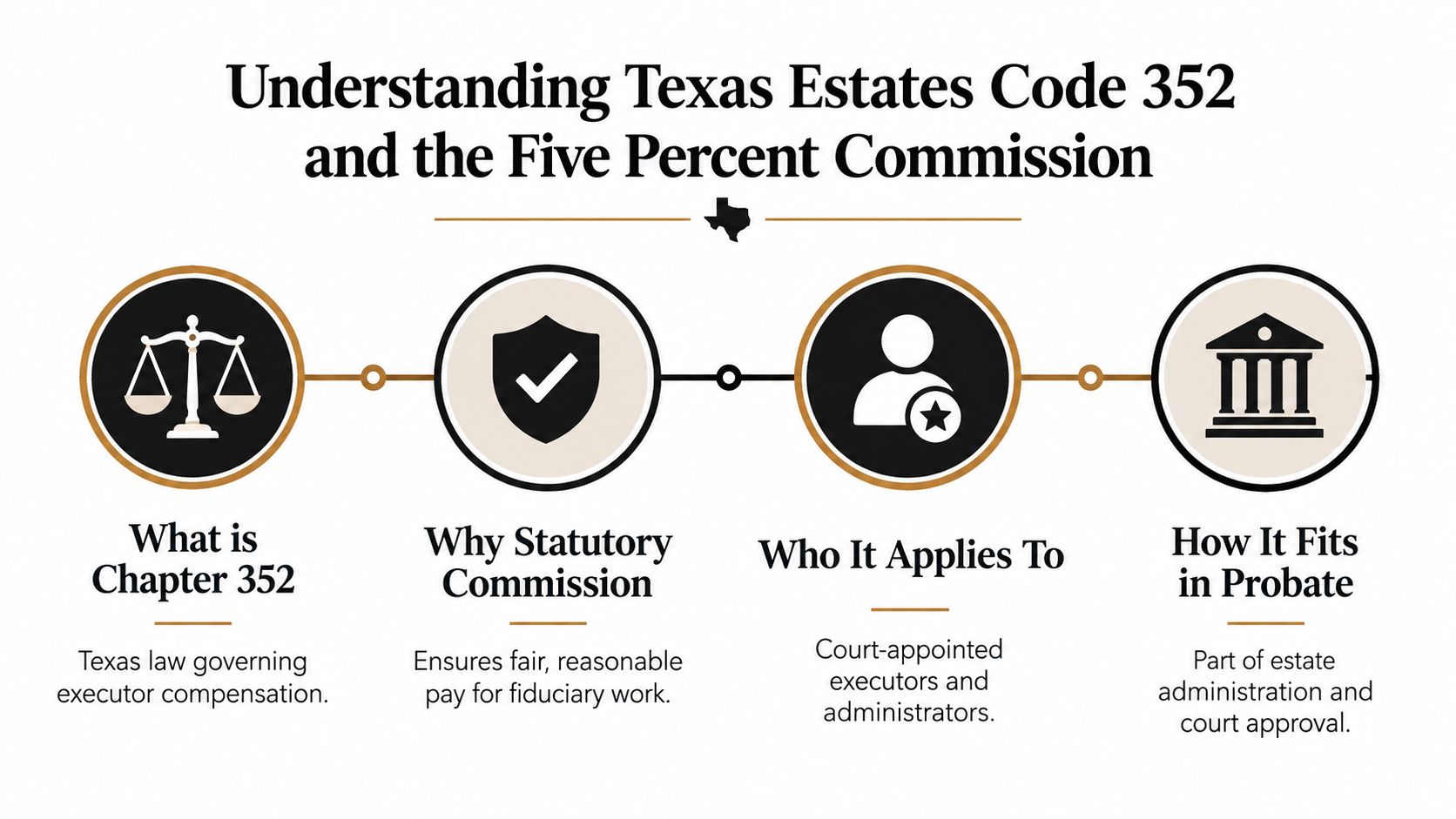
Understanding Texas Estates Code 352 and the Five Percent Commission
Consider a Houston family whose father died with a house, bank accounts, personal property, and several outstanding bills. His daughter, named executor, believed the “Texas 5% rule” meant she could claim 5% of the estate's total value. Her siblings were surprised and felt the proposed payment would reduce their inheritance.
That reaction is understandable. The phrase “5% executor fee” sounds like a percentage of everything the deceased owned. But Texas Estates Code Chapter 352 focuses on compensation for a personal representative's administration work, especially qualifying cash received and paid out. It doesn't automatically turn every inherited asset into a commissionable amount.
The Texas Estates Code is part of the legal framework governing estates, probate, and fiduciary relationships. Title 2 addresses estates of decedents, while Title 3 addresses guardianship and related protective proceedings. Chapter 352 provides rules for compensating an executor, administrator, or temporary administrator. In plain English, a personal representative is the person authorized to handle the estate for the benefit of creditors, heirs, and beneficiaries.
Why Texas uses a statutory commission
Probate administration can involve collecting property, depositing funds, paying legitimate debts, handling taxes, protecting real estate, communicating with heirs, and completing final distributions. A statutory commission gives courts and families a starting point for evaluating compensation without requiring every executor to negotiate a separate fee agreement.
A useful analogy is a cash register. The commission generally follows qualifying money that moves through the administration, not the price tag attached to every asset sitting in the estate. A house that passes to an heir without a qualifying cash transaction isn't treated the same way as money collected from a sale or income received during administration.
The structure can apply in both independent and dependent administration. Independent administration gives the representative more freedom to act without obtaining court approval for every routine decision. Dependent administration involves closer court supervision. The administration type affects procedure, but it doesn't erase the need for accurate records and responsible management.
Families dealing with estate value should also distinguish probate compensation from tax questions. A plain-language resource on inheritance tax explained for 2025 can help separate inheritance-tax concepts from executor compensation, because these are different legal and financial issues.
For a practical overview of the topic, families can review this Texas executor compensation guide. A clear understanding at the beginning helps relatives discuss pay based on records and statutory rules rather than assumptions made during a painful time.
Who Qualifies for Commission and How Texas Courts View the Role
The people who may fall within Section 352.002 include a court-appointed executor, administrator, or temporary administrator. An executor is usually the person named in a will. An administrator is appointed when there is no qualifying executor or when the estate requires another form of appointment. A temporary administrator handles limited estate needs for a temporary period.
Appointment alone doesn't guarantee payment. The representative must first receive legal authority from the probate court and then administer the estate responsibly. Letters Testamentary and Letters of Administration in Texas are the court documents that give a representative legal authority.
The authority step
A typical sequence looks like this:
- The will, if one exists, is presented to the probate court.
- The court determines whether the proposed representative can serve.
- The representative takes required steps to qualify.
- The court issues the documents establishing authority.
- The representative begins collecting, protecting, and administering estate property.
The legal word fiduciary describes someone who must act for another person's benefit. An executor is a fiduciary because the executor must protect estate property and follow the law instead of treating estate funds as personal money. That obligation continues whether the administration is independent or closely supervised.
Prudence matters
Texas courts can examine whether the representative managed estate property prudently. “Prudently” means making careful, reasonable decisions in light of the estate's circumstances, preserving assets, paying proper obligations, and maintaining records that allow interested persons and the court to understand what happened.
A representative who handles a complicated estate carefully may have a reasonable claim for statutory compensation. A representative who ignores financial problems, mixes estate funds with personal funds, delays administration without a sound reason, or distributes property improperly may face an objection.
Practical rule: Treat every estate dollar as belonging to the estate until the court-approved administration is complete.
The court's role is important because the statutory commission is a baseline, not an unconditional reward. Texas law permits the court to adjust compensation under applicable rules, and Section 352.004 allows the court to reduce or deny commission if the representative failed to prudently manage estate property or was removed under the statute. Families should therefore view eligibility and entitlement as separate questions. A person may be properly appointed yet still need to justify the amount requested.
How the Five Percent Calculation Actually Works
Section 352.002 has two connected limits. First, the representative may receive 5% of amounts received or paid out in cash during administration. Second, the total commission cannot exceed 5% of the gross fair market value of the estate subject to administration. The first limit focuses on qualifying transactions. The second prevents the statutory calculation from exceeding the estate-value ceiling.
The formula is not:
Total estate value × 5% = automatic executor fee
Instead, the practical starting point is:
Qualifying cash received and paid out × 5%, subject to the statutory cap and court review

What may be excluded
Section 352.002 excludes significant categories from the commission base. These include:
- Cash already on hand: Cash or cash equivalents held in bank or brokerage accounts at the time of death aren't automatically treated as qualifying cash received during administration.
- Life insurance proceeds: Insurance proceeds are excluded from the commission base in the circumstances described by the statute.
- Direct payments to heirs: Cash paid directly to an heir or legatee in that person's capacity as heir or legatee is excluded.
These exclusions matter because an account balance may look like “cash received” even though it was already owned by the decedent and merely transferred into the administration process. The executor must distinguish the estate's starting assets from new qualifying receipts and administration disbursements.
Suppose an executor sells estate property and receives money during administration, then uses qualifying estate funds to pay valid debts and administration expenses. Those cash movements may be relevant to the calculation. But the executor shouldn't add every asset's appraised value, count the same funds repeatedly, or include excluded payments.
A concrete calculation
An estate with $1,000,000 of qualifying cash receipts and disbursements could generate up to $50,000 in statutory commission, because 5% of $1,000,000 is $50,000. That result applies only if the transactions fit the statute's definitions and the court finds that the fiduciary complied with the required standards. The amount can also be constrained by the gross fair market value cap.
For a visual explanation of the calculation, review this guide to how much executor commission may be available in Texas. The math is straightforward once the transaction categories are separated, but classification is often where disputes begin.
The embedded video offers another format for reviewing the subject:
A written ledger should identify the date, source, amount, purpose, and supporting document for every receipt and payment. That record gives the court a way to test the request instead of relying on an unsupported percentage.
When Commissions Apply Are Waived or Denied and How Attorney Fees Fit
The statutory commission may not be the only possible compensation arrangement. A will may waive compensation, fix a different method, or provide terms that affect the representative's request. Beneficiaries may also reach an agreement, although the agreement should be documented carefully and may still require court review depending on the circumstances.
The important question is not whether the executor worked hard. The question is whether the requested compensation is authorized, properly calculated, reasonable under the circumstances, and consistent with the representative's duties.
Comparing compensation paths
| Compensation Type | When It Applies | Court Discretion | Key Risk |
|---|---|---|---|
| Statutory commission | The representative seeks the Section 352.002 formula for qualifying cash received and paid out | The court may review, adjust, reduce, or deny payment | Misclassifying excluded cash or assuming the fee is automatic |
| Alternate compensation | A will, agreement, or alternate-compensation rule supplies another basis for payment | The court may increase or reduce compensation based on the administration | Disagreement over whether the alternative amount is fair |
| Attorney fees | Legal services are provided for the estate or administration and approval is requested | The court reviews whether fees are reasonable and connected to estate work | Treating attorney fees as part of the executor's commission |
An executor's commission and attorney fees are separate categories. Attorney fees aren't automatically included in the 5% commission, and a commission request doesn't automatically authorize legal fees. The estate's attorney generally must seek court approval for fees connected to estate administration, with documentation showing the services performed and why they benefited the estate.
When the statutory amount becomes a dispute
A family business can create a difficult compensation question. The executor may spend substantial time preserving operations, collecting income, dealing with customers, and resolving ownership issues. The statutory cash-flow formula may not fully reflect that burden, while other heirs may object if the executor seeks a large payment based on transactions they believe were routine.
The court can also reduce or deny commission under Section 352.004 when the representative failed to prudently manage estate property or was removed for misconduct. The law's history helps explain this balance. The former Texas Probate Code Section 241(a) already used a 5% formula tied to cash received and paid out, and the Estates Code preserved that core structure in Chapter 352. The formula has continuity, but it has never meant guaranteed payment regardless of conduct.
Families should review the will, any written agreements, the accounting, and the representative's conduct together. If the estate includes unusual assets or prolonged collection work, legal advice before filing a request can prevent an avoidable conflict.
How to Claim or Object to Executor Commission in Texas Probate
A commission request should be supported by the same kind of records a careful fiduciary would maintain throughout administration. The process varies with the court and administration type, but the following roadmap helps an executor or interested person understand the practical sequence.
For an executor seeking payment
Confirm authority. Verify that the court appointed you and that your qualification documents are complete. Keep copies of the appointment and authority papers with the estate file.
Build the transaction record. Separate cash received during administration from assets held at death. Record qualifying payments, including the recipient, purpose, date, and supporting invoice, statement, or receipt.
Prepare the accounting. Reconcile the estate bank account and compare deposits and withdrawals with the inventory and other required records. The court needs a reliable picture of what entered and left the estate.
Review the governing documents. Read the will for compensation language, waiver provisions, and directions affecting distributions. Check whether beneficiaries have signed any written agreement that changes the compensation question.
File the request. Submit the appropriate application or request for commission in the probate proceeding, with the calculation and supporting records. The request should identify the statutory basis and explain how the amount was derived.
Provide notice. Heirs, beneficiaries, and other interested persons may need notice and an opportunity to review or respond. Transparency is particularly important when relatives are already worried about unequal treatment.
Attend the hearing. The judge may examine the records, the nature of the work, the administration's condition, and the representative's compliance before approving, adjusting, or denying the request.

For an heir or beneficiary who objects
An interested person should first obtain the accounting and identify the specific transactions being challenged. An objection might concern excluded cash, duplicate counting, missing records, an unreasonable request, imprudent management, or misconduct.
The objecting party should gather documents rather than rely only on suspicion. Bank statements, closing statements, insurance records, payment confirmations, correspondence, and inventory schedules can show whether the requested commission matches the estate's actual activity.
A court may consider an objection filed by an interested person, and the court may also act on its own motion. A beneficiary who believes the representative mishandled estate property can review this resource on challenging an executor's decisions in Texas probate. Because deadlines and notice requirements depend on the proceeding, prompt advice is safer than waiting until final distribution.
Realistic Texas Examples Showing Commission Calculations in Action
The following examples are educational illustrations, not predictions of what a particular probate judge will award. The result depends on the actual transactions, the governing documents, the court's findings, and the representative's conduct.

Example one, a Houston home and rental income
Maria serves as executor of her mother's Houston estate. The estate includes a residence, bank accounts that were already open at death, and a rental property. During administration, Maria collects rental income, pays property expenses, and sells the residence.
The bank balances that existed at death aren't automatically added to the commission base merely because Maria transferred or managed them. Life insurance proceeds paid directly to a beneficiary would also be treated separately from qualifying administration cash. The relevant review focuses on what cash was received or paid out during administration and whether each transaction fits the statutory definition.
If the residence sale produces qualifying cash received during administration and Maria uses qualifying estate funds to pay valid debts or expenses, those entries may support a commission request. She must preserve the closing statement, bank records, invoices, and payment confirmations. The court still applies the gross fair market value cap and reviews whether Maria managed the property prudently.
The lesson is simple. A valuable house doesn't automatically produce a 5% commission merely because it belongs to the estate. The transaction and its statutory classification matter.
Example two, insurance proceeds and a family business
David administers an estate that includes life insurance paid directly to a named beneficiary and an interest in a family business. The business requires ongoing cash management, collections, payroll decisions, and careful preservation of value while ownership issues are resolved.
The insurance proceeds may fall outside the commission base under Section 352.002. Business receipts and payments may involve qualifying cash administration, but the records must distinguish estate transactions from ordinary business activity and show how David acted in his fiduciary capacity.
David may believe alternate compensation better reflects the burden of operating the business. Other beneficiaries may argue that the statutory formula should control or that some work benefited the business rather than the estate. The court can evaluate the circumstances and apply the appropriate compensation rules. If David failed to protect business assets or acted with misconduct, Section 352.004 creates a risk that the court could reduce or deny his commission.
A careful executor should never inflate the request by counting life insurance proceeds, starting cash balances, direct heir payments, or the same transaction more than once. A careful heir should ask for the supporting records before assuming the request is improper.
Key Takeaways and Your Executor Commission Checklist
Key insight
The Texas Estates Code 352 statutory executor commission five percent rule is a cash-flow commission, not a flat percentage of the estate's total value. Section 352.002 starts with qualifying cash received or paid out, applies the gross fair market value cap, and excludes specified categories such as cash already on hand at death, life insurance proceeds, and direct payments to heirs in that capacity. Payment remains conditional because the court can reduce or deny compensation when the representative fails to manage estate property prudently.
Use this checklist before requesting or challenging a commission:
- Confirm eligibility: Verify the appointment, qualification, and legal authority to act.
- Separate transactions: Keep qualifying cash receipts and disbursements apart from excluded assets and starting balances.
- Preserve records: Maintain statements, invoices, closing documents, receipts, and distribution records.
- Read the will: Look for a waiver, fixed compensation, or another compensation provision.
- Separate attorney fees: Treat legal fees as a distinct request requiring appropriate review and approval.
- Check the accounting: Reconcile every deposit and payment before calculating a commission.
- Assess conduct: Consider whether estate property was managed carefully and whether any conflict may affect payment.
- Seek court approval: Don't distribute or retain compensation based solely on an informal family understanding.
Families may also find guidance about the Texas Probate Process, Wills & Trusts, Guardianship, and Probate Litigation useful as related issues arise. Probate can feel overwhelming after a loss, but organized records and early advice can make the compensation question clearer and less personal.
If you're facing probate in Texas, our team can help guide you through every step, from reviewing qualifying cash transactions to preparing or responding to a commission request. The Law Office of Bryan Fagan, PLLC offers probate guidance, estate administration support, and dispute assistance, so visit Law Office of Bryan Fagan, PLLC to schedule your free consultation today.


