 Skip to content
You've recently been appointed independent executor of a loved one's Texas estate. The family is grieving, the paperwork is unfamiliar, and a detailed list of property, debts, and values may feel uncomfortable to place in a public court file. At the same time, the inventory deadline is approaching, and you're worried that choosing the wrong filing could expose you to personal trouble.
Texas Estates Code § 309.056 offers a limited alternative. In the right estate, an independent executor may file an affidavit in lieu of inventory instead of filing the full inventory, appraisement, and list of claims with the probate court. The trade is important: asset details may stay out of the public record, but the executor must first give beneficiaries a verified, full, and detailed inventory and must truthfully confirm that the estate meets the statute's debt requirements.
This option isn't a general shortcut or a way to avoid disclosure. It's a timed compliance choice that balances privacy for the family with transparency for beneficiaries. The following guide explains how the process works, who may qualify, what must happen before filing, and why accuracy matters.
Introduction to the Affidavit Option for Texas Executors
Consider an adult child who has just received Letters Testamentary as independent executor. The estate includes a home, financial accounts, personal property, and ordinary administration expenses. The executor wants to protect the family's privacy, but also knows Texas law requires an accounting of the estate's assets.
The ordinary process involves filing an inventory, appraisement, and list of claims with the probate court. That document identifies estate property and provides values and claims information. Because probate records can generally be accessed by interested people, many families understandably prefer not to place sensitive financial details in a public file.
Section 309.056 addresses that concern, but only in a narrow situation. The independent executor may file an affidavit instead of the full court-filed inventory if the statutory conditions are satisfied. The executor must have already delivered a verified, full, and detailed inventory and appraisement to the beneficiaries who are entitled to receive it, and the estate must have no unpaid debts other than the categories recognized by the statute.
The process therefore has two sides:
- Public filing: The executor files the detailed inventory with the probate court.
- Private disclosure plus affidavit: The executor gives the detailed inventory to beneficiaries and files an affidavit confirming statutory compliance.
Neither option eliminates the executor's duty to identify estate property accurately. The affidavit changes where the detailed information is kept and how the executor demonstrates compliance. It doesn't excuse incomplete research, careless valuation, or failure to communicate with heirs and beneficiaries.
Practical perspective: Privacy is available only when the executor has already done the complete accounting work.
The timing also matters. The affidavit uses the same deadline framework as the ordinary inventory requirement under Texas Estates Code § 309.051(a). That means an executor shouldn't wait until the deadline is close to decide whether this option is appropriate. Early review of debts, beneficiary contact information, property records, and account statements can prevent a rushed or inaccurate sworn filing.
If you're still learning the broader probate process, the firm's guide to the Texas Probate Process can help explain the administration steps surrounding the inventory issue.
What Texas Estates Code Section 309.056 Actually Permits
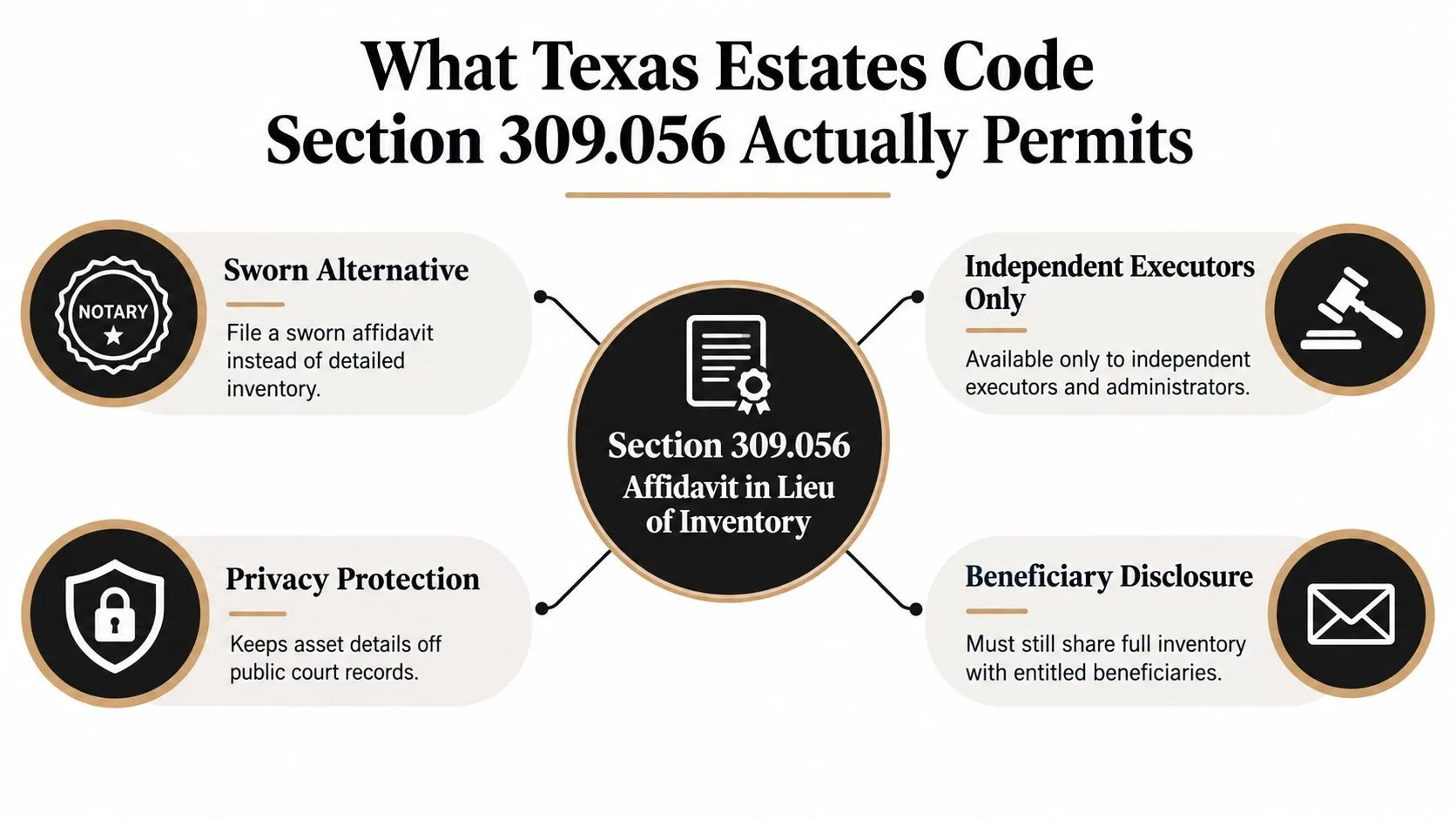
A family may want beneficiaries to see the estate's financial details while keeping those details out of the public probate file. Texas Estates Code § 309.056 creates a timed compliance trade for that situation. An independent executor may file an affidavit instead of placing the full inventory, appraisement, and list of claims in the court record, but only after meeting the statute's conditions.
The affidavit is therefore not a shortcut around the accounting. The executor still must identify estate property, determine appropriate values, and prepare a verified, full, and detailed inventory and appraisement. The practical difference is the destination: beneficiaries receive the detailed document, while the court receives the executor's sworn confirmation.
The two conditions that control the option
First, by the time the inventory is due, the estate must have no unpaid debts except secured debts, taxes, and administration expenses. A mortgage or other lien is an example of a secured debt because it is connected to particular property. An unpaid unsecured obligation outside those statutory exceptions may prevent the executor from using the affidavit.
Second, the executor must have provided beneficiaries with a verified, full, and detailed inventory and appraisement. “Verified” means the information has been confirmed through the required sworn process. “Full and detailed” means the accounting must identify the estate's property with meaningful information, rather than refer generally to “various assets.”
This arrangement works like a private accounting paired with a public compliance notice. Beneficiaries receive the substance needed to understand the estate, while the court receives the affidavit. The choice can protect family financial privacy, but a missed deadline or a false sworn statement can turn that privacy decision into a compliance problem. The statute's penalty for a violation can reach $1,000, so the filing deadline and the quality of the underlying inventory both matter.
What the affidavit doesn't do
The affidavit doesn't:
- Erase the inventory deadline.
- Allow an executor to hide assets from beneficiaries.
- Eliminate the duty to investigate debts.
- Protect an executor who makes a false sworn statement.
- Turn a dependent administration into an independent administration.
Readers who need background on the ordinary accounting document can review The Inventory, Appraisement, and List of Claims in Texas and this guide to inventory and appraisement filing in Texas probate.
Interested persons, including heirs and prior-will beneficiaries, may request a copy of the inventory. Reduced public filing does not mean reduced family transparency. The executor should keep delivery records, the inventory, and supporting documents in case a beneficiary asks questions or the court later reviews compliance.
Who Qualifies and When You Must File Under Texas Law
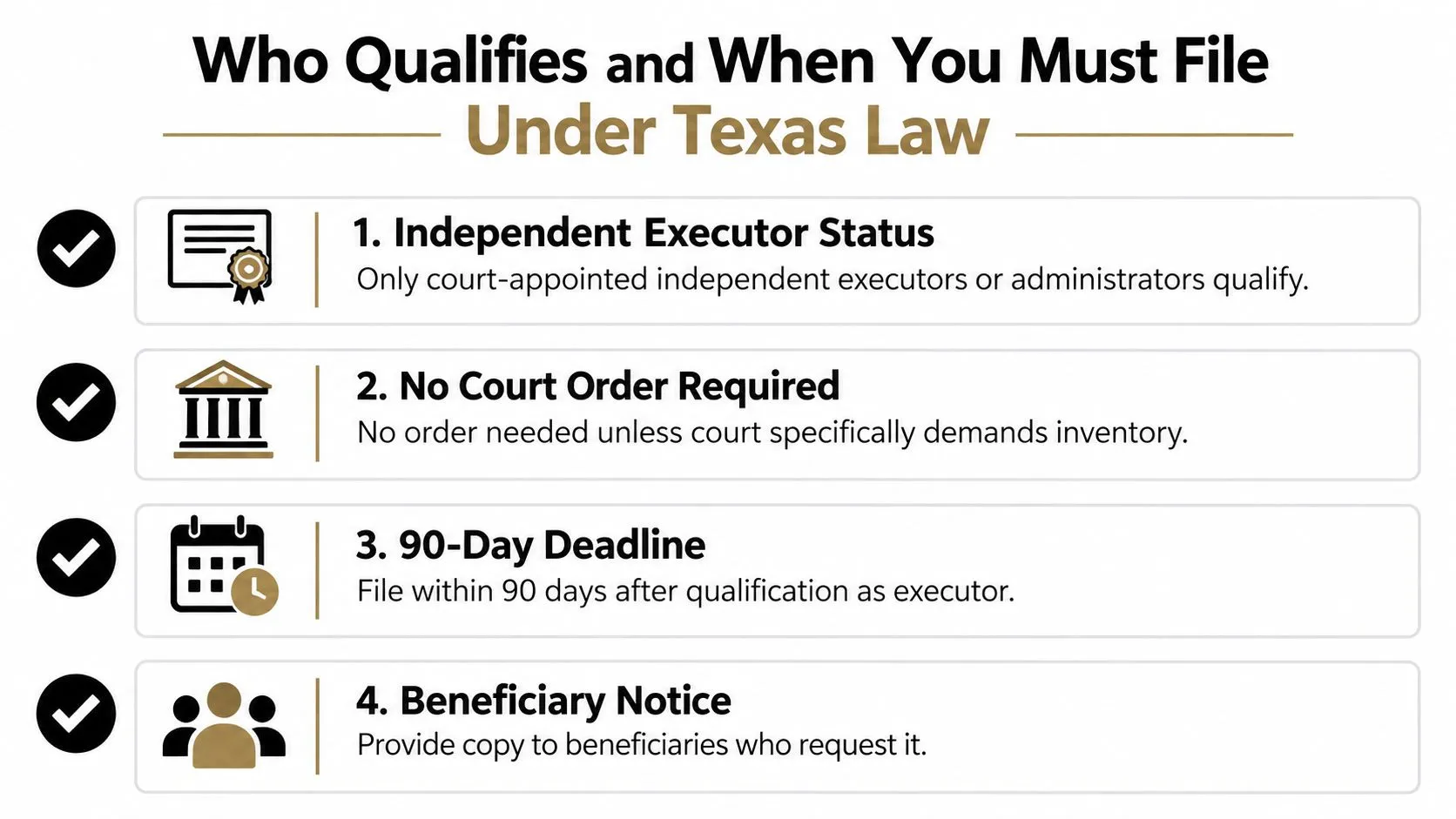
The first question is authority. Section 309.056 applies to an independent executor, and the statute also addresses independent administrators in its broader framework. A person who hasn't been appointed with the necessary authority shouldn't assume they can file the affidavit just because they're a family member or named in a will.
The second question is debt status. The estate must satisfy the statute's condition concerning unpaid debts by the time the inventory is due. The presence of secured debts, taxes, and administration expenses doesn't automatically disqualify the estate, but other unpaid debts may require a closer review before the executor selects this option.
The third question is disclosure. Beneficiaries must have received the verified, full, and detailed inventory and appraisement before the affidavit is filed. Sending a partial list, an informal estimate, or information only to some required recipients can create a serious compliance problem.
A practical eligibility screen
Before preparing the affidavit, an executor can ask:
- Am I serving as an independent executor or administrator with court authority?
- Have I identified unpaid obligations and separated secured debts, taxes, and administration expenses from other debts?
- Have I prepared a verified, full, and detailed inventory and appraisement?
- Have I delivered that document to every beneficiary entitled to receive it?
- Can I document when and how each delivery occurred?
- Am I still within the statutory filing period, or have I obtained a court extension?
The ordinary deadline is tied to Texas Estates Code § 309.051(a). The inventory, or the affidavit used in its place, must be filed within the 90-day period prescribed by that provision, unless the court grants an extension. Section 309.051(a) otherwise requires the representative to file the inventory before the 91st day after qualifying, which makes the affidavit a timed compliance option rather than an open-ended procedure. The Texas Estates Code § 309.051 inventory deadline provides additional context on that timeline.
Why the calendar should come first
The deadline can arrive while the executor is still locating deeds, requesting account records, confirming beneficiary addresses, and investigating liabilities. Waiting to assess eligibility may leave too little time to prepare a reliable inventory and complete beneficiary delivery.
A court extension may be available, but an executor shouldn't treat that possibility as automatic. If the estate has unusual assets, disputed debts, missing records, or beneficiaries who are difficult to locate, legal advice early in the administration can help identify the safest filing path.
Required Contents and How to Prepare the Affidavit Correctly
Preparation starts with the inventory, not the affidavit. The executor should gather records for real estate, financial accounts, vehicles, valuable personal property, business interests, insurance-related assets, and known claims. The exact contents depend on the estate, but the document must be detailed enough to give entitled beneficiaries a meaningful picture of the estate.
The executor should also review debts and expenses. A mortgage or other secured obligation, taxes, and administration expenses fit within the statutory exceptions, but the executor should not casually label every unpaid bill as an administration expense. Classification can affect whether § 309.056 is available.
A careful preparation sequence
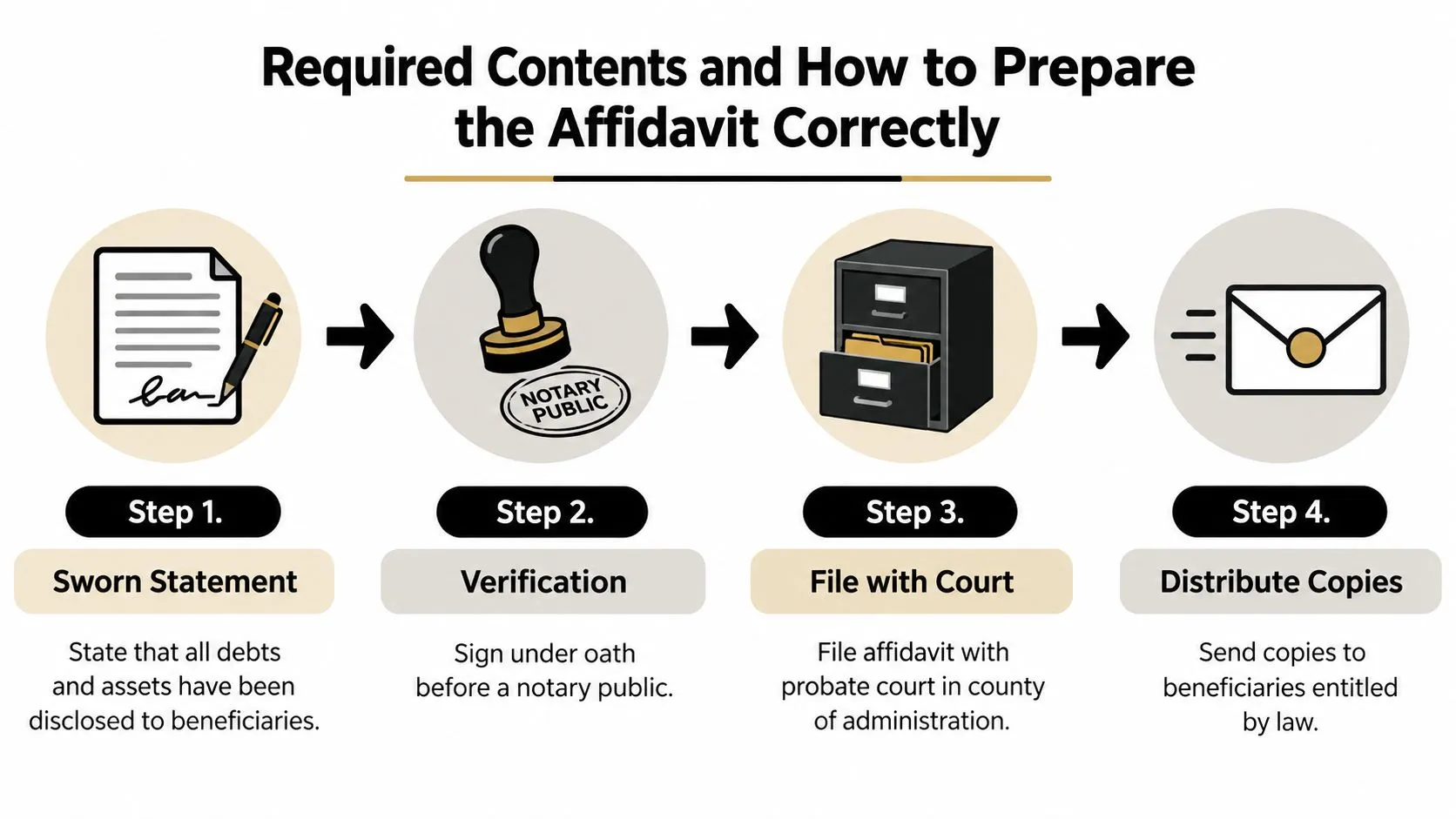
Prepare the accounting. List each known estate asset with enough identifying information and an appropriate value. If an asset is difficult to value, such as a closely held business interest or unusual property, the executor may need professional assistance rather than an unsupported estimate.
Verify the information. Confirm ownership, account balances, liens, and claims using reliable records. The inventory should distinguish property owned by the decedent from property that belongs to someone else or passes outside probate.
Deliver the inventory. Provide the verified, full, and detailed inventory and appraisement to the beneficiaries who are entitled to receive it. Keep copies of the document and proof of delivery, such as correspondence, signed receipt, or another reliable record.
Draft the sworn affidavit. The affidavit should accurately state that the statutory conditions are satisfied, including the required beneficiary disclosure and applicable debt status. It should identify the estate and administration and use language that matches the facts, not boilerplate that the executor hasn't checked.
Sign under oath. Because the document is an affidavit, the executor signs it as a sworn statement, typically before a notary public. The notary confirms the signing formalities, but the notary doesn't investigate whether the information is true.
File with the probate court. File the affidavit in the county where the estate is being administered, within the statutory deadline or an approved extension. Confirm local filing requirements and retain a file-stamped copy.
For a focused review of the preparation issues, see the firm's discussion of probate affidavit requirements for Texas executors.
The following video may help families understand the role of probate affidavits:
A lawyer can help compare this option with filing the traditional inventory, but the executor remains responsible for providing truthful information and preserving supporting records.
Real World Example of Using the Affidavit in Texas Probate
Maria is serving as independent executor of her mother's Houston-area estate. The estate includes a residence, bank accounts, household property, and ordinary administration expenses. Maria learns that the family may qualify for the affidavit in lieu of inventory, but she doesn't file immediately because she first needs to confirm the estate's obligations and complete the accounting.

Maria's private accounting
Maria collects the deed, bank statements, property records, and available bills. She prepares a detailed inventory and appraisement that identifies the assets and values as accurately as she can, then reviews the estate's debts to determine whether any unpaid obligation falls outside the statutory exceptions.
Her siblings are beneficiaries. Maria sends each sibling the verified inventory and appraisement and keeps records showing what she provided and when. That step protects the siblings' ability to understand the estate, even though the detailed asset list won't be filed publicly if the affidavit is properly used.
Maria then prepares the affidavit, signs it under oath, and files it with the probate court within the applicable filing period. The court receives her sworn compliance statement, while the family receives the detailed financial information privately.
What this example teaches
Maria's decision isn't based only on a desire for privacy. It depends on completing the same substantive accounting work required for the ordinary inventory. She also needs confidence that the debt condition is satisfied and that every beneficiary entitled to the inventory received it.
If one sibling later asks for another copy, Maria should respond promptly and preserve the delivery record. If the estate later reveals an overlooked unsecured debt or an omitted asset, she should seek legal advice before making further sworn statements or distributing property.
Families handling the broader Texas Probate Process may also need coordinated advice about real estate, beneficiary designations, creditor issues, or estate planning documents. A will or trust may affect who receives property, but it doesn't relieve the executor of accurate administration duties.
Common Pitfalls and the Cost of Getting It Wrong
The most dangerous assumption is that the affidavit is merely a shorter form. It's a sworn representation that the estate meets specific legal conditions and that required beneficiaries received the detailed inventory and appraisement.
One mistake is filing while an unpaid unsecured debt remains. Another is giving beneficiaries only a general summary instead of a verified, full, and detailed inventory. An executor may also send the information to one beneficiary while overlooking another person entitled to receive it.
Errors that deserve immediate attention
- Unpaid debts: Don't assume every bill qualifies as a secured debt, tax, or administration expense. Review the nature of each obligation.
- Incomplete asset research: Don't file before checking available records for property, accounts, and claims.
- Missing beneficiaries: Don't rely on family assumptions about who should receive the inventory. Confirm the beneficiaries entitled under the governing documents and law.
- Weak delivery records: Don't send sensitive documents without preserving evidence of what was delivered and when.
- Unverified language: Don't sign a statement that uses broad wording you haven't matched to the estate's facts.
- Deadline problems: Don't wait until the filing period is nearly over to determine whether the affidavit is appropriate.
Texas Estates Code § 309.0575 provides a specific enforcement mechanism. If the court finds that the affidavit falsely stated that all beneficiaries, other than those described by § 309.056(b-1), received the required verified, full, and detailed inventory and appraisement, the court may fine the executor up to $1,000. The statute makes the executor and any sureties liable for the fine, damages, and costs caused by the misrepresentation. See the statutory text of Texas Estates Code § 309.0575.
The affidavit protects privacy only when the executor protects accuracy first.
The penalty framework matters even when the executor didn't intend harm. A careless filing can create disputes, financial exposure, and loss of trust among heirs. If information is incomplete, the safer course is to pause, investigate, and obtain advice about whether to correct the filing, seek an extension, or file the traditional inventory.
Key Takeaways and Next Steps for Texas Families
Section 309.056 creates a useful but narrow path for an independent executor. It may keep detailed asset information out of the public probate file, but only after the executor has completed the accounting and delivered it to entitled beneficiaries.
The decision can be reduced to several principles:
- Eligibility matters: The executor must have the appropriate independent authority.
- Debt status matters: The estate must meet the statute's condition concerning unpaid debts.
- Disclosure matters: Beneficiaries must receive a verified, full, and detailed inventory and appraisement.
- Timing matters: The affidavit follows the same 90-day filing window tied to Texas Estates Code § 309.051(a), unless the court grants an extension.
- Truthfulness matters: A false statement can lead to a fine of up to $1,000, along with liability for damages and costs under § 309.0575.
Key Insight: The affidavit isn't a way to avoid preparing an inventory. It's a way to keep the detailed inventory private while showing the court that the executor has completed the required disclosure.
Some estates need more than a straightforward filing. A disputed beneficiary may require Probate Litigation, while a family member unable to manage personal or financial affairs may need guidance about Guardianship. For future planning, families can also review Wills & Trusts, particularly when privacy, business assets, or beneficiary conflict is a concern.
The Law Office of Bryan Fagan, PLLC can review the estate's authority, debts, inventory, beneficiary disclosures, and filing deadline. If you're an executor, heir, or out-of-state family member, getting advice before signing the affidavit can help you choose a compliant path with greater confidence.
If you're facing probate in Texas, the Law Office of Bryan Fagan, PLLC can help guide you through the affidavit decision, beneficiary disclosures, deadline planning, and final distribution. Contact the firm to schedule your free consultation and receive step-by-step guidance for your family's estate.


