In Texas, an interested person may file written opposition under Estates Code §55.001 at any time before the court decides the issue, but a separate will contest generally must be filed within 2 years after a will is admitted to probate.
That difference matters more than many families realize. If you're reading probate papers, feeling uneasy about a will, and wondering whether you've already waited too long, you're not alone. Texas probate procedure gives people a way to speak up before the court rules, but it also has separate deadlines that can keep running in the background while grief, family pressure, and confusion make everything harder.
For guidance on Estates Code 55.001 filing opposition in a Texas probate proceeding, they usually need more than a legal definition. They need to know what to do next, what the court will expect, and how to avoid the timing trap that catches many heirs. This article walks through that process in plain English, with a focus on what Texas families, executors, and heirs should watch for in probate under Titles 2 and 3 of the Texas Estates Code.
Understanding the Scenario When an Heir Must Oppose
Sarah lives in Harris County. A few months after her father dies, she learns that a newer will has been submitted for probate. The document leaves most of the estate to one sibling, even though an earlier estate plan treated the children more evenly. She also hears that the newer will may have been signed when her father was isolated and under pressure.
She does what many heirs do. She starts reading probate papers, sees that Texas allows a written opposition, and assumes that filing something with the court will protect her rights across the board.

That assumption is where families get into trouble.
A written opposition under Texas Estates Code Section 55.001 lets an interested person object to a probate issue before the judge decides that issue. If the court has not ruled yet, the person may still be able to file and ask for a hearing with witnesses and evidence, much like any other civil dispute. A good way to picture it is a red flag on a specific issue already in front of the probate court. It tells the judge, "Do not treat this as routine. Someone disputes it."
That does not always stop a different deadline from running in the background.
For heirs like Sarah, the timing problem often has two tracks. One track is the pending probate issue, such as whether a will should be admitted. The other track is a separate will contest deadline that may expire even while the family is focused on filing an opposition. Families often confuse those tracks because both involve challenging the will, but they do not operate the same way.
Sarah's fear is understandable. If she waits too long, the judge may admit the will before she speaks up. If she files only an opposition and then assumes she is fully protected, she may miss the separate deadline to bring a will contest later. That is the trap.
Her next step should be practical and immediate. She should get the probate case number, confirm whether a hearing date has already been set, and make sure any written opposition is filed before the court rules on the issue she wants to dispute. If she suspects undue influence, lack of capacity, or another basis to challenge the will itself, she should also evaluate the separate contest deadline at the same time, not after the hearing has come and gone.
Probate can also become more complicated quickly. If a second will application is filed before the hearing, Texas Estates Code Section 256.101 allows the court to hear the competing applications together and decide which will, if any, should be admitted, or whether the decedent died intestate, as explained in this discussion of Section 256.101 and competing will applications. In plain English, one probate case can turn into a dispute over multiple documents, multiple stories, and multiple deadlines.
For many heirs, a written opposition is the first moment when concern turns into action. It matters. But it is only one tool, and using that tool on time does not automatically solve the separate timing problem that can decide whether a broader will challenge survives.
Who May File an Opposition Under Texas Estates Code
Not everyone who is upset about a probate case has the legal right to object. Section 55.001 uses the phrase interested person. In plain language, that means someone with a real financial or legal stake in what the probate court decides.
People who usually qualify
In many cases, the following people may have standing to oppose an issue in probate:
- Heirs at law: These are family members who could inherit if there were no valid will.
- Beneficiaries or devisees: These are people named in a will to receive property.
- Creditors: If the estate owes them money, the court's decisions can affect their rights.
- Personal representatives: An executor or administrator may need to oppose an issue to protect the estate.
- Others with a direct property or legal interest: Sometimes that includes someone whose rights rise or fall based on whether a will is admitted.
If you're unsure whether you're an heir, a beneficiary, or both, this explanation of heir vs. beneficiary can help sort out the difference.
A common misunderstanding
Maria's aunt dies leaving a will that cuts Maria out, but if the will were invalid, Maria would inherit under intestate succession. Maria might assume she has no standing because she isn't named in the will. That assumption can be costly.
She may still be an interested person because the probate court's decision directly affects whether she inherits anything at all. The key question isn't whether someone feels hurt. The question is whether the court's ruling changes that person's legal or financial position.
Emotional concern alone usually isn't enough. The court looks for a concrete stake in the estate.
People who usually do not qualify
Some people care about the outcome but still may not have standing.
- Distant relatives with no inheritance path: If the person wouldn't inherit under any likely scenario, standing may be hard to show.
- Friends or neighbors with no legal claim: Personal knowledge may make them important witnesses, but not parties.
- People objecting on principle alone: Probate courts decide legal rights, not family fairness in the abstract.
How to show the court why you count
If another side challenges your standing, be ready to connect the dots clearly. You may need to show your relationship to the decedent, your place under a prior will, or your status as a creditor or heir. Probate judges want specifics.
A simple way to think about it is this:
| Question | Why it matters |
|---|---|
| Would this ruling affect whether you receive property? | That supports interested-person status |
| Would this ruling affect your legal rights in the estate? | That may also support standing |
| Are you only upset, but not legally affected? | That may not be enough |
Families should also remember that not every estate follows the same path. For example, The Small Estate Affidavit in Texas is a simplified path for modest estates with no will. That process is different from a contested will probate, so standing and procedure need to be matched to the kind of estate proceeding pending.
Step by Step Process for Filing a Written Opposition
A lot of families reach this point in a hurry. Someone has filed an application, a hearing may already be on the calendar, and an heir knows something is wrong but is not sure what the court needs to see.
That is why a written opposition has to be handled carefully.
A Section 55.001 opposition is a formal filing in an existing probate case. The court is looking for a clear statement of what issue you oppose, why you have the right to object, and what you want the judge to do. A phone call to the clerk, a letter full of frustration, or a general complaint about unfairness usually will not do that job.
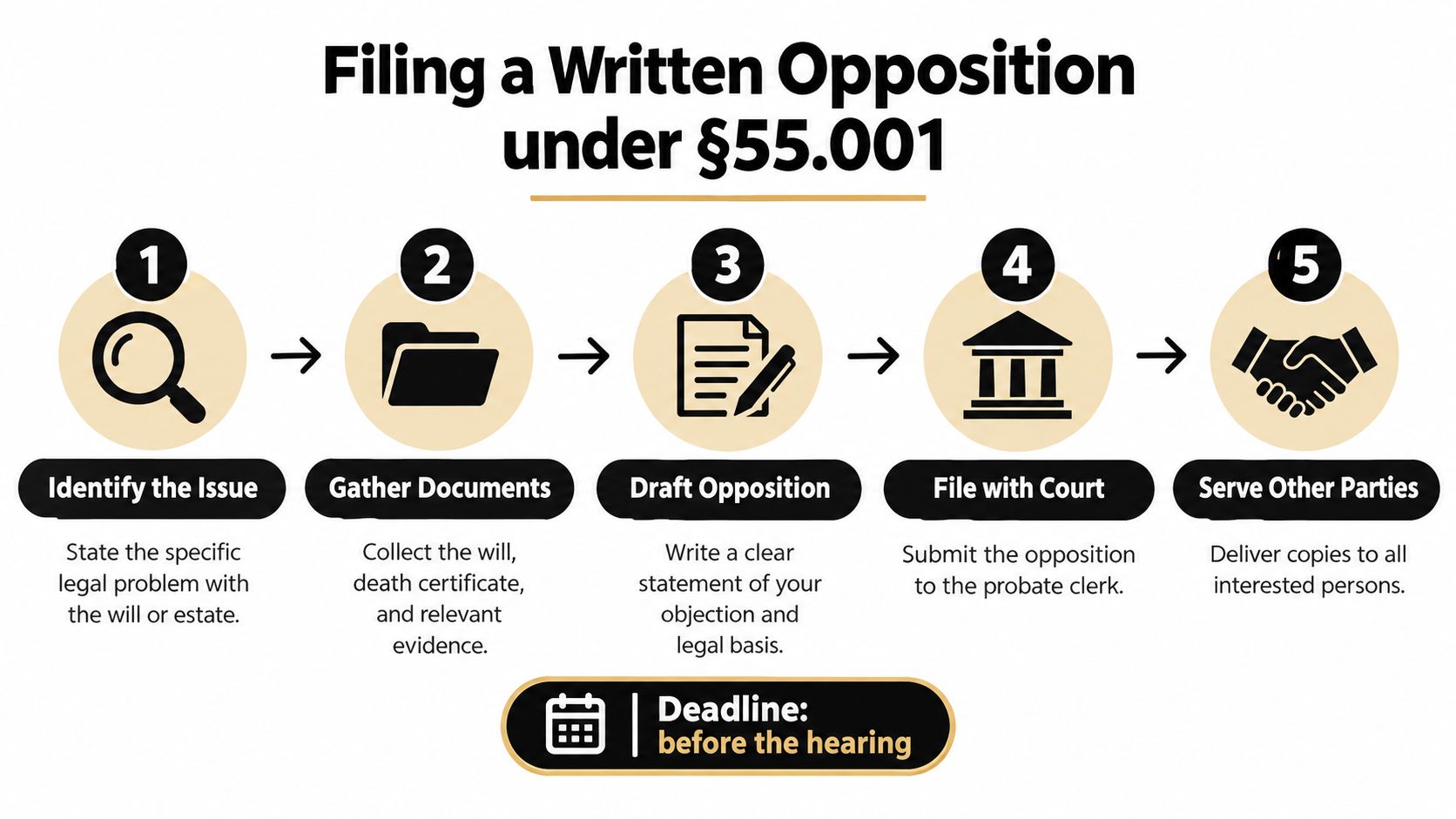
Step one and step two
Start with the target. Pin down the exact issue the judge is being asked to decide. It might be admission of a will, appointment of an executor, probate of a codicil, or some other request pending in the estate. If your objection is broad or fuzzy, the court may not know what ruling you want stopped or changed.
Next, gather the papers tied to that issue. In many cases, that means the application on file, the will being offered, any prior will or codicil that matters, death certificate information, and records that support your concern. If your objection involves capacity, undue influence, signature problems, or notice defects, start collecting the documents that connect to that claim now.
Step three and step four
Then draft the opposition.
A good written opposition usually includes these parts:
- Case caption: Use the same court, cause number, and estate name already on file.
- Your identity and legal interest: Explain who you are and why this probate ruling affects your rights.
- The specific issue you oppose: Name the pending request directly.
- The factual basis for your objection: State the facts in numbered paragraphs if possible.
- The relief requested: Tell the court what you want, such as denial of the application, a continuance, or a hearing on the contested issue.
Plain language helps. So does discipline. Judges and clerks need a filing they can process quickly, and the other side needs fair notice of the dispute.
After drafting, file the opposition in the same probate court where the estate is pending. Depending on the county, that may be a statutory probate court, a county court, or a district court exercising probate jurisdiction. Check local filing rules, because e-filing, formatting, and hearing procedures can differ from county to county.
Step five
After the opposition is filed, make sure the right people get a copy. That commonly includes the personal representative or proposed representative, any party who has already appeared, and the lawyers of record.
Service problems can stall the case for reasons that have nothing to do with whether your objection is valid.
File soon enough for the judge to act on it. Section 55.001 allows opposition before the court decides the issue, but that window closes fast once an order is signed. A good practical rule is to treat the hearing date, not the statute's broad wording, as your working deadline.
What the hearing can look like
If the dispute goes forward, the court may set a hearing and receive evidence much like it would in other civil matters. That can include witness testimony, medical records, handwriting evidence, prior estate planning documents, and argument from both sides about the facts and the law.
Some probate fights also carry a right to jury determination on fact-heavy disputes under Texas Estates Code Section 55.002. That becomes important when the question is who the judge or jury believes about capacity, pressure, authenticity, or family circumstances surrounding the signing.
A working checklist for families
Use this checklist to keep the process organized:
- Identify the pending request: What exactly is the court being asked to approve?
- Confirm the ruling has not already happened: If the order is signed, this tool may no longer help on that issue.
- Draft a focused written opposition: Keep the facts tied to the issue before the court.
- File it in the correct estate case: Match the cause number and court precisely.
- Serve everyone who should receive it: Do not assume filing alone gives notice.
- Watch the hearing setting closely: A filed objection does not always automatically create a hearing.
- Calendar every related deadline separately: This is the trap many heirs miss. An opposition can protect your position on the pending probate issue without protecting a later, separate will contest deadline.
Takeaway
A written opposition works like an emergency brake on a specific ruling the probate court is about to make. It can be powerful, but only if it is aimed at the right issue, filed on time, and followed through with proper notice and hearing preparation.
It also does not freeze every other probate deadline. Families often feel relief once the objection is filed, then later learn a separate contest deadline kept running in the background. That timing split causes real damage when no one calendars both tracks.
Critical Timing Between Opposition and Will Contest Deadlines
Many probate disputes go off course. A family member files a timely opposition under Section 55.001, assumes the challenge is fully preserved, and later learns that a separate will contest deadline kept running anyway.
That mistake can be devastating.
Two timelines that serve different purposes
A Section 55.001 opposition is tied to a pending issue in an existing probate proceeding. It lets an interested person object before the court decides that issue.
A will contest after admission is different. According to the Texas State Law Library's guidance on will contest deadlines in Texas, a will that has already been admitted to probate generally may be contested within 2 years after admission, with exceptions, and a narrower timing rule can apply when a will is admitted as a muniment of title only. The practical lesson is straightforward. Filing an in-proceeding opposition does not automatically stop the later statutory clock from running.
Why this trap is so common
The wording of Section 55.001 sounds broad. It allows opposition "at any time before the court decides the issue." Families hear that and think, "Good, I've objected. My rights are protected."
Sometimes that's true for the issue currently before the judge. It isn't always true for a later, separate contest claim if the will has already been admitted or if admission happens while the family assumes the earlier filing covered everything.
One filing can preserve one procedural right and still leave another deadline untouched.
The litigation reality
Timing matters because contested probate is hard even when filed correctly. A probate litigation study reported that across a century-long dataset, proponents prevailed in 60% of will contests while contestants prevailed in 40%, and reversals occurred in less than 23% of will contest cases since the turn of the century, as summarized in this probate litigation study discussing Texas will contests. Those figures don't mean a contestant shouldn't act. They mean procedure, proof, and deadlines matter from the beginning.
A realistic example
Take Sarah's situation again. She files a written opposition before the hearing on the application to probate the newer will. The court resets the matter, the family negotiates, and months pass. Eventually, the will is admitted.
Sarah assumes her earlier opposition still carries everything forward. It doesn't. If she needs a separate post-admission will contest, she must still watch the applicable limitations period. If she misses that deadline because she believed the first filing was enough, the court may never reach the substance of her concerns.
A simple way to manage the dual-track problem
Families and executors should think in parallel, not in sequence.
| Filing problem | What to ask immediately |
|---|---|
| There is a hearing coming up on a probate issue | Has a written opposition been filed before the court decides it? |
| A will has been admitted, or may soon be admitted | What is the separate contest deadline, and has it been calendared? |
| The probate is by muniment of title only | Does the narrower timing rule change the response plan? |
Key Insight
The safest habit is this. If you oppose an issue under Section 55.001, calendar any downstream contest deadline the same day. Families lose rights when they treat these timelines as one event. Texas law treats them as separate tracks.
If you're dealing with this exact concern, this page on the Texas will contest deadline gives a practical starting point.
Evidence Witnesses and Preparing for the Hearing
Once a probate dispute is contested, the focus shifts from suspicion to proof. The court won't decide a case based on family tension alone. You need evidence that a judge, or in some cases a jury, can evaluate.

What usually helps the court
Strong probate evidence often falls into a few categories:
- Documents with direct relevance: The offered will, prior wills, medical records where appropriate, correspondence, and estate planning notes.
- Witnesses with personal knowledge: People who saw the decedent, the signing process, or the surrounding conduct.
- Testimony about capacity or pressure: Facts can matter more than labels. What did the person understand? Who was present? What changed?
- Procedural records: Notices, filings, and prior applications can show what happened and when.
A witness doesn't become persuasive just because they're passionate. Probate courts care about firsthand knowledge, consistency, and whether the testimony connects to a legal issue.
A hearing example
Suppose an heir says a late-life will was signed because a caregiver isolated the decedent from family. The strongest witness may not be the angriest sibling. It may be the longtime neighbor who observed sudden restrictions on visits, or the person present when the decedent expressed confusion about the document.
That doesn't guarantee success. It does show why preparation matters. A useful witness answers facts cleanly. A weak witness speculates, repeats rumors, or wanders into family history that doesn't prove the point at issue.
Bring witnesses who know something, not witnesses who simply agree with you.
A practical preparation checklist
Before the hearing, organize your presentation:
- Build a timeline: Put events in date order, including death, filing dates, notices, and major document changes.
- Match each fact to proof: If you plan to say something happened, ask what document or witness proves it.
- Prepare simple questions: Start with who, what, when, where, and how.
- Screen for hearsay problems: If the witness only heard it from someone else, the court may not give it weight.
- Check court procedure: Some counties have local expectations for exhibits, witness lists, or hearings.
For a clearer look at what courts may and may not consider, this guide on evidence rules in probate court cases is a helpful reference.
A short video can also help families understand how contested probate hearings tend to unfold in practice.
What families often overlook
Many people spend all their energy proving the other side is wrong and not enough time proving their own position with admissible facts. That's a serious mistake. Probate courts decide based on evidence presented in the record.
Takeaway
The most effective hearing preparation is usually simple, disciplined, and fact-driven. If you're considering opposition, collect documents early, line up firsthand witnesses, and test every claim by asking, "How will I prove this in court?"
When to Hire a Texas Probate Litigation Attorney
A common probate mistake starts like this. An heir files a written opposition early, feels relieved that the court has been put on notice, and then waits. Months later, the family learns that the opposition did not automatically preserve a separate will contest claim, and the two-year deadline may have kept running the whole time.
That is the point to get legal help. In Texas probate, an opposition under Section 55.001 and a will contest can move on two related but separate tracks. One filing may slow or stop a probate step in front of the court. It may not protect every claim you might need to bring later.
You should seriously consider hiring a probate litigation attorney if any of the following are true:
- You have filed, or plan to file, a Section 55.001 opposition and are unsure whether a separate contest is also needed
- Someone is alleging undue influence, fraud, lack of capacity, or the existence of another will
- A relative controls medical records, financial papers, or access to key witnesses
- The estate includes a house, business interest, mineral rights, or other property that raises the stakes
- The other side already has a lawyer
- A hearing date has been set and you are still trying to figure out what claim belongs in what pleading
A lawyer helps sort the case into the right procedural buckets. That matters more than many families expect. In probate, being right on the facts does not fix using the wrong filing or missing the wrong deadline.
Counsel is also useful when the case becomes harder to manage at home. Grief clouds judgment. Family history spills into every conversation. A good probate litigator can separate the issues the judge can decide now from the claims that must be formally pleaded and preserved.
A practical way to decide
Use this quick test:
| If this is happening | It usually makes sense to do this |
|---|---|
| You are only gathering information and no one disputes the will or appointment | Start with document review and deadline tracking |
| You believe the will should not be admitted, or should be challenged later on separate grounds | Get legal advice quickly about both timelines |
| The probate hearing is close | Treat the matter as urgent |
| Family conflict is blocking records, witnesses, or communication | Bring in counsel early |
| You already filed an opposition and assumed that was enough | Ask a lawyer to review whether a separate contest deadline is still running |
Law Office of Bryan Fagan, PLLC handles contested probate matters, estate disputes, and related court proceedings. If you have filed or are considering a Section 55.001 opposition, contact the firm to review the probate status, identify any separate contest claim, and calendar both the immediate hearing deadlines and the distinct two-year will contest deadline in the same consultation.