 Skip to content
Yes. A formally adopted child inherits from and through adoptive parents in Texas exactly like a natural child under Texas Estates Code § 201.054, and the reverse is also true. The adoptive parents and their relatives can inherit from and through the adopted child on the same legal basis.
After a parent dies, however, families rarely face the law in a calm setting. An adopted son may be trying to understand whether he is an heir while grieving. An executor may be searching for records before distributing property. Biological relatives may believe they should inherit because they stayed connected over the years. These questions become especially difficult when there's no will, an old will appears later, or the family has only incomplete adoption paperwork.
Introduction When Family and Texas Inheritance Law Meet
Consider a Texas family whose father dies unexpectedly without a will. His daughter was adopted when she was young, and she has always understood herself to be his child. After the funeral, a relative suggests that she might not inherit because she isn't biologically related. The question feels personal, but the legal answer begins with a document, the final adoption decree.
Under Texas law, a formal adoption places the child in the adoptive parent's legal family line for intestate inheritance. “Intestate” means dying without a valid will. In that situation, Texas law identifies the deceased person's heirs and determines how property passes. The adopted child isn't treated as a lesser child or a temporary family member. The law treats the child as the adoptive parent's child for inheritance purposes.
That general rule doesn't answer every dispute. Families often use the word “adopted” loosely when they mean a child was raised in the home, cared for by a stepparent, or treated as family without a completed adoption. Formal adoption, equitable adoption, adult adoption, and a contested will can produce different legal questions.
Why the paperwork matters
A grieving family may know the story of an adoption but not have the court order. Adoption records may be sealed, stored in another county, or difficult to obtain without following the proper process. A termination order may also contain language that affects inheritance from a birth parent.
This guide focuses on the practical questions behind adopted child inheritance in Texas:
- What § 201.054 means in everyday language.
- How adoptive and biological family inheritance ties differ.
- Why equitable and adult adoption require separate analysis.
- Which records an executor or heir should locate.
- How probate courts confirm an adopted child's claim.
Texas law can provide a clear path, even when family relationships and memories are complicated. The right documents and careful probate guidance can reduce uncertainty at a painful time.
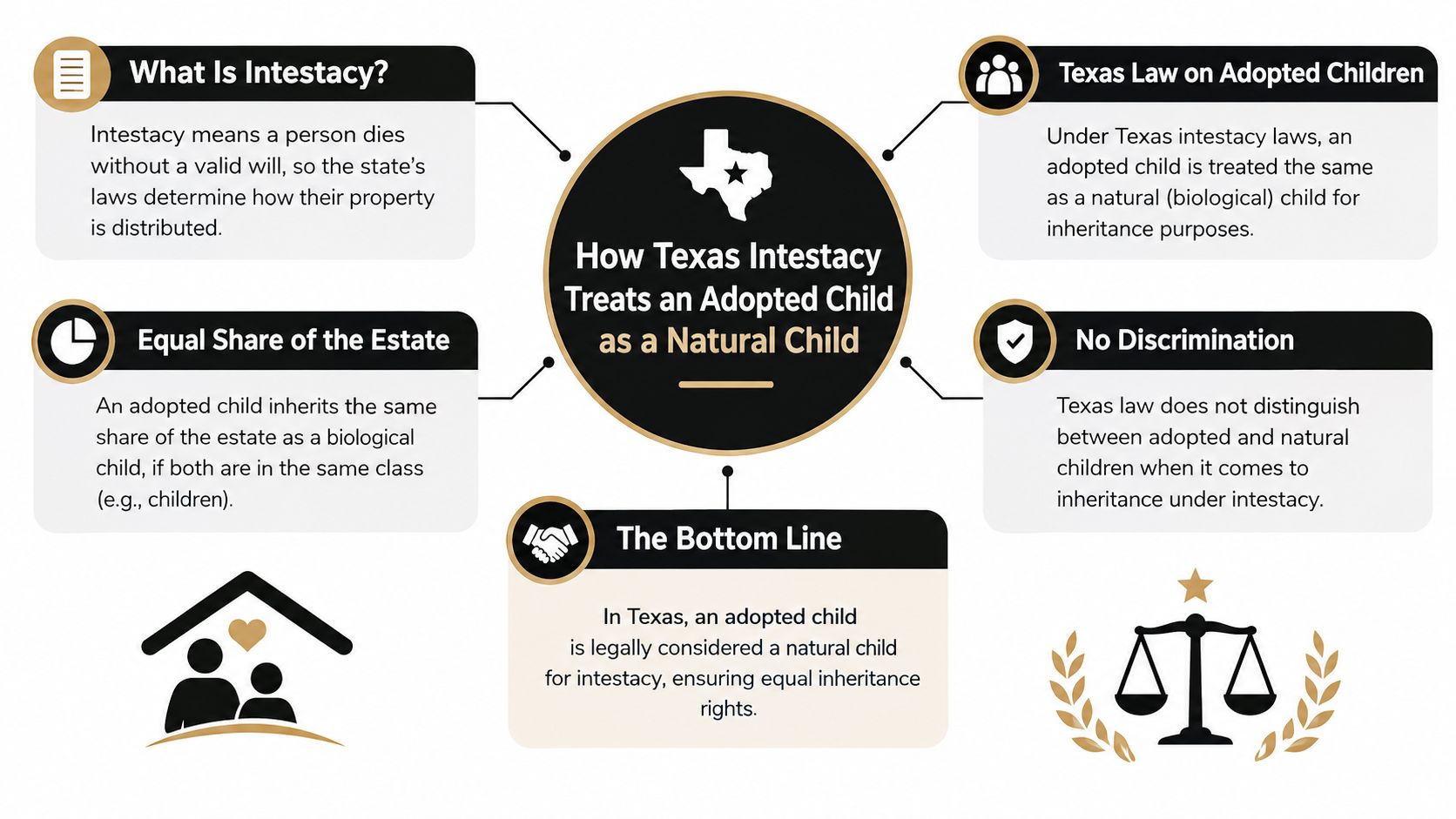
How Texas Intestacy Treats an Adopted Child as a Natural Child
Intestate succession is the legal process used when someone dies without a valid will. Instead of distributing property according to written instructions, the probate court applies Texas inheritance rules to identify the people legally entitled to receive the estate.
Texas Estates Code § 201.054 states that an adopted child and the child's descendants inherit from and through the adoptive parent or parents and their kindred as if the child were a natural child. The statute also applies the reverse rule. The adoptive parents and their kindred can inherit from and through the adopted child as they would from a natural child. The rule has continued across Texas code revisions, appearing in the 2005 Texas Probate Code and the 2011 Texas Probate Code before recodification into the Estates Code. You can review the statutory language in the Texas Estates Code provisions on adopted children and inheritance.
A simple family-tree analogy
Think of formal adoption as changing the legal family tree for inheritance. The adopted child moves into the adoptive parent's branch and receives the same legal position as a child born to that parent. That position can matter not only when the adoptive parent dies, but also when property passes “through” the adoptive parent from another relative.
For example, if an adoptive parent is entitled to inherit from a relative but dies before receiving that property, the adopted child may stand in the adoptive parent's line under the applicable succession rules. The important point is that the law recognizes the adopted child as part of the adoptive family's descent-and-distribution chain.
The reverse direction matters, too. If an adopted child dies without a will, the adoptive parents and their relatives may be considered under the same legal framework that would apply to natural parents and relatives. Adoption creates reciprocal legal inheritance relationships within the adoptive family.
Key statutory principle: A formally adopted child inherits from and through the adoptive family as if the child were a natural child, and the adoptive family can inherit from and through the adopted child on the same basis.
Who has standing in probate
“Standing” means having a legally recognized right to participate in a court matter. An adopted child may have standing to receive notice, participate in determining heirship, object to an improper distribution, or assert an interest in estate property. The exact procedure depends on the estate and whether there is a will.
Families dealing with a death without a will may also benefit from the plain-language explanation of Texas intestate succession and who inherits without a will. A Texas Probate Lawyer may assist with representation through Texas probate and estate administration when the family needs help presenting heirship evidence or administering property.
The court doesn't decide heirship based only on who attended the funeral or who was closest to the deceased. It reviews legal relationships, available records, and the applicable provisions of Texas Estates Code Titles 2 and 3. A final adoption decree is often central evidence because it proves the legal relationship rather than merely describing the family's history.
What Happens to Inheritance Ties With Biological Relatives
Formal adoption creates a legal relationship with the adoptive family, but biological-family inheritance questions require separate attention. In many cases, people assume that emotional connection, an open adoption arrangement, or a biological relationship automatically creates intestate inheritance rights. Texas probate courts focus instead on the governing legal documents and statutory rules.
The general rule is that formal adoption substitutes the adoptive family into the inheritance chain. The adopted child inherits from and through the adoptive parents and their kindred as a natural child would. The statute's treatment of biological relatives can depend on the adoption decree and any order terminating parental rights, so families shouldn't rely on assumptions based only on the fact that an adoption occurred.
| Relationship | Can Inherit Intestate | Legal Basis |
|---|---|---|
| Adoptive parent and formally adopted child | Generally yes | Texas Estates Code § 201.054 treats the adopted child as a natural child |
| Adoptive family relatives and adopted child | Generally yes, through the adoptive family line | The statute recognizes inheritance from and through adoptive kindred |
| Biological parent and adopted child | Depends on the governing adoption and termination documents | The exact decree or termination order may affect whether rights were preserved or ended |
| Person who raised a child without formal adoption | Not automatically | Caregiving and family history alone don't necessarily create intestate heirship |
| Biological relative named in a valid will | Potentially yes | A will may provide for a person who isn't an intestate heir |
Why a decree can change the answer
A termination order may expressly preserve inheritance from a birth parent, or it may contain language that cuts off that relationship. Sealed records can make the document difficult to review, but difficulty obtaining a record doesn't eliminate the need to verify it. The court may need the final decree and related orders before it can determine who belongs in the estate's heirship chain.
This distinction is particularly important for people researching stepchildren versus biological children in Texas probate. A stepchild who was never formally adopted may not hold the same automatic intestate position as a formally adopted child, while a stepparent adoption may require close review of the documents and family relationships.
Protecting valuable personal property
Inheritance disputes often involve a home or financial account, but personal property can create tension as well. Jewelry, family heirlooms, and collectibles may need identification and valuation before distribution. Families considering appraising inherited jewelry yourself should still remember that valuation and legal entitlement are separate issues. An appraisal may help determine an item's value, but it doesn't establish who legally inherits it.
If a biological parent left a valid will, the will generally controls the distribution of property within its terms. Intestacy rules matter when there isn't a valid will or when a particular asset isn't effectively addressed by the estate plan. That's why an executor should locate every possible will before treating the estate as intestate.
Exceptions That Change Adopted Child Inheritance Rights in Texas
The formal-adoption rule is powerful, but it isn't a substitute for reviewing the actual adoption record. Real probate disputes often arise because family members use “adopted” to describe different legal situations. A child may have been formally adopted, raised under an informal arrangement, adopted by a stepparent, or adopted as an adult. Those facts can affect the analysis.
Formal adoption versus equitable adoption
Formal adoption results from a court-approved legal process and a final adoption decree. That decree establishes the parent-child relationship for legal purposes, including intestate inheritance under § 201.054.
Equitable adoption is different. It generally involves an argument that a person promised to adopt a child or treated the child as their own but never completed a formal adoption. Courts may consider equitable principles in limited circumstances, but equitable adoption generally doesn't create the full intestate succession rights that a final adoption decree creates.
This is one of the most common sources of confusion. A person may have lived with a family, used the family name, received financial support, and been loved as a child. Those facts matter greatly to the family, but they don't automatically establish heirship under Texas intestacy law.
Stepparent adoption and preserved relationships
A stepparent adoption can raise questions about the child's relationship with a biological parent. The court record may show whether parental rights were terminated, whether a parent consented, and whether the final order preserved a right connected to inheritance. The answer depends on the language and legal effect of the documents, not solely on whether the stepparent became the child's legal parent.
Adult adoption
An adult adoption occurs after the person being adopted has reached adulthood. It can formalize a longstanding relationship, but its inheritance effects may differ from those of an adoption completed while the person was a minor. Questions can arise about inheritance from the adoptive parent's extended family, not just direct inheritance from the adoptive parent.
Families should avoid treating adult adoption as a simple paperwork update. The adoption agreement, final order, applicable Texas Family Code provisions, and the estate documents should be reviewed together.
Stale wills and probate disputes
A will may have been signed before an adoption, before a divorce, or before the family structure changed. A document that refers to “children” or “descendants” may require interpretation in light of the adoption and the language used. A will contest or heirship dispute can also arise if someone believes the estate plan excluded a person who should receive property.
The Texas pretermitted child probate resource addresses a related issue. A child may argue that a will failed to account for the child in a legally significant way, but the result depends on the will's wording and the surrounding facts.
Document-first rule: Don't decide inheritance rights from a family story alone. Locate the final adoption decree, termination order, and current estate documents before distributing property.
Sealed adoption records, missing orders, and inconsistent names can slow the process. A probate court may need certified copies or additional evidence. When the language is unclear, a lawyer can help determine whether the issue belongs in an heirship proceeding, a will contest, or another probate filing.
How to Prove or Protect an Adopted Childs Inheritance Claim
An adopted child's legal right may be clear, but the probate court still needs evidence. Executors, heirs, and family members should treat document collection as an early administration task. Waiting until property is about to be distributed can create avoidable conflict.

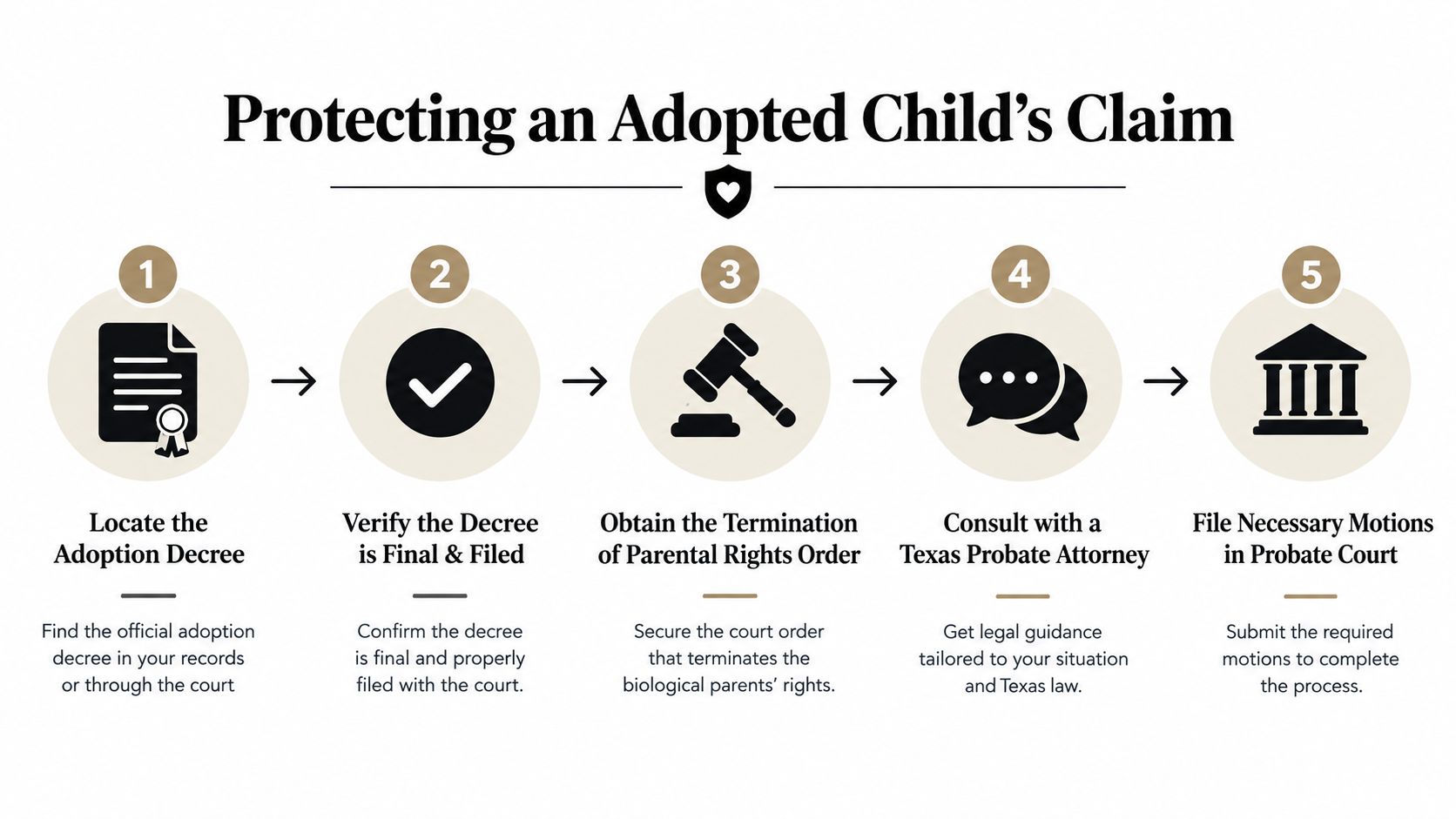
A practical sequence for heirs and executors
Locate the final adoption decree. Ask family members, prior counsel, the adoption agency, or the court that handled the adoption where the record may be held. Because adoption files may be sealed, follow the court's process for requesting access rather than relying on an informal copy.
Confirm that the decree is final. A proposed order, placement record, or consent document isn't necessarily the final proof of adoption. Look for the court's final order and confirm that the names and dates match the deceased person's records.
Find any termination order. The termination of parental rights may affect inheritance from a biological parent. Obtain the order and read the operative language carefully. A family member's memory of what the order said isn't enough for a probate filing.
Collect identity records. Gather death certificates, birth records, marriage records, name-change documents, and other records that connect the adopted child to the deceased person. Inconsistent names should be explained rather than ignored.
Identify the correct probate proceeding. Depending on the estate, the court may need an application to determine heirship, an administration proceeding, or filings connected to a will. Texas Estates Code Titles 2 and 3 contain the statutory framework, but the proper procedure depends on the facts.
Pause distribution when heirship is uncertain. An executor should not distribute disputed property because one relative appears to be the obvious heir. Preserve estate assets, disclose the issue to the probate court, and obtain legal advice before taking an irreversible step.
What administration may involve
Texas probate may proceed through independent or dependent administration. Independent administration can allow an authorized representative to handle estate tasks with less court supervision. Dependent administration generally involves more court oversight. The appropriate path can depend on the will, family agreement, asset types, and the presence of disputes.
A family may need to inventory property, address debts, identify beneficiaries, and obtain authority to transfer real estate. Information about the Texas Probate Process can help an executor understand the broader sequence. If a minor heir is involved, the family may also need to consider a guardianship application or another court-approved arrangement for managing the child's property.
For visual guidance on the sequence, review the following educational resource:
Planning before a death
Parents can reduce future confusion by naming adopted children clearly in wills and trusts, reviewing beneficiary designations, and keeping adoption documents with other estate records. A plan should address biological children, adopted children, stepchildren, and any person the parents intend to include who may not have automatic intestate rights.
If the adoption is unusual, the child was adopted as an adult, or a biological inheritance relationship may have been preserved, the estate plan should acknowledge those facts directly. Clear drafting cannot change every statutory rule, but it can explain intent and reduce ambiguity.
Real World Example How Adoption Plays Out in Texas Probate
Suppose an adoptive father in Texas dies without a will. He has one daughter, adopted when she was an infant, and a biological sibling who believes the estate should pass through the blood family because the daughter isn't biologically related. The daughter has always lived as the father's child, but the family can't immediately locate the adoption decree.
The executor's first responsibility isn't to choose sides. The executor should preserve the estate, search for the final adoption order, and identify every person who may have an inheritance interest. The daughter or her attorney may request the records through the proper court process if the file is sealed.
Once the final decree is located and verified, Texas Estates Code § 201.054 provides the governing principle. The daughter is treated as the father's child for intestate inheritance. The court then applies the broader Texas intestacy rules to determine the estate's distribution, considering the father's marital status, property classification, debts, and other legally relevant facts.
The dispute might have taken a different path if the daughter had only been raised by the father without a completed adoption. In that situation, the family would need to examine equitable adoption arguments, any will or trust, and other possible sources of a legal claim. The emotional bond would be real, but the automatic intestate position would not necessarily be the same.
The same caution applies if the daughter was adopted as an adult or if the adoption involved a stepparent and a biological parent. The exact decree and any termination order could determine whether inheritance ties were preserved or ended. A probate court resolves that question from legal records and evidence, not assumptions about family relationships.
Key Insight and Next Steps for Texas Families
Takeaway
A formal adoption makes an adopted child part of the adoptive family's intestate inheritance chain under Texas Estates Code § 201.054. The child inherits from and through the adoptive parents and their kindred as a natural child would, and the adoptive family can inherit from and through the child on the same basis.
The difficult cases usually involve the edges of that rule. Equitable adoption may not provide full intestate rights. Adult adoption can require separate analysis. A stepparent adoption or termination order may affect biological-family inheritance. A stale will may also change the outcome.
Practical next steps
If you're administering an estate, preserve the assets, locate every will, and collect the final adoption decree and any termination order before distributing property. If you're an adopted heir, ask the probate court or the appropriate records office for certified documentation and avoid signing a release until you understand your legal position.
For future planning, review your Wills & Trusts documents after an adoption and address every intended beneficiary by name when appropriate. If relatives disagree about heirship, interpretation, or distribution, Probate Litigation counsel can help evaluate the dispute and protect the estate's proper administration.
If you're facing probate in Texas, the Law Office of Bryan Fagan, PLLC can help verify adoption records, determine heirship, and guide executors through administration and final distribution. Visit Law Office of Bryan Fagan, PLLC to request a free consultation and receive compassionate guidance for your family's situation.


