 Skip to content
A family in Houston may discover a hardware wallet in a desk drawer only after a parent has died. The device may look like a small USB drive, but the value it controls may depend on a recovery phrase that nobody can find. Unlike a bank account, cryptocurrency doesn't come with a local branch, a familiar account statement, or a customer-service representative who can retitle the funds.
Texas families facing cryptocurrency inheritance must handle two connected problems. First, the digital assets must be identified, valued, and included in the estate. Second, the executor or trustee must obtain lawful access, while protecting private keys that can transfer the assets permanently. Texas law provides an important framework, but a court appointment alone may not solve a missing-key problem.
The process becomes more manageable when families separate the legal questions from the technical ones. The steps generally involve locating the assets, documenting them, establishing fiduciary authority, working with exchanges or wallets, and deciding whether beneficiaries should receive cryptocurrency or cash.
Why Cryptocurrency Inheritance Works Differently in Texas
Maria's father owned Bitcoin through an exchange and Ethereum in a hardware wallet. His will left everything to his children, so the family expected both assets to transfer like money in a bank account. The exchange requested formal estate documents. The hardware wallet required a private key or seed phrase. The will identified the beneficiaries, but it did not automatically provide access to either asset.
The federal government treats cryptocurrency as property, rather than cash or a bank deposit, under IRS Notice 2014-21. In probate, that means crypto must be identified, inventoried, valued, and distributed as estate property. Its value may change substantially between the date of death and distribution, so records should show what the estate owned and when it was valued.

The private-key problem
A self-custodied wallet works without a company holding the cryptocurrency for its owner. The blockchain records transactions, but it does not treat an executor's court appointment as a substitute for a missing credential. If the private key or seed phrase cannot be found, the family may confirm that a wallet exists and still be unable to move its contents.
Exchange-held cryptocurrency follows a different recovery path. The platform may maintain account records and a process for a deceased customer, but it can request proof of death, fiduciary authority, and identifying information before releasing records or transferring assets. Texas law can give a fiduciary the right to request digital assets. The exchange's procedures and account terms still affect how that request is handled.
Texas adopted the Revised Uniform Fiduciary Access to Digital Assets Act in Chapter 2001 of the Texas Estates Code, effective September 1, 2017. The statute gives a fiduciary with authority over a decedent's property a right to access digital assets in which the decedent had a right or interest, subject to limits involving custodians and terms-of-service agreements. Its hierarchy gives priority to platform settings, then estate documents, and finally default terms of service, as described in Texas Estates Code Chapter 2001.
Court authority can help obtain information from an exchange. It cannot create a lost private key. That boundary is why estate planning must include practical instructions for wallets, recovery phrases, and account providers.
Key Insight: A will can identify the intended heir, and probate can establish the executor's authority. Neither one can replace a lost private key.
The appropriate response depends on whether the asset is exchange-held or self-custodied, what records remain, and which actions can permanently transfer funds. Careful handling gives a grieving family time to protect the estate while separating legal authority from technical access.
How to Find and Inventory Cryptocurrency After a Loved One Passes
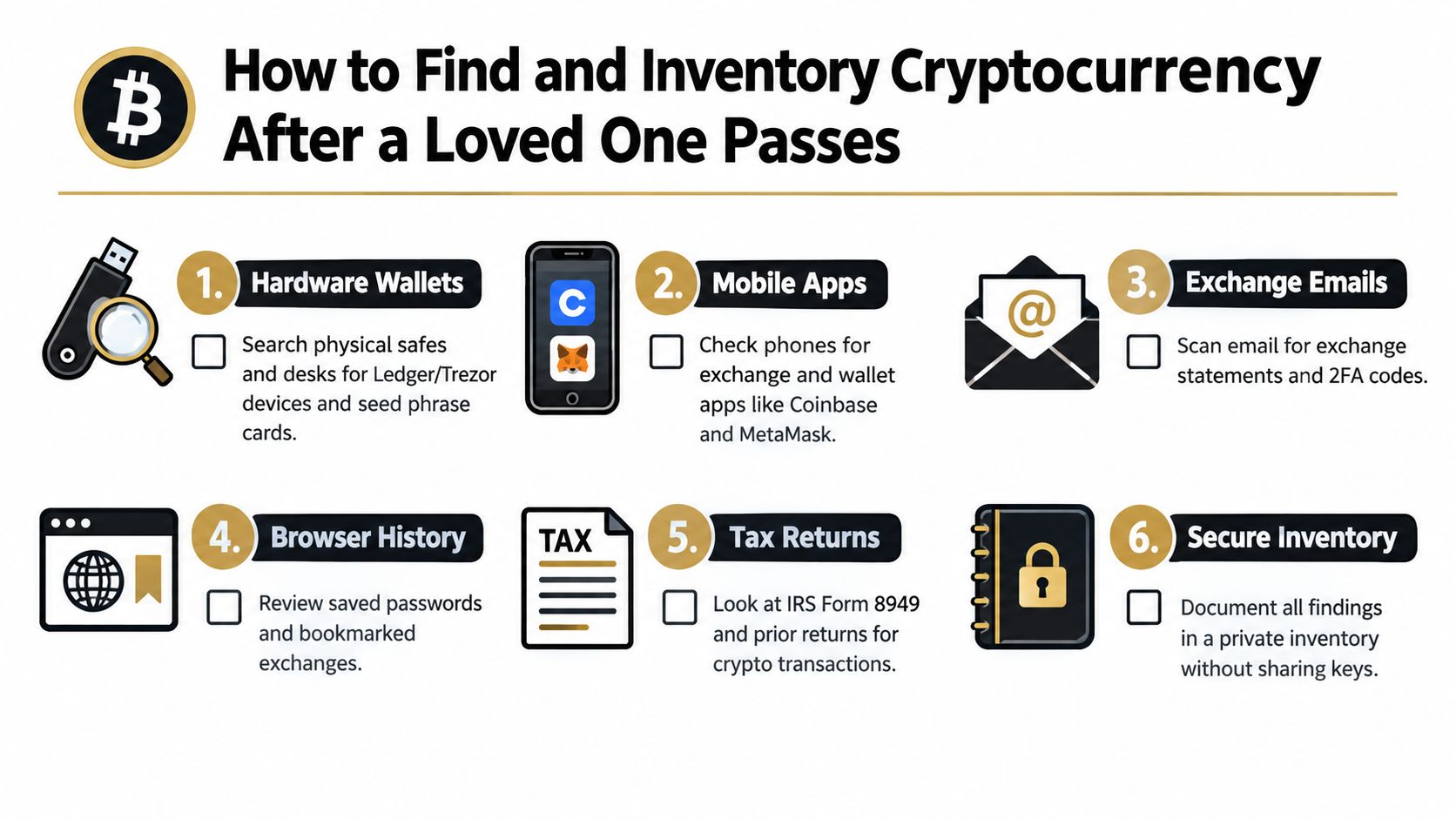
Begin with observation, not movement. Don't connect an unfamiliar hardware wallet to a computer, reset a device, or transfer coins because you found a label or address. First create a secure record of what exists, where it was found, and what information appears to relate to it.
Texas probate administration requires the representative to identify estate property. For digital assets, that means documenting more than a coin name. The inventory should distinguish an exchange account from a self-custodied wallet, note known wallet addresses, identify devices, and preserve statements or transaction records.
A practical discovery process
Search physical locations. Look in safes, desk drawers, document envelopes, and other secure storage for Ledger or Trezor devices, paper recovery cards, USB devices, and written instructions.
Review phones and tablets carefully. Look for wallet and exchange applications such as Coinbase and MetaMask. Don't open or change settings unless you understand the security consequences.
Search email records. Exchange notices, transaction confirmations, security alerts, and two-factor authentication messages may reveal an account even when the family doesn't know the username.
Review browsers and password records. Bookmarks, saved passwords, and browser history can identify platforms. Don't copy passwords into an unsecured shared document.
Examine tax records. Prior returns and IRS Form 8949 may show crypto transactions, sales, or transfers. A tax record may not show the current balance, but it can help establish that an account or wallet existed.
Create a restricted inventory. Record the asset type, platform or wallet, account identifier, wallet address if known, date discovered, and supporting documents. Store the inventory securely and limit access to people who need it.
Protecting evidence and credentials
A seed phrase is a recovery sequence that can control a wallet. Treat it like the ability to authorize a transaction, not like an ordinary note. Don't email it, text it, upload it to cloud storage, or share it with a broad group of relatives. If the phrase is found, document its location and consult counsel or a qualified digital-asset professional before using it.
The same caution applies to mining equipment. If the family finds old Bitcoin miners, GPUs, or related electronics, preserving the devices and records may be more useful than disposing of them immediately. A specialized resource such as Beyond Surplus electronics recycling can help explain disposal considerations after the estate has assessed whether the equipment has evidentiary or practical value.
The representative's broader responsibilities are summarized in An Executor's Duties in a Texas Probate. Families can also review how hidden estate assets are traced in probate when records suggest that additional holdings may exist.
The inventory is not a transfer document. It's a controlled record that helps the executor, attorney, accountant, and beneficiaries understand what must be addressed before anyone moves value.
Establishing Fiduciary Authority Under Texas Estates Code
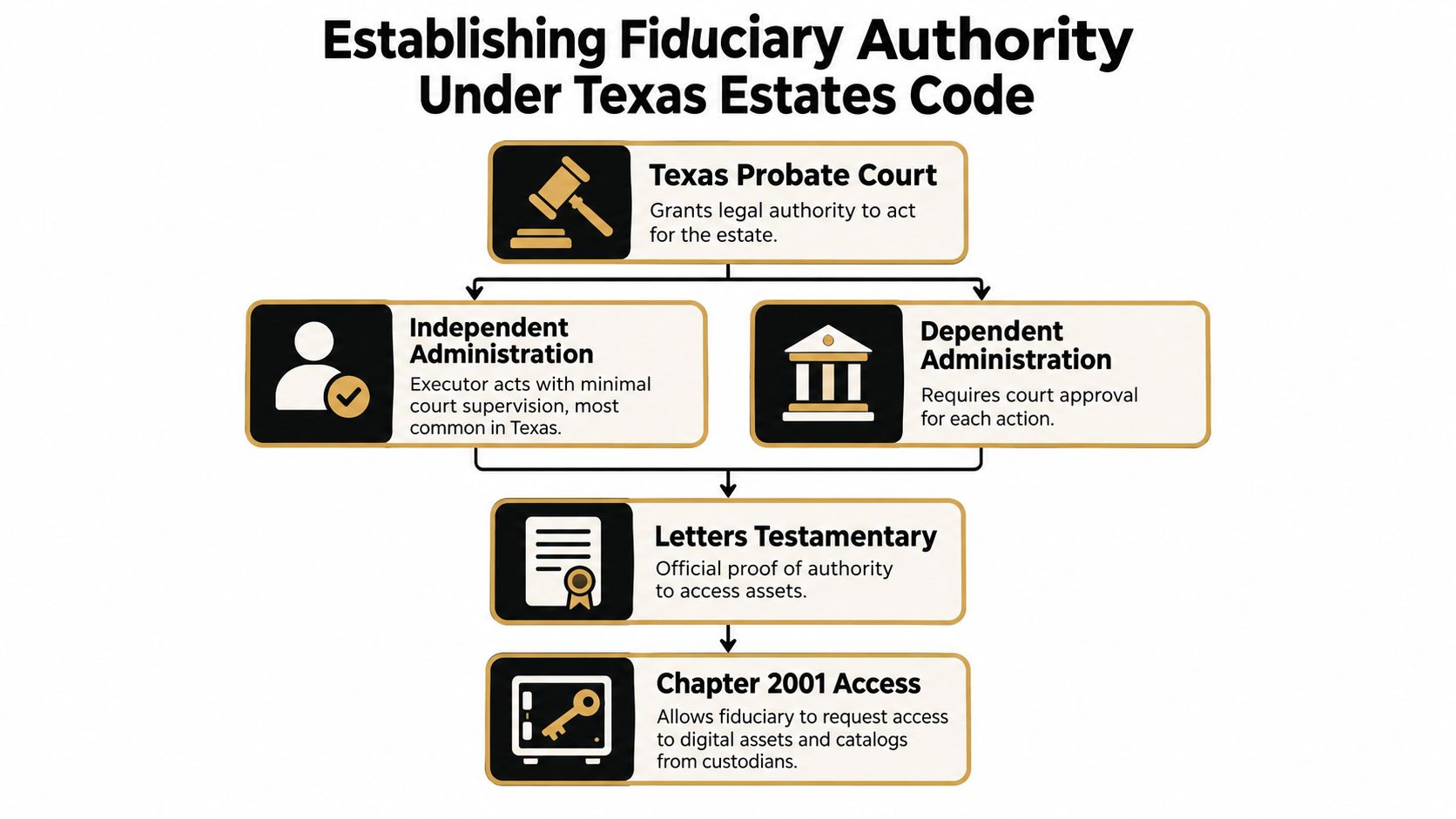
Suppose a family finds an exchange account after a death. A will may identify the intended executor, but the exchange may still refuse access until a Texas probate court appoints that person and issues the required documents. That distinction matters even more when the assets sit in a private wallet, where court authority cannot replace a missing recovery phrase.
A fiduciary acts for the estate and its beneficiaries. In probate, the role may belong to an executor named in a will or an administrator appointed when no qualifying executor can serve. The fiduciary protects estate property, addresses debts and claims, and distributes the remainder to the proper beneficiaries.
Texas Estates Code Titles 2 and 3 provide the main rules for estate administration. An estate may use independent administration, with less continuing court supervision, or dependent administration, which brings the court into significant decisions. The court's order and formal documents establish legal authority, while the custodian's procedures determine how that authority is verified.
What Chapter 2001 adds
Texas Estates Code Chapter 2001 supplies Texas's statutory framework for fiduciary access to digital assets. A digital asset is an electronic record in which an individual has a right or interest. The category can include cryptocurrency, exchange balances, email, cloud storage, and social-media accounts. The chapter became effective September 1, 2017, giving Texas probate matters a defined access process.
Its hierarchy helps explain which instructions control:
- Platform settings come first. A user's direction within a platform may govern access.
- Estate documents come next. A will, trust, power of attorney, or similar document may authorize fiduciary access.
- Terms of service apply after that. Default platform rules govern when higher-priority directions do not control.
The hierarchy can reduce disputes and delays when digital-asset instructions are clear. It also draws a firm line between legal authority and technical control. A court can appoint a representative and authorize estate action, but it cannot create a private key or recovery phrase that was never preserved.
What an exchange may request
An exchange may request a certified death certificate, the probate court's order, Letters Testamentary or Letters of Administration, the representative's identification, and account information. Each custodian sets its own submission process. Preserve every request and response so the estate file shows why an account was transferred, frozen, or liquidated.
A plain-language explanation of the documents that establish a representative's authority appears in Letters Testamentary and Letters of Administration in Texas. For the representative's duties, review this guidance on probate executor fiduciary duty in Texas.
An executor who sends only a will and death certificate may receive a denial. The will expresses the decedent's wishes, but it may not show that the court appointed the person contacting the exchange. After the executor obtains the required letters and submits the custodian's documents, the exchange can review the request under its process.
Practical rule: Court authority can open the door to an exchange account. It cannot manufacture a seed phrase for a self-custodied wallet.
Accessing and Transferring On Chain and Exchange Held Assets
After the inventory and authority questions are addressed, the family must distinguish self-custodied assets from custodial assets. “Self-custodied” means the owner controlled the private keys directly through a hardware, software, or paper-backed wallet. “Exchange-held” means a platform maintained the account and controlled the operational access.
These paths shouldn't be combined. A hardware wallet may require a recovery phrase and careful transaction testing. An exchange may require a formal estate packet, identity verification, and internal review.
Self-custodied wallets
If the seed phrase is available, keep it offline and limit handling. Don't photograph it, email it, paste it into a website, or enter it into an unfamiliar application. The executor should consider involving a qualified digital-asset professional who can explain transaction security without taking possession of the credentials.
Before transferring anything, document the wallet address, the date of access, the assets visible, and the value used for the estate records. The executor must also decide whether to transfer coins directly to a beneficiary or sell them and distribute cash. A direct transfer may preserve the asset, but it can leave the beneficiary responsible for security and later tax reporting. A sale may simplify equal distribution, but it converts a volatile asset into cash and can create a taxable transaction.
Exchange-held accounts
For an exchange, gather the death certificate, court documents, Letters Testamentary or Letters of Administration, account identifiers, and beneficiary information. Contact the custodian through its estate or deceased-account process rather than attempting to access the account using the decedent's password. A Texas practice guide describes a 60-day compliance window after receipt of required documents for a custodian response process, as discussed in Texas crypto and digital-asset estate planning guidance.
Keep a submission log. Record what was sent, when it was sent, the ticket number, and any instructions from the exchange. If the platform freezes the account, delays a transfer, or disputes the representative's authority, legal counsel can help protect the estate's position.
The following comparison can help frame the distribution decision:
| Factor | Transfer In Kind | Sell and Distribute Cash |
|---|---|---|
| Asset exposure | Beneficiary receives the coin and future price changes | Beneficiary receives cash after the sale |
| Security responsibility | Beneficiary must protect the receiving wallet or account | Estate or custodian handles the sale process |
| Equalization | Different coins may be difficult to compare fairly | Cash can simplify division among heirs |
| Documentation | Record the asset, quantity, destination, and transfer date | Record the sale date, proceeds, fees, and tax information |
| Family preference | Works when the beneficiary understands digital assets | May be clearer for beneficiaries who don't want crypto |
The executor should explain the choice to beneficiaries and preserve the reasoning in the estate file. More guidance on the legal process appears in Texas probate and cryptocurrency inheritance.
Building a Texas Estate Plan That Protects Digital Assets
A family may know that cryptocurrency exists, yet still be unable to reach it after a death because nobody can identify the wallet, device, or recovery method. Planning before that loss gives the fiduciary a map while preserving the private key. It also clarifies the boundary between court authority and technical access.
Texas Estates Code Chapter 2001 can support a fiduciary's request for digital records and custodial assistance. That authority does not create a missing seed phrase or reconstruct a self-custodied wallet. An exchange may have a recovery process, while an on-chain wallet depends on the private key and its security arrangement. The estate plan must address both paths.
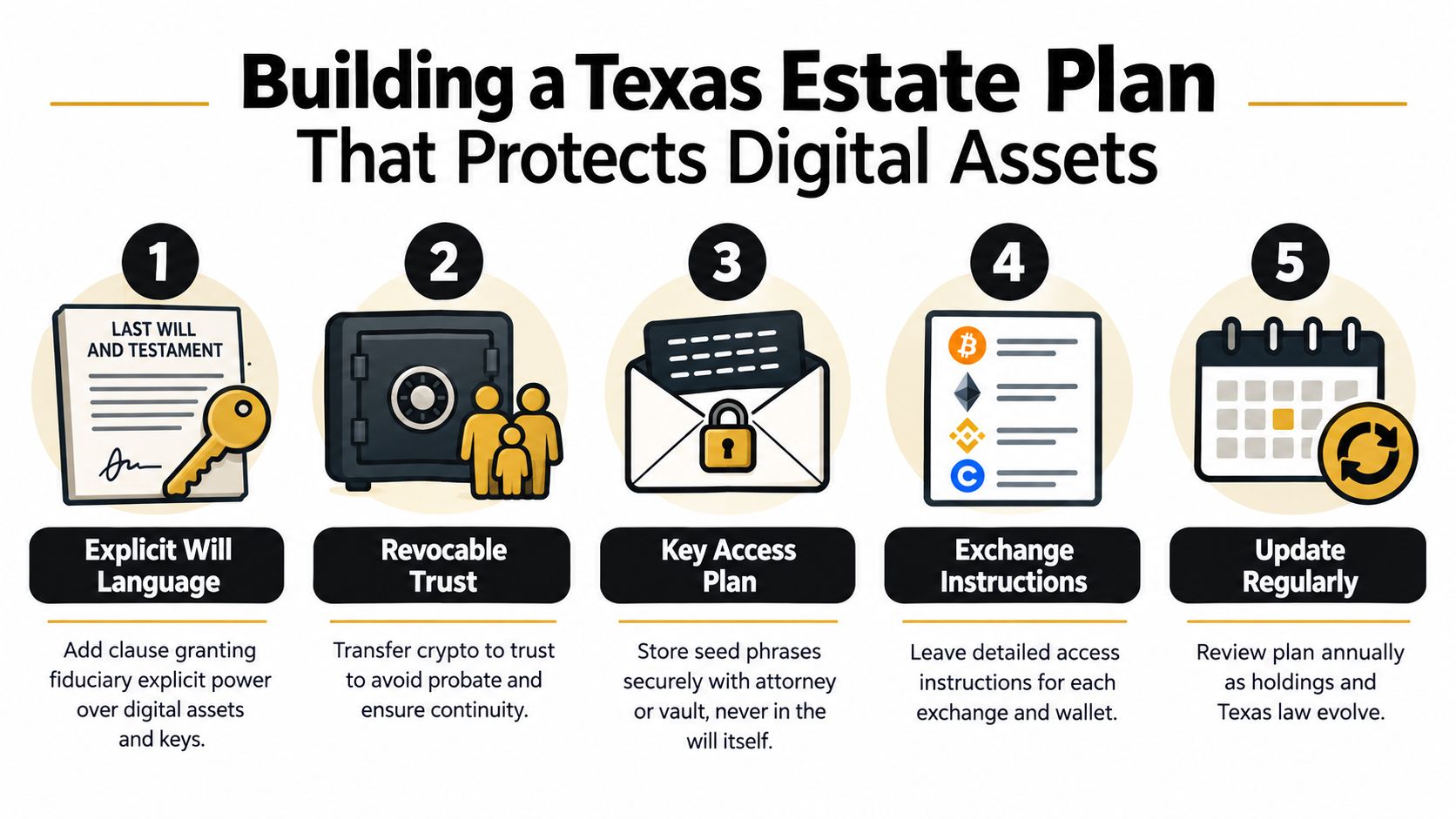
A will can grant specific authority over cryptocurrency, wallets, exchange accounts, records, and related electronic information. A revocable trust may provide continuity and privacy for property titled to the trust, since the trustee can act without waiting for every probate step. The suitable structure depends on ownership, family circumstances, asset complexity, and the person selected to serve.
Five planning decisions
Authorize digital-asset management clearly. The will or trust should let the executor or trustee request information, secure assets, transfer them, or sell them as the plan permits.
Keep the access map separate from the legal instrument. The estate document can identify where instructions are stored without placing a seed phrase in a filing that could become public. Update that location when devices, exchanges, or storage methods change.
Match security to the family. Multisignature wallets can require more than one approval. Shamir backup can divide recovery information into protected parts. Each method needs understandable instructions, a designated person who can follow them, and a safe way to preserve the components.
Plan for valuation and basis. Cryptocurrency becomes part of the decedent's gross estate. Inherited property may receive a basis equal to fair market value on the date of death under IRC §1014, as explained in guidance on inherited cryptocurrency basis. Preserve valuation records and transaction history for later tax reporting.
Review after meaningful changes. New wallets, exchange accounts, security devices, or family circumstances require an update. A stale inventory can leave a fiduciary searching for answers at the worst time.
Texas has no state estate or inheritance tax, while federal rules still affect valuation and later sales. A CPA or tax professional can explain the reporting consequences of distributing or selling the assets.
For broader educational material, see The Coin Course estate planning. Families can also consider the firm's Wills & Trusts and Guardianship services when planning for incapacity, family care, and future administration.
Key Takeaways and When to Consult a Texas Probate Attorney
Cryptocurrency inheritance in Texas becomes less intimidating when the family keeps three priorities in view:
- Inventory everything. Identify devices, exchanges, wallet addresses, records, and mining equipment before moving funds.
- Establish authority properly. The probate court, governing documents, and Chapter 2001 determine how a fiduciary can request digital records and custodial access.
- Protect keys relentlessly. A seed phrase should never be shared through ordinary email, text messages, cloud notes, or an unsecured family document.
Legal advice becomes especially important when a will is contested, a private key is missing, an exchange freezes an account, beneficiaries disagree about an in-kind transfer, or the estate holds a substantial and volatile crypto position. Counsel can also help evaluate independent administration, dependent administration, muniment of title, small estate affidavits, trust administration, and probate litigation. The appropriate path depends on the estate's documents, assets, debts, and family relationships.
The Law Office of Bryan Fagan, PLLC helps Texas families with the Texas Probate Process, estate administration, digital-asset issues, and Probate Litigation. A probate attorney can help organize the inventory, prepare filings, communicate with custodians, document valuation, and reduce the risk of an irreversible mistake while your family is grieving.
Takeaway: A court appointment establishes who may act for the estate. A secure access plan determines whether the cryptocurrency can actually be recovered.
If you're facing probate in Texas, our team can help guide you through digital-asset discovery, fiduciary access, exchange communications, and final distribution. Contact Law Office of Bryan Fagan, PLLC to discuss your circumstances and schedule your free consultation today.


