 Skip to content
A probate hearing may have already happened. The judge may have signed an order. The executor may be moving forward. Then someone in the family notices a problem that won't go away.
Maybe an heir was left out. Maybe a piece of property was handled under the wrong assumptions. Maybe the order says something that doesn't match what happened in the family. That moment is unsettling, especially when everyone is grieving and trying to do the right thing.
Texas law does give families a way to ask the probate court to correct certain serious mistakes. One of the most important tools is the Estates Code 55.251 bill of review in a Texas probate case. It is not a do-over of the entire estate. It is a probate-specific procedure that lets an interested person go back to the same court and ask that a probate order or judgment be revised and corrected.
Families often assume that once a probate order is signed, nothing can be done. That isn't always true. At the same time, this process has rules, deadlines, and practical risks. It helps to understand where correction is possible, where it isn't, and when fast action matters.
If your family is also dealing with conflict between relatives, questions about omitted heirs, or arguments over what should happen next, it can help to understand broader issues around resolving inheritance disagreements while you evaluate your Texas probate options. Whether a court order can still be challenged after probate begins, this guide on whether probate can be reopened in Texas is also a helpful starting point.
Introduction When a Texas Probate Order Does Not Feel Right
A signed probate order can look final on paper and still feel wrong to the family living with it.
Take a common situation. A father dies, one child files paperwork, and the court signs an order that moves the estate forward. Weeks later, another child learns that the order lists the family relationships incorrectly, or leaves out a child from an earlier marriage. Now the executor is acting under that order, accounts may be changing hands, and everyone is asking the same question. Can this still be fixed?
Why families feel stuck
Don't come into probate with a working knowledge of Title 2 or Title 3 of the Texas Estates Code. They're trying to bury a loved one, protect a home, and avoid family conflict. So when a court order appears to contain an important mistake, it's normal to feel frozen.
The confusion usually comes from three places:
- The order is already signed. People assume signed means untouchable.
- The estate is still moving. Bills get paid, property may be transferred, and the executor may keep acting.
- The language is unfamiliar. Terms like “bill of review,” “interested person,” and “injunction” sound technical when the issue is simple. Something important may have gone wrong.
Probate courts understand that serious errors can happen. Texas law includes a correction path for probate orders, but families need to act carefully and within the law's limits.
Why this remedy matters
Section 55.251 exists because probate has its own pressures. Decisions about heirs, title to property, and estate administration often affect people right away. Texas created a probate-specific way to ask the same court to revise and correct an order rather than forcing families into the harsher rules that often apply in ordinary civil cases.
That distinction matters. For grieving families, a focused correction procedure can be more practical than a broader and more difficult challenge.
If you're reading this because something in a probate order doesn't sit right, you're not overreacting. The next step is learning what this remedy does, who can use it, and when it needs to be filed.
Understanding Estates Code Section 55.251 in Plain English
A signed probate order can feel final, almost like wet concrete that has already hardened. Section 55.251 gives some families a narrower, probate-specific way to ask the same court to fix a serious mistake without forcing the case into the tougher rules that often apply to an equitable bill of review.
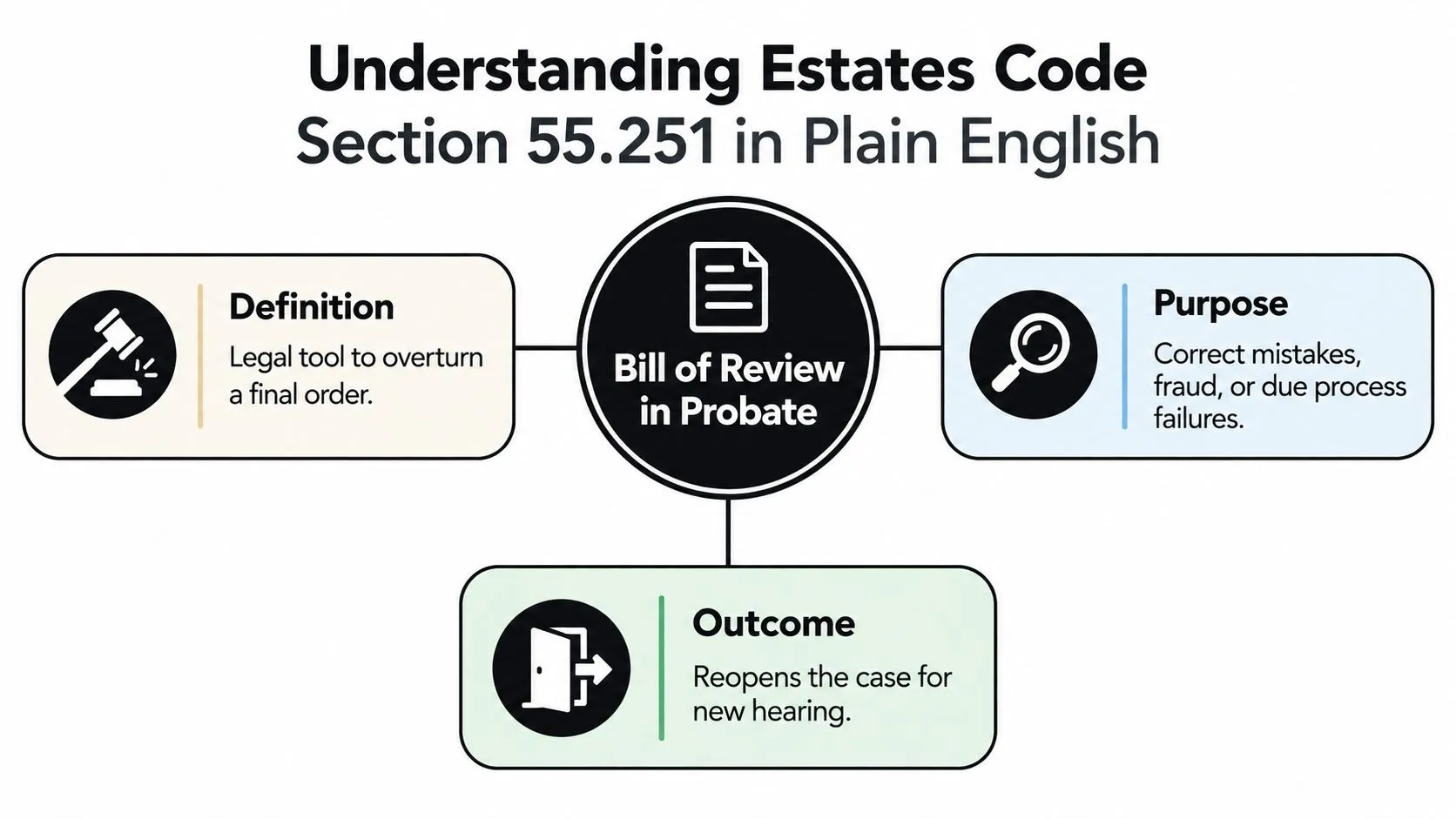
Under Texas Estates Code Section 55.251, an interested person may file a statutory bill of review in the same probate court to have an order or judgment revised and corrected for error. You can read the statute here: Texas Estates Code Section 55.251.
What a bill of review means in everyday language
A statutory probate bill of review works like a correction request aimed at one order, not a reset button for the whole estate.
That difference matters. In many civil cases, an equitable bill of review can be hard to win because the person asking for relief often must satisfy strict extra requirements. Section 55.251 serves a different role in probate. It gives the probate court a direct statutory path to correct substantial error in its own order, as long as the request is filed on time.
Here is the practical idea:
- Who may file: an interested person
- Where it is filed: the same probate court that signed the order
- What the court may do: revise and correct the order or judgment
- Why families use it: to fix a serious probate mistake without reopening every part of the estate
Families often find that point reassuring. The question is usually not, “Do we start all over?” The question is, “Can this specific order be corrected before more decisions stack on top of it?”
Who counts as an interested person
“Interested person” sounds technical, but the concept is grounded in common sense. It usually means someone whose legal rights, property rights, or financial interest are affected by the estate.
That may include an heir, beneficiary, executor, administrator, or another person directly affected by the order. A person with only general concerns about family drama usually does not qualify. A person left out of an heirship determination, or someone whose share of property changes because of the order, may qualify.
Why this remedy is different from the harsher civil version
Probate moves while people are still grieving. Homes must be protected, accounts may need attention, and a personal representative may keep acting under the order already signed. Texas law recognizes that probate needs a correction tool fitted to that reality.
Section 55.251 is that tool. It is probate-specific, and it gives the same court a chance to correct a substantial error within the statute's time limits, which are discussed later in this article. By contrast, an equitable bill of review is often a steeper climb.
One more point causes confusion for many families. Filing under Section 55.251 does not automatically freeze the estate. If the order is causing immediate harm, such as a pending sale, transfer, or distribution, injunctive relief may be needed to pause action while the court considers the challenge. In other words, the bill of review asks the court to fix the order. An injunction asks the court to stop something from happening before the fix comes too late.
That is the probate-specific shortcut in plain English. It is narrower than a full retrial, more specific than the traditional equitable bill of review, and often more realistic for families trying to correct a serious probate mistake without losing control of what happens next.
Required Elements and How Texas Courts Measure Error
A bill of review under Texas Estates Code Section 55.251 is not a second chance to reargue everything that happened in probate court. It is a focused request to correct a serious mistake in the order itself. The family member bringing the case must prove a substantial error by a preponderance of the evidence. In plain English, that means showing a meaningful probate mistake, and showing the judge it is more likely true than not.

What substantial error usually means
Courts are looking for a real probate defect that changed the result in an important way.
A helpful way to view it is this. Probate paperwork works like a set of instructions for the estate. If one small detail is off but nothing changes, the court may treat that as minor. If the order rests on the wrong heirs, the wrong property facts, missing notice, or another mistake that affects who inherits, who serves, or what property is controlled, the error is far more likely to be substantial.
That is why ordinary disappointment is not enough. A person may feel the judge gave too much weight to one witness, or may believe another family member was more persuasive than truthful. Those concerns matter emotionally, but Section 55.251 is aimed at correcting a meaningful legal or factual error in the probate order.
Examples that may point toward substantial error include:
- an heirship order based on incomplete family information
- an administration order entered with a serious defect affecting who should serve
- an order that misstates ownership or omits property in a way that changes estate administration
- a probate ruling tied to a trust-related dispute when the probate order itself contains the serious mistake
What preponderance of the evidence means
This burden of proof is lower than many families expect, but it still requires evidence.
The judge does not have to be certain. The judge has to believe your explanation of the error is more likely correct than the competing version. If you picture a scale, even a slight tip in your favor can meet this standard, so long as the evidence is reliable and tied to the order you want corrected.
That proof often comes from the probate file, family records, deeds, death certificates, wills, prior court filings, testimony, or other documents that show what the court got wrong and why the mistake mattered.
Courts often ask three practical questions:
- Was there an actual probate error in the order?
- Did that error affect the result in a serious way?
- Has the petitioner proved the point with credible evidence?
Those questions sound simple. In practice, they force the case back to the basics. What was ordered, what was wrong with it, and what proof shows the mistake.
How courts measure this differently from the harsher equitable bill of review
The probate version is narrower than a general do-over, but easier to use than the traditional equitable bill of review used in other civil cases.
That difference matters. In a standard civil bill of review, the petitioner often faces extra barriers tied to fault, diligence, or why the earlier judgment was not challenged another way. Section 55.251 reflects a different choice for probate. It gives the same probate court a shorter path to fix substantial error within the statutory window, which makes sense in estate cases where property, titles, distributions, and fiduciary actions may continue while the family is still trying to sort out what happened.
So the question is usually not, "Was this unfair in a general sense?" The better question is, "Can I show a substantial probate error in this order, with proof, in the court that signed it?"
For a broader comparison of post-judgment review standards, this guide to probate appeal standards in Texas helps place Section 55.251 in context.
Timing Venue and Why Probate Orders Keep Moving Without a Stay
A family often learns about the pressure of timing after something has already started to change. The house is about to be sold. An account is about to be distributed. An administrator is still acting under the order you believe contains a serious mistake.
That is why this probate remedy works like a shorter correction window, not a reset button you can press at any time. As noted earlier, Section 55.251 gives the probate court a limited path to correct substantial error, and that path must be used within two years of the order or judgment.

Why the deadline matters so much
Probate cases do not stay still while a family decides what to do. Title can shift. Money can leave the estate. People may rely on the court's order and keep acting on it in ways that become harder to unwind later.
The two-year limit reflects a balance. Families get a defined chance to ask the same probate court to fix a serious mistake. At the same time, estates need an end point so administration can continue and third parties can rely on orders already signed.
This is one of the main differences between this probate-specific shortcut and the harsher equitable bill of review used in other civil cases. Section 55.251 gives a narrower, time-limited correction process. It is still a deadline the court will expect you to respect.
Where the case must be filed
The petition belongs in the same court that signed the probate order being challenged.
That rule is practical. The judge already has the estate file, the prior orders, and the history of the administration. If someone files in a different court, the problem may become procedural before the judge ever reaches the claimed error.
A short video may help if you're trying to place this remedy inside the larger probate timeline:
Why filing does not automatically stop estate activity
This point causes real confusion for grieving families. Filing a bill of review does not, by itself, pause the estate.
Under Texas Estates Code Section 55.252, action under the challenged probate order may be stayed only by writ of injunction. In plain English, if property may be sold, funds distributed, or other estate steps taken before the court can hear your challenge, you may need to ask separately for injunctive relief.
A simple way to view it is this. The bill of review asks, "Was the order substantially wrong?" The injunction asks, "Should the court press pause while we sort that out?"
Practical rule: Filing the bill of review and stopping the estate are separate requests. If estate action during the case could cause immediate harm, ask whether a writ of injunction is needed.
That distinction can shape the whole strategy. A family may file on time, in the right court, and still watch the estate keep moving if no one asks the judge for a stay.
Common Defenses Pitfalls and How to Avoid Them
Families often lose momentum not because their concern is imaginary, but because the filing approach is weak. Probate courts expect precision. The other side may argue that the challenge is late, misplaced, unsupported, or aimed at relitigating family conflict rather than correcting a substantial probate error.
The most common trouble spots
Some pitfalls are procedural. Others are about proof.
A missed filing deadline can defeat the case before the judge ever weighs the underlying issue. Filing in the wrong court can create avoidable delay. A vague complaint about unfairness can be treated very differently from a focused claim supported by records, testimony, and a clear explanation of the error in the order.
Another common mistake is practical rather than legal. The estate keeps moving, property changes hands, and no one asks the court for relief to pause those actions.
| Common Pitfalls vs Stronger Approaches in a Section 55.251 Filing | |
|---|---|
| Pitfall or Defense Raised | Stronger Approach to Avoid It |
| Missed the statutory deadline | Calendar the order date immediately and evaluate correction options without delay |
| Filed outside the original probate court | Confirm the exact court that signed the challenged probate order and file there |
| Complaint sounds like family disagreement rather than legal error | Tie the petition to a specific substantial mistake in the order itself |
| Weak evidence | Gather the order, probate docket, family records, title documents, and witness information before filing |
| Estate actions continue while the case is pending | Consider whether injunctive relief is needed to pause distributions, transfers, or other estate steps |
| Petition is too broad | Ask for revision and correction of the identified order rather than trying to restart the entire estate |
How to strengthen the filing early
A stronger petition usually starts with organization, not emotion.
- Pinpoint the exact order: Identify the signed probate order or judgment you believe contains the problem.
- Match the evidence to the error: Don't hand the court a stack of papers without a story. Show how each document supports the specific mistake.
- Protect against moving targets: If the executor or another party is likely to act under the order right away, raise the question of a stay early.
- Stay focused on probate correction: The court is more receptive when the request is disciplined and tied to the statute.
Many failed filings have a real grievance underneath them. The problem is that the grievance was never translated into a clear probate correction claim.
Step by Step Filing Checklist and What to Expect in Court
A family can feel blindsided when a probate order is already in motion and property, money, or decision-making authority may change before the court corrects the mistake. Section 55.251 helps in that moment because it is a probate-specific way to ask the same court to revise and correct a substantial error within two years. It is often more direct than a traditional equitable bill of review, but it does not freeze the estate by itself.

A practical order for getting the case ready
Start by pulling the signed order you want corrected. Families often work from memory, email summaries, or what someone said happened in court. The judge will want the actual signed order.
Next, line up the papers that show the mistake. Good examples include probate pleadings, heirship records, deeds, beneficiary documents, letters testamentary, account records, and witness information. The goal is simple. Match each document to one part of the claimed error so the court can follow the problem without guessing.
Then ask a narrow question: what exactly should be revised and corrected? Section 55.251 is usually strongest when the request is focused. A petition that tries to reopen every family conflict at once can blur the issue.
After that, prepare the petition for filing in the same probate court that signed the order. This remedy works like a court correction tool built for probate cases. By contrast, an equitable bill of review can involve harder procedural demands and a broader fight over why the prior judgment should be set aside.
Filing checklist
Use this checklist to keep the process organized:
Get the signed probate order
Confirm the date it was signed and read the language closely.State why you are affected
Explain why you qualify as an interested person and how the order impacts your rights.Describe the substantial error clearly
Use plain language. Point to the exact finding, omission, or ruling that is wrong.Attach or identify supporting proof
Connect each exhibit to the claimed error.File in the original probate court
The request goes back to the court that entered the challenged order.Consider whether estate action must be paused
If a sale, distribution, transfer, or appointment under the order could cause immediate harm, ask whether injunctive relief is needed. Section 55.251 seeks correction of the order. An injunction is the separate tool that may pause action while the court decides.Serve the required parties
Make sure notice goes to the people whose interests may be affected.Prepare a short hearing outline
List the order, the error, the proof, and the relief requested in that order.
What to expect in court
The hearing usually feels more structured than families expect. The judge is not there to sort through every old grievance. The judge is usually looking for a clear answer to four questions: What order is being challenged? What is the substantial error? What proof supports that claim? What correction are you asking the court to make?
That structure helps.
If witnesses are needed, keep their testimony tied to the specific mistake in the order. If documents matter, organize them so the court can move from the order to the evidence and then to the requested correction without flipping through a pile of unrelated papers. A clean presentation often matters as much as strong facts because probate courts handle active estates, and confusion can slow relief.
One more point causes a lot of stress. Filing under Section 55.251 does not automatically stop the estate from moving ahead. If assets may be distributed or transferred before the hearing, raise the need for injunctive relief early and directly. For families comparing this option with appellate review, this explanation of a probate appeal in Texas can help clarify the difference.
Real World Example When to Challenge and When to Seek Counsel
A family in Harris County opens a probate file after a parent dies. Later, they discover the court's heirship order leaves out an adult daughter from an earlier marriage. That kind of mistake does more than sting emotionally. It can change who is legally recognized, who receives notice, and who may share in the estate.
In that situation, the first question is practical. Is this the kind of problem Section 55.251 was built to fix?
Often, yes. If the signed probate order contains a substantial error and the omitted daughter can prove her relationship to the decedent with records such as birth certificates, marriage records, or prior court filings, Section 55.251 may offer a probate-specific path to ask the same court to correct the order. That is a different posture from the harsher equitable bill of review. Instead of starting with the older, more demanding remedy, the family should first examine whether this statute fits the problem and the timing.
The second question is urgency. If the administrator is about to distribute property, transfer title, or take another step that relies on the incorrect order, filing the challenge alone may not protect the estate in time. The family may also need injunctive relief to pause those actions while the court decides whether the order should be corrected. A helpful comparison is this. Section 55.251 is the correction request. Injunctive relief is the pause button.
That distinction matters because families often assume that once they file, everything stops. Probate usually does not work that way.
Lawyers are especially helpful when the facts are tangled. An omitted child may have standing, but proving it cleanly, choosing the right remedy, and deciding whether temporary court orders are needed can become complicated fast, especially if property is already being prepared for sale or distribution. A calm legal review can separate a fixable court error from a broader family dispute that may require a different strategy.
Some families can collect the paperwork on their own. Fewer can comfortably assess whether the error is substantial enough for Section 55.251, whether the estate needs to be paused, and whether another remedy belongs alongside the petition.
Key Insight and Your Next Steps Toward Peace of Mind
A probate order can feel final, even when something about it still seems plainly wrong. Section 55.251 matters because it gives families a probate-specific way to ask the same court to correct a substantial error within two years. For many estates, that is a more direct path than the older equitable bill of review, which usually brings a harder set of rules and proof problems.
The practical question is simple. Is this a correctable court error, or is it a broader fight that calls for a different remedy?
That distinction can bring real peace of mind. Families do not have to start with the harshest tool in the toolbox. They can first ask whether Section 55.251 fits the problem, whether the deadline is still open, and whether estate activity needs to be paused while the court reviews the challenge. If property may be sold, transferred, or distributed before the judge can rule, a request for injunctive relief may be just as important as the petition itself. Section 55.251 works like the correction request. Injunctive relief works like the pause button.
Many families feel stuck at this stage because they are grieving and trying to make legal decisions at the same time. That is normal. A careful review of the probate order, the court file, and the estate's next scheduled actions often brings the answer into focus.
Law Office of Bryan Fagan, PLLC helps Texas families assess probate orders, prepare Section 55.251 filings, and decide whether added court action is needed to protect estate property while a challenge is pending. If you need guidance on an Estates Code 55.251 bill of review in a Texas probate case, contact the firm to discuss your options.


