 Skip to content
In Texas probate, the inventory deadline runs from the date the personal representative qualifies, not from the date of death. Under Texas Estates Code § 309.051, the representative must file the inventory, appraisement, and list of claims before the 91st day after qualifying, unless the court grants more time.
If you're holding a loved one's will, sorting through mail, and trying to understand what happens next, this deadline can feel abrupt. Many families assume they have time to grieve first and paperwork later. Texas probate doesn't work that way. One of the court's earliest expectations is that the executor or administrator identify what the estate owns, what it may be owed, and, beginning with a major statutory change taking effect in 2025, how marital property should be characterized.
That last point matters more than many families realize. In blended families, second marriages, and estates with property acquired before and during marriage, the inventory may become the first place where separate property and community property questions surface. The filing is still about timing. But it's also about getting the facts right before the deadline arrives.
Understanding the Ninety Day Clock After You Qualify
You leave the courthouse with letters in hand, and by that evening a practical question lands on the kitchen table. What has to be done first, and how fast? For many Texas families, the first hard answer is the inventory deadline.
Texas Estates Code § 309.051 sets the rule. The personal representative must file a verified, full, and detailed inventory, appraisement, and list of claims before the 91st day after the representative qualifies, unless the court allows more time. You can review the statute here: Texas Estates Code § 309.051.
What “qualify” means in plain English
The clock starts when you legally step into the job, not on the date of death.
In many estates, that means the court appoints the executor or administrator, the required oath is completed, and any bond requirement is satisfied if one applies. Families often miss this point because grief begins first, while probate authority begins later. The law cares about the second date.
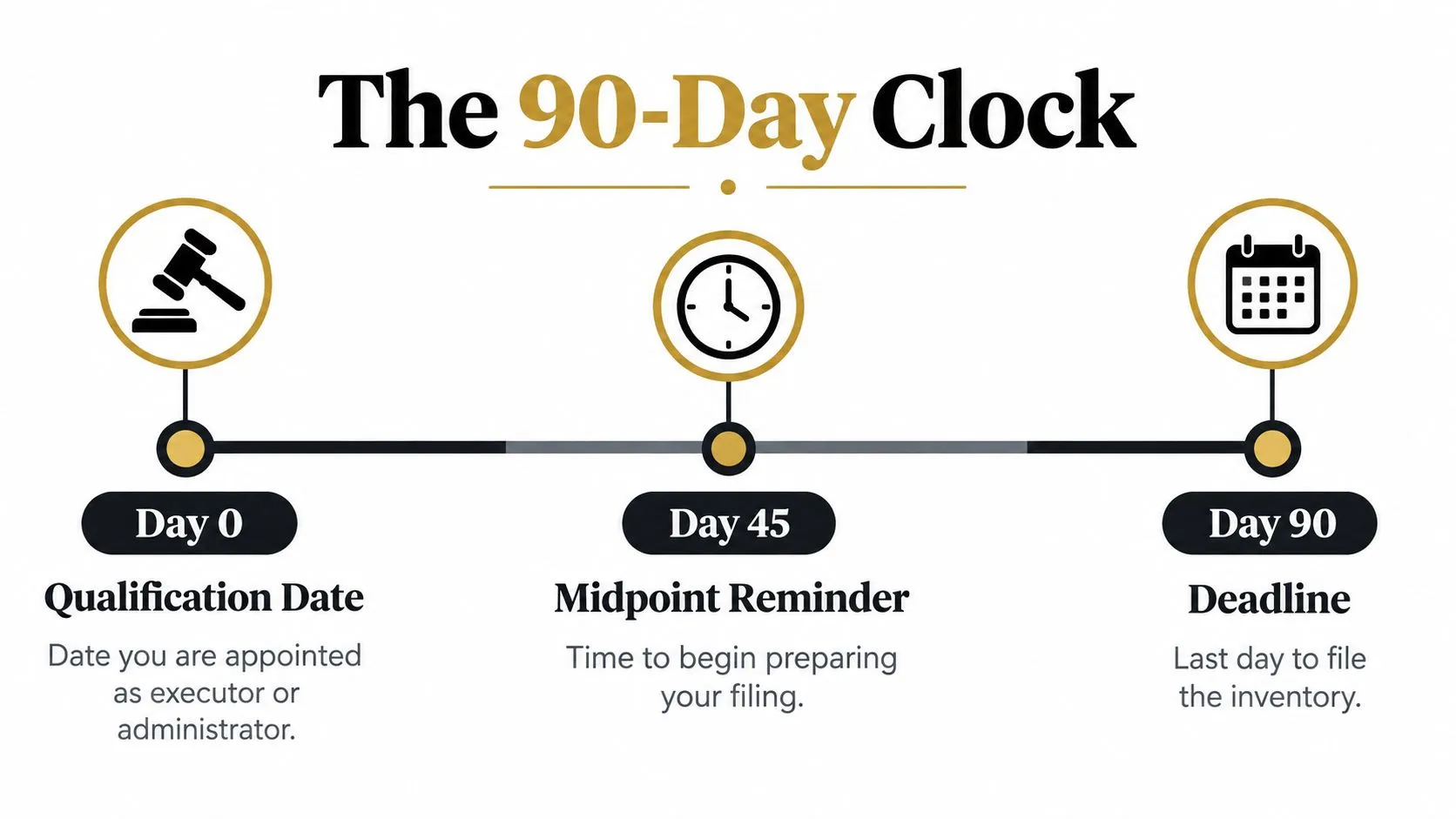
A courthouse example makes this easier. If Daniel dies in February, but his wife is not qualified as executor until April, the 90 days run from April. The earlier date may matter for taxes, insurance, or bills. It does not control this filing deadline.
Write down that qualification date the same day you receive authority. Put it on your calendar, your phone, and the front of the estate file.
Why the first 90 days are harder after the 2025 change
For years, families often treated the inventory as a gathering project. Find the accounts. List the house. Get values. File on time.
Beginning in 2025, Senate Bill 1448 raises the level of care required in many estates. The inventory must address marital status and whether property is separate property or community property. That sounds technical, but the-world effect is simple. The first 90 days may now require early tracing work, especially in second marriages, blended families, and estates where assets were acquired both before and during marriage.
Property characterization works a lot like sorting two sets of puzzle pieces that were stored in one box. Some assets may clearly belong in one pile. A house bought before marriage may point toward separate property, while wages earned during marriage often point toward community property. Other assets are harder. Refinance proceeds, commingled accounts, inherited funds deposited into a joint account, or a business that grew during marriage can raise questions fast.
That is why the deadline now carries more pressure than many families expect. You are not only listing what exists. You may also need to identify how Texas law views ownership between the estate and a surviving spouse.
Why blended families feel this pressure first
In a first-marriage estate with simple finances, the inventory may be straightforward. In a blended family, the same document can become the first serious fact-check of who owned what, when, and why.
A surviving spouse may view an account as shared because both spouses used it. Adult children from an earlier marriage may believe part of that same account should pass through the estate. Both reactions are common. Neither question can be answered by guesswork.
A clear early process helps. Pull the deed, the closing papers, beneficiary forms, old bank statements, and records showing when an asset was acquired. If an asset came from inheritance or was owned before marriage, keep the paper trail together. If funds were mixed over time, make a note now instead of hoping the issue goes away later.
If you want a practical overview of the Texas probate inventory deadline and how families prepare for it, that guide can help connect the rule to the day-to-day work in an estate.
The deadline becomes manageable once you anchor the right date
Families usually feel less overwhelmed once they know two things. First, the clock starts on qualification. Second, the 2025 inventory may require more than a simple asset list.
That knowledge helps you act in the right order. Start with the qualification date. Then gather ownership records before relying on memory, especially if the estate includes a surviving spouse, prior marriages, inherited funds, or property purchased across different periods of the marriage. Clear educational resources also help, and the Helbling Digital Media estate planning page is one example of how complicated estate topics can be explained for families in a readable way.
Who Must File and Who May Use an Alternative
A daughter is named executor in her father's will. His second wife is still living in the home. Some accounts were opened before the marriage. Others were funded during it. Before she can decide what to file, she has to answer a harder question: what property was part of his estate, and how should it be characterized?
That question matters more now. The 2025 changes under SB 1448 push representatives to sort out marital status and whether property is separate or community property early in the process. For blended families, the 90-day deadline is no longer just a paperwork date. It often becomes the first deadline for property tracing.
The person responsible is the personal representative. In plain English, that usually means the executor named in the will or the administrator appointed by the court if no executor is serving.
If the court has issued Letters Testamentary and Letters of Administration in Texas, you are the one expected to handle the Chapter 309 duties.

The basic rule
Both dependent and independent administrations have inventory responsibilities. The difference is the path, not the existence of the duty.
A dependent administrator usually files the inventory with the court as part of a more supervised process.
An independent executor may have another option in some estates. Under Texas Estates Code § 309.056, a qualifying independent executor can use an affidavit in lieu of inventory rather than filing the full inventory in the court record. The same 90-day framework still matters unless the court extends the deadline.
That point causes confusion for families. An affidavit in lieu does not mean the executor can skip the work of identifying, valuing, and classifying property. It mainly changes what gets filed publicly.
Why the alternative is not always simple in 2025
For some estates, the affidavit route sounds easier on paper than it is in real life.
If the decedent had one marriage, one house, and clearly titled accounts, the choice may be straightforward. In a blended family, it often is not. You may need to trace whether a brokerage account began with premarital funds, whether a refinance changed the character of a home, or whether inherited money stayed separate after it was deposited into a joint account. Those are inventory questions now, not problems to postpone.
A good comparison is sorting luggage after a long trip. The label on the suitcase helps, but it does not always tell you what is inside or who packed it. Title helps. Source of funds and marital history matter too.
A practical way to identify your lane
Start with three questions:
- Was I appointed by the probate court? If yes, you are likely the personal representative with Chapter 309 duties.
- Is this dependent or independent administration? Your order admitting the will to probate, your letters, and your lawyer can confirm that.
- If independent, do I qualify to use an affidavit in lieu? That depends on the estate's circumstances and whether the legal requirements are met.
If you are unsure, do not guess.
The safer approach is to assume you still need to build the full inventory file, even if an affidavit in lieu may later be available. That approach protects you if the estate includes a surviving spouse, children from different relationships, premarital property, inherited assets, or accounts that mixed funds over time. In those estates, the hardest part is often not filing the document. It is getting the property characterization right before the 90 days run out.
What Your Inventory Appraisement and List of Claims Must Include
A family often reaches this stage with a stack of papers on the kitchen table. There may be a deed, a few bank statements, an old will, and an account that nobody can explain. The inventory turns that pile into a sworn probate record, and after the 2025 law change, it also requires an early position on whether certain property was separate or community if the decedent was married at death.
That is why this document deserves careful attention. It is one of the first formal statements to the court about what the estate owns, what it is worth, and what the estate has a right to collect.
The core contents of the filing
Texas requires a verified inventory, appraisement, and list of claims. In plain English, that usually means the personal representative must gather and disclose:
- Texas real property: Homes, land, mineral interests, and other real estate in Texas that the decedent owned.
- Personal property wherever located: Bank accounts, vehicles, business interests, household items, stock, and other personal property, even if the property is outside Texas.
- A value for each item: The filing must state fair market value as of the date of death, as required by Estates Code Chapter 309.
- Claims owed to the estate: Debts, notes, refunds, or other receivables that the estate has the right to collect.
- Verification under oath: The representative signs a sworn filing, so accuracy matters.

Families sometimes ask whether this is just a list of what they found in the house. It is broader than that. The inventory covers legal interests, not just physical items you can hold in your hand.
The 2025 change raises the stakes
Beginning September 1, 2025, SB 1448 adds something many families have never had to address this early. If the decedent was married at death, the inventory must state that fact and identify which property is separate property and which is community property.
That change matters most in estates where the marriage history is complicated.
A blended family can feel this pressure quickly. One asset may have started before marriage, grown during marriage, and then been refinanced, retitled, or mixed with other funds. A retirement account may include contributions from different periods. An inherited account may have been kept alone for years, then partially mixed into a joint account. The inventory deadline still runs on the court's timetable, but the work now looks more like property tracing than simple form completion.
Why characterization can be the hardest part
Property characterization is the legal label attached to an asset. That label can affect who owns what, which part passes under the will, and what remains with a surviving spouse.
A helpful comparison is sorting family photos into albums. The picture in your hand may be clear, but its place in the story depends on when it was taken and how it got there. Property works much the same way. Title helps, but title alone does not always answer the separate-property versus community-property question.
Consider a common example. A husband owned a house before a second marriage. During the marriage, the couple used earnings to pay the mortgage and made major improvements. The inventory may need more than the deed. It may require records that show when the property was acquired, how it was paid for, and whether later transactions changed the analysis.
Terms that often cause confusion
These terms help families read the inventory with more confidence:
- Separate property: Property the law treats as belonging to one spouse individually, often because of when or how it was acquired.
- Community property: Property the law treats as belonging to the marital estate of both spouses.
- Claims: Rights the estate has to collect money or enforce repayment.
- Appraisement: The value assigned to property for probate purposes.
Small details can change the answer. Source of funds, dates of acquisition, gifting history, and whether money was mixed together may all matter.
For that reason, good inventory preparation usually starts with documents, not guesses. Deeds, closing papers, beneficiary forms, account statements, loan records, and prior marriage or divorce records may all help explain both ownership and character. In 2025 and after, that explanation is often part of meeting the ninety day deadline, not a problem to save for later.
How Valuations Work and When Appraisers Are Involved
Valuation is where many families realize the ninety day deadline is not just paperwork. It is also an early fact-finding job. You are not listing what assets seem worth today. You are stating what each asset was worth on the date of death, using support you could defend if a beneficiary or court asked questions later.
That date matters for another reason in 2025. If the inventory must also reflect marital status and whether property is separate or community, value and character often have to be worked out together. A house may need a date-of-death value, but in a blended family, the harder question is sometimes which part of that house belongs in the decedent's estate at all.

A snapshot as of the date of death
The inventory value captures the estate as it existed on the date of death. A later sale can offer clues, but it does not automatically answer the probate question. If a home sells six months later for more money because the market rose or repairs were made, the inventory still looks back to the earlier date.
A simple example helps. If your father owned ranch land that increased in value after an oil company showed interest, the inventory does not use the later excitement unless that condition already existed at death. Probate valuation asks, "What was this worth then?" not "What did it become later?"
Who can value property, and when outside help makes sense
Some assets are easy to document. A bank statement close to the date of death may give you the answer with very little dispute. Publicly traded stocks are often similar because the date-of-death pricing can be pinned down from market records.
Other assets need judgment. Real estate, a family business, mineral interests, collectibles, or property tied up in a second marriage can raise questions that records alone do not settle. In those cases, the personal representative may need a qualified appraiser, and in some estates the court may appoint appraisers.
Here is the practical difference:
| Asset type | Valuation difficulty | Why appraiser help may be needed |
|---|---|---|
| Checking, savings, brokerage accounts | Usually lower | Statements or market records often show date-of-death value |
| Real estate | Moderate to high | Condition, comparable sales, and market timing can affect value |
| Business interests | High | Ownership restrictions, income history, and lack of a public market can complicate value |
| Minerals, royalties, collectibles, disputed personal property | High | Specialized knowledge is often needed |
If you want a fuller explanation, this guide on how probate property appraisals work in Texas walks through common real-estate valuation issues in probate.
The blended-family problem: value is only half the job
For many families, the bottleneck is not getting a number. It is figuring out what interest should be valued.
Suppose a surviving spouse says the house is community property, while the decedent's adult children from a first marriage believe it began as separate property before the marriage. An appraiser can estimate fair market value. The appraiser usually does not decide the legal character of the property. That part may require deeds, closing records, refinance documents, payoff history, and proof showing whether community funds were used in a way that created reimbursement issues or changed the analysis.
That is why it helps to separate two questions early:
- What is the asset worth as of the date of death?
- What portion of that asset belongs in the decedent's probate estate?
Families often blend those together and get stuck.
How to gather valuation proof without losing time
Start with assets that have clean paper trails, then identify the trouble spots fast. Waiting until week ten to order a real-estate appraisal or collect old closing records can put real pressure on the deadline.
A workable approach looks like this:
- Financial accounts: Get date-of-death statements and beneficiary information.
- Real estate: Gather the deed, tax appraisal, mortgage history, refinance papers, and any recent comparable-value information.
- Business or unusual assets: Ask early whether a professional valuation is needed.
- Marital-property questions: Pull records showing when the asset was acquired and what funds were used during the marriage.
Good inventory work often feels less like filling in blanks and more like assembling a careful family timeline. The earlier you spot assets that need both a value and a property-character analysis, the easier it is to stay accurate and stay on time.
Extensions Affidavit in Lieu and How to Stay Compliant
On day 78, a daughter serving as executor finds the bank statements. On day 82, a deed from a prior marriage turns up in an old file box. On day 86, someone realizes the house may be partly separate property, partly community, and the decedent remarried years after buying it.
That is the point many Texas families see the problem. The 90 day deadline is not only about getting papers filed. After the 2025 SB 1448 change, the inventory also requires marital-status information and property characterization work that can become difficult fast in blended-family estates.
Two ways estates usually comply
Chapter 309 gives estates two common paths.
The first is the standard inventory, appraisement, and list of claims under Estates Code § 309.051. The second is an affidavit in lieu of inventory under Estates Code § 309.056, which is available only in certain independent administrations.
The choice matters because it affects what goes to the court, but it does not erase the early homework. Even if an independent executor may use an affidavit in lieu, the executor still needs a reliable picture of the estate's assets, debts, and property character. You cannot sensibly swear to what belongs in the estate if the separate-versus-community question is still a blur.
| Feature | Standard Inventory Filing | Affidavit in Lieu for Independent Executor |
|---|---|---|
| Who uses it | Personal representatives required to file the inventory with the court | Certain independent executors who qualify for the alternative |
| What is filed | Verified inventory, appraisement, and list of claims | An affidavit permitted by Chapter 309 instead of filing the full inventory with the court |
| Timing | Due before the 91st day after qualification, unless the court grants more time | Built around the same 90 day deadline, unless the court grants more time |
| Court visibility | The inventory is filed with the court | The statute allows a substitute filing for qualifying estates |
| Best fit | Estates that need or require formal court-filed disclosure | Independent estates that meet the legal conditions for the alternative |
When asking for more time is the careful choice
Some delays are avoidable. Others are responsible.
If the estate includes a second marriage, a home bought before marriage but refinanced later, mixed funds in brokerage accounts, or property shared across family lines, extra time may be the honest answer. In those cases, the representative is not stalling. The representative is trying to avoid filing an inventory that guesses at ownership.
Property tracing works a lot like balancing an old family ledger. You are matching dates, deeds, account records, and marriage history to answer a simple question with major legal consequences: what part of this asset belongs in the probate estate?
Ask for the extension before the deadline passes. That gives the court a cleaner record and shows that you are treating the duty seriously.
If the estate cannot yet support a confident statement about marital status or whether an asset is separate or community property, filing for more time is often safer than filing a rushed inventory that may need correction.
Staying compliant while the records are still coming together
A practical approach helps.
Keep a dated list of what has been requested, what has arrived, and what remains unclear. Separate valuation problems from ownership problems. A house may have a workable value from tax records or an appraisal, while the harder question is whether all of that value belongs in the decedent's estate.
This distinction has become more important after SB 1448. Families sometimes assume an affidavit in lieu solves the pressure. It can reduce what gets filed with the court, but it does not solve missing title records, unclear marital history, or commingling questions.
Courts also have enforcement tools if the deadline is ignored. Texas court instructions discuss consequences that can include an order to show cause, revocation of letters, and a fine of up to $1,000 under Estates Code § 309.057, as reflected in these Texas court instructions on letters and inventories.
For families who want help organizing that process, the Law Office of Bryan Fagan, PLLC provides representation through Texas probate and estate administration.
What Happens If You Miss the Deadline
A missed deadline often starts with a family doing its best.
An executor qualifies, takes home a stack of court papers, and spends the next few weeks dealing with funeral expenses, house keys, mail, and worried relatives. Then the estate hits a harder problem. A surviving spouse says one account was community property. An adult child from an earlier marriage says it was separate property because it came from before the marriage. After the 2025 SB 1448 change, that dispute matters earlier, because the inventory must do more than list assets. It must also address marital status and characterize property as separate or community.
That is why missing the ninety day deadline is more than a late form. In many estates, especially blended-family estates, it signals that the representative has not finished the early tracing work the court now expects.
What the court may do
If no inventory, affidavit in lieu, or approved extension is on file by the deadline, the court may treat the delay as a failure to perform a duty of office. Texas probate materials describe consequences that can include an order to show cause, revocation of letters, and a fine of up to $1,000 under Estates Code § 309.057. For a closer explanation of those consequences, see what happens if you miss a probate deadline in Texas.
Courts often care as much about the response as the delay itself. Silence creates concern. A prompt filing, a request for relief, or a clear explanation shows the representative is still doing the job.
Why some late inventories happen
Late filings often come from ownership questions, not laziness.
A date-of-death value can usually be obtained for a house, vehicle, or account statement. The harder question is whose property it was. SB 1448 has made that distinction more visible. If the decedent had a prior marriage, mixed funds over time, or bought property during marriage with partly separate funds, the representative may need deeds, account history, and marital records before signing an inventory with confidence.
That is a little like trying to label boxes during a move before you know which room they belong in. You can count the boxes. You still may not know where each one properly goes.
What to do if you are already late
Start with the clock. Confirm the exact qualification date from the oath and the order.
Next, identify the problem. Is the estate missing values, ownership records, claim information, or proof needed to classify property as separate or community?
Then act. A representative who files late, asks for the right relief, and explains the source of the delay is in a better position than one who waits for family conflict to settle on its own.
Practical steps often include:
- Confirm the missed deadline in writing: Put the qualification date and the due date in the file.
- Separate valuation issues from characterization issues: An appraisal problem is different from a community-property tracing problem.
- Gather the records that answer ownership first: Deeds, account opening documents, beneficiary forms, and marriage-related records may matter more than household item values.
- Prepare a correction plan: Decide whether to file the inventory, seek leave of court, or address defects the clerk or court has identified.
- Get legal help if a spouse, child from a prior relationship, or creditor is disputing ownership: Delay and property conflict often arrive together.
The court may understand why a blended-family estate needed more time to sort out marital property character. The court has much less patience for a representative who misses the deadline and says nothing.
Your Practical Timeline Checklist and Next Steps
A family often reaches day 30 or 40 of probate and feels a new kind of pressure. The court papers are signed, but the hard question is no longer just, “What did the decedent own?” In 2025, SB 1448 makes the inventory ask more. For a married decedent, the representative may need to say whether the person was married at death and whether property was separate property or community property. That turns the 90 day deadline into an early tracing project, especially in remarriage and blended-family estates.
The first three months help to sort the estate into clear buckets. A practical way to picture it is this: first identify the asset, then value it, then decide how it should be characterized. Families often want to do those steps in the opposite order because the account balance or house value feels more concrete. But if you wait too long to examine marital history, title history, and source of funds, you may run out of time to answer the harder question correctly.
A steady plan for the first ninety days
The timeline usually works best when each stage has a job:
- Days 1 to 15: Save the order appointing the representative, the oath, and any letters. Write down the qualification date so the 90 day deadline is clear. Open one file for deeds, titles, account statements, beneficiary designations, tax records, and creditor information.
- Days 15 to 30: Build the asset list. Include Texas real property, bank and brokerage accounts, vehicles, business interests, life insurance payable to the estate, and personal property, including items located outside Texas.
- Days 30 to 45: Focus on marital-status and property-character questions. If the decedent was married, widowed and remarried, or separated, gather marriage dates, divorce decrees, deeds, and account-opening records. For many families, work begins here in earnest.
- Days 45 to 60: Match each asset with date-of-death value support. Some items can be supported with statements or tax records. Others may need an appraiser or a more formal valuation source.
- Days 60 to 75: Review the draft inventory for gaps. Ask whether each listed item has enough information for ownership, value, and characterization.
- Days 75 to 90: Decide whether to file the inventory, use an affidavit in lieu if allowed, or ask the court for more time before the deadline passes.
Where families get stuck
The delay usually starts with one mistaken assumption. A son or daughter serving as executor may believe the inventory is just a property list that can be polished later. In a married decedent's estate, that approach can create trouble because the characterization question often takes longer than the valuation question.
Watch for these common problems:
- Using the date of death instead of the qualification date: The Chapter 309 clock starts when the representative qualifies.
- Listing assets before checking title and source of funds: A bank account opened before marriage and funded during marriage may need closer review than the balance alone suggests.
- Treating remarriage as a side issue: In blended families, old deeds, prior marriages, and pre-marriage savings often affect what belongs in the estate and how it should be described.
- Waiting until the last week to address separate versus community property: Tracing takes records. Records take time.
- Assuming every disagreement is about value: Many probate disputes begin with ownership and characterization, not price.
A realistic example
Suppose David is executor for his father's estate. His father remarried, owned a house purchased before the second marriage, kept one investment account for many years, and used that account both before and during the marriage. David can quickly make a list of assets. What slows him down is proving how those assets should be characterized for the inventory.
That is the practical effect of the 2025 change. The inventory is no longer only a filing task for many families. It is an early fact-gathering test. If David starts tracing the house, the account history, and the marriage timeline in the first month, he has a fair chance of filing accurately on time. If he saves those questions for the end, the deadline can arrive before the answers do.
Next steps that help
Start with the calendar. Then start tracing.
If the estate involves a surviving spouse, a prior marriage, children from different relationships, commingled accounts, or real property acquired at different points in the decedent's life, treat those facts as priority issues in the first month. They often matter more than household item values.
If you need legal help sorting out the inventory deadline, marital property characterization, or whether an affidavit in lieu is available, the Law Office of Bryan Fagan, PLLC can help evaluate the estate's next steps and prepare the required probate filings with clearer direction.


