 Skip to content
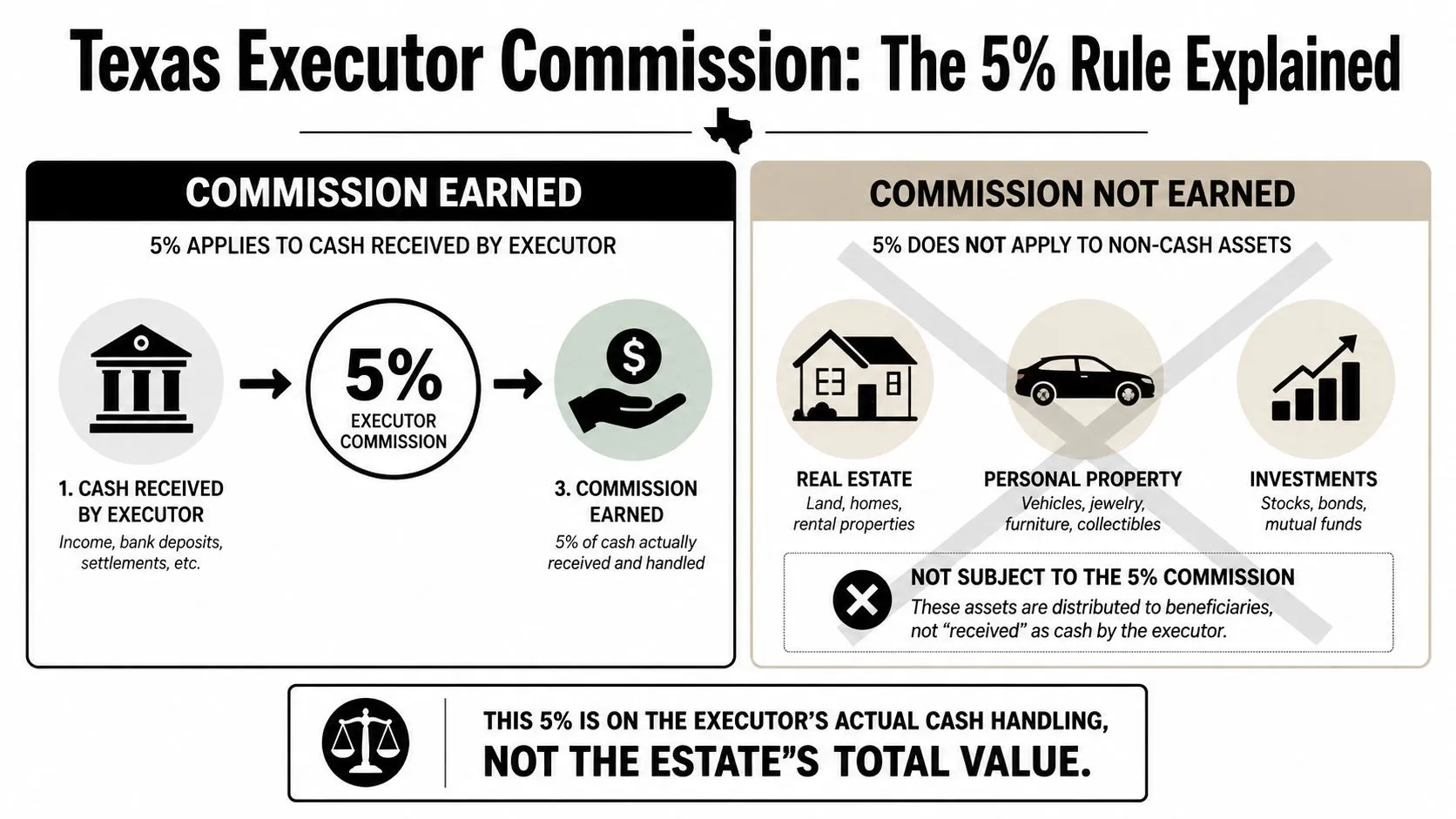
Texas sets executor pay at 5% of cash received and 5% of cash paid out during administration. Cash already on hand at death, life insurance proceeds, and distributions to heirs are excluded, so the actual fee is often far smaller than 5% of the estate's headline value.
A few weeks after a parent's death, a Texas family may sit around the kitchen table with a will, bank statements, and a growing stack of bills. One sibling has agreed to serve as executor, and another finally asks the uncomfortable question: “Are you getting paid for this?”
That question isn't selfish. Probate involves collecting property, paying valid debts, keeping records, communicating with beneficiaries, and following court requirements while the family is grieving. Texas law does allow compensation, but the phrase “5% executor commission” can create the wrong impression. The calculation usually isn't 5% of everything the decedent owned.
The executor's work and legal responsibilities are outlined in resources such as what an executor must do during Texas probate. The fee question depends on what money moves through estate administration, which assets bypass probate, what the will says, and whether the court approves the requested amount.
What Texas Families Usually Ask First About Executor Pay
Texas Estates Code § 352.002 generally provides a 5% commission on cash the executor receives and another 5% commission on cash the executor pays out while administering the estate. The statute doesn't treat the estate's total value as the commission base. Texas Estates Code § 352.002 also excludes several important categories, including cash already held in bank or brokerage accounts at death, life insurance proceeds, and cash distributions to heirs or legatees.
That distinction matters at the kitchen table. Suppose a parent owned a home, a retirement account with a named beneficiary, a life insurance policy, and money already sitting in a checking account. The family might describe the estate as large, but much of that property may not create a commission under the statutory formula.
Practical rule: Start with the transactions, not the headline value of the estate.
The executor may receive a commission on money collected for the estate, such as proceeds from selling estate property, and on qualifying estate expenses the executor pays. However, transferring an account that was already in the decedent's name at death, or distributing inherited cash to a beneficiary, doesn't automatically create another commissionable transaction.
Families commonly ask four follow-up questions:
- Is the payment automatic? No. The court must determine that the executor complied with the Estates Code, and compensation can be adjusted in appropriate circumstances.
- Can the executor waive the fee? Yes, an executor may choose not to claim compensation, often to avoid tension among heirs.
- Does the will control? The will may address compensation differently, so it must be reviewed alongside the statute.
- What happens in independent administration? The executor may have less routine court supervision, but the commission still needs to be calculated and properly claimed.
The math becomes manageable once each receipt and payment is classified. The important question isn't “What was the estate worth?” It's “What qualifying cash did the executor handle during administration?”
How Texas Estates Code §352.002 Calculates the Commission
Section 352.002 uses a two-sided calculation. The first side concerns cash received by the personal representative. The second concerns cash paid out during estate administration. A personal representative is the person appointed to manage the estate, whether called an executor under a will or an administrator when there's no will.
The statute provides the basic framework for this commission, subject to its exclusions and the court's review. The Texas Estates Code provisions governing executor compensation should be read with the specific estate's administration method and court filings in mind.
The cash received side
Qualifying receipts can include money collected after death for the estate. Examples may include:
- Sale proceeds: If the executor sells an estate-owned vehicle or house and receives the proceeds, that cash may enter the commission calculation.
- Rents and royalties: Income collected after death for estate property can be part of the receipts.
- Post-death income: Money received during administration, such as income owed to the estate, may qualify depending on the circumstances.
A simple example shows the arithmetic. If $50,000 in sale proceeds comes in, the receipt-side commission is $2,500, calculated as 5% of $50,000. The payment side is calculated separately.
The cash paid-out side
The executor may also calculate 5% on qualifying cash paid during administration. These payments can include estate debts, taxes, bills, and administration expenses. However, cash distributions to heirs or legatees are excluded, so handing beneficiaries their inheritance doesn't create an additional commission under the ordinary statutory formula.
Several assets also sit outside the usual commission base:
- Cash already on hand at death, including funds in a bank or brokerage account at the date of death.
- Life insurance proceeds payable directly to named beneficiaries.
- Retirement accounts passing to named beneficiaries outside probate.
- Property transferred in kind, such as a house or personal property delivered without a cash sale.
The statute also places a cap of 5% of the gross fair market value of the estate subject to administration. That cap doesn't turn the entire estate into the commission base. It limits the total compensation that can be allowed under the statutory framework.
For a broader look at the work involved, An Executor's Duties in a Texas Probate describes what an executor must do to administer the estate properly. The will may provide different compensation, and independent and dependent administration can affect how the executor presents and seeks approval for the fee.
Three Sample Estates and the Fees They Actually Produce
The clearest way to understand executor commission Texas how much is to work through different asset mixes. The following examples use the statutory categories described above. They're illustrations of the calculation, not predictions of what a court will approve in a particular case.
Estate A, mostly cash already held at death
Assume the estate is described as having a headline value of $200,000. Most of that amount is a bank account held at death, so it's excluded. The executor sells a car for $15,000 and pays $8,000 in final bills.
Running calculation:
- Qualifying cash received: $15,000
- Receipt commission: 5% of $15,000 = $750
- Qualifying cash paid out: $8,000
- Payment commission: 5% of $8,000 = $400
- Approximate total commission: $1,150
The result is roughly $1,150, not $10,000, because the bank balance already existed at death and doesn't become commissionable merely because the executor accesses it.
Estate B, a house sale and post-death income
Assume a $600,000 estate includes a house sold through the executor for $350,000, investment income received during administration of $12,000, and $40,000 in qualifying debts and administration expenses paid by the executor.
Running calculation:
- Qualifying cash received from house sale: $350,000
- Post-death investment income received: $12,000
- Total qualifying receipts: $362,000
- Receipt commission: 5% of $362,000 = $18,100
- Qualifying cash paid out: $40,000
- Payment commission: 5% of $40,000 = $2,000
- Approximate combined commission: $20,100
This estate produces a larger fee because a substantial asset was converted into cash and the executor handled post-death income. The estate's remaining value still matters for the statutory cap, but the transaction base drives the running calculation.
Estate C, a large estate that mostly bypasses probate
Assume a $1.5 million estate is mostly life insurance, retirement accounts passing to beneficiaries, and cash already on hand at death. Those categories generally don't create a statutory commission base. If the executor collects $20,000 from a small estate-owned asset sale and pays $10,000 in qualifying administration expenses, the calculation would be:
- Qualifying cash received: $20,000
- Receipt commission: $1,000
- Qualifying cash paid out: $10,000
- Payment commission: $500
- Approximate total commission: $1,500
| Estate Profile | Headline Estate Value | Qualifying Cash Received | Qualifying Cash Paid Out | Actual 5% Commission |
|---|---|---|---|---|
| Estate A, bank funds and car sale | $200,000 | $15,000 | $8,000 | $1,150 |
| Estate B, house sale and income | $600,000 | $362,000 | $40,000 | $20,100 |
| Estate C, mostly non-probate assets | $1.5 million | $20,000 | $10,000 | $1,500 |
In an independent administration, the executor may handle more matters without obtaining advance court orders, but that doesn't eliminate the need for accurate records. Keep sale documents, deposit records, invoices, checks, and a clear explanation of each commissionable transaction.
When the Court Can Lower or Deny an Executor Commission
The statutory calculation isn't a guaranteed paycheck. Texas Estates Code § 352.004 permits the court to wholly or partly deny an otherwise allowed commission if the executor didn't prudently care for and manage estate property or was removed under the applicable statute. The Texas State Law Library also explains that compensation is paid from estate funds, counts as taxable income, and may be increased or reduced by the court based on the circumstances. See the Texas State Law Library's executor guidance for that broader explanation.
A probate judge may examine conduct such as:
- Unexplained delays: The executor allows administration to stall without a reasonable explanation.
- Missing records: Required inventories, accountings, or supporting documents aren't timely or complete.
- Commingled funds: Estate money is mixed with the executor's personal account.
- Unauthorized sales: Property is sold without required authority or court approval.
- Neglected claims: Creditor matters are ignored instead of being evaluated and handled.
- Self-dealing: The executor uses the position to benefit personally at the expense of the estate or beneficiaries.
Consider an executor managing an estate valued at $400,000 who lets the estate sit untouched for two years, ignores repeated attorney demand letters, and then requests the full statutory commission. The court could reduce the fee substantially or deny it altogether if the evidence shows a failure to prudently manage the estate. The exact result would depend on the record and the judge's findings.

For executors: Good records protect more than the accounting. They help show the court that you acted carefully, followed instructions, and treated every beneficiary fairly.
Reductions are fact-specific. Beneficiaries who believe an executor mishandled property should preserve communications and account statements, while executors should avoid waiting until the end of probate to reconstruct years of transactions.
Requesting, Waiving, or Disputing the Commission in Probate Court
An executor generally claims compensation through the estate's accounting rather than by taking money from an estate account. The accounting should identify the receipts and payments, separate excluded items, show the applicable calculation under § 352.002, and state the requested commission as its own line item.
How the claim usually moves forward
The practical sequence often looks like this:
- Prepare the account. Gather bank records, closing statements, invoices, checks, and documentation for estate transactions.
- Classify each transaction. Separate qualifying cash receipts and payments from excluded cash, direct beneficiary proceeds, and non-cash transfers.
- State the commission. Show the receipt-side and payment-side calculations instead of presenting one unexplained number.
- File the account. Submit the accounting through the appropriate probate court process.
- Wait for approval. The judge may approve, reduce, or deny the requested fee after considering the accounting and any objections.
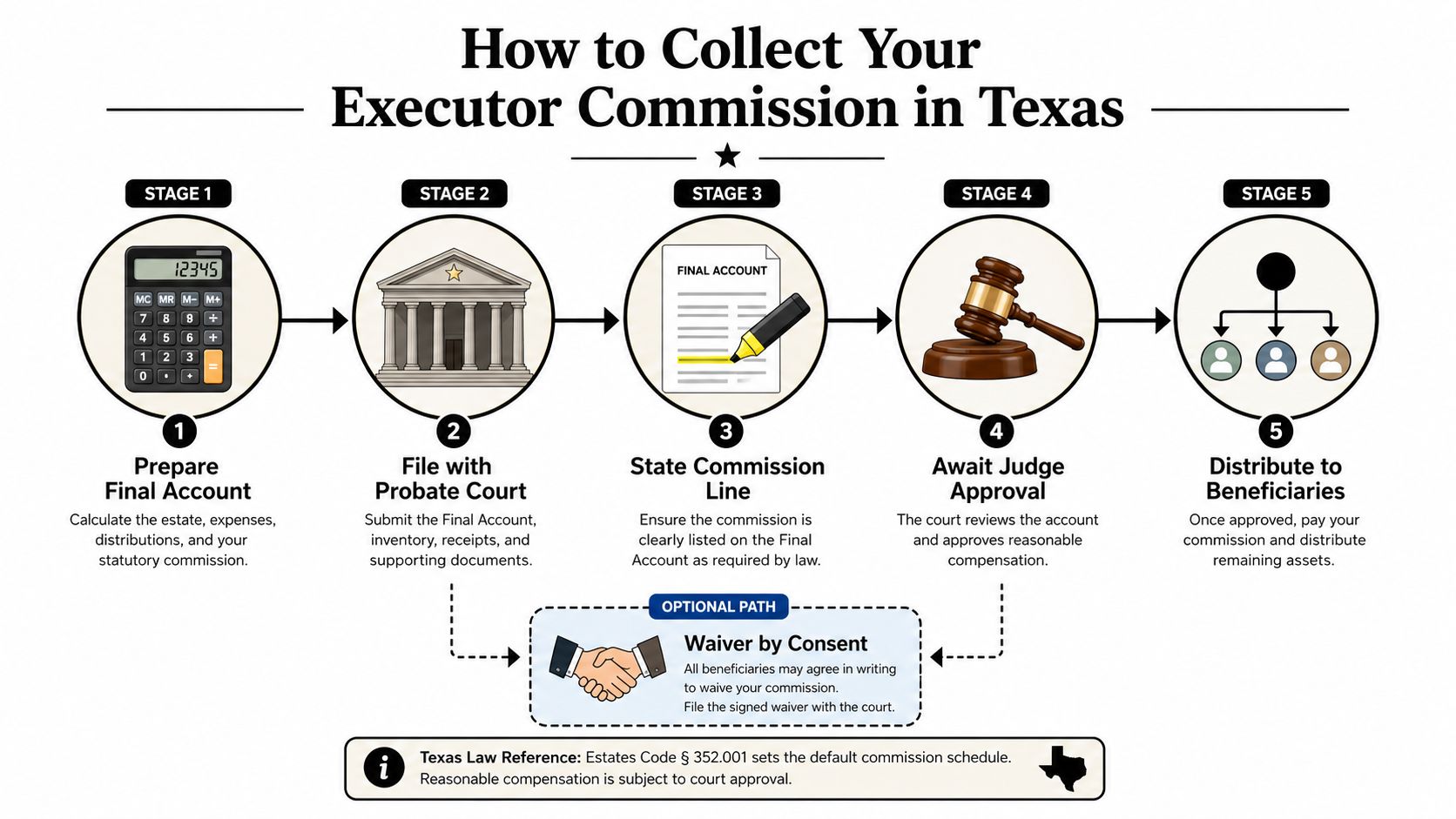
An executor who wants to waive compensation can sign a written waiver, including one in an application or sworn affidavit when appropriate. A sole heir may waive the fee because the executor and beneficiary are effectively on the same side financially, while another executor may waive it to preserve family harmony. The waiver should be clear, intentional, and presented for court approval.
An interested party who disputes the fee can file a written objection to the accounting within the applicable statutory period. That objection can require the executor to explain each receipt, payment, exclusion, and calculation. The judge may then approve the requested amount, reduce it, or deny it.
Before filing, an executor should consider giving heirs an informal explanation of the proposed commission. That conversation doesn't replace court approval, but it can prevent a surprise and identify questions while records are still easy to review.
How Executor Commissions Interact With Attorney Fees
Families often look at the executor commission and attorney bill as if they're competing versions of the same expense. They aren't. The executor commission compensates the personal representative for qualifying cash handling, while legal fees pay the attorney for probate advice, filings, court work, and administration support.
Texas probate attorneys may use a flat fee based on estate complexity or an hourly arrangement. The verified guidance for this topic identifies flat-fee arrangements that may range from $3,000 to $8,000 for an independent administration and hourly rates of $250 to $450. Those figures are not universal quotes, and families should ask what services and expenses the engagement covers. A discussion of Texas probate attorney fees can help frame the questions.
Attorney fees and court costs are administration expenses paid from the estate before the executor calculates a commission on qualifying cash handled. That means the family should review both cost lines together, while remembering that the commission base still depends on qualifying receipts and payments, not solely on the balance remaining after bills.
| Cost Element | Executor Commission | Texas Probate Attorney Fee |
|---|---|---|
| Purpose | Compensates the executor for qualifying estate cash received and paid out | Pays for legal advice, filings, court work, and administration support |
| Basic structure | Statutory 5% calculation, subject to exclusions, cap, and court review | Flat fee or hourly arrangement, depending on the engagement |
| Payment source | Estate funds, after the claim is properly presented and approved | Estate funds when properly incurred and approved |
| Main concern | Whether each transaction belongs in the commission base | What services, court work, and expenses the fee includes |
In a modest estate, the attorney fee can exceed the executor commission. That outcome surprises families who heard “5%” and assumed the executor would receive the largest cost allocation.
For attorneys and law firms evaluating client communication and public-facing professionalism, TheBestReputation for legal professionals offers a separate resource on online reputation management. It doesn't replace careful fee disclosures, engagement terms, or probate accounting.
Key Takeaways and Your Next Step
Takeaway
The central rule is simple, but the categories require care:
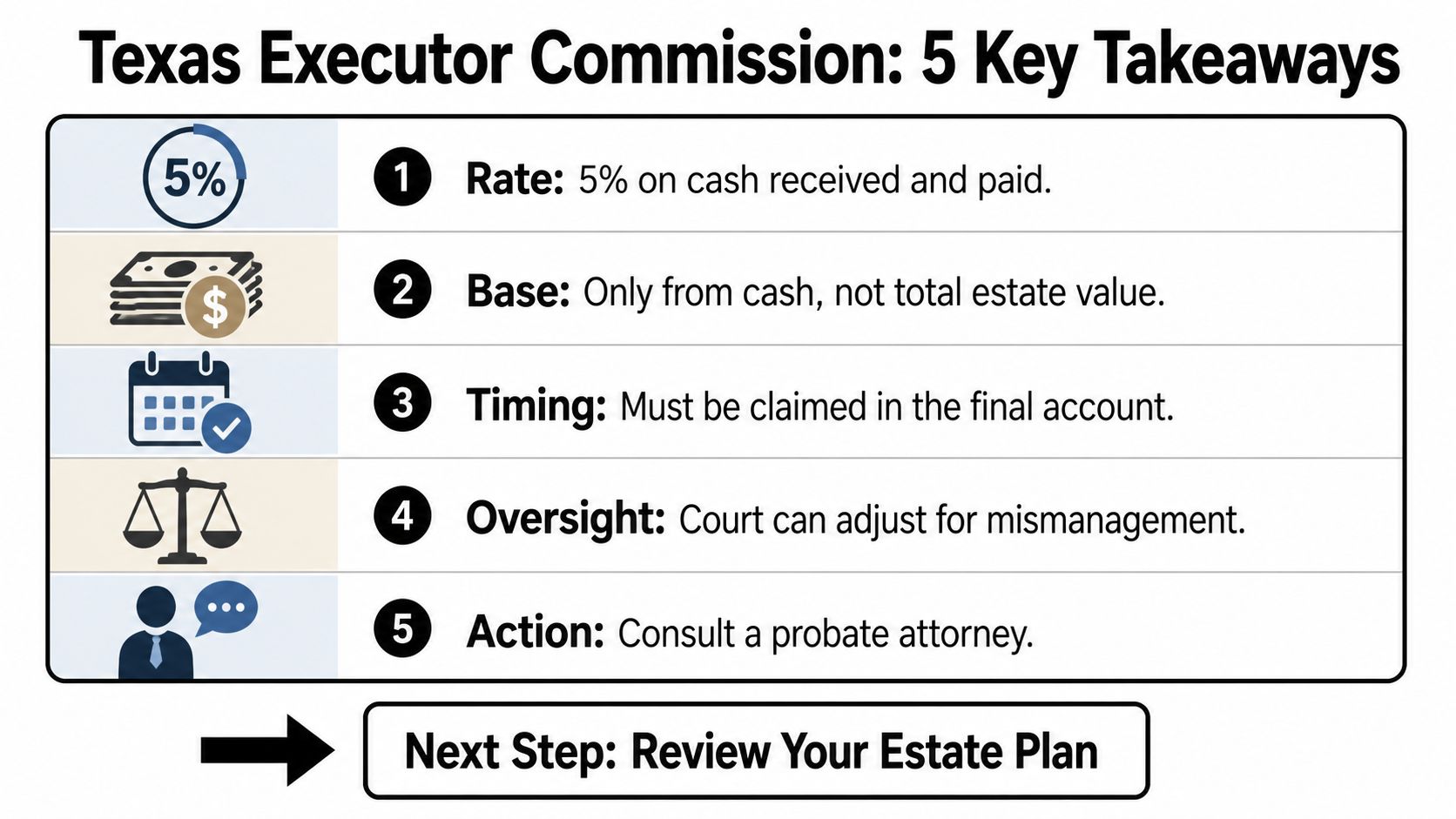
- The rate is transaction-based. Texas generally applies 5% to qualifying cash received and 5% to qualifying cash paid out, rather than to the estate's full headline value. See Section 352.002 of the Texas Estates Code.
- The base can shrink quickly. Life insurance paid to named beneficiaries, retirement accounts passing outside probate, real property transferred without a sale, and cash already held at death may not increase the statutory commission base.
- Court oversight matters. Section 352.004 allows the court to reduce or deny compensation when the executor fails to prudently care for estate property or is removed.
- Attorney fees are separate. Legal fees and court costs are administration expenses, and in modest estates the attorney's fee may exceed the executor's commission.
- Timing protects everyone. An executor who wants compensation should present a clear calculation in the accounting. An heir who objects should act promptly under the applicable probate procedure. A waiver should be written and submitted for approval.
Before anyone claims or contests a fee, gather the will, bank and brokerage statements, insurance and retirement beneficiary information, sale documents, bills, and probate filings. A Texas probate attorney can review which assets belong in the calculation, identify excluded transactions, check the statutory cap, and explain whether independent or dependent administration changes the filing path.
If you're trying to resolve a disagreement, legal guidance can also help protect the estate from unnecessary conflict. The Law Office of Bryan Fagan, PLLC helps Texas families with probate administration, estate accounting, executor questions, and disputes involving estate property. Contact the firm to schedule a free consultation and discuss the likely commission before money is withdrawn or an objection is filed.
If you're facing probate in Texas, our team can help guide you through every step, from filing to final distribution. Schedule your free consultation today.


