 Skip to content
When a loved one dies, the mailbox can become a second source of grief. A funeral home invoice may arrive beside a hospital statement, a credit card demand, and a lender's notice, all asking the executor to act quickly. If you're responsible for the estate, you may wonder whether every bill must be paid immediately and whether the family could become personally responsible.
Texas probate law provides an organized answer. Texas Estates Code § 355.102 creates an eight-tier priority system for creditor claims, so debts aren't paid in the order they arrive. The statute helps preserve estate funds, identifies which claims receive attention first, and determines what may remain unpaid when the estate doesn't have enough money.
A useful starting point is the Texas probate creditor claims process, but families should also remember that the correct classification can depend on the documents, liens, timing, and facts of the individual estate. For general background on preparing for obligations after death, families may also find value in planning for debt with Coveredly.
Understanding Creditor Claims in Texas Probate
Suppose Elena becomes executor after her father's death. She has a funeral bill, a final medical invoice, estate-related expenses, and several ordinary debts. One creditor calls repeatedly and insists on immediate payment. Another sends a form that looks official. Elena feels pressure to pay whoever appears most urgent, but urgency isn't the same as legal priority.
Under Texas Estates Code § 355.102, the probate court uses a statutory order to evaluate claims against the estate. Not all debts carry the same legal status. A funeral expense, an administration cost, a debt secured by collateral, a tax claim, and a credit card balance may all be valid obligations, but they don't necessarily stand in the same place in the payment queue.
The statute's purpose is practical. Probate administration requires someone to collect property, identify obligations, protect estate assets, and distribute what remains. If the estate has limited cash, paying one claim can leave nothing for another claim that the law places ahead of it.
Practical rule: Don't promise payment because a creditor calls first. Preserve the bill, identify the type of claim, and review its priority before sending money.
Families often confuse two separate questions. First, does the estate owe the debt? Second, if it does, where does that debt rank under the statute? A claim can be legitimate and still receive only partial payment, or no payment, if higher-priority claims consume the available estate assets.
That distinction can feel harsh during an already painful time, but it protects the estate from arbitrary decision-making. The executor isn't supposed to choose the creditor who sounds most persuasive. The executor must apply the law, maintain records, and avoid distributing property until valid claims have been addressed.
The Eight Priority Classes for Estate Debts
Texas Estates Code § 355.102 organizes creditor claims into eight classes. The ladder is easier to understand when each class is translated into ordinary language.
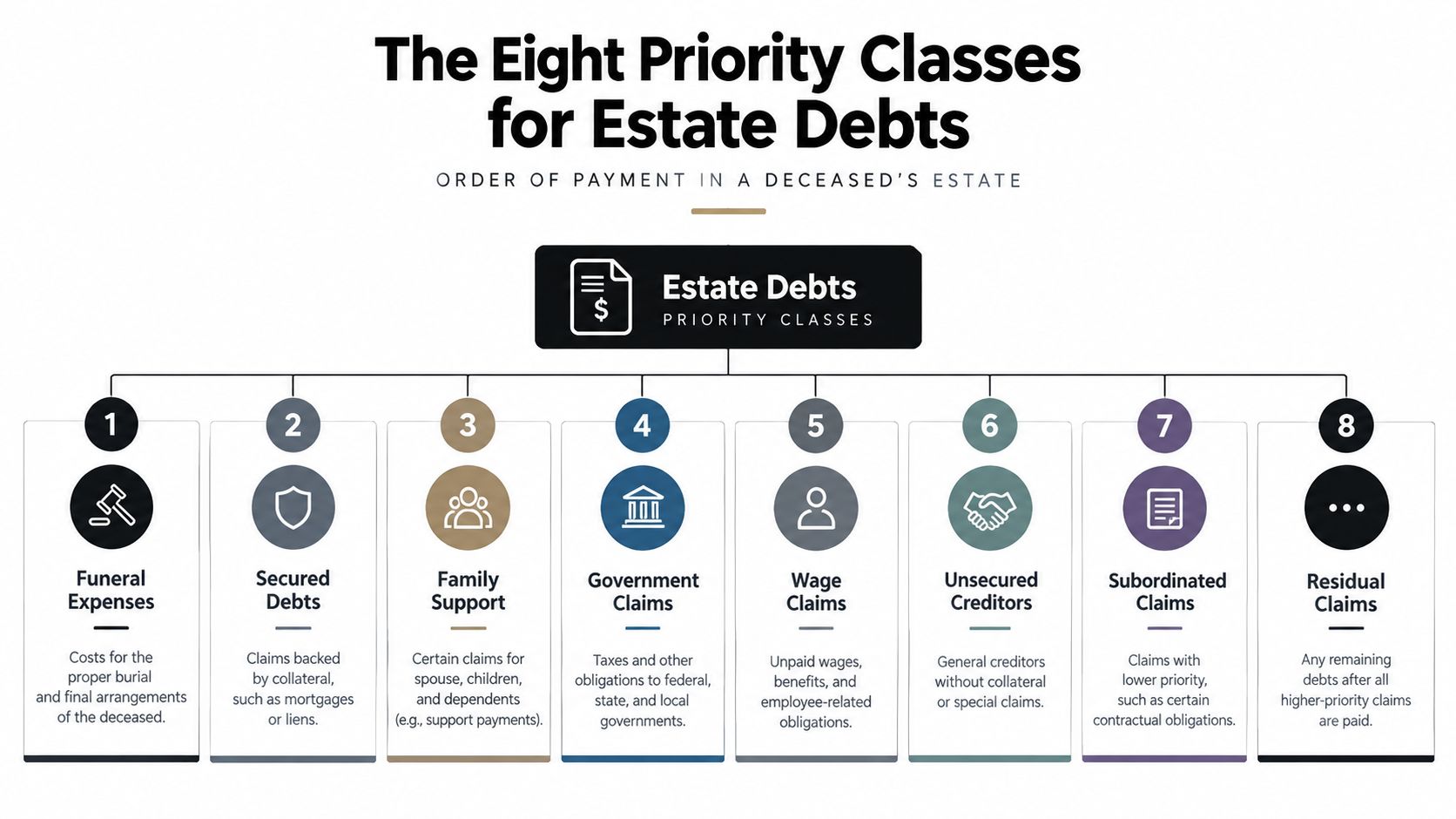
Classes one through three
Class 1 covers funeral expenses and the decedent's last illness. These costs receive the highest statutory priority, but only within the limits discussed below. Funeral costs include reasonable expenses connected with final arrangements. Last-illness expenses concern care associated with the decedent's final illness.
Class 2 covers administration and estate-preservation expenses. These are costs required to manage, protect, and settle the estate. The category exists because the estate needs administration before anyone can properly evaluate claims or distribute assets.
Class 3 covers secured claims for money, including tax liens, to the extent paid from collateral. A secured claim is tied to specific property, such as a vehicle or real estate. The creditor's rights depend on the lien and the collateral, so this claim doesn't operate like an ordinary credit card balance against general estate funds.
Classes four through eight
Class 4 covers child support claims. These obligations receive priority because they represent legally enforceable support owed to a child.
Class 5 covers certain state and federal tax claims. Tax obligations can have special legal treatment and shouldn't be lumped together with ordinary consumer debt.
Class 6 covers confinement costs. This category concerns qualifying costs associated with the decedent's confinement.
Class 7 covers medical assistance repayment claims. These claims can arise from assistance programs and require careful review of the applicable records and legal basis.
Class 8 includes all remaining claims. Credit card balances, many personal loans, and other ordinary unsecured obligations generally fall toward the bottom when they don't fit within a higher class.
| General class | Plain-English meaning |
|---|---|
| Class 1 | Funeral and last-illness expenses, subject to statutory limits |
| Class 2 | Administration and preservation of the estate |
| Class 3 | Secured claims paid from collateral |
| Class 4 | Child support claims |
| Class 5 | Certain state and federal taxes |
| Class 6 | Confinement costs |
| Class 7 | Medical assistance repayment |
| Class 8 | Remaining claims, including ordinary unsecured debts |
This framework is the central subject of Handling Creditor Claims in Texas Probate, which addresses how estate debts are handled before assets are distributed. The important point is that classification comes before payment. An executor should look at the legal source of the debt, whether collateral exists, and whether the claim belongs in a specific statutory category.
How the Statutory Caps and Waterfall Effect Work
The most easily missed feature of Class 1 is that qualifying funeral and last-illness expenses aren't automatically paid in full at the top of the ladder. Texas Estates Code § 355.102 limits the Class 1 treatment to a court-approved reasonable amount, with a statutory ceiling of $15,000 for funeral expenses and $15,000 for last-illness expenses. The statutory text is available through Texas Public Law's version of Section 355.102.
The cap creates what many families experience as a waterfall effect. A bill may begin partly in Class 1, but the amount above the permitted Class 1 limit moves down and is treated as an ordinary unsecured claim. That excess no longer stands at the top of the payment line.
A hospice bill example
Consider a hospice bill of $20,000. If the bill qualifies as a last-illness expense, the executor shouldn't assume that every dollar receives Class 1 priority.
The analysis works like this:
- The executor identifies the bill as a possible last-illness claim.
- The court-approved amount is compared with the statutory Class 1 ceiling.
- Up to $15,000 may receive Class 1 treatment, assuming the amount is reasonable and otherwise qualifies.
- The remaining $5,000 is treated as an ordinary unsecured claim.
- That remaining amount is paid only after the higher classes have been addressed and only if estate assets remain.
The same principle applies to funeral expenses. A funeral invoice can be valid without every dollar receiving first priority. Executors should review the invoice, supporting records, and estate solvency before promising full reimbursement.
Protect the estate's cash: Classifying a bill correctly is a payment decision. Paying the entire amount too early can reduce funds available for administration costs and expose the executor to a dispute.
The cap also prevents a high final bill from automatically exhausting estate liquidity ahead of other legally protected claims. An executor should therefore maintain separate accounting for the portion treated as Class 1 and any excess that falls into the final unsecured category.
Common Misconceptions About Exemptions and Unsecured Debts
Texas families often hear that exemption laws protect certain property from unsecured creditors. That information can be helpful, but it doesn't mean every estate obligation disappears. Exempt property rules and creditor priority rules address different legal questions.
An exemption generally concerns whether particular property is protected from certain unsecured claims. Section 355.102 concerns how claims against the estate are classified and paid. Administration expenses may still need attention, and a perfected lien may give a secured creditor rights connected to specific collateral.
Why a credit card isn't the same as a mortgage
A credit card balance is usually unsecured. The creditor doesn't hold a lien on a particular estate asset just because the decedent used the card. Its recovery generally depends on the estate's available assets and the claim's place in the statutory hierarchy.
A mortgage lender operates differently because the debt is connected to collateral. If the estate retains the property, the lien may continue to affect that property. The executor must review the loan documents, the lien, the property's status, and the estate's administration strategy instead of treating the mortgage as another ordinary invoice.
Texas Law Help explains that exemptions can protect assets from unsecured debts such as credit cards and medical bills. That protection doesn't erase administration expenses or every secured claim, and families should review the specific property and debt rather than rely on a broad statement about “protected assets.” The Texas Law Help discussion of debts and deceased relatives provides plain-language background on this distinction.
Questions to ask about any bill
When a statement arrives, ask:
- Who is the creditor? Is it a medical provider, lender, taxing authority, or collection company?
- What supports the claim? Look for an invoice, contract, account history, or lien documentation.
- Is collateral involved? A secured claim may affect a particular asset differently from an unsecured debt.
- Where does the claim fit? Classification determines whether it stands above or below other obligations.
Heirs generally shouldn't use personal funds to pay estate debts merely because a collector demands payment. If a family member co-signed, jointly borrowed, or separately guaranteed an obligation, the analysis may differ. That's one reason an executor should obtain legal advice before signing a payment agreement or transferring estate property.
Executor Responsibilities and Critical Filing Deadlines
An executor's work is less about reacting to individual letters and more about creating a controlled process. The personal representative should identify estate assets, gather creditor information, preserve records, and evaluate claims before making distributions.
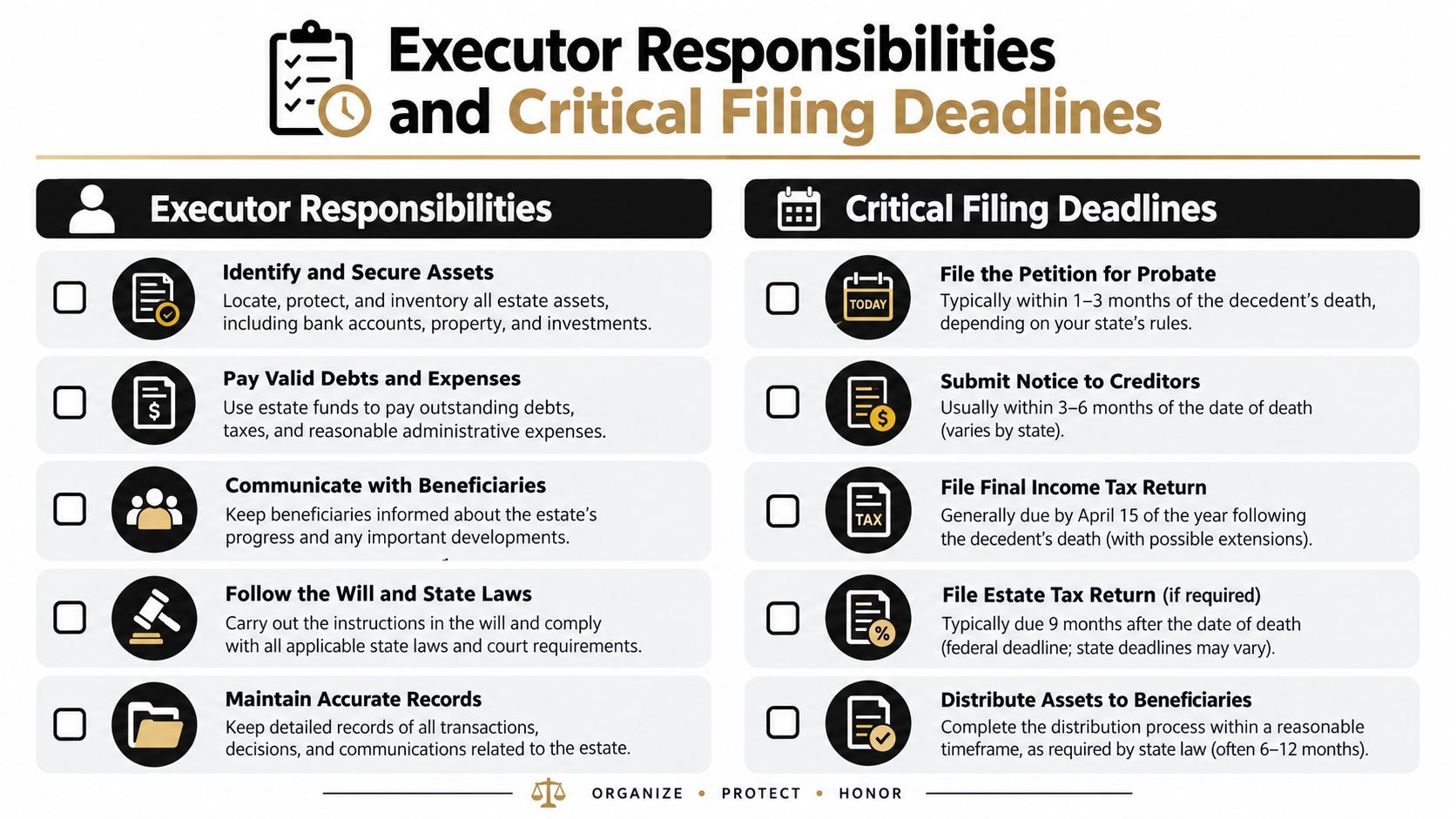
A practical administration sequence
Open the probate estate. The executor or administrator receives authority through the probate process. The exact procedure depends on the will, estate structure, and whether the administration is independent or dependent.
Collect and protect records. Keep account statements, invoices, loan documents, tax notices, medical records, and funeral contracts together. Don't discard a bill because it appears confusing or repetitive.
Prepare the estate inventory. The executor needs a clear picture of estate property before deciding whether available funds can cover claims.
Provide required creditor notices. Notice requirements can vary based on the creditor and administration. Known creditors, secured lenders, and published notice procedures may involve different obligations.
Review and authenticate claims. A creditor's letter isn't automatically proof that the estate must pay the full amount. Check the identity of the creditor, the amount, the supporting documents, the timing, and the statutory class.
Approve, reject, or negotiate carefully. If a claim appears invalid, inflated, or improperly classified, the executor should respond through the appropriate legal process. A negotiated resolution should be documented and approved when court involvement is required.
Pay in statutory order. Record the class assigned to each payment and retain proof of payment. Don't allow a lower-priority creditor to move ahead merely because its demand is more aggressive.
Delay final distribution until debts are resolved. Distributing property too soon can leave the estate unable to satisfy a valid higher-priority claim.
Keep a claims log: Record the creditor, amount, proposed class, notice date, supporting documents, response, and payment decision. Organization is part of protecting the executor.
The Texas Estates Code contains additional provisions governing administration, notices, and claims. Titles 2 and 3 may both matter depending on the estate's structure and the relief being requested. Because filing requirements and deadlines can depend on the type of administration and the creditor's status, an executor shouldn't copy a deadline from a different case without confirming that it applies.
Handling Disputes and Insolvent Estates
A family may discover that the estate cannot pay every valid bill after property, accounts, and other assets are gathered. The payment waterfall then determines who receives money first. Higher-priority claims can use the available cash, leaving lower-ranked creditors with partial recovery or no payment.
As noted above, Class 1 treatment is capped at $15,000 per category (see the waterfall analysis). Amounts above those limits fall into the ordinary unsecured category, so a funeral provider or medical creditor may receive priority for one portion of its bill while the remainder waits behind higher-ranking claims. The Texas Estates Code provision on creditor priority provides the statutory framework.
Where disputes commonly arise
Disagreements may involve whether a bill is connected to the last illness, whether a funeral expense is reasonable, whether a lien was perfected, or whether the creditor supplied adequate documentation. A creditor may seek a higher classification, while the executor must preserve funds for administration and claims that rank ahead of ordinary unsecured debt.
A demand made with urgency does not change the statutory order. The executor should preserve records, communicate in writing, and seek court guidance when the classification or authority to pay is uncertain. Families reviewing an insolvent estate can use this guide to insolvent estates in Texas probate to identify questions for counsel.
A measured response to collection pressure
Calls may reach relatives instead of the estate, especially during a period of grief. Heirs should avoid acknowledging personal responsibility, promising payment, or using personal funds before the executor evaluates the claim. Direct the creditor to the personal representative or probate counsel, and keep every letter, voicemail, and email.
If a claim is disputed, negotiation may help when assets are limited or classification remains uncertain. The agreement still must respect the statutory order. It should protect funds needed for higher-priority claims, state what the estate will pay, and remain in the estate file with the supporting documents. A careful record helps the executor explain each decision if another creditor or the court later questions the distribution.
Key Takeaways and Next Steps for Texas Families
The central lesson is simple: Texas probate debts must be classified before they're paid. Section 355.102 creates an eight-class structure, and Class 1 has a hidden limitation that many general priority charts fail to show. Funeral and last-illness expenses may receive top priority only within the statutory ceilings, while excess amounts fall to the ordinary unsecured category.
An executor can reduce confusion by following a steady process:
- Pause before paying. A demand letter doesn't establish priority or prove the full amount is owed.
- Separate collateral from ordinary debt. A lien-backed claim may affect a particular asset differently from a credit card balance.
- Track every document. Invoices, notices, contracts, lien records, and court filings can determine how a claim is treated.
- Protect estate liquidity. Administration costs and higher-priority claims must be considered before distributions.
- Ask for help early. A classification mistake can create financial and legal problems that are harder to fix later.
Families managing the broader Texas Probate Process may also need guidance on Wills & Trusts or Probate Litigation, particularly when the will, ownership of property, or validity of a creditor claim is contested. The Law Office of Bryan Fagan, PLLC helps Texas families address probate administration, estate planning, and disputes through a structured legal process.
Key insight: The estate's payment order is not based on who calls first. It's based on statutory classification, documentation, available assets, and the rules governing the specific administration.
If you're facing probate in Texas, our team can help guide you through every step, from filing to final distribution. Schedule your free consultation today.
The Law Office of Bryan Fagan, PLLC can help review creditor claims, classify debts under Texas law, organize notices and filings, and protect the estate from premature distributions. Contact the firm to discuss your estate's circumstances and schedule a free consultation.


