 Skip to content
Texas law guarantees a one-year family allowance for surviving spouses and children from estate assets before most creditors are paid. Estates Code §353.101 gives eligible family members a legal path to support based on actual need, not a fixed statutory dollar limit.
A death can leave a family facing an immediate cash-flow crisis while the estate remains tied up in probate. The mortgage, utilities, groceries, transportation, medical care, and children's expenses don't pause because a loved one has died. The family allowance is designed to help bridge that gap during the first year after death.
Understanding Immediate Financial Needs After Death
Maria's husband dies unexpectedly in Texas. His paycheck stops, but the family's household expenses continue. The mortgage remains due, the electric bill arrives, the children still need food and transportation, and one bank account is held only in his name. Maria may know that the estate should eventually provide financial support, yet she needs money during the period when the estate is being identified and administered.
That is the practical problem Texas Estates Code §353.101 addresses. The family allowance gives a surviving spouse, minor children, and adult incapacitated children a way to request support from estate assets during the transition after death. It isn't an inheritance advance based on generosity. It is a statutory probate protection intended to preserve basic maintenance while the estate is being handled.

Why probate timing creates hardship
Probate administration involves identifying property, determining which assets belong to the estate, reviewing claims, and arranging lawful distribution. Some funds may be accessible, while others require court authority or additional documentation. Even an executor who is acting carefully may need time to establish what the estate owns and what it owes.
Families often need help quickly when ordinary income has disappeared or estate accounts are temporarily unavailable. A request for emergency probate situations requiring immediate court action may be appropriate when delay threatens housing, utilities, food, or other essential needs.
Practical point: The family allowance is about continuity. It helps qualified family members maintain a reasonable standard of support while probate moves forward.
The allowance covers maintenance for one year from the date of death, and the court evaluates the circumstances surrounding the family's needs. The amount isn't automatically the same in every estate. A family with limited separate resources may present a stronger request than a family with substantial property already available for support.
Families should also understand that the allowance doesn't replace other rights. A surviving spouse may have separate community-property, homestead, exempt-property, or inheritance rights. Those issues require their own analysis, but the family allowance directly addresses the immediate need for living support.
What Texas Estates Code Section 353.101 Actually Says
Section 353.101 uses mandatory language. Once the estate's inventory, appraisement, and list of claims are approved, or once an affidavit in lieu of inventory is filed, the probate court “shall fix” a family allowance for the surviving spouse, minor children, and adult incapacitated children. In plain English, the court must determine an allowance when the statutory conditions are met.
The statute also permits an earlier request. An applicant can file an application and verified affidavit before the inventory is approved, but the applicant must show the amount needed for one year of support. The applicant carries the burden of proving that amount by a preponderance of the evidence, meaning the evidence must show that the requested amount is more likely than not supported by the family's circumstances. These requirements appear in Texas Estates Code Chapter 353.
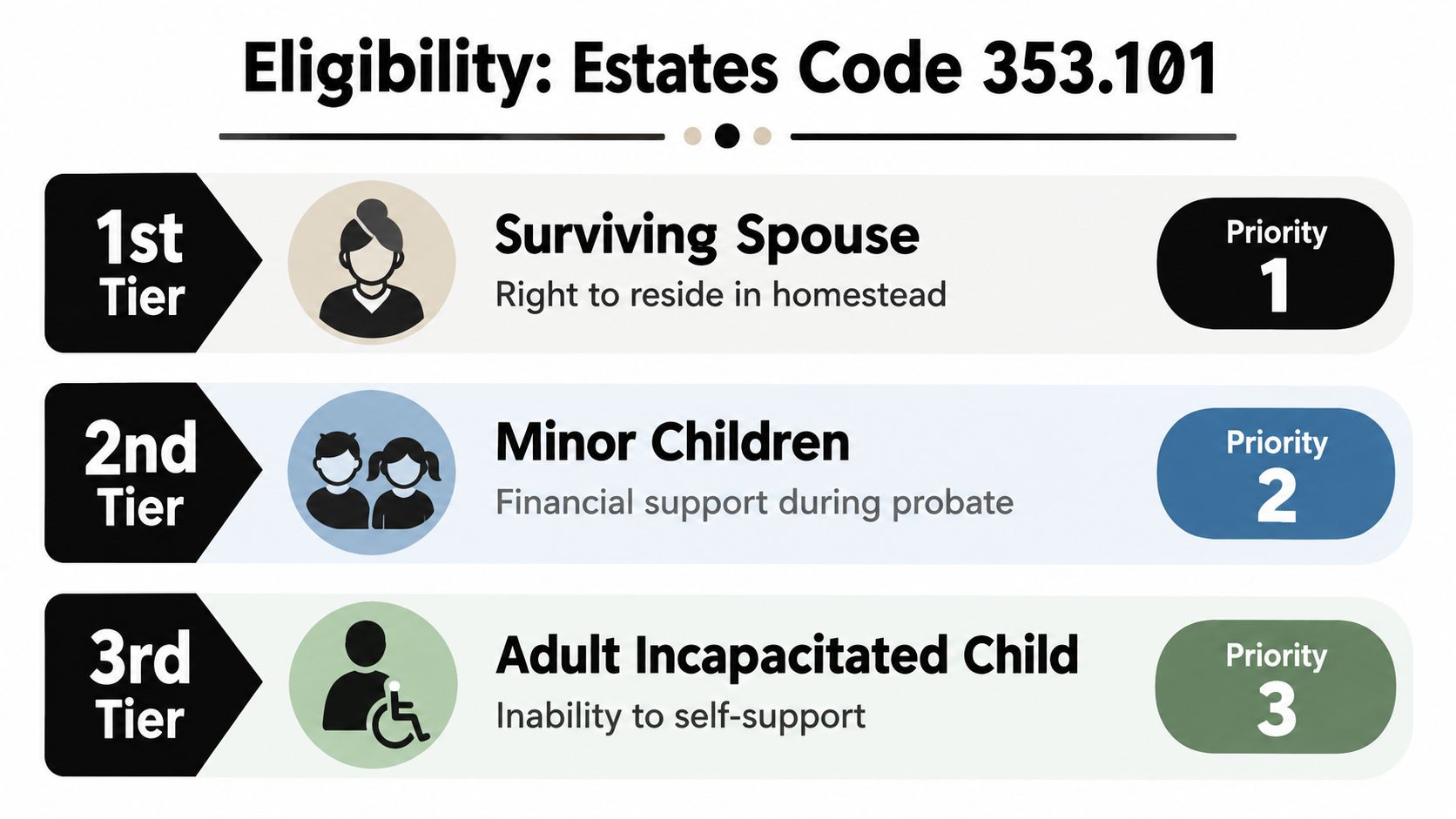
Who may qualify
The protected family members are:
- Surviving spouse: A spouse who survived the decedent and needs support from the estate.
- Minor children: Children who require maintenance during the probate period.
- Adult incapacitated children: Adult children whose condition prevents them from supporting themselves.
The court doesn't treat the allowance as an automatic payment just because someone falls within one of these categories. Separate property and other available resources matter. If a spouse or child already has enough property to provide maintenance, the court may reduce or deny the request.
What the one-year standard means
The statute measures support from the date of death, not from the date the application is filed or the date the judge signs an order. The court considers facts existing at death and circumstances anticipated during the first year afterward. Section 353.102 reinforces that the allowance must be sufficient for maintenance for that one-year period.
A family allowance also isn't limited to a particular statutory dollar ceiling. The court looks at actual need, the estate's assets, and available separate property. A lawyer handling Texas probate representation and estate administration can help identify how those facts fit within the statute.
How to Request a Family Allowance in Texas Probate
The law provides a path, but the family must use the probate process correctly. A strong request connects the household's actual expenses to the support needed during the one-year period. General statements such as “we need help” may not give the court enough evidence to set an amount.
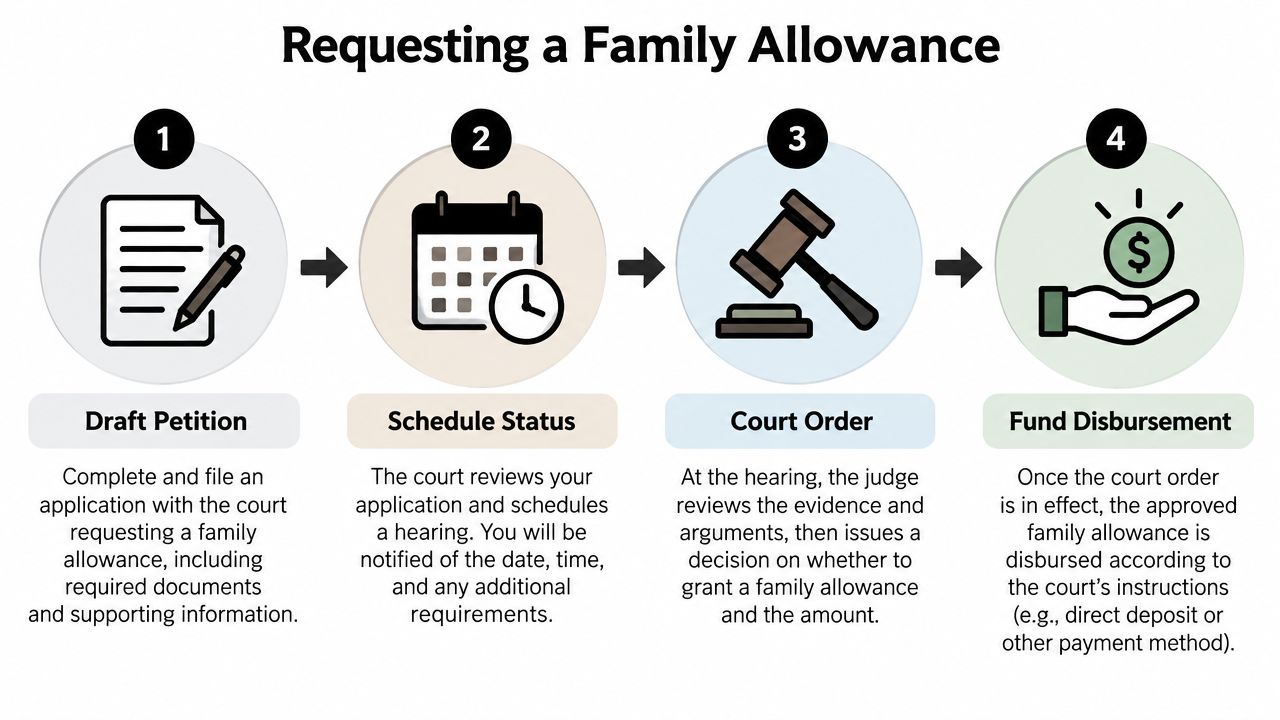
Step one, prepare the application and affidavit
The applicant generally begins by filing an application with the probate court handling the estate. A verified affidavit supports the request. “Verified” means the applicant swears that the facts provided are true to the best of the applicant's knowledge.
The affidavit should identify the family members seeking support, describe the household's maintenance needs, state the requested amount, and disclose separate property or other resources available to the applicant. The request should explain how the proposed amount relates to the family's needs during the first year after death.
Step two, assemble financial evidence
Documentation helps the court distinguish necessary maintenance from speculation. Useful materials may include:
- Household budget: Mortgage or rent, utilities, food, transportation, insurance, and recurring household expenses.
- Child-related costs: School needs, transportation, supervision, and ordinary care expenses.
- Medical information: Ongoing health-related expenses for a spouse or child.
- Separate-property records: Bank accounts, income, real estate, investments, or other resources owned independently of the estate.
- Estate information: Available probate assets and property that may affect the court's ability to fund the allowance.
The applicant must prove the requested support by a preponderance of the evidence. That burden makes accurate records important, particularly when the application is filed before the inventory has been approved.
Step three, prepare for the hearing
The judge may consider the application, affidavit, supporting records, objections, and testimony. The personal representative may need to provide information about estate assets and competing claims. A hearing gives the parties an opportunity to explain why the requested amount is or isn't supported.
The court may order payment as a lump sum or in installments. Installments can help match support with household cash flow, while a lump sum may address an urgent need or simplify administration.
Step four, follow the court's order
After the judge fixes the allowance, the personal representative should distribute funds exactly as ordered and keep appropriate estate records. If the request is denied or reduced, the family should review the stated reasons promptly. A revised evidentiary presentation or legal response may be possible depending on the procedural posture and the facts.
This educational video may also help families understand how probate court proceedings typically develop:
Family Allowance Versus Other Texas Probate Protections
Families often use the phrase “probate protection” to describe several different legal rights. These protections don't all do the same job. The family allowance provides support money, while homestead and exempt-property protections generally protect a home or essential personal belongings.
| Protection | Main purpose | What the court or law evaluates |
|---|---|---|
| Family allowance | Support for eligible family members during the first year after death | Actual maintenance needs, estate assets, and available separate property |
| Homestead protection | Protects the family's ability to occupy the homestead | Whether the property qualifies as the family homestead and who holds protected occupancy rights |
| Exempt property | Preserves certain necessities and household property | Whether property falls within applicable exemption categories |
| Spousal and inheritance rights | Determines ownership or inheritance of property | The will, intestacy rules, marital-property character, and other statutory rights |
The family allowance is therefore not a substitute for a homestead claim. A surviving spouse may need continuing occupancy of the home and access to funds for food, utilities, and transportation. The protections can work together, but each requires a separate legal analysis. Texas families can review the relationship between homestead and exempt-property protections through this resource on Estates Code 353 homestead and exempt property set-aside.
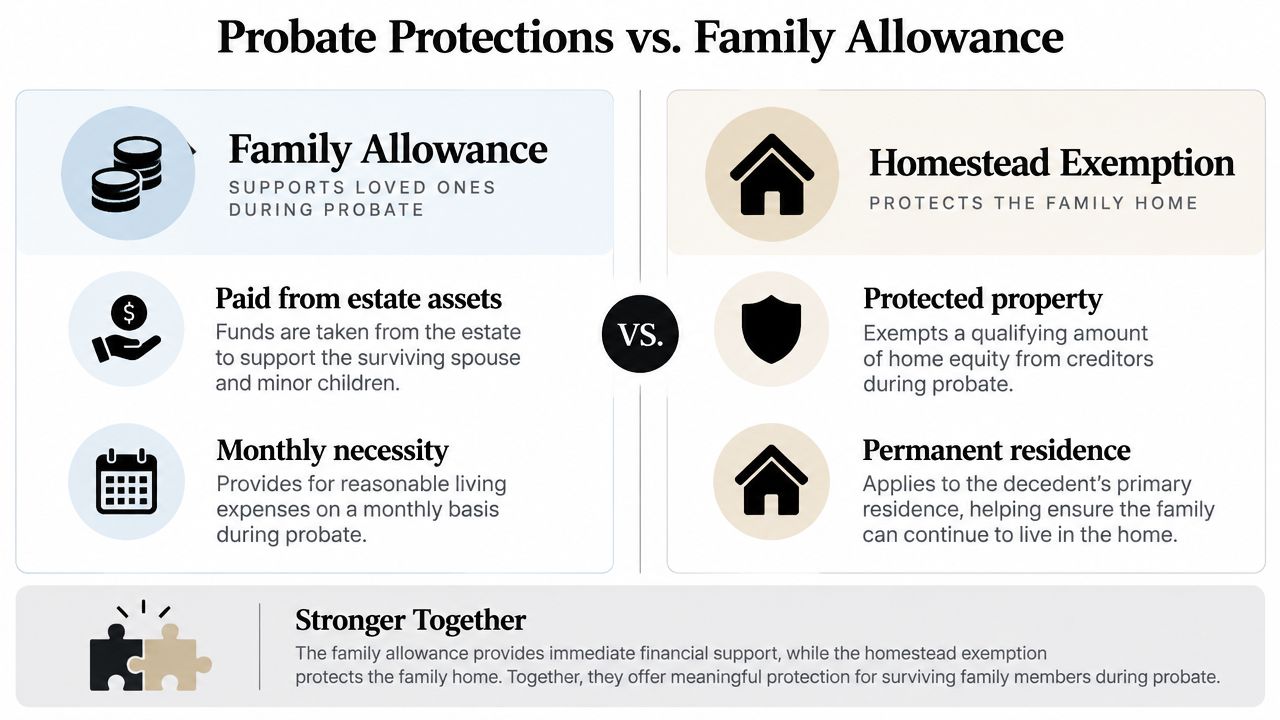
Payment priority matters
Texas gives the family allowance strong protection against ordinary creditor claims. It is generally paid ahead of ordinary debts, although funeral expenses and last-illness claims come first. The Texas State Law Library describes the allowance as having no statutory dollar limit while recognizing that a court may deny or reduce it when the applicant has sufficient property of their own. See the Library's explanation of Texas family protections in probate.
That priority can matter when an estate has limited liquidity. A family may need support before ordinary creditors receive payment, but the personal representative still must follow the statutory order and court instructions.
Don't confuse ownership with support
A surviving spouse's community-property interest is a separate question from the family allowance. Likewise, a homestead right concerns the home, not the household's full maintenance budget. A family allowance focuses on the cash-flow problem that arises when ordinary living expenses continue after the decedent's death.
How Courts Determine Reasonable Family Allowance Amounts
Texas law doesn't provide a fixed dollar cap for the family allowance. The judge must evaluate the family's actual needs, the decedent's estate, and the circumstances existing at death together with those reasonably anticipated during the first year. This fact-specific approach gives the court flexibility, but it also means applicants must present a credible financial picture.
The household budget is the foundation
A court may consider ordinary maintenance expenses such as housing, utilities, food, transportation, insurance, and necessary care. The analysis isn't limited to the surviving spouse's personal expenses when minor or adult incapacitated children also qualify. The applicant should show which expenses are recurring, which are necessary, and which are connected to the eligible family members.
A useful budget separates essential costs from discretionary spending. Bank statements, bills, insurance records, school records, and medical invoices can help show the family's real cash needs. The purpose isn't to make the family feel as though it must justify every meal. It is to give the judge reliable information for setting support.
Separate property can change the result
The existence of separate property is central. If the surviving spouse or children already have adequate resources for their maintenance, the court may reduce or deny the allowance. That doesn't mean every asset eliminates eligibility. The court must assess whether the property is sufficient to provide support during the relevant period.
Evidence matters more than an unsupported estimate. A clear budget, supported by records and explained in sworn testimony, gives the court a practical basis for decision-making.
Estate size and payment method
The estate's available assets also matter. A court cannot treat the allowance as independent of the estate's ability to pay. At the same time, the absence of a fixed statutory cap means the judge isn't applying an arbitrary preset maximum.
The court may order a lump sum or installments. Installments may be appropriate when the family needs predictable support or when the estate's assets become available over time. A lump sum may be useful when the family faces an immediate expense. The order should reflect both the family's needs and responsible estate administration.
Common Misconceptions About Family Allowance in Texas
Confusion often arises because people treat the family allowance like a standard benefit with a published payment schedule. Texas law works differently. The right is statutory, but the amount and outcome depend on evidence.
Misconception one, there is a fixed maximum
There is no fixed dollar limit in the statute. The Texas State Law Library explains that no law sets a limit on the allowance, while also noting that a court may reject or reduce a request when the applicant has enough separate property for maintenance. The absence of a cap doesn't mean every requested amount will be approved.
A realistic request should be tied to the household's documented needs and the estate's resources. A large request without supporting evidence may be less persuasive than a carefully explained budget.
Misconception two, only a surviving spouse qualifies
The statute also identifies minor children and adult incapacitated children as eligible family members. Their needs should be included when appropriate, especially if the surviving spouse is managing the household while caring for them.
Eligibility doesn't eliminate the need to prove support requirements. The court still considers available property and the facts surrounding the family's maintenance.
Misconception three, payment happens automatically
The court's duty to fix an allowance doesn't mean money appears without a probate filing. Before inventory approval, the family must submit an application and verified affidavit. The applicant must establish the amount needed for one year of maintenance by a preponderance of the evidence.
Misconception four, the allowance is a final inheritance
The family allowance serves a different purpose from final distribution. It supports eligible family members during the first year after death. The estate still requires administration, debt review, property transfers, and distribution under the will or Texas law.
A family allowance request is strongest when it is treated as a focused financial application, not as a general claim to the estate.
Real Example of Family Allowance in a Texas Estate
Consider a fictional Texas family. Daniel dies with a surviving spouse, Elena, and two minor children. Elena is responsible for the household while the estate's assets and obligations are being reviewed. Their normal expenses continue, but part of the estate's money isn't immediately available for ordinary household use.
Elena prepares a sworn budget covering housing, utilities, food, transportation, insurance, and the children's regular needs. She also identifies her separate property and explains which resources are available to her. Her attorney files an application and verified affidavit requesting a family allowance for support during the one-year period measured from Daniel's death.
What the court reviews
At the hearing, the judge considers Elena's documentation, the estate's assets, and whether Elena's separate property is sufficient to maintain the family. The personal representative provides information about the estate and any debts that may affect administration.
The court doesn't approve a number because Elena is grieving or because the estate appears valuable. It evaluates the evidence. If the records establish genuine need and the estate can support the request, the judge may fix an allowance and order payment either as a lump sum or in installments.
Why the example matters
The important point isn't a particular payment amount. The verified data for Texas law doesn't establish a standard award, and inventing one would mislead families. The lesson is that documentation, timing, and disclosure of separate property shape the outcome.
If Elena waits until the family has fallen behind on essential expenses, the financial pressure may become harder to manage. An early application can give the court a clearer opportunity to address the cash-flow problem, although an early request requires careful evidence because the estate's inventory may not yet be approved.
When to Consult a Texas Probate Attorney About Family Allowance
A family allowance request may look straightforward, but the surrounding probate facts can complicate it quickly. A lawyer can help distinguish estate assets from nonprobate assets, identify separate property, prepare the sworn application, and present evidence at a hearing. That assistance becomes especially important when the family's immediate needs conflict with creditor demands or disputes among heirs.
Situations that call for legal guidance
Consider consulting a Texas probate attorney when:
- The estate is contested: A will contest, heirship dispute, or disagreement among beneficiaries can delay administration and make a support request more contentious.
- Assets are difficult to classify: Community property, separate property, business interests, trusts, and beneficiary-designated accounts may affect both need and estate liquidity.
- Creditors are pressing for payment: The allowance's priority must be applied correctly alongside funeral and last-illness claims.
- The request is denied or reduced: The family may need to understand what evidence was missing and whether a legal response is available.
- The family includes an adult incapacitated child: Establishing eligibility and support needs may require careful medical and financial documentation.
- The personal representative and family disagree: A neutral, legally supported presentation can reduce confusion and protect the estate record.
A lawyer can also coordinate the allowance request with the broader Texas probate process from filing through final distribution. The family may need more than a single court order. It may need help with the will, inventory, claims, title transfers, homestead issues, or whether a probate lawyer is needed.
The Law Office of Bryan Fagan, PLLC helps Texas families with probate, estate administration, guardianship, wills and trusts, and probate litigation. Families can also review information about guardianship services, wills and trusts, and probate litigation when related issues arise.
A consultation doesn't change the facts of an estate, but it can clarify which facts matter, what documents to gather, and how to approach the court with a complete request. During a period of grief, that structure can make an unfamiliar process feel more manageable.
If you're facing probate in Texas, our team can help guide you through every step, from preparing a family allowance request and presenting evidence to handling estate administration and final distribution. Contact the Law Office of Bryan Fagan, PLLC to discuss your situation and schedule your free consultation today.


