 Skip to content
The day after a funeral, a surviving spouse may be standing in the family home with unpaid medical bills on the kitchen counter and a creditor's notice near the front door. The questions arrive before the grief has settled: Can the family remain in the house? Who can take the furniture? Will creditors force a sale?
Texas Estates Code Chapter 353 addresses that immediate period of uncertainty. The homestead and exempt-property set-aside is designed to preserve shelter and essential household assets during estate administration. It works alongside the family allowance, which can provide support from the estate when the statutory requirements are met.
The protection isn't a promise that every debt disappears or that every family member receives ownership of the home. It is a legal safety net with limits, deadlines, and a court process. Understanding the sequence can help you protect the family's position without treating probate as an impenetrable legal maze.
When a Texas Family First Faces the Homestead Set-Aside
A Houston bungalow can feel like the last stable thing left after someone dies. The surviving spouse may still be paying utilities, sorting medications, and caring for children while an estate creditor asks when payment will arrive. Chapter 353 recognizes that the family shouldn't have to surrender its basic security before the court determines what property belongs in the estate and which claims are valid.
The chapter has three related parts:
- The homestead: The residence receives special protection for qualifying surviving family members.
- Exempt personal property: Certain household and personal items can be preserved for family use.
- The family allowance: The court may provide financial support during administration when the statutory conditions are satisfied.
Texas Estates Code §353.051 directs the court to set aside the homestead for a surviving spouse and minor children after the inventory, appraisement, and list of claims have been approved. The court must also set aside other exempt property described by Texas Property Code §42.002(a) for qualifying family members. You can review the statutory language in Texas Estates Code Section 353.051.
The protection starts before final distribution
The set-aside isn't something the family must wait to receive at the end of probate. Before the inventory is approved, a surviving spouse or someone acting for minor children may apply by filing an application and verified affidavit listing the property claimed as exempt. An unmarried adult child who remains with the family, or an incapacitated adult child, may apply for exempt property other than the homestead.
That early application matters because probate administration can involve creditor notices, property inspections, and disagreements about ownership. The law gives the family a way to identify protected property while the estate is still being organized.
Practical rule: Treat the home and essential household property as items to identify immediately, not assets to discuss only when probate is nearly finished.
A set-aside also doesn't replace the broader probate process. The executor or administrator still has duties involving the estate's inventory, claims, taxes, and distribution. Families dealing with title, occupancy, and creditor questions may benefit from reviewing this Texas homestead rights guide and obtaining advice about the particular property.
Who Qualifies Under Chapter 353 of the Texas Estates Code
Eligibility depends on the survivor's relationship to the decedent and, for some adult children, the child's living arrangement and condition. The first question is not just, “Who is an heir?” It's, “Who does Chapter 353 protect during administration?”
The primary protected family members
A surviving spouse and the decedent's minor children generally occupy the central position under §353.051. The court sets aside the homestead for their protection and sets aside qualifying exempt property for the family's use. These rights apply whether the decedent left a will or died without one. A will determines distribution of property that remains subject to the estate plan, but it doesn't automatically erase statutory protections.
The statute also recognizes certain unmarried adult children. An unmarried adult child who remains with the family may apply for exempt property other than the homestead. An incapacitated adult child may also qualify for exempt property other than the homestead. The household connection is important because the law focuses on people who depend on the family home and its essential contents during administration.
A possessory right means the person may use or occupy property without receiving complete ownership. That distinction can become important where several heirs ultimately hold interests in the estate. The protected survivor may have a right to remain in the home even though title and final inheritance questions still require separate analysis.
Comparing the eligibility tiers
| Survivor | Type of Right | Duration |
|---|---|---|
| Surviving spouse | Homestead protection and exempt-property set-aside | During the period provided by Texas probate law and while applicable qualifying conditions continue |
| Minor children | Homestead protection through the surviving family and exempt-property benefit | During minority and the period covered by the statutory protection |
| Unmarried adult child remaining with the family | Application for exempt property other than the homestead | Tied to qualifying household circumstances |
| Incapacitated adult child | Application for exempt property other than the homestead | Tied to the qualifying incapacity and statutory circumstances |
The homestead rule can also reach situations where the decedent held less than full ownership, including a life estate or a trust-style arrangement described in the governing law. That doesn't mean every person connected to the property receives fee ownership. It means the surviving spouse's protected homestead position can be more durable than a casual review of the deed might suggest.
A modest estate without a will may sometimes qualify for The Small Estate Affidavit in Texas, a simplified path for modest estates with no will. That procedure doesn't eliminate the need to identify exempt property or understand who may claim it.
For a plain-language overview of the property categories, families can also review what counts as exempt property in Texas probate. Eligibility and ownership are separate questions, and both should be addressed before anyone removes, sells, or distributes estate property.
What the Homestead and Exempt Property Protections Actually Cover
The homestead protection concerns the family residence and its improvements, subject to statutory requirements. The rules in Texas Estates Code §§353.001 through 353.015 describe an urban homestead limit of 10 acres plus improvements and a rural homestead limit of 100 acres plus improvements. The protected property must fit the statutory framework for a single-family residence or manufactured home.
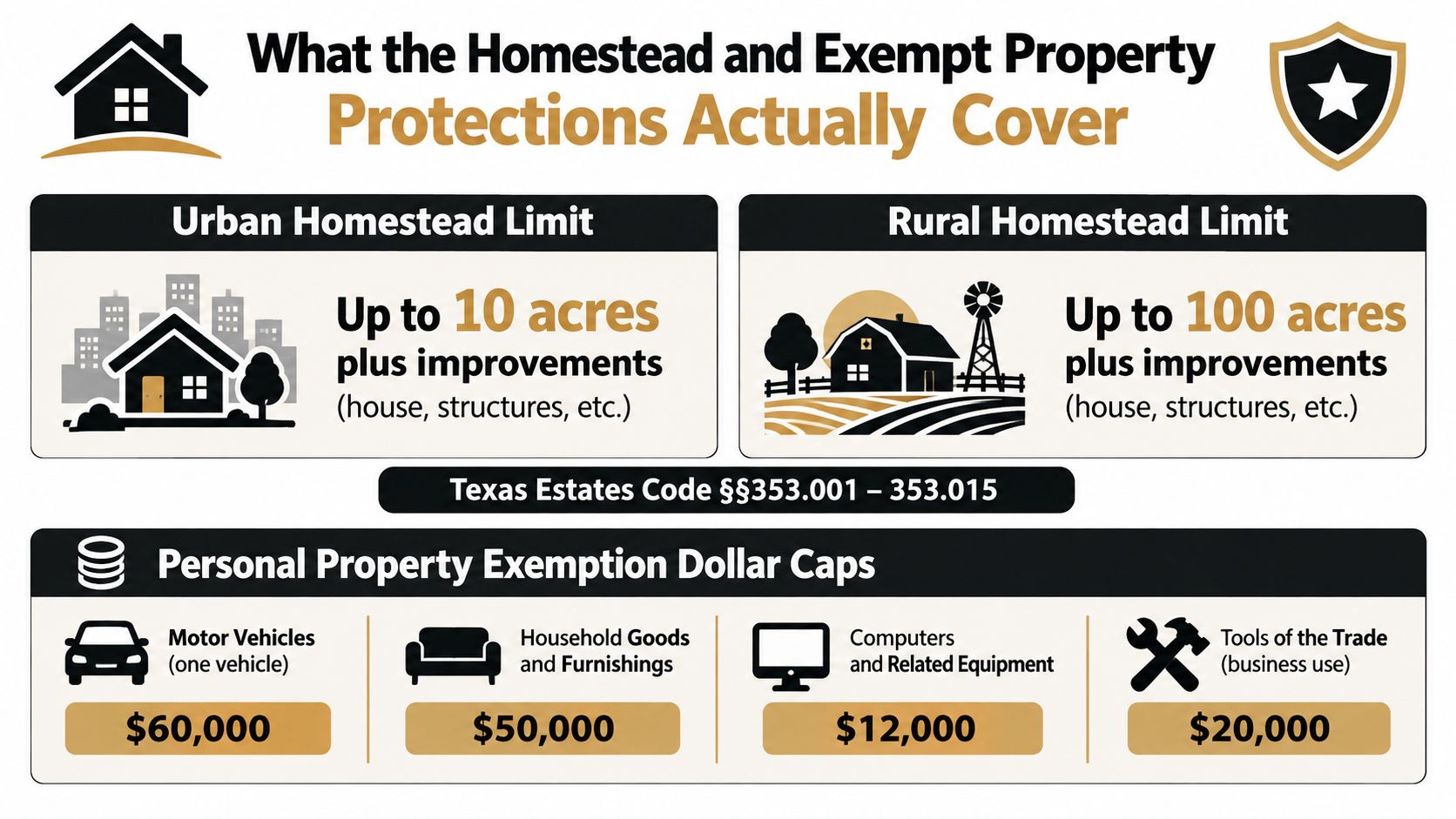
The allodial homestead right, in practical terms, protects the family's homestead interest from being devised away when a surviving spouse or minor child remains. That protection concerns occupancy and creditor reach. It doesn't automatically give one survivor complete ownership or eliminate a valid mortgage, tax obligation, or other enforceable lien.
Personal property has its own categories
Section 353.101 points to exempt-property categories that commonly include:
- Home furnishings and appliances: Items used to maintain ordinary household life.
- Family heirlooms: Certain heirlooms within the statutory limits.
- Vehicles: Transportation that falls within the exemption rules.
- Personal effects: Ordinary belongings connected to the family's use.
- Other listed property: Property included through the applicable Texas Property Code provisions.
The Texas State Law Library explains that up to $100,000 worth of exempt personal property may be set aside for a family's use during administration. The figure and applicable categories should be checked against current law and the facts of the estate through the Texas State Law Library's family-protection materials.
When the item is gone
The law has an allowance-in-lieu mechanism. If the specific exempt items aren't found among the decedent's effects, the court may substitute money. Under the referenced rules, the allowance in lieu of a homestead may not exceed $45,000, and the allowance in lieu of other exempt property may not exceed $30,000. See Texas Estates Code Section 353.053.
Many families misunderstand the word “homestead.” A homestead set-aside isn't the same as fee ownership. If the house was sold before death, was jointly held with a right of survivorship, or otherwise isn't part of the decedent's effects, the court may not have a house to deliver through the estate. The remedy can become a capped cash allowance instead.
How the Set-Aside Works Step by Step During Probate
The procedure begins with identifying the applicant, the property, and the timing. A surviving spouse may apply, and a person acting for minor children may apply on their behalf. The application or verified affidavit should describe the homestead and exempt items being claimed and should be supported by records that help the court understand occupancy, ownership, value, and family relationships.
Filing before the inventory milestone
The statute creates a pre-approval path. Before the inventory is approved, the applicant files an application and verified affidavit listing the claimed exempt property. In practice, the filing may be coordinated with the executor or administrator's work, but the applicant shouldn't assume that the personal representative will automatically assert every family protection.
Useful supporting materials may include:
- Proof of relationship: Marriage records or documents identifying minor children.
- Property records: Deeds, tax records, mortgage statements, and insurance documents.
- Household evidence: Photographs, receipts, purchase records, and a careful contents list.
- Estate documents: The inventory, appraisement, and list of claims when available.
- Missing-item information: Evidence showing that an exempt item was sold, damaged, transferred, or cannot be located.
The inventory, appraisement, and list of claims are not just administrative paperwork. They give the court a structured picture of estate assets and debts. Families can learn more about that milestone through this guide to inventory and appraisement filing in Texas probate.
The court must order the homestead set aside once the statutory approval point is reached and the qualifying family members are identified. If the protected property isn't available, the court addresses the allowance-in-lieu rules instead.
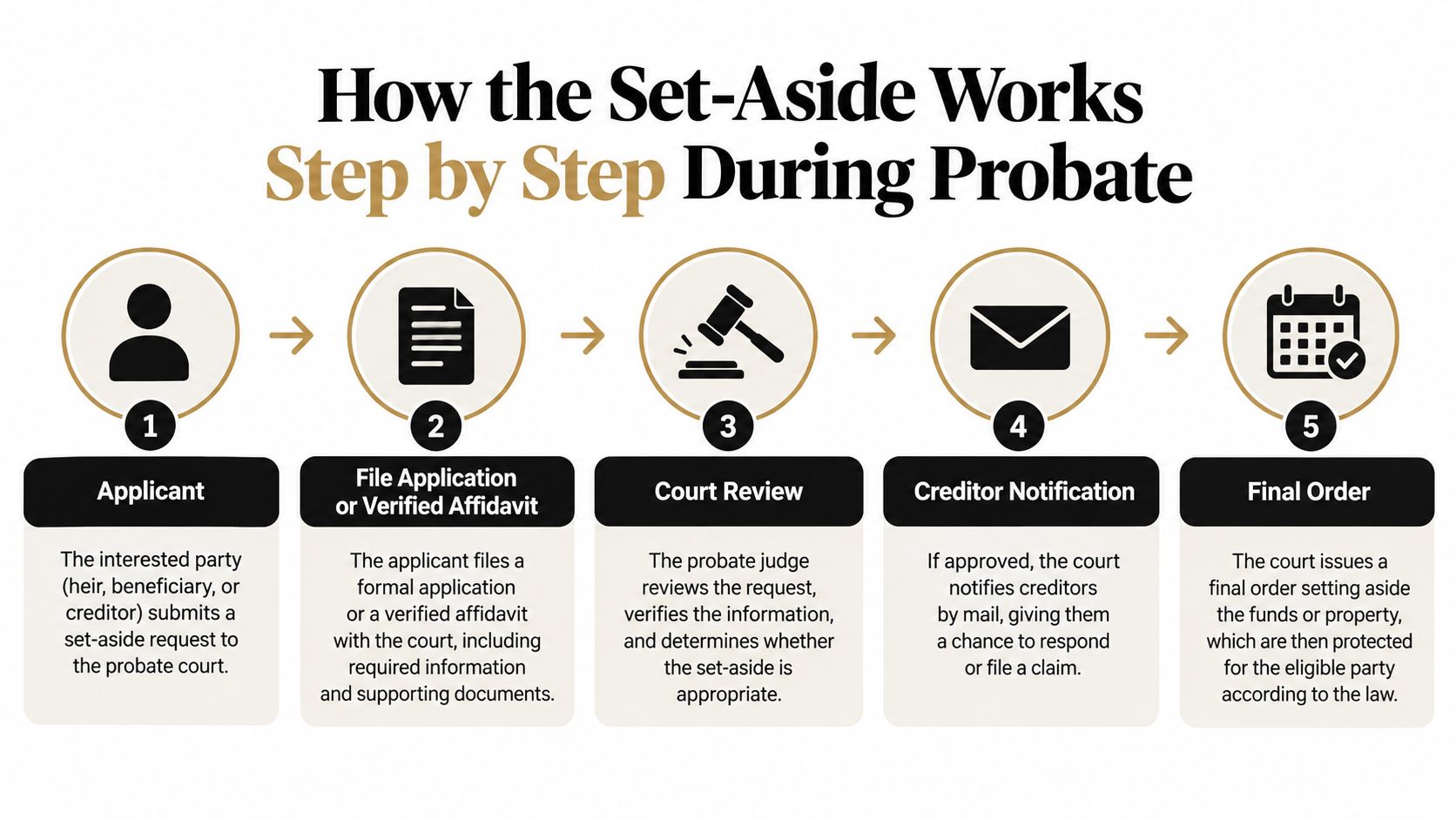
The court may grant the application as filed, modify the requested property, or deny it if the legal requirements aren't met. An order affecting real property may need to be recorded so that the public land records reflect the court's action. A denial isn't the end of every possible remedy, but it should be addressed promptly because later distribution or creditor action can complicate the family's position.
The federal redemption issue deserves immediate attention when a home is federally encumbered. The family homestead claim has a deadline that interacts with the IRS right of redemption, so an applicant shouldn't wait for the end of administration before obtaining advice.
A Realistic Example of the Homestead Set-Aside in Action
Consider a representative Texas family. A homeowner dies leaving a surviving spouse and two minor children. The primary residence is worth $310,000, the household furnishings are worth $6,000, the family has two modest vehicles, and the estate has limited cash.
The spouse begins by identifying the residence as the family homestead. The home is treated separately from the probate property available for ordinary distribution, assuming the family and property satisfy the statutory requirements. The spouse then reviews the inventory and selects qualifying furnishings and vehicles for the exempt-property set-aside rather than asking the court for an allowance in lieu.
The hypothetical facts include a $60,000 exempt-property cap under Section 353.151, as specified for this example. The selected household items and vehicle values fit below that cap, so the family claims specific property instead of requesting substitute cash. The $310,000 home isn't added to that personal-property calculation because the homestead and exempt personal property are distinct protections.
Hypothetical Homestead Set-Aside Calculation
| Asset | Value | Treatment Under §353 |
|---|---|---|
| Primary residence | $310,000 | Set aside as the family homestead, subject to statutory qualification |
| Household furnishings | $6,000 | Selected as exempt personal property |
| Two modest vehicles | Not specified | Reviewed and selected if they qualify and fit within the applicable cap |
| Limited cash | Not specified | Remains part of the estate unless another protection applies |
| Remaining probate property | Not specified | Passes under the will or intestacy after administration |
The numbers in this example show why families should separate categories before doing arithmetic. The house is protected as a homestead. The furniture and vehicles are evaluated as exempt personal property. Cash and other assets remain subject to administration unless the law provides another protection.
The family allowance is a separate concept under §353.101. It can provide cash support for the applicable period when the court finds that the statutory requirements are met. It isn't the same as selecting furniture or vehicles, and it may operate alongside the exempt-property set-aside for an eligible family.
A protected asset and a cash allowance answer different problems. One preserves things the family uses. The other helps meet support needs while the estate remains open.
At final settlement, if the estate is solvent, exempt property other than the homestead or a homestead allowance may be subject to partition and distribution among heirs like other estate property. That later stage is why the set-aside should be documented carefully at the beginning.
Common Mistakes and Hidden Risks Families Should Know
A family can qualify for protection and still lose valuable time by treating the set-aside as automatic in every practical sense. The court's authority matters, but so do the property's title, the creditor's lien, the family's occupancy, and the documents supporting the claim.
Mistaking occupancy for ownership
A spouse may have the right to occupy a homestead without receiving complete ownership of every interest in it. A child or another heir may hold an ownership interest while the spouse's protected occupancy continues. Conversely, a house that passed outside probate through survivorship ownership may not be available for the estate court to set aside as an estate asset.
Secured creditors remain a separate concern. A homestead protection generally operates against general estate claims, not as a universal cancellation of purchase-money debt, taxes, or valid liens. Medicaid estate recovery and claims involving the Texas Department of Family and Protective Services may require specialized analysis rather than assumptions based on the word “exempt.”
Missing the evidence
Families often know who bought the sofa or gave a vehicle as a gift, but they can't prove it. Verbal gifts, undocumented transfers, and commingling household items with estate property create disputes. Photographing the home, keeping receipts, and making a dated contents list can help distinguish a genuine family-use claim from a later disagreement.

The IRS redemption deadline is another danger. When the home is federally encumbered, filing after the applicable nine-month redemption window can put the family's position at risk. That deadline should be evaluated at the beginning of administration, not after the estate has already distributed property.
Insolvency changes the practical picture
An insolvent estate cannot pay every claim in full. The homestead may still be protected for qualifying family members, while other exempt-property issues may involve statutory limits, unavailable items, or competing claims. The family shouldn't sell furniture, transfer a vehicle, or sign away an occupancy right because a creditor sends a demand letter.
Second marriages and omitted children add another layer. A person challenging the set-aside may dispute household membership, title, the existence of a qualifying child, or the classification of property. Those conflicts can become probate litigation, especially when the family's understanding differs from the recorded documents.
Key Takeaways and When to Call a Texas Probate Attorney
The most useful way to remember Chapter 353 is this: the set-aside is a statutory floor, not a gift from the estate. It protects qualifying family members during administration, but the protection doesn't transform every family residence into fee ownership or every missing item into an unlimited payment.
Timing drives the result. During the first weeks of administration, preserve records, identify the home, photograph household contents, and communicate with the executor or administrator. A surviving spouse or authorized person acting for minor children should consider filing the verified affidavit before the court approves the inventory, appraisement, and list of claims.
A practical self-audit
| Mistake | Better response |
|---|---|
| Assuming the spouse owns the entire homestead | Separate occupancy rights, title, survivorship ownership, and liens |
| Waiting until final distribution | Identify and claim protected property during administration |
| Treating missing property as physically available | Ask the court to evaluate the allowance-in-lieu rules |
| Giving away or selling household items informally | Preserve receipts, photographs, titles, and written explanations |
| Assuming exempt means immune from every claim | Review secured debt, taxes, federal claims, and recovery actions |
| Ignoring a blended-family dispute | Obtain advice before signing releases or distributing property |
Chapter 353 also operates alongside the family allowance, the exempt-property list, and the broader homestead rules in Titles 2 and 3 of the Texas Estates Code. The protections serve different purposes, so a family may need to address several applications or court findings rather than rely on a single request.
Key insight: The earlier you identify the family's protected property, the fewer decisions will be made in the dark.
A Texas probate attorney is especially helpful when the home's title is unclear, the estate appears insolvent, exempt items are missing, a surviving spouse's occupancy is challenged, or a creditor objects. Legal guidance can also be important for blended families, unmarried adult children with disabilities, federally encumbered homes, and situations involving Medicaid recovery or a governmental claim.
The Law Office of Bryan Fagan, PLLC helps Texas families with estate administration, homestead and exempt-property issues, guardianship matters, wills and trusts, and probate litigation. Families can also review the firm's resources on the Texas Probate Process, Guardianship, Wills & Trusts, and Probate Litigation before deciding what assistance they need.
If you're facing probate in Texas, our team can review the homestead, exempt-property claims, creditor issues, and required filings with you. Contact the Law Office of Bryan Fagan, PLLC for a free consultation and step-by-step guidance before an important deadline expires.


