 Skip to content
Texas Estates Code §351.354 does not authorize the sale of a homestead during administration. It addresses a judge's liability, while families must look primarily to Chapter 356 and related Texas law for the actual sale procedures.
That distinction matters because grieving families often search for “Estates Code 351.354 sale of a homestead during administration” expecting to find a step-by-step conveyance rule. The statute number appears relevant, but it points to the wrong legal question. Section 351.354 concerns judicial accountability, not an executor's power to sell a home.
Selling a decedent's residence can involve probate authority, administration type, title, heirship, homestead protections, surviving-spouse rights, minor-child protections, creditor claims, and closing requirements. A court order may be necessary, but a court order alone doesn't automatically resolve every homestead issue. The safest path is to identify the correct authority before signing a listing agreement, accepting an offer, or promising heirs that funds can be distributed.
The Statute Number Misconception in Texas Probate
A common assumption is that Texas Estates Code §351.354 tells an executor how to sell a homestead. It doesn't. The statute's subject is a judge's liability when an estate suffers damage because the judge grossly neglected reasonable diligence in carrying out duties under the applicable subchapter. It isn't a grant of authority to sell real estate, a required notice period, a sale-price rule, or a distribution formula. Texas Estates Code §351.354
That correction may feel technical, but it protects families from following the wrong procedure. If an executor relies on the section number alone, the estate may miss the provisions that govern a sale. The resulting problem might not appear until a title company questions authority, an heir challenges the transaction, or a surviving spouse asserts homestead rights.
What the statute does not answer
Section 351.354 doesn't tell you:
- Who may sign: Appointment as executor or administrator doesn't, by itself, answer whether the personal representative may convey the home.
- Whether court approval is needed: The answer depends in part on whether the estate is independently or dependently administered and on the applicable sale provisions.
- How homestead protections apply: A home may have constitutional or statutory protections that affect creditors, surviving family members, and sale proceeds.
- Who receives the proceeds: A voluntary sale doesn't automatically turn protected proceeds into money available for general estate debts.
The correct analysis begins with the estate's administration type, the will, the property's ownership history, and the family members who survived the decedent. It also requires attention to the specific Texas Estates Code provisions governing estate-property sales.
Practical rule: Don't treat a statute number found in a search result as permission to sign a deed. First confirm the legal authority, the homestead status, and the required participants.
This is especially important for out-of-state representatives, real-estate professionals, and heirs who are trying to move quickly. A listing can be appropriate, but marketing the property and legally conveying it are separate steps. A careful review at the beginning is often less stressful than repairing an authority problem after a buyer, lender, or title insurer has become involved.
What Texas Estates Code Section 351.354 Actually Covers
Section 351.354 is an accountability provision concerning judges. It provides that a judge may be liable on the judge's bond when an estate suffers damage or loss because the judge grossly neglected to use reasonable diligence in performing duties under the relevant subchapter. That language addresses judicial neglect and resulting harm, not the personal representative's power to sell a homestead.
The provision was added by the 81st Texas Legislature in 2009 through House Bill 2502 and became effective on January 1, 2014. Those dates explain the statute's legislative history, but they don't transform it into a sale procedure. The statutory text and chapter placement are available through Texas's Estates Code materials.
Why the distinction matters
A conveyance rule usually answers practical questions such as who can act, what approval is required, what notice must be given, and how the transaction becomes effective. Section 351.354 answers a different question: when a judge's gross neglect may create liability for damage to an estate.
That difference affects how families research the problem. If the question is whether a home may be sold, the search should move away from §351.354 and toward the applicable sale provisions, administration rules, title requirements, and homestead protections. If the concern is judicial inaction or neglect that harmed an estate, §351.354 may be relevant, but it still isn't the deed-authority statute.
A plain-English distinction
Think of the statute as an accountability rule, not a permission slip. It may matter after a judicial failure causes harm, but it doesn't give an executor permission to sell, establish a sale price, authorize a deed, or determine how the proceeds should be distributed.
For families, this distinction reduces confusion. Finding §351.354 in a probate search isn't the same as finding the law that controls the transaction. The next step is to identify the administration framework and then evaluate the homestead's separate protections.
Finding the Correct Authority for Selling Estate Property
The operative sale analysis generally moves to Chapter 356 of the Texas Estates Code, together with the provisions governing the type of administration and the specific facts of the estate. The first practical question is whether the estate is being handled independently or dependently. That classification affects how much court supervision applies and what the personal representative must file before and after a sale.
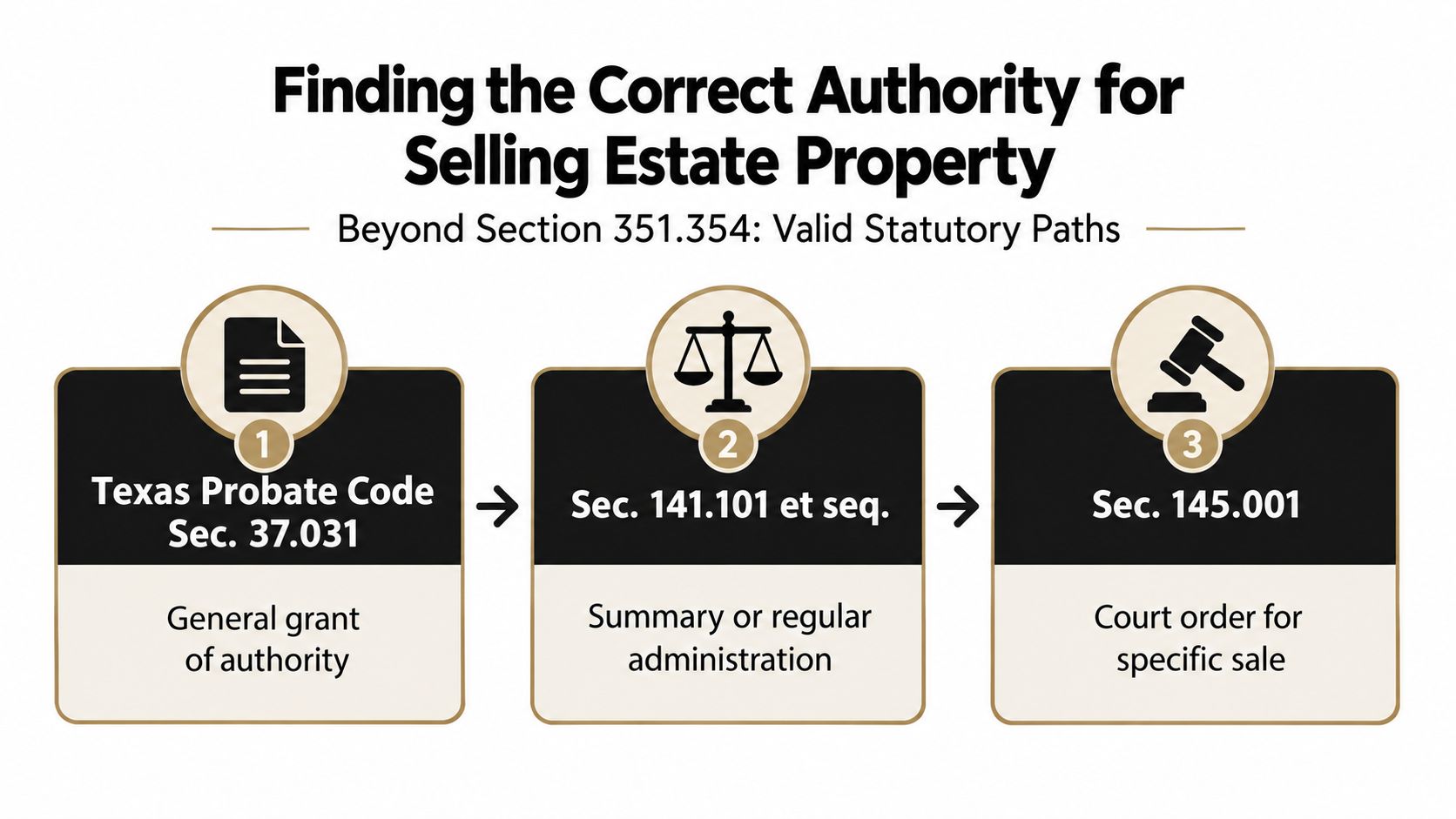
Independent administration
Independent administration usually involves less day-to-day court supervision than dependent administration. That doesn't mean the executor can ignore the will, heirship, creditor issues, title requirements, or homestead protections. It also doesn't mean every sale can proceed without court involvement.
Start with these questions:
- Read the will: Look for authority relating to real estate, administration, and sales.
- Confirm the appointment: Determine whether the representative has received the authority needed to act for the estate.
- Review the property: Confirm ownership, liens, occupancy, and whether it was the decedent's homestead at death.
- Identify interested people: Determine whether a surviving spouse, minor children, heirs, or other protected parties have rights.
- Ask the title company early: Learn which probate and heirship documents will be required before closing.
A Texas Probate Lawyer may assist with Texas probate and estate administration, including the authority and documentation questions that arise before a sale. Families should also review whether all beneficiaries need to approve a transaction, rather than assuming that the executor's signature settles the issue. Questions about beneficiary approval and executor authority should be addressed before an offer becomes difficult to unwind.
Dependent administration
Dependent administration is more formal. Estate property generally can't be sold until the court authorizes the sale, and the process may include a pre-sale order followed by post-sale confirmation. The court-supervised process exists to create notice, review, and a record showing that the representative acted within the authority granted.
For a dependent administration, the practical sequence is:
- Application: File an application for an order of sale under the applicable Chapter 356 procedure.
- Opportunity for objections: Allow the required period for objections before approval.
- Order: Obtain the court's authorization before treating the transaction as approved.
- Completion: Conduct the sale consistently with the order.
- Report and confirmation: File the report of sale and obtain the court's confirmation when required.
The representative should keep the contract, notices, court orders, closing documents, title materials, and receipts together. A signed contract isn't a substitute for authority, and an attractive offer doesn't eliminate the need to follow the correct statutory path.
Navigating Homestead Protections and Survivor Rights
Probate authority is only one part of a homestead sale. A Texas homestead can receive special treatment for family and creditor purposes, and those protections may continue to affect the transaction even after a personal representative has been appointed.
Texas Estates Code homestead-administration provisions can require the executor or administrator to deliver the homestead to the decedent's surviving spouse. If there is no surviving spouse, the property may need to be delivered to the guardian of the decedent's minor children in the circumstances addressed by the statute. These rules mean the representative must identify protected survivors before treating the home as just another estate asset. The Texas homestead law guide offers additional background for families reviewing how homestead protections fit into broader Texas property law.
Spousal participation
Texas Family Code §5.001 provides that, whether the homestead is separate or community property, one spouse generally can't sell, convey, or encumber the homestead without the other spouse's joinder unless a statutory exception applies. Joinder means the required spouse participates in the transaction, usually by signing the relevant documents.
An executor can't assume that probate appointment removes this protection. The family should determine whether the surviving spouse occupied or retained rights in the property, whether the property was a homestead at death, and whether the proposed transaction requires spousal participation or court-supervised relief. The Texas Estates Code discussion of homestead and exempt-property set-aside can help readers identify the separate probate issues that may arise.
Survivor and creditor concerns
The Texas Supreme Court has held that a probate-court-ordered sale of a protected homestead to pay general estate creditors may be void when a surviving constituent family member, such as a widow or minor child, remains. The court also recognized that such a sale may be subject to collateral attack. The Texas Supreme Court decision explains these limits on a court-ordered sale.
A voluntary sale can raise a different issue. Sale proceeds generally pass to the heirs under descent-and-distribution rules rather than being diverted to the deceased person's general debts. Because the result depends on the property, the family, the debt, and the administration, proceeds should be segregated and reviewed before distribution.
A Realistic Scenario of a Dependent Administration Sale
Suppose an administrator receives a $300,000 offer for the decedent's home. The estate is in dependent administration, and the administrator believes the offer will help preserve the property and resolve estate expenses. The administrator shouldn't treat the signed offer as final authority to convey title.
Before the sale
The administrator first reviews the probate appointment, the will if one exists, the property records, the decedent's occupancy, and the identity of surviving family members. The administrator also asks whether the home retained homestead status at death and whether a surviving spouse or minor child has a protected interest.
Next, the administrator files an application for an order of sale. Under the dependent-administration process described in the Tarrant County probate guide, the application must remain on file for 10 days before the judge may approve it, allowing objections to be raised. Tarrant County's dependent-administrator guide describes the Chapter 356 process.
The offer starts the review. It doesn't replace the court's authority.
The administrator must follow the order's terms. That may include requirements concerning the property, the sale, notice, or the documents needed to complete the conveyance. The administrator shouldn't change material terms casually or close in a way that differs from the authorization.
After the sale
Once the authorized transaction is completed, the administrator files a report of sale and seeks a decree confirming the sale. The same county guide explains that the report remains on file for five days before approval, giving interested people an opportunity to raise concerns.
The administrator then preserves the closing statement, deed, confirmation order, lien releases, receipts, and proof of where the proceeds went. Distribution should wait until the estate's debts, protected rights, and court requirements have been evaluated.
This example shows why dependent administration can feel slow to a grieving family. The waiting periods and filings create a record, but they also prevent an administrator from treating a private contract as complete authority. If the home has homestead complications, those issues must be addressed alongside the sale application, not after closing.
Post-Sale Risks and Closing Readiness Requirements
A probate sale doesn't end the representative's responsibilities. The closing team still needs to establish authority, resolve title concerns, confirm the proper parties, and determine how the net proceeds should be held and distributed.
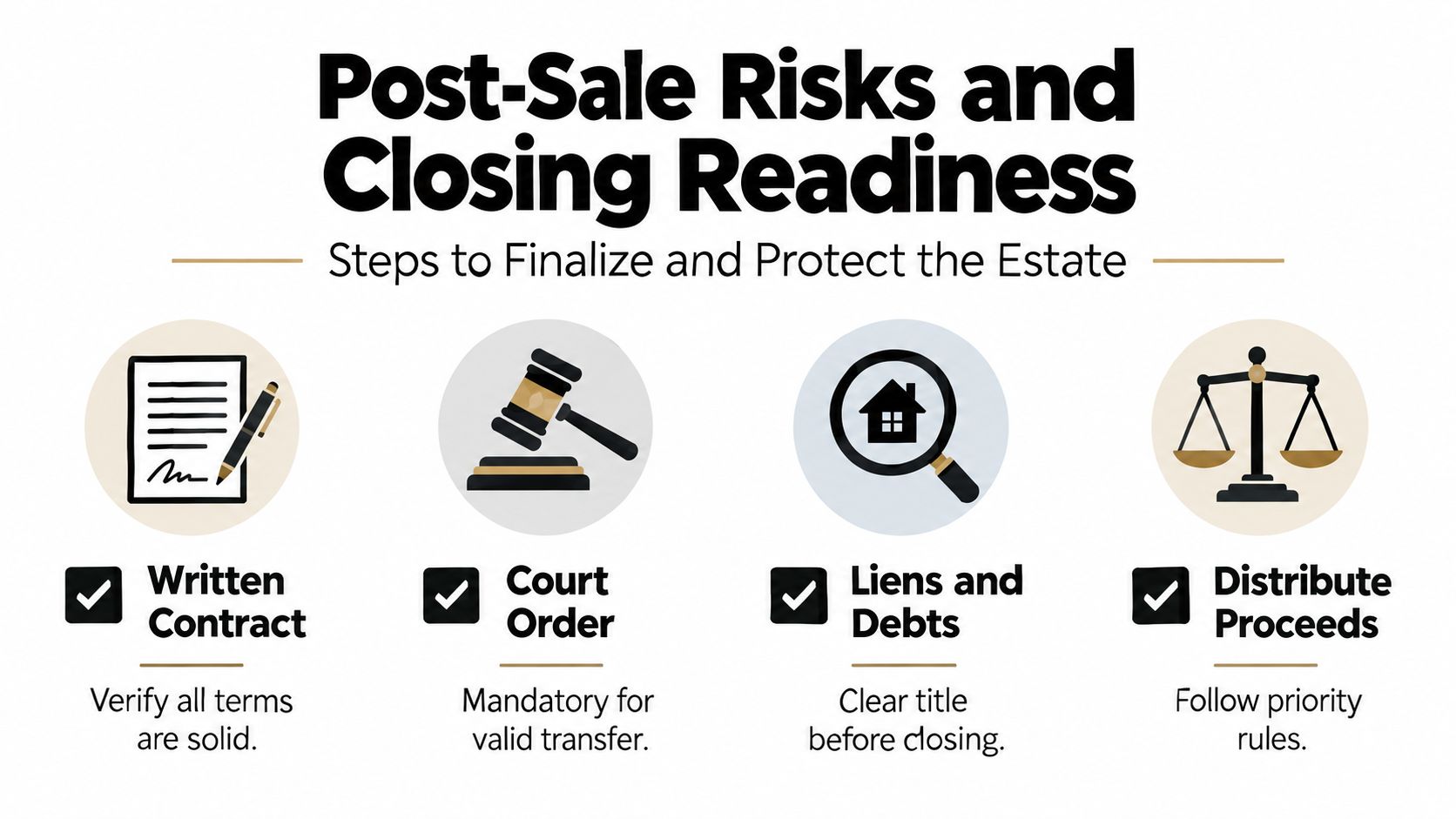
Smooth closing compared with a delayed closing
| Closing readiness | What it looks like |
|---|---|
| Authority is documented | The title company receives the appointment papers, applicable court orders, sale report, and confirmation documents. |
| Heirship is clear | The representative can identify heirs, surviving spouses, minor children, and any person whose signature or protection matters. |
| Title is reviewed | Liens, judgments, ownership records, and probate claims are examined before the deed is signed. |
| Proceeds are controlled | Net funds remain traceable until lawful debts, allowances, and distributions are addressed. |
The opposite situation creates delay. A buyer may be ready, but the title company may question whether the order authorized this property, whether the required confirmation occurred, or whether a surviving spouse must participate. A family should also coordinate ordinary property diligence, including handling termite findings before closing, because a physical-property issue can complicate an otherwise prepared transaction.
Court orders don't erase homestead protections
The Texas Supreme Court's ruling described above is a warning against treating judicial approval as an automatic answer to every homestead question. A court-ordered sale to pay general estate creditors may be void when a protected surviving family member remains, and a defective transaction may face collateral attack. That risk makes it essential to identify survivor rights before the estate asks the court to authorize a sale.
The representative should also avoid distributing proceeds immediately after closing. The money may need to be segregated while creditor claims, family protections, title matters, tax questions, and heirship are reviewed. Selling estate property before probate can create separate authority and title concerns, so families shouldn't assume that an early contract solves the administration problem.
Key Insights and Next Steps for Texas Families
The central lesson is straightforward: Texas Estates Code §351.354 is not the homestead-sale statute. It addresses judicial liability for gross neglect. The sale analysis generally requires Chapter 356, the administration type, the will, title records, homestead law, Family Code spousal protections, and the rights of surviving family members.
A grieving family can begin with a focused document review:
- Gather the probate papers: Collect the will, application, appointment order, letters, and any administration orders.
- Confirm the property facts: Obtain the deed, tax records, lien information, and evidence concerning occupancy and homestead status.
- Identify protected people: List the surviving spouse, minor children, heirs, beneficiaries, and anyone whose signature or participation may be required.
- Classify the administration: Determine whether the estate is independent or dependent before relying on a proposed sale procedure.
- Coordinate with the title company: Ask early for the documents needed to insure the conveyance.
- Protect the proceeds: Keep sale funds traceable and don't distribute them until the estate's obligations and survivor protections have been reviewed.
Key insight: The most dangerous mistake isn't always accepting a low offer. It may be using the wrong legal authority and discovering the problem after closing.
If a dispute develops over the sale, heirship, authority, or distribution, the family may need advice about probate litigation rather than a routine closing. A careful review can help clarify what the representative may do, what the court must approve, and which family members need protection.
The Law Office of Bryan Fagan, PLLC helps Texas families evaluate homestead status, administration procedures, sale authority, title concerns, and proper distribution of estate proceeds. If you're facing probate in Texas, contact Law Office of Bryan Fagan, PLLC to schedule a free consultation and discuss the next step for your family.


