 Skip to content
Under Texas Estates Code Section 123.001, divorce generally treats a former spouse as having predeceased the testator for most will provisions, so a gift, executor role, or fiduciary appointment for the ex is removed unless the will says otherwise. The rule applies after a divorce, annulment, or declaration that the marriage was void, but it doesn't automatically clean up every part of an estate plan.
A finalized divorce can leave a family with an old will, outdated account forms, and an uncomfortable question: who has authority now? Texas law provides an important safeguard for will provisions, but families still need to examine trusts, retirement accounts, life insurance, and other assets separately.
A Texas Family Faces a Post-Divorce Will
Maria and her husband signed matching wills while they were married. Each named the other as the primary beneficiary and executor. Years later, the divorce became final. They never replaced the wills, and one of them has now died.
The surviving family may assume the former spouse will inherit everything or take control of the probate case. That assumption can be wrong. Texas Estates Code §123.001 generally treats the former spouse as having failed to survive the person who made the will. In ordinary language, the law reads the former spouse out of affected will provisions unless the will expressly provides a different result. The statute appears in Title 2, Subtitle C, Chapter 123, which addresses the effect of marriage dissolution on a decedent's will (Texas Estates Code Chapter 123).
The practical question isn't only whether Maria's former spouse receives a particular gift. The family must also ask whether the former spouse was named as executor, trustee, guardian, or another fiduciary. If so, the appointment may be displaced as well. The will's alternate provisions, residuary clause, or survivorship language may determine what happens next.
Practical point: Divorce may change how an old will operates, but it doesn't necessarily replace the will or create a complete new estate plan.
Texas carried this rule forward from an older Texas Probate Code provision that treated testamentary provisions for a divorced spouse as null and void unless the will stated otherwise. That history reflects a straightforward concern. A will written for a marriage may no longer express the person's wishes after the marriage ends.
Families facing this situation often need help with more than a legal conclusion. They may need to determine who can apply for Letters Testamentary, identify the correct beneficiaries, protect estate property, and communicate with financial institutions. A careful review can provide reassurance while preventing an avoidable dispute.
How the Statute Rewrites a Pre-Divorce Will
A lot of families hear that divorce "revokes the will" and stop there. That is not what Section 123.001 does. It rewrites certain parts of a pre-divorce will so the document can still operate, while treating the former spouse, and in some cases the former spouse's relatives who are not related to the testator, as if they did not survive the person who made the will.
The rule generally applies if the marriage ends by divorce, annulment, or a court declaration that the marriage was void after the will was signed. Texas law also allows a different outcome if the will clearly says the former spouse should still benefit despite the later end of the marriage. The statute itself is discussed in Texas Estates Code Chapter 123.
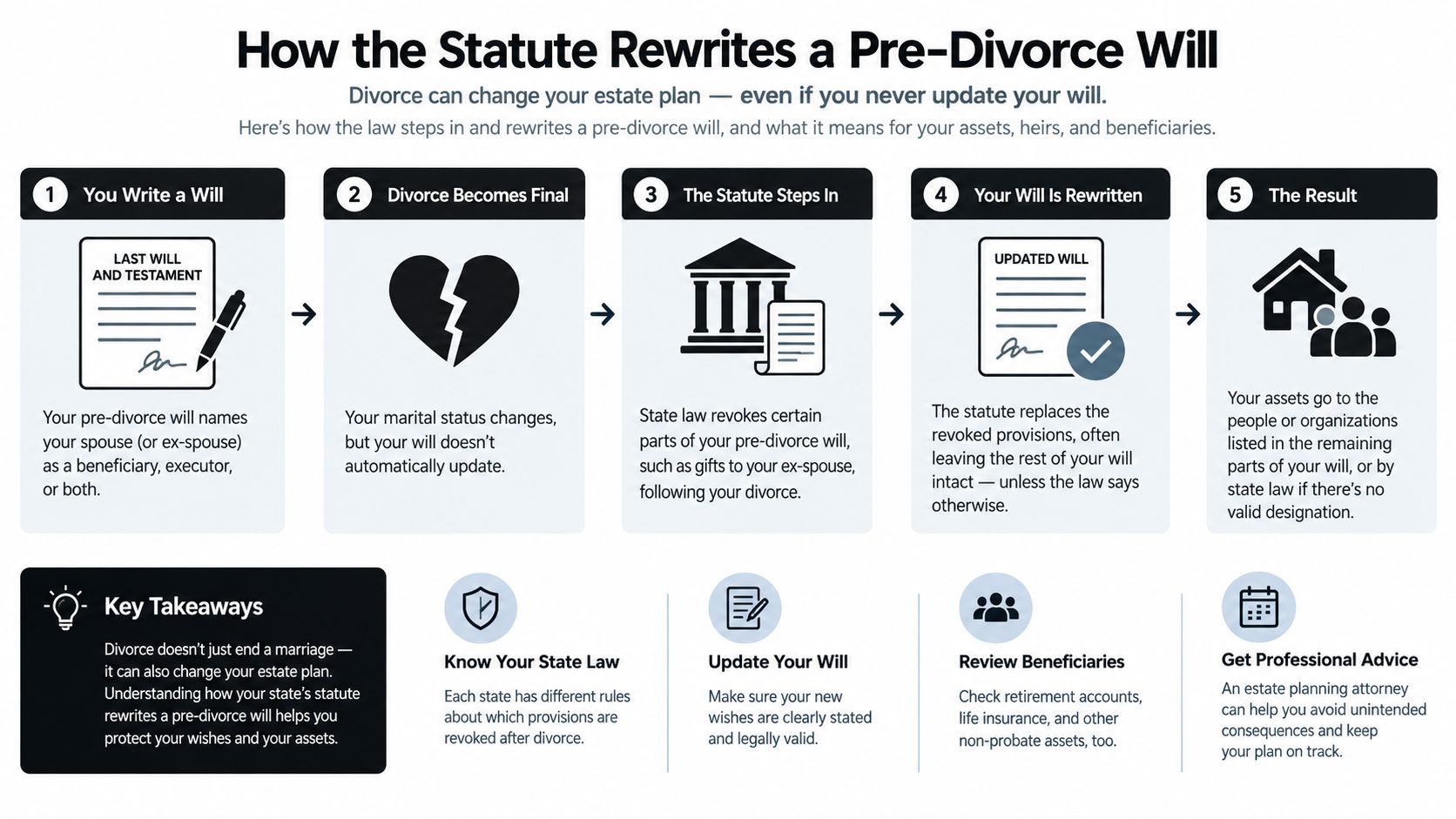
The substitution process in plain English
A probate court or estate lawyer usually works through the will in a practical order.
- Confirm the marriage ended legally. Separation is different from a final divorce, annulment, or declaration that the marriage was void.
- Check the timing of the will. The statute matters when the marriage ended after the will was executed.
- Find each clause tied to the former spouse. That includes gifts, appointments, and other rights created by the will.
- Apply the substitution rule. The former spouse is generally treated as having failed to survive the testator.
- Read the backup language carefully. The next beneficiary, alternate fiduciary, survivorship clause, or residuary provision may now control.
That is why the statute works more like editing than erasing. If a will leaves the estate to a spouse and then names a sister as the alternate beneficiary, the sister may step into the first workable position under the document. If there is no backup clause that fits, the estate may need court guidance.
This distinction matters because families often focus on whether the ex-spouse still inherits, when the bigger question is what happens to the rest of the will after those clauses are displaced. Section 123.001 controls the will. It does not answer every post-divorce estate planning problem.
If someone wants to keep a former spouse in the plan, the will must say so clearly. If someone wants to change more than the divorce changes automatically, review how Texas law treats revoking a will before death, then confirm with counsel that the revocation method fits the situation. For readers comparing this will-based rule with estates that pass without any valid will, Dying Without a Will in Texas: Intestate Succession explains the intestacy framework.
Gifts, Executors, Trustees, and Powers of Appointment
Section 123.001 reaches more than an outright inheritance. It can affect the legal roles and control rights assigned to a former spouse, which is why reading only the first page of a will can produce the wrong answer.
| Provision type | Treatment under §123.001 | Practical result |
|---|---|---|
| Direct gift to former spouse | Former spouse is generally treated as having failed to survive | The gift follows the will's substitute or residuary provisions |
| Residuary gift | The former spouse's interest is generally displaced | The next applicable residuary or contingent clause may control |
| Executor or independent executor appointment | Former spouse is generally treated as unavailable for the appointment | An alternate executor may serve, or court guidance may be needed |
| Trustee appointment | The former spouse is generally removed from the fiduciary role | The successor trustee named in the instrument may act |
| Guardian nomination | The former spouse is generally treated as having failed to survive | Another nomination or court appointment may become relevant |
| Power of appointment | Certain rights involving the former spouse may be treated as disclaimed | The governing instrument's next mechanism may apply |
| Certain irrevocable trust provisions | Beneficial interests, appointment powers, or fiduciary nominations may receive separate statutory treatment | Trust language, exceptions, and related agreements require careful review |
A fiduciary is someone trusted to act for another person or for an estate. An executor handles probate tasks, such as gathering property and paying valid debts. A trustee manages trust property. A guardian may care for a minor or another protected person. Section 123.001 generally removes a former spouse named in one of these roles by treating that person as having died before the testator (Texas Estates Code §123.001).
Consider a will that leaves everything to Maria and names Maria as independent executor. After the marriage ends, the statute generally treats Maria as having failed to survive the testator for those provisions. The court then looks for an alternate executor and determines where the gift passes under the will.
Trust provisions need closer reading
The statute also addresses certain provisions involving irrevocable trusts. A former spouse's beneficial interest or power of appointment may be treated as disclaimed, while a nomination to serve as trustee or another fiduciary may be treated as though the person died immediately before the dissolution. The exact trust language matters, and exceptions can involve a court order or an express marital-estate contract.
The word disclaimed means the person is treated as refusing or not accepting the interest. It doesn't necessarily mean every trust provision vanishes. The document still needs to be read to find the next beneficiary, trustee, or decision-maker.
Readers often ask whether an ex can inherit anything at all. The answer depends on the document, the asset, the divorce record, and whether another law controls. A detailed discussion of this issue appears in Can Your Ex Inherit Your Estate, but no online summary can replace reviewing the actual plan.
What the Statute Does Not Cover
The phrase “divorce revokes provisions for an ex spouse” can create a dangerous misunderstanding. Section 123.001 is not a universal rule that erases an ex-spouse from every financial document. It primarily changes how certain provisions in a pre-divorce will are read.
Assets that pass by beneficiary designation may never enter the probate estate. These can include retirement accounts, IRAs, life insurance, payable-on-death accounts, transfer-on-death accounts, and certain jointly owned property. Their controlling documents may be an account agreement, beneficiary form, plan document, state statute, federal law, or some combination of those sources.
The account administrator may control the outcome
Texas public retirement guidance illustrates the operational problem. Divorce doesn't automatically revoke a former spouse's beneficiary designation for death benefits. The retirement system must receive a certified divorce decree before payment, and a new beneficiary form is recommended if the participant wants to change the result (Texas Government Code §824.101).
That means a person can have a will that no longer favors an ex-spouse while an old retirement designation remains on file. The will and the account form may point in different directions because they operate under different rules.
A will can provide a safety net for probate assets. It cannot substitute for updating every form held by a plan administrator, insurer, bank, or brokerage firm.
Federal law and plan documents may control employer retirement benefits. Insurance contracts may control life insurance proceeds. Bank and brokerage agreements may control payable-on-death and transfer-on-death arrangements. A divorce decree may address ownership or beneficiary rights, but an institution may still require specific documentation before changing its records.
Build an asset inventory
After divorce, review the plan by asset rather than by document title:
- Retirement accounts: Confirm the beneficiary form and ask the administrator what documentation it requires.
- Employer plans: Review the plan document and any divorce-related order that governs the account.
- Life insurance: Contact the insurer and request confirmation of the current beneficiary.
- Bank and brokerage accounts: Check payable-on-death and transfer-on-death forms.
- Trusts: Read both revocable and irrevocable trust documents, including successor fiduciary provisions.
- Joint property: Confirm title, survivorship language, and the effect of the divorce decree.
This is why a post-divorce review should include the will, trust documents, account forms, and decree together. The goal is not merely to remove an ex-spouse's name. The goal is to make sure the entire plan points to the intended people.
Two Realistic Texas Scenarios
Scenario one with a functioning alternate plan
Maria and her former husband signed wills before their marriage ended. Each will named the other as beneficiary and independent executor, then named a sibling as alternate executor and an adult child as contingent beneficiary. The divorce became final, and neither person signed a replacement will.
When Maria later died, her family gathered the divorce decree, original will, and death certificate. The probate attorney identified the affected provisions and applied Section 123.001. Maria's former husband was generally treated as having failed to survive her for the gift and executor appointment. The alternate executor could seek Letters Testamentary, subject to the court's review, and the contingent or residuary language determined the next beneficiary.
The executor still needed to identify estate property, notify appropriate creditors, and prepare an inventory before distributing assets. Because the will included workable substitutes, the administration had a clearer path.
Scenario two with outdated account forms
In another family, the person updated the will after divorce and named a new executor. The updated will left probate property to the children. The person never changed the beneficiary forms for an IRA or life insurance policy, however, and the former spouse remained listed.
After death, the new executor reviewed the will and assumed the children would receive all major assets. The IRA custodian and insurer reviewed their own records instead. The family then had to determine what the divorce decree, account agreements, beneficiary forms, and applicable rules required.
The second scenario shows the central risk. A revised will can be carefully drafted and still fail to address assets controlled outside probate. Executors should inventory both probate and nonprobate assets before promising heirs a particular result.
Practical Steps for Executors and Divorcing Texans
An executor often begins work while grieving. A methodical review can reduce confusion and protect the estate from premature distributions. Section 123.001 establishes a statutory revocation-upon-divorce rule for wills and applies to all will provisions, including fiduciary appointments. Separate Texas provisions and plan rules address trusts, retirement systems, life insurance, and payable-on-death accounts (Texas Estates Code §123.001 overview).

If you're the executor
Start with the legal timeline. Obtain the final divorce decree and confirm whether the decedent signed a later will or codicil. Then examine the old will clause by clause.
- List every affected provision. Mark gifts, executor appointments, trustee nominations, guardian nominations, and powers of appointment involving the former spouse or certain former-spouse relatives.
- Find the substitutes. Identify alternate beneficiaries, successor fiduciaries, survivorship conditions, and residuary clauses.
- Review trust documents separately. Don't assume the will answers questions about an irrevocable trust.
- Inventory nonprobate assets. Request current beneficiary information for retirement accounts, life insurance, bank accounts, and brokerage accounts.
- Check ownership records. Review deeds, joint accounts, and transfer-on-death or payable-on-death forms.
- Pause disputed distributions. If the documents conflict, obtain legal guidance before distributing property.
The probate process may involve an application, a court hearing, Letters Testamentary, creditor notices, an inventory, payment of valid expenses and debts, and final distribution. The exact path depends on the will, the estate, and whether anyone contests the administration. Families also need to distinguish probate administration from guardianship. A Texas Probate Process resource can help explain the broader administration steps, while a Guardianship resource addresses court-supervised care for a person who needs protection.
If you're divorcing or recently divorced
Don't wait for a future death to discover which documents still name the former spouse. Ask your attorney whether a new will, trust amendment, or beneficiary update is permitted while the divorce is pending, because court orders and the terms of the case may affect what you can change. For general procedural background, readers may also review navigating Texas divorce requirements, then coordinate estate changes with Texas counsel.
After the divorce becomes final, review:
- Your will: Name current beneficiaries and replacement fiduciaries.
- Retirement and insurance forms: Submit new designations directly to each administrator.
- POD and TOD accounts: Retitle or update beneficiary instructions where permitted.
- Trust agreements: Confirm trustee succession, beneficiary rights, and any marital provisions.
- Financial and medical documents: Consider new powers of attorney and advance directives.
- Joint property: Review title and survivorship language with the divorce decree.
If a former spouse remains in a will or estate document, don't mark it up by hand. A properly prepared replacement document may be safer than informal changes. Guidance about removing someone from a Texas will can help identify the questions to raise with counsel.
Key Takeaways and Your Next Step
Section 123.001 provides an important Texas default. After a divorce, annulment, or declaration that a marriage was void, the former spouse is generally treated as having failed to survive the testator for affected will provisions. That treatment can reach gifts, executor and trustee appointments, guardianship nominations, certain powers of appointment, and certain interests involving former-spouse relatives who aren't related to the testator.
The statute doesn't necessarily destroy the will. It redirects affected provisions to the alternate or residuary terms that remain. It also allows the will to provide otherwise, so the document must be read rather than summarized with the phrase “the ex gets nothing.”
The larger planning lesson concerns assets outside the will. Retirement accounts, life insurance, payable-on-death accounts, transfer-on-death accounts, trusts, and jointly owned property may follow separate rules. Updating the will without updating those records can leave an estate plan divided between old and new intentions.
Key insight: Treat a final divorce as a trigger for a complete estate-plan audit, not just a reason to glance at the will.
Executors should gather the divorce decree, all wills and codicils, trust instruments, beneficiary forms, account statements, deeds, and ownership records before distributing property. Divorcing Texans should coordinate the decree, new estate documents, and account updates so each document supports the same plan.
If you're grieving and facing probate, confusion is understandable. A probate attorney can help identify which provisions changed automatically, which documents require action, and whether a disputed issue needs court involvement.
The Law Office of Bryan Fagan, PLLC helps Texas families review wills, trusts, beneficiary designations, probate filings, and fiduciary appointments after divorce or death. Visit Law Office of Bryan Fagan, PLLC to request guidance with an estate-plan review or Texas probate matter, and schedule your free consultation today.


