 Skip to content
Under Texas Estates Code § 203.001, a properly executed and recorded affidavit of heirship becomes prima facie evidence of the stated heirship facts once it has been on file for five years or more. That gives the affidavit an important evidentiary advantage in a title dispute, but it does not automatically transfer title or prevent someone from challenging inaccurate family-history statements.
A parent dies, the family mourns, and the paperwork waits. Years later, one of the children tries to sell the family home or refinance the land, only to learn that the county records still list the deceased parent as owner. Then a title company asks for an affidavit of heirship, and a document that sounds simple suddenly carries enormous importance.
The central question is not only whether an affidavit exists. It's whether the affidavit satisfies the legal requirements that allow a court to treat it as prima facie evidence, meaning sufficient initial proof unless someone presents evidence against it. The five-year period under Texas Estates Code § 203.001 is a real statutory milestone. The sections below explain what that milestone means, how title reviewers use it, and when a different probate solution may be safer.
When a Loved One's Land Is Stuck Without Probate
Maria's father died in Texas without a will. No probate case was opened, and the family continued living with the understanding that the house belonged to the children. Years later, Maria and her siblings decided to sell. The buyer's title company found that the deed still named their father as the owner and asked the family to prove who inherited the property.
This situation is common enough that many families first encounter an affidavit of heirship at a closing table. The document is a sworn statement about the deceased person's family history and heirs. It can help create a public record explaining what happened to Texas real property after the owner died, especially when no will was probated.
TexasLawHelp explains that affidavits of heirship are commonly used when someone dies without a will or when a will wasn't probated within four years of death. It also explains that the affidavit should be signed under oath by someone who knew the decedent and the family history, then filed in the property records of the county where the land is located. Learn more about obtaining an affidavit of heirship in Texas.
The rule Maria needs to understand
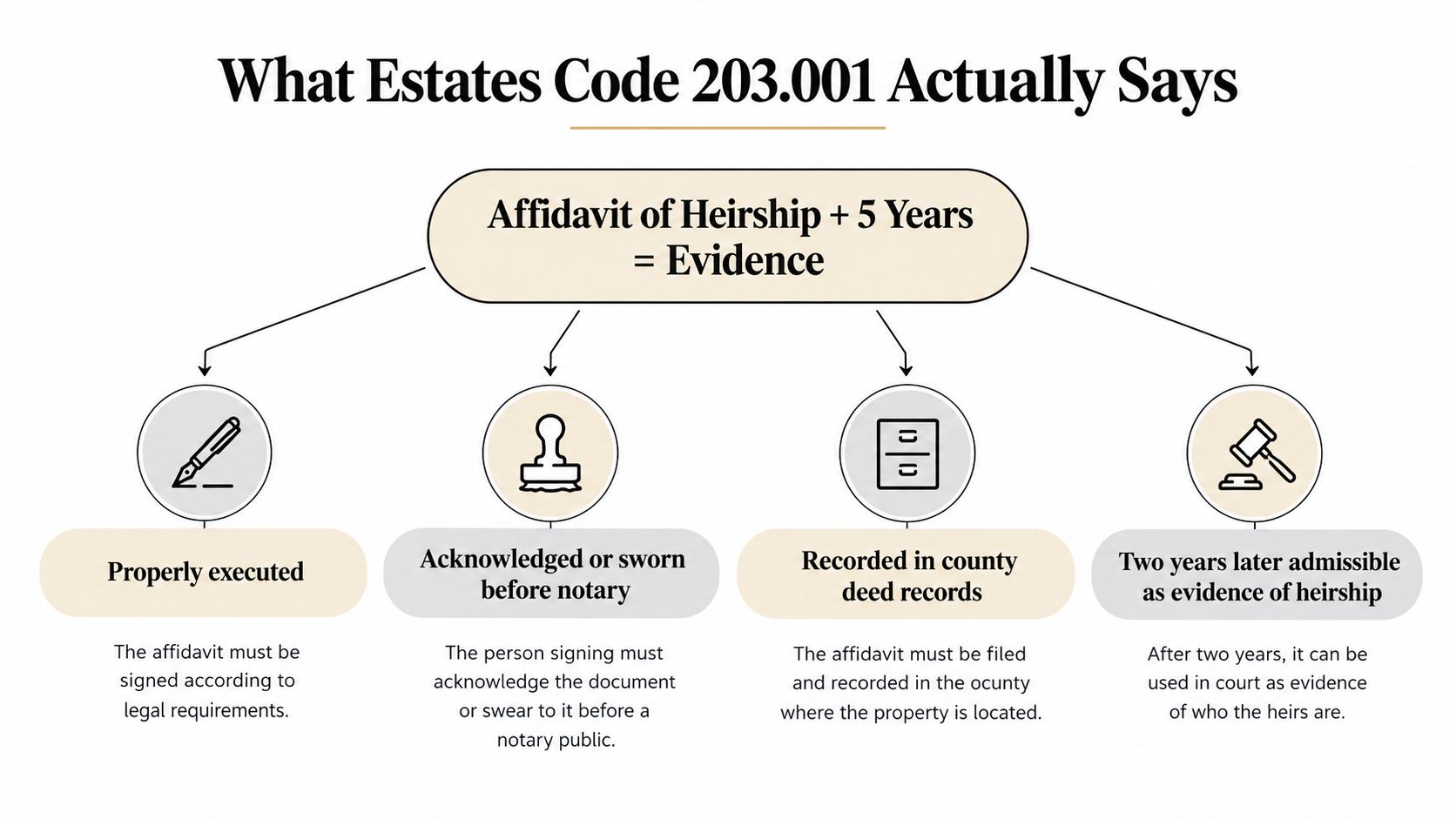
Under Estates Code § 203.001, the affidavit receives the statutory evidentiary treatment only after it has been properly executed, acknowledged or sworn, and recorded for five years or more in the appropriate deed records. Before that period has passed, the document may still help a title examiner understand the family history, but the statutory milestone hasn't matured.
That doesn't mean a family must wait five years before doing anything. If a sale, refinance, or title correction is needed sooner, the heirs may need a court proceeding or other evidence acceptable to the title company. The right answer depends on the family history, the property, the recording history, and whether anyone disputes the proposed heirship.
A grieving family shouldn't have to guess whether a form is enough. The important point is reassuring but limited: a properly prepared affidavit can be useful evidence, and the law gives it stronger treatment after the required recording period. It isn't a deed, and it isn't a court judgment.
What Estates Code 203.001 Actually Says
The statute uses formal language, but its practical meaning can be stated plainly. If an affidavit satisfies the required formalities and remains recorded for at least five years, a court must receive it as prima facie evidence of the family-history or heirship facts stated in it in certain proceedings.
Those proceedings include a proceeding to declare heirship and a title dispute. The statute applies when the document was properly executed and acknowledged or sworn, then recorded in the deed records of the county where the property is located or where the decedent was domiciled or had a fixed residence at death. Read the text of Texas Estates Code § 203.001.
Translating the legal terms
Prima facie evidence is a legal starting point. Think of it as a head start in court. The affidavit presents an initial account of who the decedent was, what family relationships existed, and who the heirs are. The opposing party can still introduce evidence showing that the account is incomplete or incorrect.
The statute does not say that the affidavit wins every dispute. It says that a qualifying affidavit must be received as initial evidence of the facts it states. A court can consider contrary evidence, including proof of an omitted heir, an undisclosed marriage, or an incorrect statement about the family.
Evidence is not the same as a transfer
An affidavit records sworn facts. It does not function like a deed signed by an owner who has authority to convey property. It also doesn't appoint an executor, administrator, or personal representative to manage estate assets.
That distinction matters during a closing. A title company may use the affidavit as part of its review, but the company may ask for additional records or a court order if the family history presents risk. The affidavit supports a claim about heirship. It doesn't independently settle every question involving ownership, creditors, personal property, or competing heirs.
The five-year period is therefore more than a customary waiting period. It's a concrete statutory milestone that affects how the document may be used as evidence. The recording date matters because the clock runs from proper recording, not from the day someone signs the affidavit.
The embedded video below provides another visual explanation of the subject:
The Statutory Elements That Make the Affidavit Count
A five-year-old affidavit isn't automatically a qualifying affidavit. The document must first satisfy the legal building blocks that give it evidentiary value. If one of those pieces is unreliable, the family may discover the problem when a buyer, lender, or court examines the record.
Proper execution and personal knowledge
The person signing the affidavit is called the affiant. That person should know the decedent and have personal knowledge of the family history. A stranger who has only heard a few family stories may not provide the reliable foundation the document needs.
The affidavit should address the facts necessary to identify the decedent and the heirs. That includes relevant marriages, divorces, children, and other family relationships that affect who may inherit. A family member's confidence isn't a substitute for a complete and truthful investigation.
Acknowledgment or sworn statement
The affiant must acknowledge the document or swear to it before an authorized officer, ordinarily a notary. This formal step confirms that the person understands the statement is being made under oath or through an official acknowledgment.
A signature placed on a document casually, followed by an attempt to notarize it later, can create avoidable questions. The signing process should be completed exactly as required before the document is recorded.

Recording in the right county
The affidavit must be recorded in the deed records of a county recognized by the statute. That may be the county where the property is located, or the county where the decedent was domiciled or had a fixed residence at death.
Recording in the wrong place can create a serious problem. Even if the family history is accurate and the signatures are proper, the recording may not satisfy the statutory requirement for the property or dispute involved.
The five-year clock
The five-year period concerns the time the qualifying affidavit has been on file in the proper deed records. Before the milestone, the affidavit may provide useful information, but it doesn't yet have the specific evidentiary status described in § 203.001.
The simplified path described in The Small Estate Affidavit in Texas is a different procedure for modest estates with no will. Families should avoid treating every affidavit as interchangeable.
How the Five-Year Rule Plays Out in a Real Texas Closing
Consider a Harris County family whose father died without a will in 2019. The family didn't open probate. In 2021, the eldest son recorded an affidavit of heirship in the county deed records. The siblings later agreed to sell the family home, and the property went under contract after the affidavit had been recorded for more than five years.
The title company's examiner would likely begin by checking the recording information. The examiner may review the date the affidavit entered the records, the county where it was filed, the identity and relationship of the affiant, and the family facts stated in the document.
What the examiner is looking for
The review isn't limited to the document's title. The examiner may compare the affidavit with other parts of the property record and ask whether the stated family history accounts for the possible heirs. Questions may arise about a surviving spouse, children from an earlier relationship, a child who died before the parent, or a person whose identity appears differently in older records.
The five-year milestone gives the affidavit the statutory position described in § 203.001. It doesn't prevent the examiner from identifying a contradiction. If the record contains unresolved concerns, the title company may request additional documentation or a judicial determination of heirship.
Practical rule: A recording receipt or certified copy can help document when the statutory period began. Keep it with the estate records instead of relying on memory years later.
The year-three contrast
Now change the facts. One sibling wants to sell in the third year after recording, before the five-year milestone. The title company may decide that the affidavit alone doesn't provide the level of evidence needed for the transaction and may require a court proceeding.
That result doesn't necessarily mean the affidavit was prepared incorrectly. It means the statutory evidentiary milestone hasn't arrived, and the underwriter may not want to accept the remaining title risk. A determination of heirship or another probate route may provide the court-based evidence needed for the closing.
The practical lesson is to ask the title company about its requirements early. Families can then compare the timing of the transaction with the recording history instead of discovering the gap after signing a contract.
Preparing and Recording an Affidavit of Heirship
Preparation should begin with the family history, not with a blank form. A careful process helps the family identify missing information before anyone signs under oath.
Step one choose the right affiant
The strongest affiant is usually a disinterested person who knew the decedent and can truthfully explain the family relationships. A person who stands to inherit may still have relevant information, but an independent witness can provide additional credibility. Families often use two knowledgeable witnesses when the facts justify it.
Ask whether the proposed affiant knows about the decedent's marriages, divorces, children, and important family changes. If the person only knows part of the story, another witness or a court proceeding may be more appropriate.
Step two build the family record
Gather available information about:
- Marriages and divorces: Identify each relevant spouse and how the relationship ended.
- Children and descendants: Account for biological and adopted children, as well as descendants of a child who died earlier.
- Residence and property: Confirm where the decedent lived at death and where each parcel is located.
- Supporting records: Review death, marriage, divorce, birth, adoption, and prior deed records when available.
The affidavit should state the family history accurately and completely. An omission may not be discovered until a later sale, when correcting the title becomes more difficult.
Step three complete the formal signing
The document should be reviewed by the people involved, signed under oath or properly acknowledged, and notarized as required. Everyone should understand that the affidavit is a sworn record, not an informal family note.
Step four record and preserve proof
Record the completed affidavit in the appropriate county deed records. If the decedent owned property in more than one county, discuss whether additional recording is needed for the properties involved. Keep the recording information, certified copy, and related family records together so the date can be established later.
The firm's team prepares these affidavits routinely and can help families evaluate the facts before signing. You can also review the Texas Probate Process and Determination of Heirship in Texas resources for information about court-based alternatives. Families who need forms should use Texas affidavit of heirship forms carefully, because a template cannot investigate the family history for you.
Risks and Limits of Relying on an Affidavit of Heirship
The phrase prima facie evidence can sound stronger than it is. After the statutory recording period, the affidavit receives an important evidentiary advantage, but another party may still challenge the facts it contains.
A long-lost heir may claim that the affidavit omitted a child. A surviving spouse may have been overlooked. A marriage or divorce may not have been disclosed. If the document states an incorrect family fact, opposing evidence can weaken or defeat the presumption.
When perfect paperwork still fails
Formal execution doesn't cure a false or incomplete family history. An affidavit can be signed, notarized, recorded, and left on file for the required period, yet remain vulnerable if the underlying facts are wrong.
That's why blended families deserve special care. Children from multiple marriages, estrangement, adoption, uncertain paternity, and missing relatives can all make the family tree harder to establish. A family may believe everyone agrees because the people present agree, while an absent or unknown heir has a different legal interest.
Title companies still assess risk
The statute tells a court how to receive a qualifying affidavit as evidence. It doesn't require every title company or lender to accept the document without further review. Underwriters may remain cautious when the family history is unclear, the transaction is time-sensitive, or the record contains inconsistencies.
The affidavit also has a limited subject. It primarily documents heirship facts connected to real property. It doesn't appoint someone to manage the estate, collect debts, handle creditor claims, or control every asset owned by the decedent.
A recorded affidavit can support a title claim, but it can't replace honest family investigation or court authority when the estate needs broader administration.
Warning signs that call for another path
Pause before relying on an affidavit when:
- The family disagrees: A dispute about heirs or ownership usually calls for court involvement.
- The marital history is unclear: An undisclosed spouse can change the heirship analysis.
- An heir may be missing: Unknown or unreachable heirs create title and notice concerns.
- The estate includes broader assets: Bank accounts, investments, vehicles, debts, or business interests may require another process.
- The affidavit contains an error: Don't ignore a mistake. Have counsel evaluate whether a corrective filing, additional evidence, or court proceeding is needed.
These risks are manageable when addressed early. They become more expensive when discovered after a buyer has signed a contract or a lender has begun underwriting.
Affidavit of Heirship Versus Probate and Muniment of Title
An affidavit is only one way to address a deceased owner's property. The appropriate path depends on whether there is a will, whether the heirs agree, whether the estate has debts or other assets, and how much certainty the transaction requires.
Families who want a general overview of the court process can also consult this Texas probate guide from Cremation.Green. It can help explain the broader vocabulary before a family speaks with counsel.
| Path | Court Involvement | Best Used When | Strength of Title Evidence |
|---|---|---|---|
| Affidavit of heirship | Usually recorded in county deed records | The family history is clear and the matter centers on Texas real property | Sworn evidentiary support, with the statutory treatment after the required recording period |
| Probate administration | Court-supervised | The estate has debts, broader assets, a need for an administrator, or disagreement | Court-based authority and administration |
| Muniment of title | Court proceeding | A valid will supports transfer and a full administration isn't needed | Court-based evidence through the will |
| Determination of heirship | Court proceeding | Heirs need a binding judicial determination or the affidavit route is risky | Strong court judgment identifying the heirs |
What each alternative accomplishes
A full probate administration can place an executor or administrator in a position to handle estate property, debts, and distribution. It may be appropriate where the family needs authority over more than land or where a dispute requires structured court supervision. Families considering broader planning can review the firm's Wills & Trusts services.
A muniment of title is different because it uses a court proceeding to establish a will as the document supporting title. It isn't the same as an affidavit for intestate heirship. The existence, validity, and timing of a will matter.
A formal determination of heirship asks the court to identify the heirs. It may be preferred when the family history is contested, a possible heir is missing, or a title company wants a judgment rather than a recorded family statement. If the dispute has already become adversarial, Probate Litigation may be relevant.
For a more focused comparison of the nonjudicial and court-based routes, see affidavit of heirship versus probate in Texas. The goal isn't to choose the shortest form. It's to choose the process that produces evidence and authority suitable for the estate and the transaction.
Key Takeaways and Your Next Step
An affidavit of heirship can be a useful tool for a Texas family dealing with real property after a death. It can also create a serious title problem when people treat it as a substitute for investigation, a deed, or a court judgment.
The points to remember
- The five-year rule is statutory. Under § 203.001, a qualifying affidavit receives its specific prima facie evidentiary treatment after it has been recorded for five years or more in the proper deed records.
- The formalities matter. The affidavit must be properly executed, acknowledged or sworn, and recorded in a county recognized by the statute.
- The evidence is rebuttable. Another party can challenge an omitted heir, an undisclosed marriage, or an incorrect family-history statement.
- The document has a limited purpose. It can support heirship evidence for real property, but it generally isn't a universal method for collecting bank accounts, transferring vehicles, administering debts, or managing every estate asset.
- A court proceeding may be safer. Complicated family histories, missing heirs, disputes, and broader estate administration needs can make probate or a determination of heirship more appropriate.

What if the affidavit is already wrong
Don't sign a new document that merely repeats the mistake. Preserve the recorded affidavit, identify the incorrect statement, gather documents that clarify the family history, and ask a Texas probate attorney whether a corrective filing, additional evidence, or a judicial proceeding is needed.
If the affidavit has been recorded but the family needs access to bank accounts or a vehicle transfer, contact each institution to learn its requirements. Those assets may require probate documents or another procedure, even when the real estate record contains an affidavit of heirship.
Losing someone you love is difficult enough without discovering a title problem years later. A careful review now can help your family understand whether the affidavit is sufficient, whether the five-year milestone has been reached, and whether a court-based solution would provide better protection.
The Law Office of Bryan Fagan, PLLC can review your family history, affidavit, recording information, and title concerns, then explain whether an affidavit, probate administration, or determination of heirship fits your situation. Visit Law Office of Bryan Fagan, PLLC to schedule a free consultation. If you're facing probate in Texas, our team can help guide you through every step, from filing to final distribution. Schedule your free consultation today.


