 Skip to content
A funeral home may be waiting for payment while a Texas family is still trying to understand who has authority to act. The decedent's bank account may be inaccessible, relatives may live in different states, and no one may yet hold legal authority to manage the estate. Grief becomes mixed with urgent decisions about burial, cremation, transportation, and payment.
Texas law recognizes that some funeral expenses cannot wait for a full probate administration. The emergency intervention procedure under Chapter 152 can provide a narrow path to funds when heirs can't be found or refuse to pay. It isn't a substitute for probate, and it doesn't release every estate asset, but it can help address an immediate and dignified funeral need.
The phrase “Estates Code 451 emergency intervention for funeral expenses Texas” can create confusion because the emergency procedure discussed here is found in Chapter 152, while the broader priority rules for funeral claims are found in Chapter 355. Understanding the difference matters. One route addresses an immediate payment request, while the other addresses reimbursement and priority after estate administration begins.
When a Funeral Bill Cannot Wait for Probate
A daughter in another state learns that her father has died in Houston. The funeral home needs an answer, but the bank won't release money from his account because no personal representative has been appointed. She knows her father had funds, yet those funds feel unreachable at the exact moment they're needed.
That situation can leave a family feeling trapped. The funeral provider needs payment, relatives may disagree about who should act, and the ordinary probate process can seem too slow for decisions that must be made now. No grieving family should have to guess whether touching an account could create personal liability or violate Texas law.
Texas created an emergency path for this kind of problem. Under Chapter 152, a qualified administrator applicant may ask the probate court to intervene when heirs cannot be found or refuse to pay funeral and burial costs. If the court determines that emergency action is necessary, it can order money held by a person, employer, or financial institution to be paid directly for appropriate expenses.
Practical rule: The emergency procedure is court-controlled access to limited funds, not informal permission for a relative to withdraw money.
Families often ask whether beneficiaries can access funds before the probate case is complete. The answer depends on the type of account, the person's legal authority, and the court procedure that applies. A helpful overview of that issue appears in guidance about accessing funds before probate is complete in Texas.
This article focuses on the emergency intervention route, who may seek it, what information supports an application, and how funeral instructions or cremation disputes can affect timing. It also explains the difference between the direct emergency payment limit and the larger priority claim that may be filed during probate.
You're not the first family to face a frozen account and an urgent funeral decision. The law provides a structured way to ask the court for help while keeping the request limited and accountable.
What Emergency Intervention Under Chapter 152 Means
Probate is the legal process used to identify estate property, address valid debts, and transfer what remains to the people entitled to receive it. Before that process gives someone authority, a family member usually can't use the decedent's bank account to pay bills, even if the person is an heir.
Chapter 152 creates a limited exception for funeral and burial expenses. If heirs can't be located or refuse to pay, a qualified administrator applicant may ask the court to order money held by an individual, employer, or financial institution to go directly toward reasonable, dignified, and appropriate funeral and burial costs. The governing statute is Texas Estates Code Chapter 152.
Think of the procedure as an emergency valve on a locked pipe. The estate's funds remain protected, but the court may open a narrow channel for an urgent purpose. The applicant doesn't receive unrestricted control of the account, and the order doesn't resolve every question about ownership, heirs, or later distributions.
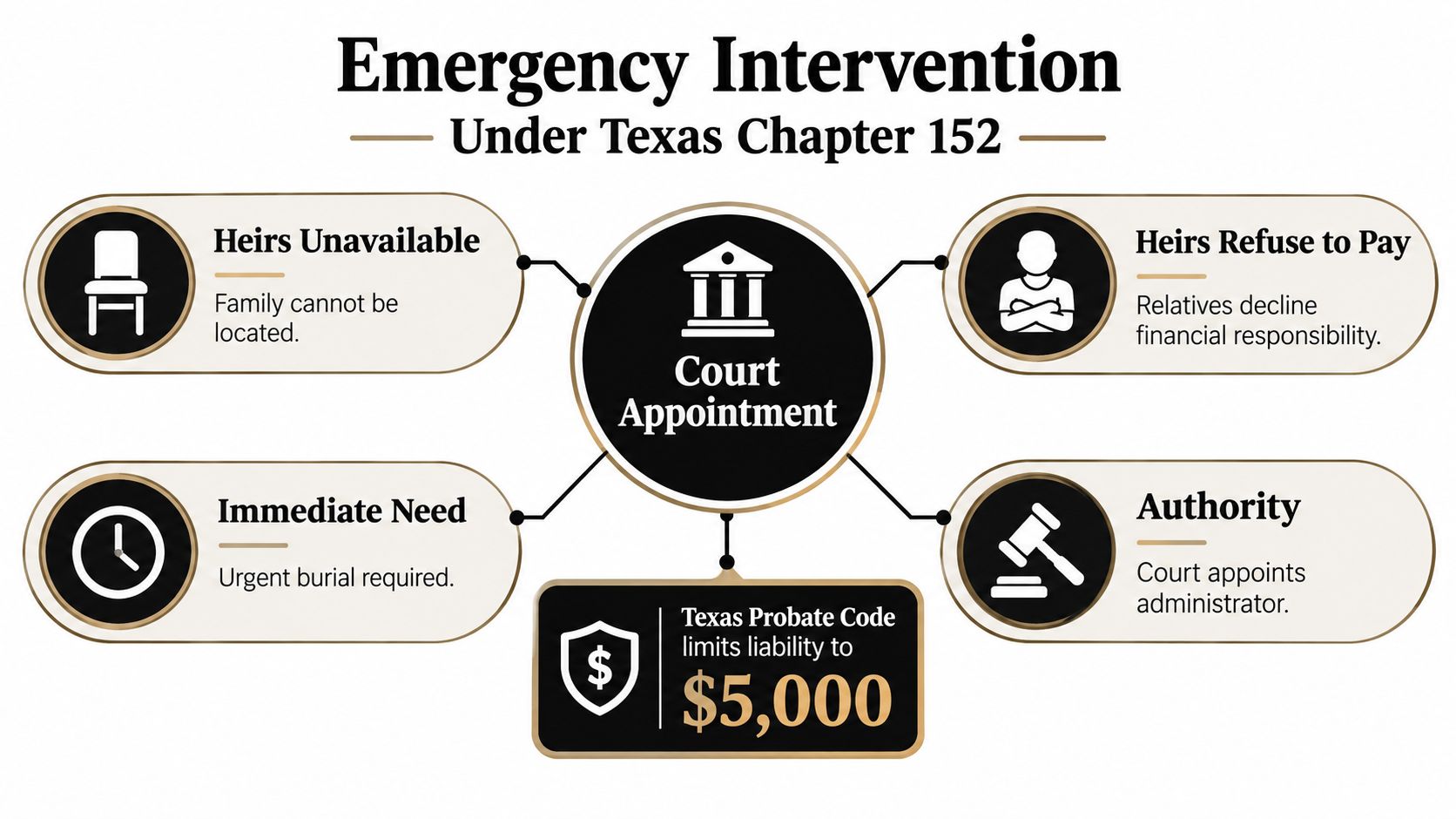
The direct emergency payment is limited to $5,000 for funeral and burial expenses under Chapter 152. The court may approve attorney's fees and court costs separately, but those amounts aren't part of the funeral and burial expense cap.
Why the court stays involved
The court's role protects several interests at once. It helps the family avoid an unnecessary delay, gives the funeral provider a lawful payment path, and prevents estate funds from being distributed casually. The judge evaluates whether emergency intervention is necessary and whether the requested expenses are reasonable and appropriate.
Texas State Law Library guidance explains that funeral and last-illness expenses receive high priority in probate, while also describing the emergency route when heirs can't be found or refuse to pay. Families can review that Texas probate guidance on expenses before probate for additional context.
The emergency order is therefore a bridge. It can address an immediate funeral need before the broader probate administration is resolved, but it doesn't replace the later accounting, creditor process, or distribution of the estate.
For families who need immediate court action, Texas emergency probate guidance can help explain why timing and legal authority matter.
Who Can Ask the Court and When It Applies
The procedure isn't designed for every unpaid funeral bill. It applies when the estate has funds that may be reachable and the people who would ordinarily handle the expense can't be found or won't pay it.
A qualified administrator applicant is a person seeking appointment to administer the estate and who meets the legal requirements to ask the court for that appointment. This person may be an heir or another eligible individual, depending on the circumstances and the court's evaluation. The important point is that the applicant is asking to take on a formal estate role, not merely requesting personal access to a relative's money.
The trigger may look different from family to family:
- Out-of-state relatives: An heir may live far away, may not know how to respond, or may be difficult to locate.
- Estranged families: Relatives may know about the death but refuse to accept financial responsibility for the funeral.
- Unclear authority: Several people may believe they should act, while no one has yet been appointed.
- Available estate funds: Money may be held by a bank, an employer, or another person who owes or possesses funds belonging to the decedent.
The court's order can reach money held by an individual, employer, or financial institution. For example, an employer may possess unpaid wages, while a bank may hold a deposit account. The order directs the holder how to pay the approved expense. It doesn't give the applicant a blank check.
A simple self-assessment
Ask three questions. Is there a funeral or burial need that requires prompt payment? Are heirs unavailable or unwilling to pay? Is there a qualified person who can seek appointment and provide the court with reliable information about the estate and the requested expense?
If the answer to each question is yes, the situation may fit the emergency procedure. If relatives are available and willing to pay, or if no estate funds can be identified, another payment or probate strategy may be more appropriate.
Confusion over authority often causes families to delay decisions. A funeral provider may be ready to proceed, but a bank may be prohibited from releasing funds without a court order. That tension is precisely why applicants should document who has been contacted, what responses were received, and why waiting for ordinary administration would create a genuine emergency.
The court's involvement also helps separate personal responsibility from estate responsibility. A relative who signs a funeral contract may have obligations under that contract, while an approved court order addresses payment from the decedent's funds. Those are related but different questions.
How to File for Emergency Funeral Funds
A careful application gives the judge a clear picture of the emergency, the available funds, and the exact payment being requested. The process should be treated as a focused court request, not as a general petition to open every estate account.
Start with the funds
Identify whether the decedent left money that may cover the expense. Note where the money is held, such as a bank, employer, or individual. Gather account information or other records that show why the funds appear to belong to the estate.
The applicant should also determine whether someone with legal standing can seek appointment as administrator. If no one is qualified or willing to take that role, the emergency procedure may not provide the expected solution.
Prepare the factual request
The application should describe the death, the urgent funeral or burial need, the expected cost, and the reason ordinary payment cannot happen immediately. A funeral-home estimate or invoice can help show the amount requested and the services involved.
Useful supporting materials may include:
- Funeral documentation: An estimate, invoice, contract, or written description of the requested service.
- Asset information: Records identifying the account, unpaid wages, or other funds that may be available.
- Family communications: Messages or other documentation showing that heirs can't be located or have refused to pay.
- Applicant information: Facts showing why the person seeking relief is qualified to request appointment.
- Funeral instructions: Any written burial or funeral directions left by the decedent.
Written funeral or burial instructions deserve special attention. The application must disclose those instructions and attach them when available. The applicant must also comply with them. If the decedent left written directions, the family shouldn't treat them as a minor detail because the funeral must be arranged quickly.

The court may review the application and determine whether an order is necessary. The order should identify the approved payment and the person or institution directed to release the money. Because the purpose is narrow, precision matters. A request that combines unrelated expenses or lacks documentation may create questions that slow the hearing.
A Texas Probate Lawyer may provide representation through Texas probate and estate administration, including help organizing the application and supporting materials.
The payment is generally directed toward the funeral provider or another appropriate recipient rather than handed over for unrestricted personal spending. That structure protects the estate and creates a record for the later administration.
This video may provide additional general context about emergency probate action:
Families should keep copies of the application, order, invoice, and proof of payment. Those documents may matter when the personal representative later prepares the estate's records and addresses claims.
A Realistic Scenario and the Cremation Consent Rule
Maria lives outside Texas when she learns that her father died in Houston. No will has been located. His bank refuses to release money because Maria hasn't been appointed to administer the estate, and the funeral home needs instructions and payment before it can finalize arrangements.
Maria may have a path to seek emergency intervention if she is a qualified administrator applicant and can show the court that the need is urgent. She would need to identify the estate funds, explain why other heirs can't be found or refuse to pay, and provide the funeral documentation. The emergency request could address the immediate funeral expense while the broader probate case continues separately.
That separation matters. Maria wouldn't be asking the court to decide every inheritance question at the emergency hearing. She'd be asking for a controlled payment for a defined purpose, leaving later administration to address the estate's debts, assets, and distributions.

Why cremation can change the timing
The application must disclose written funeral or burial instructions and comply with them. If the decedent left written directions, those instructions may determine whether the family should pursue burial, cremation, or another stated arrangement.
If no written instructions exist, cremation generally requires court permission under the applicable Texas Estates Code procedure. That requirement can become especially important when relatives disagree about cremation. A family might agree that a funeral is urgent but still dispute whether the decedent should be buried or cremated.
A burial-versus-cremation disagreement can turn a focused payment request into a contested issue. The applicant should identify the disagreement early, gather any writings or evidence of the decedent's wishes, and avoid presenting the court with incomplete information.
A fast filing can't eliminate a genuine dispute about the decedent's instructions. It can, however, give the judge the information needed to address the dispute lawfully.
Funeral providers can help by preserving written instructions, documenting who gave authorization, and separating service decisions from payment questions. Heirs can help by communicating promptly and putting their positions in writing. Those steps don't guarantee agreement, but they reduce the risk that a missing document or unclear instruction causes avoidable delay.
The 5,000 Dollar Cap Versus the 15,000 Dollar Probate Claim
A funeral bill can create two separate legal questions: how to pay an urgent expense now, and how to classify that expense during estate administration. Texas addresses those questions through two different mechanisms. Chapter 152 provides a narrow emergency route. Chapter 355 governs priority and payment of claims after a personal representative is administering the estate.
The emergency route works like a bridge over an immediate cash-flow problem. It may allow the probate court to order payment from estate funds before the full administration is resolved. The later probate claim process is the accounting system that determines which expenses receive priority and how they are handled with other estate debts.
| Feature | Chapter 152 Emergency Intervention | Chapter 355 Class 1 Claim |
|---|---|---|
| Main purpose | Immediate payment for an urgent funeral or burial need | Reimbursement and payment during estate administration |
| Timing | Before full probate administration is resolved | After a personal representative is handling the estate |
| Amount | Direct funeral and burial payment capped at $5,000 | Up to $15,000 of funeral expenses receives Class 1 priority under Estates Code Section 355.102 |
| Who controls payment | The probate court through a specific emergency order | The personal representative through the claims process |
| Related expenses | Limited to the approved emergency request | Section 355.110 recognizes items incident to the funeral, including a tombstone, grave marker, crypt, or burial plot |
| Priority | A narrow emergency payment mechanism | Class 1 claims are paid before most other estate debts |
Under Chapter 152, the direct emergency payment is capped at $5,000. That cap does not mean Texas recognizes only $5,000 of funeral expenses. Chapter 355 can treat up to $15,000 in funeral expenses as a Class 1 claim. Any amount above that limit moves into a lower-priority unsecured category. Payment still depends on the estate's available assets.
Section 355.103 separately identifies $15,000 for last-illness expenses as a Class 1 amount. These are costs for care and treatment connected to the decedent's final illness. Funeral expenses arise after death. Keeping the two categories separate helps the personal representative document and evaluate each claim correctly.
Section 355.110 can cover more than the funeral ceremony. The personal representative should review the funeral-home invoice, cemetery charges, grave marker or tombstone costs, crypt expenses, and burial plot charges. These items must fit the statutory categories and should be supported by invoices, receipts, and payment records.
The two routes may address different stages of the same expense. Chapter 152 may resolve an immediate payment problem, while a later Class 1 claim may address reimbursement and related qualifying costs during administration. One route does not automatically replace the other.
For a closer explanation of the priority rules, see Estates Code Section 355.102 and creditor claims in Texas probate.
Key Takeaways and Your Next Steps
Key Insight
The emergency procedure and the probate claims process answer different questions:
- Immediate burial need: Chapter 152 may allow a qualified administrator applicant to request court-controlled payment when heirs can't be found or refuse to pay.
- Emergency payment limit: The direct funeral and burial payment is capped at $5,000, with attorney's fees and court costs potentially approved separately.
- Later reimbursement: Chapter 355 can treat up to $15,000 in funeral expenses as a Class 1 claim during estate administration.
- Cremation decisions: When written funeral instructions aren't available, cremation generally requires court permission.
- Related burial items: The probate framework can include items such as a tombstone, grave marker, crypt, or burial plot when they fit the statutory categories.

If you're an executor
Locate the estate's financial accounts and preserve every funeral-related invoice. Determine whether the expense should be addressed through emergency intervention, a later Class 1 claim, or both. Keep a written record of payments, communications with heirs, and the reasons for each estate disbursement.
If you're an heir
Don't withdraw money from the decedent's account because you believe you'll inherit it. Tell the family and funeral provider whether you can pay, can't pay, or object to a proposed arrangement. If you're out of state, respond promptly and provide any written funeral instructions or information about the decedent's wishes.
If you're a funeral provider
Give the family a clear written estimate or invoice and identify the services and burial-related charges separately. Ask whether the decedent left written instructions and preserve any documentation provided. If payment depends on a court order, coordinate with the applicant so the requested order identifies the appropriate recipient and approved expense.
The broader probate process may involve validating a will, appointing an administrator, inventorying property, paying debts, and distributing the estate. Families dealing with those responsibilities can review information about the Texas probate process, while those handling capacity or care decisions may need guidance about guardianship. Planning ahead may involve wills and trusts, and a dispute over instructions, authority, or payment may require advice about probate litigation.
You don't have to solve the emergency payment question and the entire estate at the same time. Focus first on lawful authority, the immediate funeral need, written instructions, and reliable documentation. Then address the remaining probate issues through the proper administration process.
If you're facing probate in Texas, our team can help guide you through every step, from filing to final distribution. Schedule your free consultation today.
The Law Office of Bryan Fagan, PLLC offers guidance with emergency probate filings, estate administration, funeral expense claims, and related disputes involving heirs or personal representatives. Visit Law Office of Bryan Fagan, PLLC to connect with a Texas probate team and discuss the facts of your family's situation.


