After a loved one dies, families often find themselves making decisions before they have had time to grieve. A house still needs maintenance, bank accounts remain frozen, medical bills arrive, and everyone wants to know who is legally allowed to act. When there is no will, Texas Estates Code §401.003 can give an agreeing family a way to administer the estate with less continuing court involvement, but the procedure depends on proving who the heirs are and obtaining consent from every distributee.
The phrase estates code 401.003 independent administration by agreement of distributees sounds technical. In practical terms, it describes a narrow Texas probate route for an intestate estate, meaning an estate belonging to someone who died without a valid will. This guide explains what the statute does, what it doesn't do, and where families most often encounter difficulty.
When a Texas Family Has No Will and Wants a Simpler Probate
Three siblings sit around a kitchen table in Houston after their father dies. He left a house, a small ranch account, and an unpaid medical bill. There is no signed will in the desk, no executor named in a bank file, and no obvious person with authority to sell the house or pay the bill.
The siblings may agree about nearly everything. They may trust one another and want the oldest sibling to handle the practical work. But agreement around the kitchen table doesn't create legal authority. The family still needs a probate court to determine the heirs and appoint someone to administer the estate.
Without an available independent-administration route, the estate generally proceeds through dependent administration, the more closely supervised path. A dependent administrator typically returns to court for authority before taking significant actions. That can mean added filings, hearings, delay, and expense when the family is otherwise cooperating. Families looking for a plain-language overview of the broader process can review this guide to probate without a will in Texas.
Who the distributees are
A distributee is a person entitled to inherit from an intestate estate under Texas inheritance law. Distributees may include a surviving spouse, children, or other relatives, depending on the family structure and the property involved. The label isn't based on who feels most responsible for the estate. It concerns legal entitlement.
Section 401.003 permits all distributees of an intestate decedent to agree on independent administration and jointly designate a qualified person, firm, or corporation to serve as independent administrator. The court must grant the request unless it finds that the arrangement isn't in the estate's best interest, but the court can't appoint the independent administrator until the parties seeking appointment have been determined through a Chapter 202 heirship proceeding to be all of the decedent's heirs. The statute therefore contains a practical bottleneck, unanimous agreement must come after a reliable determination of who must agree.
Texas has favored reduced court supervision for generations. Legal scholarship traces independent administration to the Republic of Texas in 1843, and Texas became the first state to allow it in 1848, according to the Texas Bar discussion of independent executor removal law. For today's families, the historical lesson is simple: Texas law allows cooperation to replace much of the court's ongoing supervision, but only when the statutory conditions are satisfied.
What Section 401.003 Says in Plain English
A Texas family may agree on who should handle an estate, yet still cannot skip the legal steps that prove everyone entitled to inherit has been included. Section 401.003 creates a narrow, family-shaped procedure for obtaining independent administration when there is no controlling will. It is not permission for one relative to take charge because that person handled the funeral, paid a bill, or seems most responsible.
The requirements in everyday language
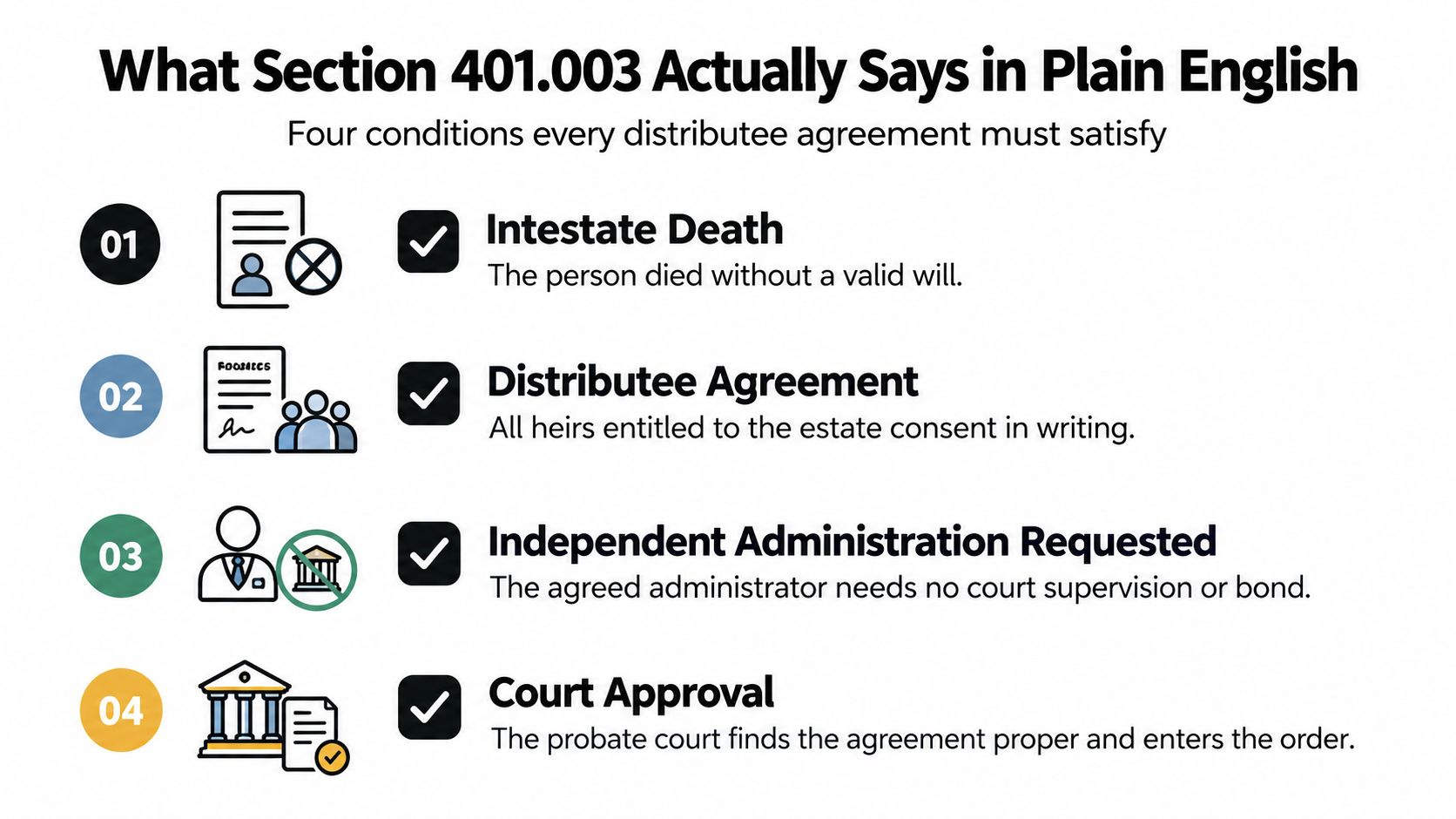
First, the estate must be intestate. The decedent must have died without a valid will controlling the administration. A diligent search that finds no enforceable will may place the estate in this framework. If a will exists but the court sets it aside, the estate may also proceed under intestacy, subject to the court's ruling.
Second, the heirs must be identified. The probate court needs a legally supported answer to “Who are all the heirs?” A relative who appears to inherit may not be the only distributee. Unknown, distant, adopted, half-blood, or disputed family relationships can change who must be included.
That heirship question often becomes the bottleneck. The family cannot obtain a valid unanimous agreement until the court has a reliable determination of everyone whose consent matters.
Third, every distributee must agree. This is an all-distributee agreement, not a majority vote. If four people inherit, three signatures do not suffice. Minors and incapacitated distributees may require authorized representation and court protection.
Fourth, the distributees must jointly designate a qualified administrator. They must identify the person, firm, or corporation that will serve. That representative will handle estate property, debts, notices, and distribution under the Texas Estates Code.
This path differs from dependent administration, where the court maintains closer supervision. It also differs from letters testamentary, which generally appoint an executor under a will. Section 401.003 is for an intestate estate whose distributees agree to a named independent administrator.
The overview of probate court procedures under the Texas Estates Code places §401.003 within the broader statutory framework. Families may also review Independent Administration in Texas for a factual explanation of this lower-supervision option.
A print-friendly checklist
- No controlling will: Confirm intestacy or a court order setting aside the will.
- Complete heir identification: Establish every heir through the required heirship process.
- Unanimous written consent: Obtain agreement from every distributee, with proper representation where required.
- Joint designation: Name a qualified independent administrator.
- Court approval: Request the appointment order and appropriate letters.
One overlooked distributee can prevent the agreement from satisfying Section 401.003.
The Legal Effect of Independent Administration on Your Estate
A family may receive the appointment order and still misunderstand what it changes. The order does not hand the administrator personal ownership of estate property. It gives that person authority to manage the estate's business, subject to fiduciary duties, the Texas Estates Code, and the rights of the distributees.
The practical effect is fewer routine trips to the probate court. An independent administrator can generally collect assets, address valid debts and claims, maintain or sell property when permitted, and distribute the estate without requesting a separate order for each substantial task. In an independent case, the representative acts under the appointment and the Estates Code, as explained in this overview of independent administration without court supervision in Texas.
That authority sharply contrasts with dependent administration. A dependent administrator commonly needs court approval before significant transactions, with the judge providing continuing supervision. Letters testamentary usually appoint an executor under a will. Section 401.003 instead supports an independent administrator for an intestate estate when the people entitled to inherit agree to that arrangement.
Texas State Law Library guidance describes independent administration as typically faster and less expensive than formal administration, with fewer routine court appearances while the representative collects property, pays debts, and distributes what remains. The court still handles the initial appointment and required filings, including notice-related documents and an inventory or permitted affidavit in lieu of inventory within the applicable period. See the library's explanation of formal administration in Texas probate.
What changes and what remains
Independent administration changes the level of routine court involvement, not the administrator's responsibility. The administrator must protect estate property, keep reliable records, address creditor matters, communicate as required, and distribute assets under Texas law. A beneficiary may challenge misconduct, and the court may act when the Estates Code permits or requires it.
The appointment order should state requested powers clearly. If the administrator is to serve without bond or receive a power of sale, those terms should be requested expressly and supported by the required sworn consents. Dallas County's uncontested intestate independent administration checklist shows why appointment consent, a bond waiver, and expanded powers are separate matters.
| Action or Filing | Dependent Administration | Independent Administration Under §401.003 |
|---|---|---|
| Court involvement | Ongoing supervision and orders for significant acts | Initial proceeding and required statutory filings |
| Estate property | Major actions generally require court authority | Administrator generally acts without a separate order |
| Inventory | Filed as required by law | Inventory or permitted substitute remains required |
| Bond | Commonly part of supervised administration | May be waived when properly requested and consented to |
| Family oversight | Court supplies continuing structure | Beneficiaries rely more on fiduciary duties, records, and remedies |
Independent administration is less routine supervision, not an absence of rules. That distinction matters when a family expects flexibility but still needs accountability.
How the 401.003 Process Moves Through the Probate Court
A family usually starts by gathering the death certificate, property records, account information, family-history documents, and any evidence about a possible will. A Texas probate attorney can then determine whether the estate needs a full administration, a Chapter 202 heirship proceeding, or another procedure under Titles 2 and 3 of the Estates Code.

Step one involves heirship
Because subsection (b) gates the appointment on a Chapter 202 determination, the application generally includes a request to determine heirship. The court reviews sworn pleadings and supporting evidence, provides notice and citation to interested parties, and determines the legal heirs. The purpose is not ceremonial. The court must know who all the distributees are before their agreement can support independent administration.
Families should discuss difficult questions early. Was there a prior marriage? Did a child die before the decedent? Are there children whose whereabouts are unknown? Is an adoption, guardianship, or informal family relationship relevant? A small omission at the beginning can create a larger problem when the court reviews the proposed heirship judgment.
For broader practical support after a death, families may also find this guide for Texas families after a death useful while gathering records and handling immediate responsibilities.
The distributees then sign the written agreement and jointly designate the proposed independent administrator. Section 401.004 requires citation and notice to distributees unless they waive service or appear in court, and it permits a guardian of an incapacitated distributee to consent on that person's behalf. The paperwork should identify the decedent, state the intestate status, identify the distributees, request independent administration, and address any bond waiver or power of sale being sought.
The court reviews the evidence and enters an order if the statutory requirements are met and independent administration is in the estate's best interest. Letters then establish the representative's authority to act for the estate.
The inventory is a central milestone
Texas Law Help describes independent administration as leaving the court involved mainly at the beginning and for a limited set of statutory filings, including notice to creditors and a sworn inventory or affidavit in lieu of inventory within 90 days. The inventory identifies estate property and helps the family understand what must be collected, protected, sold, or distributed.
After debts, expenses, and administration responsibilities are addressed, the administrator can distribute the remaining property. The estate may then be closed through an appropriate final filing or affidavit, depending on the circumstances and the advice of counsel. A careful closing process protects both the heirs and the person who served.
Choosing Between 401.003 and Other Texas Administration Paths
Not every intestate estate should use §401.003, and not every estate can use it. The best path depends on the existence of a will, the identity and legal capacity of the distributees, the nature of the assets, unpaid debts, and the family's ability to cooperate.
An estate with a will may qualify for independent administration through the will's language or through another statutory agreement route. In that setting, the appointed person is commonly described as an independent executor and receives letters testamentary, which are the court-issued documents showing the executor's authority. A will can make the route more direct because the decedent may already have named the person and expressed the desired administration style.
Section 401.003 is different. It is designed for an intestate estate where all distributees agree on both the independent administration and the person who should serve. The agreement substitutes for the missing direction in a will, but it doesn't substitute for heirship proof.
| Path | Court Supervision | Unanimous Consent | Best For |
|---|---|---|---|
| Independent administration under a will | Limited after appointment | Not necessarily required when the will authorizes it | A valid will that requests independent administration |
| §401.003 agreement | Limited after appointment, subject to statutory filings | Required from all distributees | An intestate estate with complete family agreement |
| Dependent administration | Continuing supervision | Not required for the family to choose the path | Estates with disagreement, uncertainty, or a need for court structure |
| Small-estate affidavit under §205.001 | Avoids a full administration when statutory requirements are met | Family signatures and required facts still matter | Qualifying small intestate estates |
| Muniment of title | Probate admits a will without appointing an administrator | Depends on the will and statutory requirements | Certain estates where title transfer is the primary need |
The Texas Probate Process can involve one of these alternatives rather than a full administration. A small-estate affidavit or muniment of title may be more appropriate when the estate's circumstances meet their separate requirements.
A practical decision rule is straightforward. Consider §401.003 when there is no will, every distributee can be identified and properly represented, everyone agrees to the proposed administrator, and the estate needs full probate rather than a simplified alternative. If consensus fails, dependent administration may provide the structure needed to protect competing interests.
Where Unanimous Agreement Breaks Down in Real Cases
Families often say, “Everyone agrees,” before they have identified everyone who legally counts. That distinction matters. Consent from the relatives at the table isn't enough if another distributee is a minor, incapacitated, unknown, missing, or entitled through a less obvious family relationship.
Four recurring obstacles
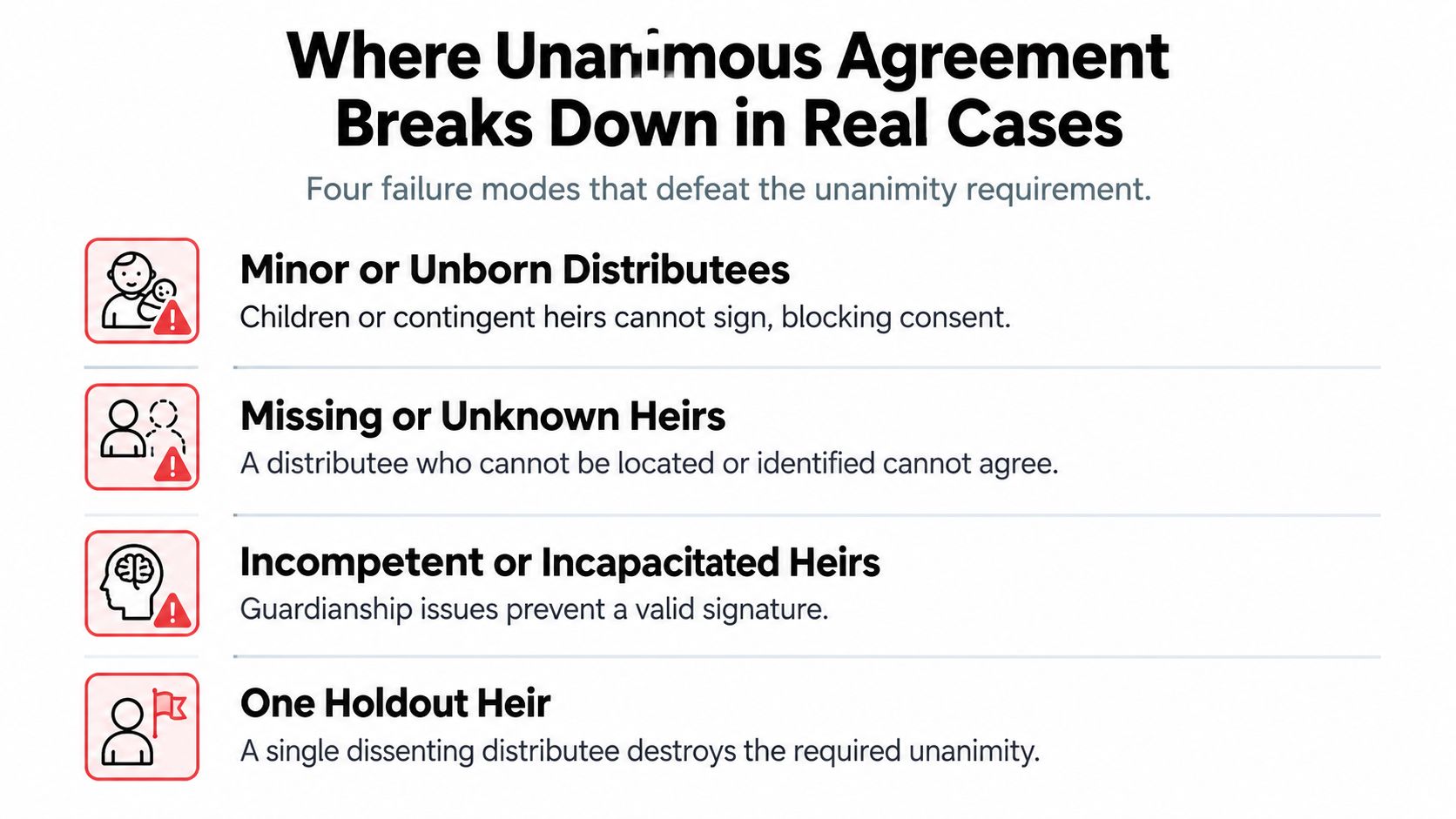
A minor or unborn contingent distributee cannot sign an agreement as an adult would. A guardian, guardian ad litem, or other court-approved representative may be necessary, depending on the interest and circumstances. Dallas County guidance indicates that courts often will not grant independent administration in intestate cases when minors or incapacitated adults are among the heirs, except under special circumstances. The court's protective role can outweigh the family's preference for a less supervised process.
An incapacitated heir may need a guardian or another authorized representative. Section 401.004 allows a guardian of an incapacitated distributee to consent on that person's behalf, but the representative must have authority to bind the interest. A signature from a relative who isn't legally authorized may not solve the problem.
A missing or unresponsive distributee creates a different difficulty. Silence isn't the same as written consent. The family may need additional notice, a court-appointed representative, or a more involved heirship process before the court can determine whether the statutory conditions are satisfied.
One dissenting heir can close the agreement route. That person may distrust the proposed administrator, fear that property will be sold too quickly, or prefer court oversight. The disagreement doesn't mean the heir is being unreasonable. Dependent administration can offer a neutral structure when the family can't manage the estate cooperatively.
Practical rule: Before filing, identify every possible distributee and ask what would make each person comfortable with the proposed administrator, records, bond, and distribution plan. Resolving a concern early is usually easier than repairing a defective consent after filing.
Sample Agreement Language and Clauses Texas Families Use
A written agreement should tell the court exactly what the distributees are agreeing to. It should connect the family facts to the statutory request, identify the proposed administrator, and avoid vague language that leaves important authority uncertain.
A basic structure may look like this:
“The undersigned, being all distributees of [decedent], who died intestate, consent to independent administration of the estate under Texas Estates Code §401.003. The undersigned jointly designate [name] as the qualified independent administrator and request that the court appoint [name] to serve without bond, if legally authorized and approved by the court.”
That sample is a starting point, not a form to sign without review. The agreement may also include a recital that the family conducted a diligent search for a will, a statement that all distributees have been identified through the heirship proceeding, and provisions addressing citation or notice when a lawful waiver is available.
Clauses that deserve careful attention
The document should use clear phrases such as “by agreement of the distributees,” “independent administration under Texas Estates Code §401.003,” and “without further court order,” but those words must match the authority the court can grant.
A bond waiver should be stated separately and supported by the required consents. The Dallas County checklist shows why families should not assume that agreeing to an administrator automatically agrees to service without bond or grants a power of sale. If a power of sale is important, the request should be explicit.
Other provisions may address:
- Successor administration: What happens if the designated administrator can't serve?
- Information sharing: How will the administrator provide account and asset information?
- Compensation: Will the administrator seek compensation, and under what arrangement?
- Tax allocation: How will estate-related tax responsibilities be handled among distributees?
- Non-obstruction: Will the parties agree to raise concerns through documented communication rather than interfering with routine administration?
A lawyer drafting the agreement should tailor each clause to the family, the assets, and any vulnerable distributee. Boilerplate can omit a necessary party, misunderstand a guardian's authority, or request powers that the court hasn't been asked to grant.
Key Takeaways and Next Steps for Texas Executors and Heirs
A Texas family may agree on the person who should handle an estate and still be unable to use independent administration under Texas Estates Code §401.003. The agreement procedure is narrow. It depends on identifying the correct distributees, proving heirship, and obtaining the required consent. Unlike dependent administration, it can reduce routine court supervision. Unlike letters testamentary, it is designed for an intestate estate rather than authority based on a will.
Use this seven-step checklist before signing anything:
Confirm there is no will. Search for an original, copies, safe-deposit records, attorney files, and messages that may identify estate-planning documents. A relative's statement alone may not settle the question.
Identify every distributee. Prepare a family tree and collect marriage and birth records. Check for prior relationships, children, or other heirs who live elsewhere.
Prepare the Chapter 202 heirship materials. The probate court must determine who the heirs are before appointing an independent administrator under §401.003. Treat heirship like the estate's map. If the map leaves out a person, the agreement may not lead to a valid appointment.
Secure written consents. Every distributee must agree. A minor's or incapacitated person's interest must be handled through the legally appropriate representative or court process.
Request each power clearly. Name the proposed administrator and address bond, any waiver, and any requested power of sale. Consent to an administrator does not automatically grant every additional authority.
Track the inventory deadline. The inventory, or an allowed affidavit in lieu, remains an important filing milestone within 90 days, as described in Texas State Law Library probate guidance.
Keep a complete record. Store estate-account statements, creditor communications, sale documents, receipts, consents, and distribution records together.
The agreement's central bottleneck is unanimity. One holdout may push the estate toward dependent administration, while an overlooked heir can challenge the proceeding before it begins. Letters testamentary do not solve that problem because they depend on a will and different authority.
Gather the family documents, then ask a Texas probate attorney to review the distributee list, requested powers, and statutory requirements. Do not sign until those points are clear. The Law Office of Bryan Fagan, PLLC can evaluate heirship, prepare independent-administration paperwork, and guide an estate from filing through final distribution. Visit Law Office of Bryan Fagan, PLLC to request a consultation.