 Skip to content
After months of gathering property, paying bills, communicating with heirs, and distributing what remained, you may feel that the estate is finished. Then a document mentions Estates Code §405.003, and a new question appears: how do you formally end your responsibilities as executor?
That confusion is understandable. Closing a loved one's estate combines grief, family expectations, court procedures, and unfamiliar statutory language. The phrase “notice of closing estate” is also used loosely, even though Texas law provides different ways to bring an independent administration to an end.
This guide explains the difference between a §405.003 judicial discharge and a notice of closing estate under §405.006, identifies the people who must receive documents, explains the deadlines that matter, and shows how the choice of closing route can affect lingering fiduciary exposure. If you're working through the broader process of closing an estate in Texas probate, understanding this distinction can make the final stage much less intimidating.
Where You Stand When the Estate Is Nearly Done
Maria became independent executor after her father died. She spent months locating bank accounts, arranging the sale of personal property, paying valid estate expenses, and transferring the remaining assets to the people named in the will. Her family believed the hardest part was over.
Then Maria received a draft court filing that referred to Estates Code §405.003. She had already distributed the property, so she assumed the statute described a simple form confirming that the estate was complete. Instead, the language referred to a declaratory judgment and possible court review. Maria wondered whether she had chosen the wrong closing procedure or whether she had somehow created a new problem.
Many Texas executors have the same reaction. The final distribution feels like the natural end of the estate, but an executor may still need to take a formal step to document closure. The right step depends on the estate's administration, the condition of the records, the wishes of the beneficiaries, the existence of a bond, and the level of protection the executor needs from future disputes.
The question behind the paperwork
An independent executor has authority to administer the estate with less routine court supervision than a dependent administrator. That independence makes administration more practical, but it doesn't eliminate fiduciary duties. The executor still must handle property carefully, address legitimate debts, keep accurate records, and distribute assets according to the governing will or Texas law.
At the closing stage, three ideas are easy to confuse:
- A notice of closing estate is a statutory filing made after specific conditions are satisfied.
- A closing report is another filing route with a different effect on bond sureties.
- A judicial discharge under §405.003 asks the court to review and discharge the executor through a declaratory judgment.
Practical rule: Finishing distributions and obtaining a formal release from past administration aren't always the same thing.
The pages that follow separate these routes carefully. You'll see what §405.003 does, what a notice must contain, how delivery must be documented, why the post-filing objection period matters, and when a more formal court discharge may be worth the additional work.
Understanding Estates Code 405.003 and Judicial Discharge
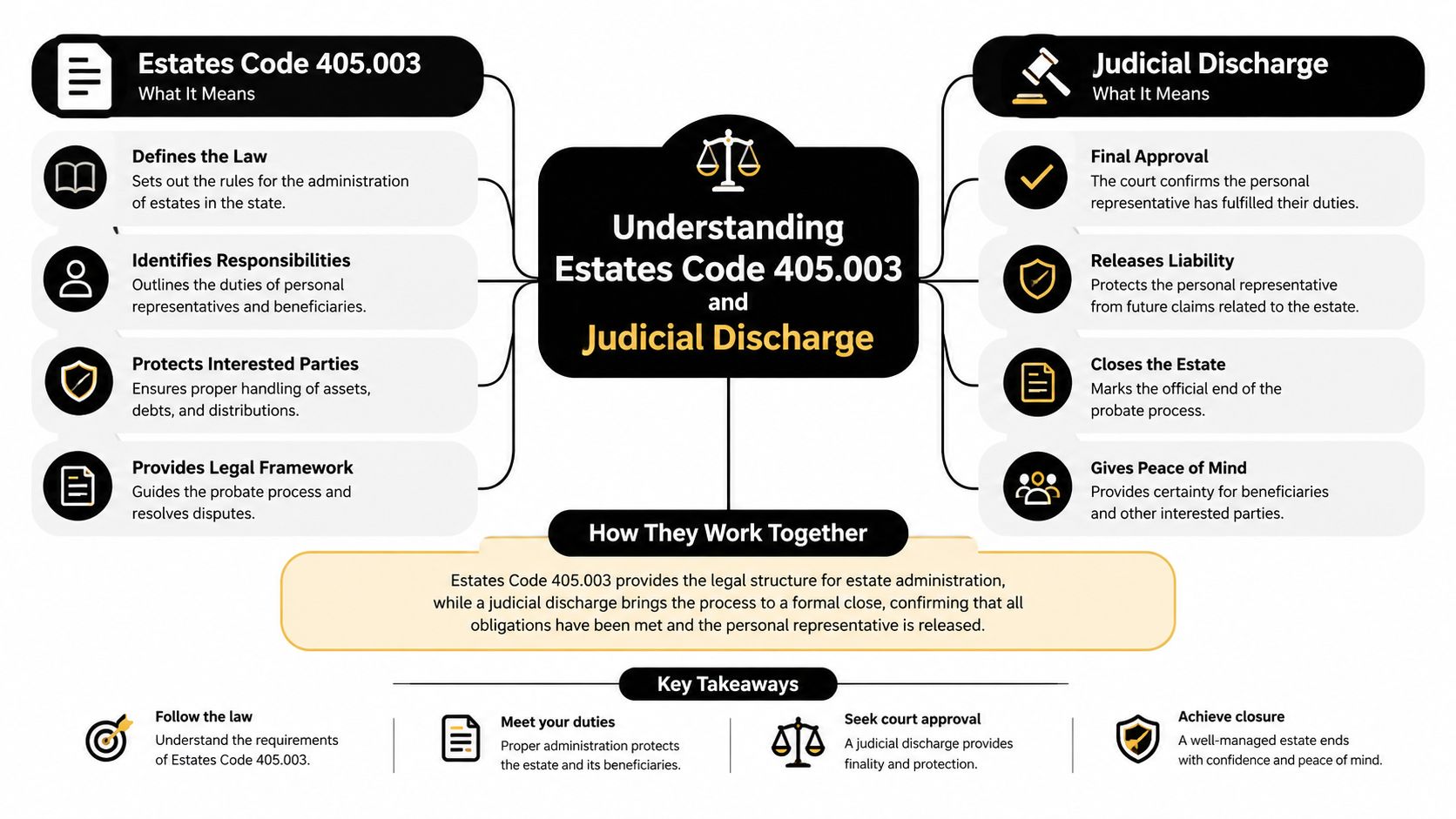
Texas Estates Code §405.003 is a judicial discharge mechanism. It is not just the standard notice form that an executor files to announce that property has been distributed. Under the statute, an independent executor seeks a declaratory judgment after administration is complete and asks the court to discharge the executor from matters connected with the past administration. The court can require a final account, audit or settle that account, and condition discharge on a full and fair disclosure of everything related to the administration. Texas Estates Code §405.003
That distinction matters because a court doesn't grant the same protection merely because an executor believes the estate is finished. The judge may examine the administration closely enough to determine whether the executor has disclosed the relevant transactions and satisfied the estate's obligations.
What the court may require
The process generally involves more than signing a closing statement. An executor pursuing judicial discharge should be prepared to address:
- The administration completed. The executor must show that the estate has reached the point where independent administration is no longer needed.
- The accounting is available. The court may demand a final account that explains property received, expenses paid, distributions made, and matters that remain unresolved.
- The disclosures are complete. The court may require full and fair disclosure of the matters connected to the past administration.
- The distributees are served. The statute requires personal service on each distributee unless that service is waived, which can affect timing and expense when heirs live in different places or are difficult to locate.
- The judge is satisfied. Discharge depends on the court's evaluation, not just on the executor's filing.
A useful analogy is the difference between leaving a job and receiving a signed release. You can stop showing up for work, but that doesn't necessarily prove that your employer has accepted your final accounting or released you from responsibility for company property. A judicial discharge is closer to obtaining that formal release after the employer reviews what happened.
Why judicial discharge can matter
An executor may face questions after property has been distributed. A beneficiary might ask why an account balance changed, whether a sale was reasonable, or whether an expense should have been paid from estate funds. A judicial discharge can reduce residual fiduciary exposure after the court has reviewed the administration and accepted the required disclosures.
That doesn't mean §405.003 is appropriate for every estate. A straightforward administration with cooperative beneficiaries may use a notice or closing report. A complicated estate, a family disagreement, significant transactions, or concern about future allegations may justify discussing the more formal discharge route with counsel.
The executor's underlying work still matters. A practical overview such as An Executor's Duties in a Texas Probate can help clarify the responsibilities that should be completed before any closing method is considered.
Who Must Receive Notice and What the Notice Must Contain
A notice of closing estate under §405.006 is available only after the executor has completed the statutory conditions. The executor must have paid all known debts, or paid them to the extent the estate's assets allow. The executor must also have distributed all remaining estate assets, and the notice must identify the distributees who received property by name and address. Texas Estates Code §405.006
The executor must provide each distributee with a copy before filing the notice. The court filing must include signed receipts or other proof showing that every distributee received the document. This requirement makes delivery evidence part of the closing record, not an optional courtesy.
A practical pre-filing checklist
Before filing, work through the following questions carefully:
- Known debts: Have all known debts been paid, or has the estate paid as much as its available assets permit? Don't treat an unresolved creditor issue as a minor paperwork detail.
- Remaining property: Has every remaining estate asset been distributed? Check bank balances, personal property, real estate interests, refunds, and any property held for later transfer.
- Distributee list: Does the notice identify every person who received estate property? Use the legal names and current addresses available to you.
- Delivery: Did each distributee receive a copy before filing? Mailing a document without retaining evidence can leave the executor unable to prove delivery.
- Receipts or proof: Do you have signed receipts or other evidence for every distributee? Keep the proof organized with the estate records.
- Filing consistency: Do the notice, distribution records, receipts, and account statements tell the same story?
The word distributee generally refers to a person who received property from the estate. That person may be a beneficiary under a will or an heir entitled to property under Texas law. The important point at closing is not only who was named in an estate document, but who received the remaining property.
Notice delivery and personal service aren't identical
Executors often assume that the delivery requirement for a notice of closing estate is the same as the service requirement for a judicial discharge. It isn't. For a §405.006 notice, the executor must give each distributee a copy and file signed receipts or other proof of delivery. Under §405.003, the judicial discharge path requires personal service on each distributee unless service is waived.
That difference can affect both timing and cost. A family with cooperative local beneficiaries may assemble receipts quickly. A family with out-of-state heirs, changing addresses, strained relationships, or multiple distributees may need more careful planning, particularly when personal service is required for a judicial discharge. Guidance about notice to beneficiaries in Texas probate can help executors distinguish beneficiary notice obligations from final closing procedures.
Timing Deadlines Executors Need to Track
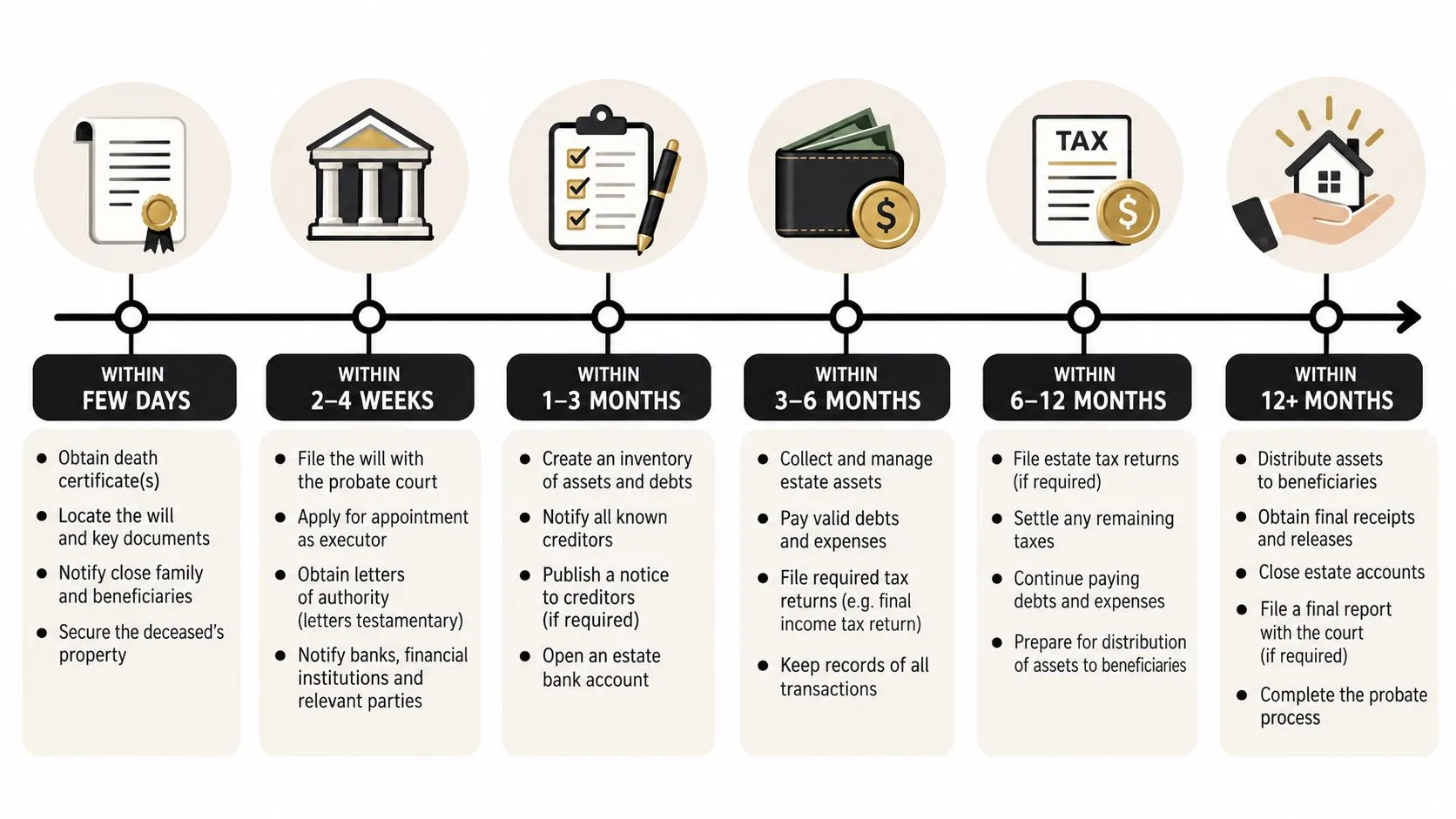
An executor may have paid the bills, collected the assets, and made the final distributions, yet the estate still has a calendar to follow. County guidance generally advises keeping an estate open for at least six months from the qualification date. That period allows time to gather property, notify creditors, file the inventory or an affidavit in lieu of inventory, and pay legitimate claims. See the Texas independent executor guidance from Travis County.
Six months is a planning reference, not an automatic closing date. Real estate, tax matters, disputed claims, missing assets, or disagreements among beneficiaries can extend administration. Treat the period as time to finish the work carefully. Distributing property while a valid obligation remains unresolved can create problems for the executor and the recipients.
The closing filing starts a separate clock
A notice of closing estate under §405.006 follows a different path from the judicial discharge procedure in §405.003. Filing the notice does not itself ask the court to approve a final account or enter a judicial discharge. Instead, after the required administration and delivery steps are complete, the notice starts the statutory objection period.
Under §405.007, the estate is treated as closed 30 days after filing unless an interested person objects during that period. If no timely objection is filed, the independent executor's authority ends. Texas Estates Code Chapter 405 provides the statutory framework for this process: Texas Estates Code Chapter 405.
The sequence is:
- The executor completes administration and distributions.
- The executor gives each distributee the required copy of the notice.
- The executor files the notice with signed receipts or other proof of delivery.
- The 30-day objection period begins.
- If no interested person objects, the estate is treated as closed and the executor's authority ends.
An objection can interrupt that sequence. The executor may need to answer the objection, produce additional records, defend a distribution, or continue administering the estate while the dispute is addressed. Heirs and creditors watch the same deadline because concerns must be raised before the estate closes.
The calendar marks more than an office filing. It identifies when active administration ends under the notice route. If an objection, claim, or distribution remains unresolved, obtain advice before starting the statutory clock.
Notice of Closing Estate Versus Closing Report Versus 405.003 Discharge
Independent executors often use the terms notice, report, and discharge as though they describe the same filing. They don't. Each route serves a different purpose and creates a different level of court involvement.
| Closure Route | Court Involvement | Effect on Executor Authority | Surety and Liability Impact |
|---|---|---|---|
| Notice of closing estate | The executor files after satisfying the statutory debt, distribution, identification, and delivery requirements. No judicial accounting is automatically required by the notice itself. | The estate generally becomes closed after the statutory objection period if no interested person objects. The filing terminates the executor's authority and cancels the letters. | Filing a notice does not release bond sureties for future acts. The post-closing risk profile differs from a closing report. |
| Closing report | The executor files a report showing that administration has been completed. | The report route brings administration to its statutory end after the applicable closing process. | Filing a closing report releases bond sureties for future acts, an important distinction in a bonded administration. |
| §405.003 judicial discharge | The executor asks the court for a declaratory judgment. The court may require a final account, audit or settle the account, and full and fair disclosure. | Discharge follows the court's satisfaction with the administration and the requested disclosures. | The court-driven process can reduce residual fiduciary exposure because the executor seeks a formal judicial discharge rather than relying only on a closing filing. |
The surety distinction deserves special attention. A bond surety is the party financially connected to an executor's bond. Under the Texas court guidance summarized in the probate FAQs, a closing report releases bond sureties for future acts, while a notice of closing estate does not. Texas probate FAQs on closing an independent administration
Choosing a route
A notice may fit an executor who has completed a straightforward administration, satisfied the statutory conditions, and can document delivery to every distributee. A closing report may be especially important where bond sureties are involved and the release distinction matters. A judicial discharge may make more sense when the administration was complicated, records require formal review, or the executor wants a court ruling addressing past administration.
No route guarantees that an executor can ignore fraud, concealed property, or a material breach of duty. The choice is about how the estate is closed and what protection the process provides. If an estate involves unusual property, disagreements, or a bond, compare the options before filing. Related procedures, including closing an independent administration by affidavit, can also create confusion if they're treated as interchangeable with Chapter 405 closing methods.
Common Mistakes and a Realistic Executor Example
Alex served as independent executor for an estate in a Texas county. Alex gathered the assets, paid debts and taxes, completed distributions, and prepared a notice of closing estate. Two heirs lived outside Texas. Alex sent them copies but filed the notice without obtaining signed receipts or preserving other proof that both heirs received the documents.
During the statutory objection period, an interested person objected to the closure and questioned one distribution. The missing delivery proof made the filing harder to defend, and the objection delayed the estate's final closure. Alex had to locate additional records, respond to the dispute, and revisit the accounting. The beneficiaries became frustrated because they thought the estate was already finished, while Alex continued carrying responsibilities that had seemed complete.
County probate guidance describes the proper general sequence: the executor gathers assets, files the inventory or affidavit in lieu of inventory, pays debts and taxes, completes distributions, and then files a closing report or notice of closing estate. After the closing filing, creditors generally must deal directly with the beneficiaries rather than the executor. Travis County guidance for Texas independent executors
Problems that commonly delay closure
- Filing before administration is complete: An executor files while a debt, tax matter, asset, or distribution remains unresolved. The notice should reflect the actual condition of the estate, not the executor's hope that the remaining issue will resolve soon.
- Leaving out a distributee: The notice doesn't list someone who received property, or it uses an outdated address. That omission can undermine the proof that every required person received the filing.
- Skipping delivery evidence: The executor sends copies but doesn't obtain signed receipts or retain other proof. Good intentions don't replace a documented record.
- Assuming closure erases every risk: A closing filing ends active authority under the statutory process, but it isn't a license to conceal information or disregard a valid dispute.
- Treating all closing routes alike: An executor chooses a notice without considering the different effect on bond sureties or the stronger protection available through judicial discharge.
A careful closing file should contain the final asset records, debt information, distribution documentation, the notice sent to each distributee, and the receipts or other delivery evidence. If an objection arises, those records give the executor a factual basis for responding instead of reconstructing the estate from memory.
Key Takeaways and Your Next Steps
The phrase “Estates Code 405.003 notice of closing estate Texas” brings together two different concepts. Section 405.003 concerns a court-driven judicial discharge through declaratory judgment. The notice of closing estate is a separate route under §405.006, with its own conditions, delivery requirements, and statutory consequences.
Keep these points in mind:
- Judicial discharge is not a simple form. The court may require a final account, an audit or settlement of the account, and full and fair disclosure before granting discharge.
- A notice requires documented delivery. Every distributee must receive a copy, and the filing must include signed receipts or other proof of delivery.
- The filing starts a 30-day objection period. If no interested person objects during that period, the estate is treated as closed and the executor's authority ends under the statutory process.
- The closing route changes the risk profile. A closing report releases bond sureties for future acts, while a notice of closing estate does not.
- A completed distribution isn't the same as a completed closing file. Records, addresses, receipts, and proof of payment should be organized before anything is filed.
Your next step is to compare the estate's actual status against the checklist in this guide. Confirm that debts and distributions are complete, identify every distributee, gather proof of delivery, and determine whether the estate's complexity or family relationships make judicial discharge worth considering.
Finishing an estate can feel like one more burden after an exhausting loss, but careful preparation makes the final stage manageable. You don't have to choose a closing route by guessing at statutory language.

The Law Office of Bryan Fagan, PLLC helps Texas families evaluate closing notices, closing reports, judicial discharge options, and the records needed to complete independent administration responsibly. Visit Law Office of Bryan Fagan, PLLC to discuss your estate with a Texas probate attorney. If you're facing probate in Texas, our team can help guide you through every step, from filing to final distribution. Schedule your free consultation today.


