 Skip to content
Under Texas Estates Code §255.451, a will can be changed after probate only through a narrow court process. A personal representative must petition the probate court within four years of the will's admission to probate, and the request must fit one of three specific statutory grounds, with a strict evidentiary standard for correcting a drafting error.
A grieving family may discover the problem only after administration is underway. An executor might be reviewing the residuary clause, the part of the will that distributes property left after specific gifts, and notice that one misplaced word appears to exclude property the deceased parent clearly meant to include. By then, the will has already been admitted to probate, and the family may wonder whether the executor can correct the language.
The answer is no. The executor can't rewrite the document personally, and the heirs can't renegotiate the distribution just because the result now seems unfair. Section 255.451 creates a judicial remedy, meaning a personal representative must ask the probate court for a specific order supported by facts and evidence.

Texas Estates Code §255.451 exists within the probate framework of Title 2 because administration sometimes reveals a problem that couldn't be resolved by reading the will as written. The statute addresses limited administrative obstacles, certain tax or government-benefit objectives, and genuine drafting mistakes. It doesn't provide a general process for rewriting a decedent's estate plan. The petition must be filed on or before the fourth anniversary of the date the will was admitted to probate. Texas Estates Code §255.451
Reformation also isn't the same as a will contest. A contest challenges whether the will should be admitted or whether it was validly created. Reformation accepts the will as a valid estate document but asks the court to correct or modify a limited provision under the statute. Families who need help understanding the broader administration process may also review guidance about whether probate can be reopened in Texas.
The rest of the analysis turns on three questions: What problem does the requested order address? Who is legally allowed to file? What evidence shows the order matches the testator's plan?
The Three Pathways Under Section 255.451
Section 255.451 separates post-probate relief into three pathways. Choosing the right one matters because the court isn't deciding whether a different outcome would be preferable. It's deciding whether the requested order fits the statute and preserves the deceased person's probable intent.
Administrative language under subsection a1
Subsection §255.451(a)(1) concerns administrative, nondispositive provisions. In plain English, these are directions about how the estate or a trust should be managed, rather than provisions deciding who receives the property. A change may be appropriate when the existing language would cause waste or impair estate administration.
For example, a will might contain an outdated administrative instruction that prevents the personal representative from handling an asset efficiently. The requested order would address the practical obstacle without changing the beneficiaries' substantive shares. Think of this as correcting the machinery used to administer the estate, not changing the destination of the estate's property.
Tax and government-benefit objectives under subsection a2
Subsection §255.451(a)(2) addresses an order needed to achieve the testator's tax objectives or qualify a distributee for government benefits. A distributee is a person who receives property from the estate. The court still can't approve a change that contradicts the testator's intent.
A family may be concerned about preserving eligibility for Medicaid-related benefits or obtaining intended tax treatment. Those concerns can matter, but the court isn't authorized to create a new estate plan after death. The proposed order must connect to the deceased person's plan, not merely to the family's current preference. For background on what happens when no valid will controls distribution, Dying Without a Will in Texas: Intestate Succession explains how Texas law distributes an estate without a will.
Scrivener's errors under subsection a3
Subsection §255.451(a)(3) permits correction of a scrivener's error, which means a clerical or drafting mistake that caused the signed language to fail to express the testator's actual meaning. This pathway can apply even when the will is unambiguous on its face.
The difference is important. A clear sentence can still contain a drafting mistake. The court doesn't need to find that the words are vague. It needs reliable evidence that the words don't reflect what the testator intended to say.
For this pathway, the required proof is clear and convincing evidence, a demanding standard higher than showing that one interpretation is merely more likely than another. The statute also limits who may initiate the proceeding. A personal representative must petition the court, and §255.455 says the statute creates no duty to seek modification or reformation and imposes no liability for failing to file. Texas statutory text and deadline provisions
What Odom v. Coleman Teaches Texas Families
Odom v. Coleman provides a concrete example of what reformation can accomplish. The case involved an unambiguous will whose residuary clause used the word “personal” before “property.” Taken at face value, that wording could exclude real property from the residuary gift, even though the evidence showed that the testator intended to dispose of all property through the clause.
The probate court corrected the problem by deleting the word “personal.” The Houston First Court of Appeals upheld that result in 2020, concluding that the evidence clearly and convincingly established the testator's intended meaning. The decision is significant because it marked one of the first Texas appellate applications of the scrivener's-error provision added in 2015. The discussion of Odom v. Coleman
Why the wording mattered
The court didn't rewrite the entire will or choose a new group of beneficiaries. It removed a single word that prevented the residuary clause from carrying out the plan supported by the evidence. That distinction helps explain why §255.451 isn't a general fairness remedy.
A family can't point to changed relationships, a beneficiary's financial difficulties, or a later disagreement and ask the court to revise the distribution. Those facts may feel compelling, but they don't establish a scrivener's error. The question is whether the signed language contains a genuine drafting mistake and whether trustworthy evidence proves what the testator intended instead.
Odom's practical lesson: An unambiguous will isn't automatically immune from correction, but the person seeking reformation must prove that the language is wrong because of a drafting error, not because the family now prefers another result.
The decision also shows that reformation doesn't necessarily invalidate the will. The court can correct a targeted provision while leaving the rest of the estate plan intact. That remedy protects testamentary intent while avoiding an unnecessary collapse of the entire document.
For families, the case offers both reassurance and caution. Texas courts can correct a true mistake, but a petition must be built around the deceased person's evidence, not the heirs' expectations.
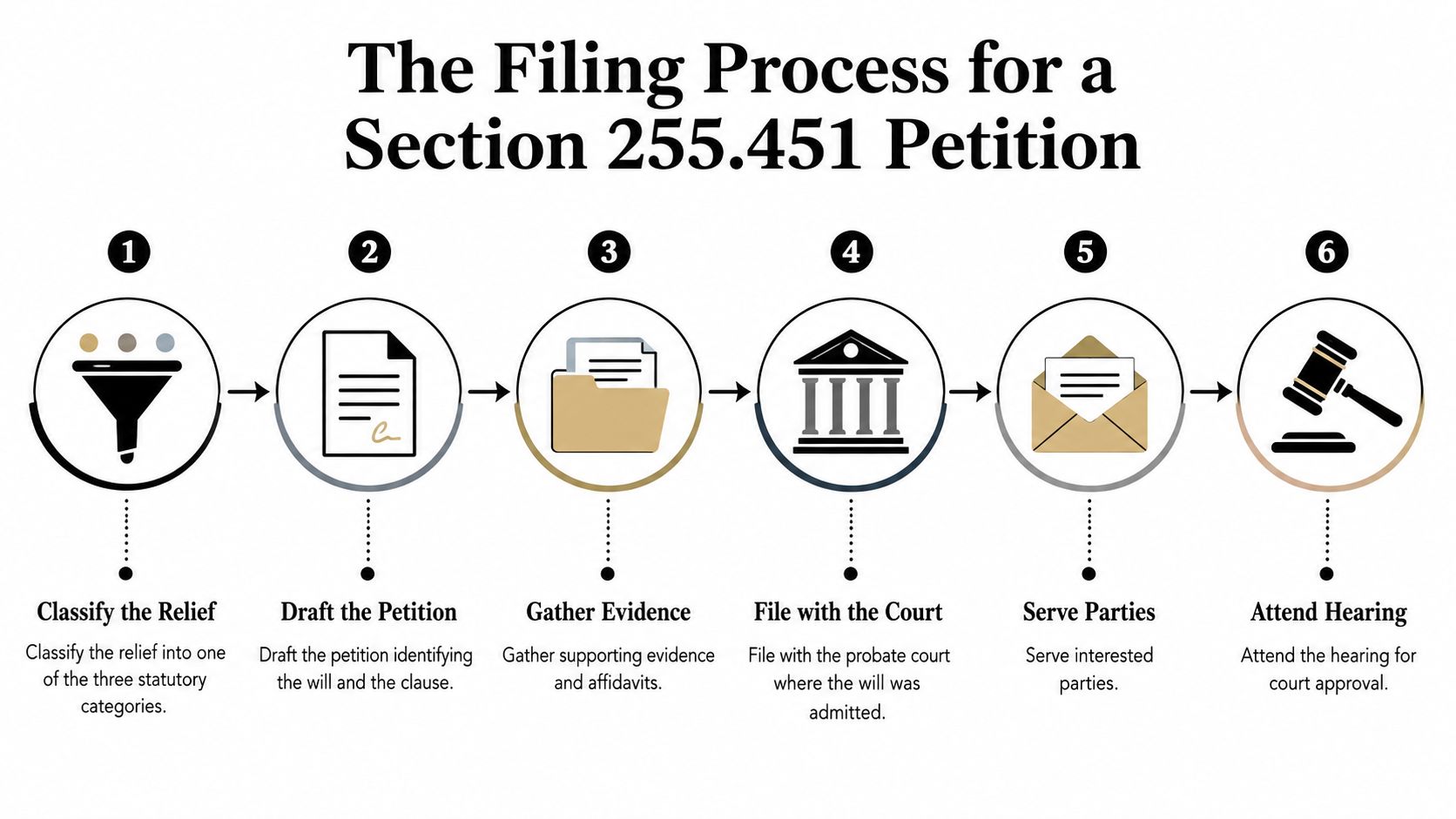
The Filing Process for a Section 255.451 Petition
A personal representative discovers that a will leaves a valuable account in a way that defeats the deceased person's stated plan. Before filing, counsel must identify which of Section 255.451's three pathways fits the problem: an administrative correction, a tax or benefits modification consistent with probable intent, or a scrivener's error. The pathway determines what evidence the court must consider.
The petition should identify the exact will, quote or describe the disputed provision, and state the precise order requested. A request to “fix the will” is too broad. The court needs a defined change tied to a statutory ground and supported by facts showing why that change reflects the testator's plan.
Building the record before filing
Evidence should be gathered before the petition is filed. The useful materials depend on the selected pathway:
- Drafting records: Attorney files, notes, execution instructions, and correspondence may show what the testator asked the drafting lawyer to prepare.
- Earlier documents: Prior wills or codicils can reveal a consistent plan, but they must be compared carefully with the final signed will.
- Estate information: Asset schedules and gift lists may explain why the disputed language conflicts with the broader plan.
- Witness testimony: The drafting attorney, execution witnesses, or people who heard the testator's instructions may address probable intent.
The petition is filed in the probate court handling the estate, usually the court that admitted the will. Interested parties must receive notice and an opportunity to object. Families can review the practical document requirements for filing a probate petition in Texas before preparing the filing.
Hearing and judicial discretion
The statutory deadline applies, so counsel should confirm it before investing in a contested petition. The filing must occur on or before the fourth anniversary of the date the will was admitted to probate. The petition should also identify the exact statutory pathway rather than rely on a general request for fairness.
At the hearing, the judge considers the pleaded ground, supporting evidence, objections, and the proposed remedy. Section 255.452 directs the court to modify or reform the will as nearly as possible to the testator's probable intent. That does not permit the judge to create a better estate plan or grant language outside the petition.
For example, a beneficiary may argue that the proposed replacement clause goes beyond correcting the identified drafting error. The court may agree if the petition asks for a new distribution rather than a narrow correction supported by the evidence. The order should therefore state the requested wording or a tightly defined method for determining it, while preserving the rest of the will whenever the statute permits.
Evidence and Pleading Elements That Carry the Day
A persuasive petition gives the judge a precise map of the dispute. It identifies the estate, the probated will, the wording at issue, the applicable subsection of §255.451, and the exact relief requested. The facts should also show how the evidence supports the testator's probable intent.
The petition generally should contain:
- Court and case identification: The caption names the probate court and estate proceeding.
- Will information: The filing identifies the will and the date it was admitted to probate.
- Specific provision: The disputed clause is quoted or described accurately.
- Statutory ground: The petition identifies the relevant §255.451 pathway.
- Supporting facts: The allegations explain the drafting error, administrative problem, or tax or benefits objective.
- Requested order: The prayer states the precise correction or modification sought.
- Verification and signature: Counsel signs the filing and presents any affidavits or testimony required for the request.

Evidence for a scrivener's-error claim
A scrivener's-error claim requires clear and convincing evidence, a standard stronger than a preponderance of the evidence. The proof must leave the court firmly convinced that the signed wording fails to express the testator's actual intent. See Evidence commonly considered under §255.451.
The value of evidence depends on what it can reliably establish. A drafting attorney's file may show the instructions given, the drafting process, and the circumstances surrounding execution. Those contemporaneous records often provide a more direct account than a beneficiary's later recollection. Handwritten notes, correspondence, prior wills, codicils, asset schedules, and witness testimony can reinforce that account when they point to the same intended result.
If the dispute edges toward the will's validity rather than its wording, see our guide on the evidence needed to contest a will.
Evidence should answer one question: What did the testator intend this specific clause to accomplish when the will was prepared and signed?
A prior will does not automatically govern, and family testimony does not automatically establish intent. Each item must fit the full record and support the particular correction requested.
That focus also separates statutory reformation from a fairness argument. Relatives may believe the deceased would have chosen differently after family circumstances changed. Section 255.451 examines the testator's intent at the time of preparation and signing, not the result heirs now prefer.
Defenses, Pitfalls, and Cost Considerations
A petition can fail before the court reaches the merits if the wrong person files it. Under the statutory procedure, the personal representative initiates the request. An heir, beneficiary, trustee, or creditor may have concerns and may respond to the proceeding, but that doesn't mean each person can file a §255.451 petition directly.
If a personal representative refuses to act, the statute's companion provision matters. Section 255.455 says the personal representative has no duty to seek modification or reformation and faces no liability merely for failing to file. A family member who believes the representative is mishandling the estate may need advice about other probate remedies rather than assuming a court will force a §255.451 petition.
Common objections
The most frequent problems are practical and evidentiary:
- Deadline failure: The petition is filed after the fourth anniversary of admission to probate. The family may have discovered the issue earlier or later, but the statutory deadline still controls.
- Insufficient proof: The evidence shows that another interpretation is possible but doesn't clearly and convincingly establish the testator's intended meaning.
- Improper distribution request: The proposed order changes beneficiaries or shares because the family wants a better outcome, rather than correcting a true drafting or administrative problem.
- Contrary planning objective: The request invokes Medicaid or tax treatment that the testator never contemplated and that conflicts with the estate plan.
- Unclear relief: The petition asks the court to “clarify” the will without identifying the exact language and replacement order.
Costs and realistic expectations
A contested petition may involve filing expenses, attorney preparation, document review, discovery, witness preparation, and a hearing. The total burden depends on the complexity of the will, the quality of the available evidence, the number of interested parties, and whether anyone objects.
The cited authorities don't provide a reliable statewide success-rate statistic. Families should therefore evaluate proof quality, deadline compliance, and statutory fit rather than rely on a general prediction that courts routinely reform wills. A careful attorney can help separate a viable statutory request from a dispute that belongs in will construction, fiduciary litigation, settlement discussions, or another probate proceeding.
Practical Next Steps and a Free Consultation
The first task is preservation. Locate the admitted will, any earlier wills or codicils, the probate order, and the documents surrounding preparation and execution. Ask the drafting attorney whether records remain, and preserve correspondence, asset schedules, and instructions that may show what the testator intended.
Calendar the fourth anniversary of the will's admission to probate immediately. Don't wait for every family disagreement to resolve before obtaining advice, because evidence can become harder to locate and the filing deadline continues to approach.
A practical review should also identify who is serving as personal representative, which beneficiaries may object, and whether the requested relief changes administration or distribution. If the dispute concerns a broader challenge to the will's validity or the conduct of an executor, a Texas Probate Process overview, Guardianship, Wills & Trusts, or Probate Litigation resource may address a different legal path. The Law Office of Bryan Fagan, PLLC handles probate and estate matters across Houston, Dallas, Austin, San Antonio, and surrounding Texas counties, with in-person and virtual consultations available.
Choosing the Right Section 255.451 Pathway
| Subsection | Typical Problem | Evidence Standard | Common Example |
|---|---|---|---|
| §255.451(a)(1) | Administrative, nondispositive language causes waste or impairs administration | Evidence supporting the administrative need and consistency with the estate plan | An administrative direction prevents practical management of estate property |
| §255.451(a)(2) | A change is needed for the testator's tax objectives or a distributee's government-benefit eligibility | Evidence of the objective and proof the order isn't contrary to testamentary intent | A benefits-related order supports the plan without creating a new one |
| §255.451(a)(3) | A drafting mistake misstates the testator's meaning, even though the will is unambiguous | Clear and convincing evidence of probable intent | Removing a misplaced word from a residuary clause, as in Odom v. Coleman |
Takeaway: Section 255.451 is a narrow court remedy, not a general rewrite button. The statutory category and evidence must match, and the four-year filing deadline should be treated as a critical date from the beginning.
If you're facing probate in Texas, our team can help guide you through every step, from filing to final distribution. Schedule a free consultation today.
The Law Office of Bryan Fagan, PLLC can review the will, probate record, drafting materials, and potential evidence supporting a Section 255.451 petition. Visit Law Office of Bryan Fagan, PLLC to connect with a Texas probate team and discuss your situation through an in-person or virtual consultation.


