 Skip to content
A family member has died, and while sorting through personal belongings, you find a handwritten document that appears to explain what should happen to the estate. There's no formal binder, no obvious attorney's signature, and perhaps no witnesses or notary seal. In Texas, that document may still matter greatly. The difficult question is often not whether the handwriting looks familiar, but whether the paper can be admitted to probate without placing the family through avoidable evidence problems.
The phrase Estates Code 251.107 holographic will requirements Texas points to a specific procedure. That procedure can make an otherwise valid handwritten will self-proved, meaning the estate may not need live handwriting witnesses to establish the document's authenticity. A valid holographic will and a self-proved holographic will are related, but they aren't the same thing.
A Handwritten Will Found in a Kitchen Drawer
After her father's funeral, a daughter cleaning out his Lubbock farmhouse finds a two-page document folded behind a stack of recipes. It's written in pencil on lined notebook paper. She recognizes her father's handwriting immediately. The document clearly divides his property, naming who should receive the farmhouse, personal belongings, and certain accounts.
There's no notary seal. No witness signatures appear anywhere on the pages. The daughter wonders whether the paper is just a private note or a legally meaningful will.
Texas law recognizes handwritten, or holographic, wills. A document that meets the legal requirements can qualify even without the usual witness-signing ceremony. The lack of a notary seal or witness signatures doesn't automatically answer the validity question.
Three concerns usually arise at the kitchen table:
- Is this paper legally a will? The answer depends on whether it was written wholly in the testator's handwriting, signed, and intended to distribute property at death.
- Does it still count years later? A date isn't generally an absolute validity requirement for a holographic will, but it can help establish which document is later, whether the maker had capacity, and whether a later document revoked it.
- What should the family do next? Preserve the original exactly as found. Don't write on it, staple anything to it, erase marks, or separate pages that may belong together.
The daughter's biggest challenge may not be proving that her father wrote the document. It may be proving that fact in probate if the will wasn't made self-proved during his lifetime. Under Texas Estates Code Chapter 251, the basic validity of a holographic will is separate from the procedure under Section 251.107. The first question concerns whether the handwritten instrument qualifies as a will. The second concerns whether the testator completed an affidavit that reduces the later proof burden.
That distinction affects the entire administration of the estate. A family may possess a valid handwritten will and still need to locate people who can testify about the decedent's handwriting. The rest of the process depends on preserving the document and identifying which evidence exists before filing in probate court.
What Makes a Holographic Will Valid in Texas
Texas Estates Code Chapter 251 separates the requirements for a holographic will from the procedure that makes it self-proved. In plain English, the handwritten instrument must satisfy the following foundational requirements.
The document must be in the testator's handwriting
A holographic will must be written wholly in the testator's handwriting. Typed or printed language generally can't supply the operative provisions of the will. Limited extraneous text may sometimes be treated as surplusage rather than automatically destroying the handwritten portions, but mixed-format documents create a serious evidentiary risk.
The person making the will is the testator. That means the person whose property and wishes the document addresses. A family member can't type a form and have the testator fill in only a few blanks while assuming the result is a holographic will.
The testator must sign the document
The testator must sign the will, or use a legally sufficient identifying mark. The signature helps connect the handwritten provisions to the person who intended the document to operate after death.
A date isn't generally required for basic holographic validity, but adding one is sensible. It can help the court compare competing documents and address questions involving capacity, revocation, or conflicting instructions.
The writing must show testamentary intent
The document must show that the testator intended to dispose of property at death. A list of possessions, a casual note about family arrangements, or an expression of hope may not be enough. The writing should communicate that the testator is directing what happens to property after death.
The testator must also meet the applicable age and capacity rules. Texas law recognizes the adult threshold and statutory exceptions for a person under that threshold who is married or serving in the United States armed forces, an auxiliary force, or the U.S. Maritime Service. The person must be of sound mind when the will is executed.

A simple example would be a dated handwritten note in which a Texas resident writes that the document is their will, names beneficiaries, describes property to be distributed at death, and signs at the end. If the writing is entirely in that person's handwriting and the person had the required capacity, it may qualify without witnesses.
A hand-written will in Texas still must be handled carefully once the testator dies. Families creating a plan from scratch may also find a fillable PDF will template useful for understanding how formal estate documents are organized, but a printed template isn't automatically a holographic will merely because someone writes on it.
The key point is simple: Chapter 251 can make a valid holographic will possible without witnesses. Section 251.107 adds a separate self-proving procedure.
How Section 251.107 Creates a Self-Proved Holographic Will
Section 251.107 does not establish the underlying rules for a holographic will. It provides a separate procedure that can make an otherwise qualifying handwritten will self-proved. The testator completes an affidavit during life, either when the will is prepared or later. The affidavit may be attached to or annexed to the will.
That distinction matters in probate. A valid holographic will expresses the testator's wishes and may qualify for admission. A self-proved holographic will also carries sworn evidence intended to reduce the proof the family must gather after death.
The affidavit addresses four facts:
- The instrument is the testator's will. The testator identifies the handwritten document as a will, rather than as notes, a list of property, or informal instructions.
- The testator satisfies the age rule or a statutory exception. The affidavit states that the testator met the applicable age requirement, unless a statutory exception applied because the testator was under 18 and married or serving in the specified military or maritime service.
- The testator was of sound mind. This statement concerns the testator's mental capacity when the will was executed.
- The testator had not revoked the will. The affidavit confirms that the document remained in effect when the self-proving procedure was completed.
The affidavit must be sworn before and attested by a notary public or another officer authorized to administer oaths. That formal setting gives the probate court sworn material to review instead of leaving the estate to prove the document through informal family recollections.
Timing creates a practical dividing line. The affidavit must be completed during the testator's lifetime. It can be sworn before or after the handwritten will is written, provided the statutory requirements are met while the testator is alive. Relatives cannot create self-proving status for the first time after death by signing an affidavit in the decedent's name.
Practical rule: A self-proving affidavit does not correct a will that failed the handwriting, signature, intent, or capacity requirements. It adds an evidentiary advantage to a document that already qualifies as a will.
The practical benefit is substantial. Without self-proving status, the estate may need witnesses familiar with the decedent's handwriting and signature. Families can learn more in this guide to the self-proving affidavit for a Texas will. With a properly completed affidavit, the will may be admitted without requiring those witnesses to participate in the same way.
A self-proving affidavit also differs from other probate shortcuts. The Small Estate Affidavit in Texas offers a simplified path for modest estates with no will. It is not the same document and does not convert a handwritten will into a self-proved will.
The affidavit reduces the initial proof burden, but it does not make the will immune from a challenge involving forgery, undue influence, incapacity, revocation, or another legal issue. It gives the estate a stronger starting point when the document's authenticity or validity is disputed.
Proving a Holographic Will During Probate
When a self-proved holographic will reaches probate, the affidavit supplies sworn evidence supporting the document. The personal representative can present the will and the self-proving materials to the court, reducing the need for live testimony about handwriting.
A non-self-proved holographic will takes a different route. The person offering it for probate generally must establish that the handwriting and signature belong to the decedent. Harris County probate materials identify the need for two disinterested witnesses to prove a non-self-proved holographic will. A disinterested witness has no financial interest in receiving property from the estate and no conflicting stake in the outcome.
That witness should have enough prior familiarity with the decedent's writing to identify the handwriting and signature credibly. A person who saw the decedent write letters, keep records, sign checks, or prepare other documents may be more useful than someone who merely recognizes the signature because it looks familiar.
When handwriting witnesses are unavailable
Families can face real difficulties when potential witnesses have moved out of Texas, died, lost contact with the family, or disagree about the writing. The court may need to consider other evidence, including comparison samples. Court-appointed experts may also compare handwriting samples with the disputed will when appropriate.
The evidentiary burden is why the distinction matters so much. The will may be legally valid as a holographic instrument, yet the estate can still experience delay and expense while proving authenticity.
| Factor | Self-Proved Holographic Will | Non-Self-Proved Holographic Will |
|---|---|---|
| Basic will requirements | Must still satisfy handwriting, signature, intent, age, and capacity requirements | Must still satisfy handwriting, signature, intent, age, and capacity requirements |
| Main proof document | Self-proving affidavit completed during the testator's lifetime | Testimony and other evidence proving handwriting and signature |
| Witness participation | The affidavit can reduce the need for live handwriting testimony | The family generally must locate qualified, disinterested handwriting witnesses |
| Risk when witnesses are unavailable | The affidavit may avoid the immediate witness problem | The court may need comparison samples or court-appointed handwriting experts |
| Practical probate effect | Admission can proceed with less participation from handwriting witnesses | The family must gather evidence and address authenticity before admission |
The evidence rules matter alongside the will itself, especially if an heir contests the writing or raises questions about capacity. Families can review evidence rules in probate court cases while gathering the original document and comparison samples.
After the will is admitted, the representative may need Letters Testamentary and Letters of Administration in Texas, the court documents that give a representative legal authority. Those letters address authority to act. They don't replace the proof needed to establish a disputed holographic will.
Common Pitfalls That Derail Holographic Wills
A rancher writes what he believes is a complete will on a legal pad. Every substantive instruction is in his handwriting, and he signs at the bottom. His daughter later types a cover letter explaining that the pages contain his final wishes and staples the letter to the legal pad.
After his death, the family finds the document and assumes the cover letter strengthens the presentation. Instead, the added material creates questions. Is the letter part of the will? Did the rancher adopt its language? Does the staple show the papers were meant to be read together? The family may still have a viable handwritten instrument, but it now has a document-assembly problem to explain.
Drafting and document problems
The most common trouble comes from details that seem harmless while the testator is alive:
- Typed portions: Printed language may not supply the operative provisions of a holographic will. A handwritten signature on a printed form doesn't automatically satisfy the wholly handwritten requirement.
- Mixed pages: Pages written at different times may be difficult to connect if they aren't numbered, dated, or clearly identified as part of one instrument.
- Missing signature: Handwritten instructions without a signature may leave the court unable to connect the directions to a completed testamentary act.
- No date: A date isn't generally required for basic validity, but its absence can complicate competing wills, capacity questions, and revocation issues.
- Unclear beneficiaries: “My family” or “the children” may create uncertainty when the testator has a blended family, adopted children, or descendants with similar names.
- Contradictory beneficiary designations: Life insurance, retirement accounts, payable-on-death accounts, and other assets may pass under separate beneficiary instructions rather than under the will.
Self-proving and preservation mistakes
A self-proving affidavit signed after death cannot solve the problem. The testator must complete the Section 251.107 procedure during life. Families also sometimes mistake a notary stamp on an unrelated page for a valid affidavit attached to the will.
Interested witnesses can create another complication. A person who expects to inherit may have a reason to testify in a way that favors the document. That doesn't automatically answer every legal question, but it can make authentication more contentious than testimony from disinterested people familiar with the decedent's handwriting.
Preservation can also determine what evidence remains available. Don't remove staples, discard envelopes, separate pages, or write explanatory notes on the original. Keep related items together and preserve the physical condition in which the document was found.
Most failures aren't caused by a lack of genuine intent. They arise because the family can't show which writing was final, whether every operative provision was handwritten, or whether the person completed a required step. Careful preservation protects the possibility of admission even when the document contains a drafting error.
Practical Checklist for Executors and Family Members
The first days after finding a handwritten will can feel disorganized, especially while the family is grieving. A methodical approach gives the estate a better chance of presenting the document accurately and locating evidence before memories fade.
Preserve the original first
Handle the paper as little as possible. Place it in a protective folder or envelope, keep it flat when practical, and don't add labels directly to the document. Photograph every page, front and back, including visible folds, staples, markings, envelopes, and attached materials.
Store the original in a secure location where it won't be lost, altered, or damaged. A clear scan helps family members and counsel review the document, but a scan or transcription isn't a substitute for the original when handwriting and physical condition may matter.

Build the evidence file
Start a separate file for information about the document:
- Locate related materials: Look for envelopes, earlier wills, letters, diaries, check registers, business records, and other writing samples.
- Identify potential witnesses: Ask who regularly saw the testator write or sign documents. Focus on people who don't receive property under the will.
- Record contact details: Write down where potential witnesses live and how they knew the testator's handwriting.
- Confirm the signature: Check whether the will is signed at the end of the handwritten provisions and whether additional writing appears below it.
- Search for an affidavit: Look for a separate self-proving affidavit attached or annexed to the will, and determine whether the testator completed it while alive.
- List competing documents: Preserve earlier and later wills rather than assuming the newest-looking paper controls.
The executor should coordinate with counsel before filing the original in probate court. Timing matters because the court must receive the proper document and supporting evidence, while the family may also need to protect property, notify interested people, and identify debts.
A Muniment of Title in Texas can be the lightest-touch probate option for clearing title when the estate and the will meet the applicable requirements. It isn't a substitute for deciding whether the handwritten document is valid or self-proved.
Acting methodically during the first 30 days can help the estate preserve the original, secure comparison samples, and find disinterested witnesses before contact information disappears. It won't guarantee admission, but it can prevent avoidable evidence problems.
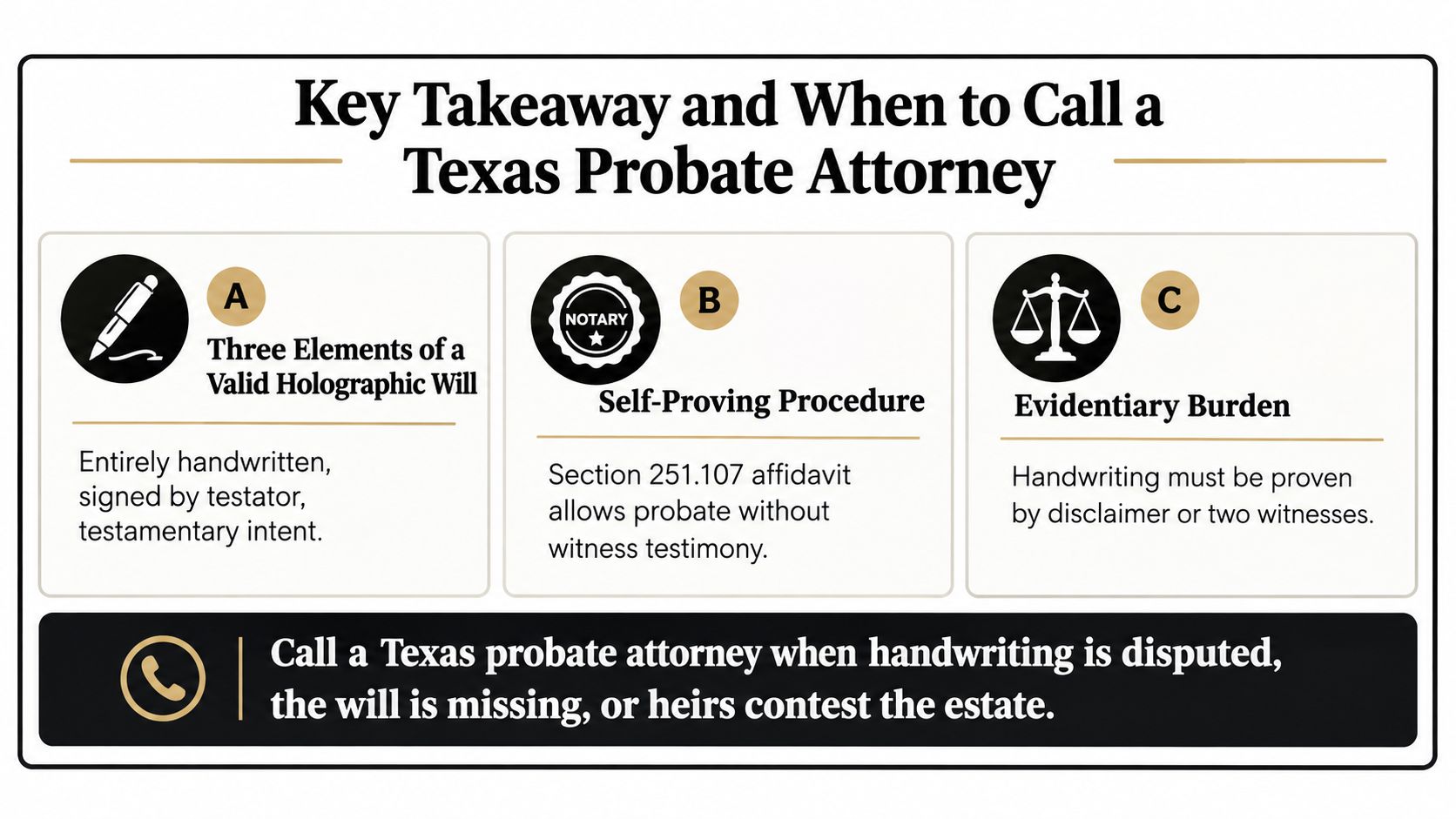
Key Takeaway and When to Call a Texas Probate Attorney
The central distinction is easy to state and easy to miss. A Texas holographic will must be written wholly in the testator's handwriting, signed, and written with testamentary intent. The testator must also satisfy the applicable age and sound-mind requirements.
Section 251.107 addresses something different. It allows the testator to complete a self-proving affidavit during life, confirming that the instrument is the will, that the testator met the age rule or exception, that the testator was of sound mind, and that the will had not been revoked. That affidavit doesn't create handwriting validity, but it can reduce the need for live testimony later.
The practical burden on the family
A non-self-proved will may require two disinterested witnesses familiar with the decedent's handwriting and signature. If those people can't be found, the estate may need comparison samples or expert assistance. In such cases, a simple handwritten document can shift substantial work and uncertainty to grieving relatives.
A Texas probate attorney can be especially helpful when:
- Handwriting is disputed: An heir claims the writing or signature isn't genuine.
- Witnesses are missing: Potential witnesses live outside Texas, are unavailable, or have conflicting recollections.
- The affidavit is unclear: The family can't determine whether a Section 251.107 affidavit was completed during life.
- Pages or language conflict: The document contains typed material, loose pages, handwritten additions, or ambiguous beneficiary instructions.
- The estate includes real property: County filing, title, administration, and beneficiary issues can overlap.
- The family structure is complicated: Blended families and competing claims can make a short handwritten sentence difficult to interpret.
- The estate is modest: A mistake can consume a disproportionate amount of the family's time and attention.
Probate is not only a legal process. It is also the period when relatives are trying to make decisions while mourning someone they love. You don't need to solve every question before asking for help. Gather the original, preserve related materials, and bring the documents to a lawyer who can explain the available path.
The Law Office of Bryan Fagan, PLLC can review the handwritten instrument, assess whether the self-proving procedure appears complete, and guide the family through Texas probate administration, estate planning, guardianship, and probate litigation concerns. If you need broader planning support, the firm also provides guidance through Texas Probate Process, Guardianship, Wills & Trusts, and Probate Litigation.
If you're facing probate in Texas, our team can help guide you through every step, from filing to final distribution. The Law Office of Bryan Fagan, PLLC can review a holographic will, evaluate its self-proving status, and help you protect the estate's evidence, so please contact us through Law Office of Bryan Fagan, PLLC to schedule your free consultation today.


