 Skip to content
If you've searched for “Estates Code 254.003 in terrorem clause enforceability Texas,” you may have encountered advice saying that Section 254.003 controls whether a no-contest clause can disinherit you. That popular explanation is wrong. Texas Estates Code § 254.003 addresses certain gifts to attorneys and people connected to them, while the Texas statute addressing forfeiture clauses is § 254.005.
That distinction matters when you're grieving, trying to administer an estate, or deciding whether to question a will. A mistaken citation can cause an heir to abandon a legitimate concern, or cause an executor to overlook a separate problem involving an attorney-beneficiary. The statutes can arise in the same probate case, but they answer different legal questions.
The Great Texas Probate Misconception
A no-contest clause, also called an in terrorem clause, is a provision in a will that threatens a beneficiary with losing an inheritance if that beneficiary challenges the estate plan. Because the clause involves a possible forfeiture, many online summaries connect it to Texas Estates Code § 254.003. That connection has led families to believe that Section 254.003 automatically decides whether a will contest is allowed.
It doesn't. Section 254.003 is aimed at attorney-related gifts in a will, not at the general enforceability of a no-contest clause. The statute concerns a devise, meaning a gift of property made through a will, to the attorney who prepared or supervised preparation of that will, along with certain people related to or connected with that attorney. You can review the statutory text in Texas Estates Code § 254.003.
Practical rule: Before deciding whether a beneficiary risks forfeiture, identify whether the dispute concerns a prohibited attorney-related gift, a no-contest clause, or both.
The correct analysis begins with the language of the will and the conduct at issue. A provision that says a beneficiary forfeits an inheritance for contesting the will raises a different question from a provision that leaves property to the lawyer who drafted the will. The first involves forfeiture and the beneficiary's conduct. The second involves the validity of an attorney-connected devise.
That doesn't make your concern any less serious. A family member who questions undue influence, capacity, accounting records, or the conduct of an executor may face difficult decisions while also trying to respect a loved one's wishes. Texas probate law requires careful reading rather than an automatic conclusion that any challenge causes disinheritance.
The statutory framework also matters historically. The current framework for Section 254.003 was enacted through Acts 2009, 81st Legislature, Regular Session, chapter 680, section 1, with an effective date of January 1, 2014. That date can become important when lawyers examine the documents and events connected with an estate.
What Texas Estates Code Section 254.003 Actually Covers
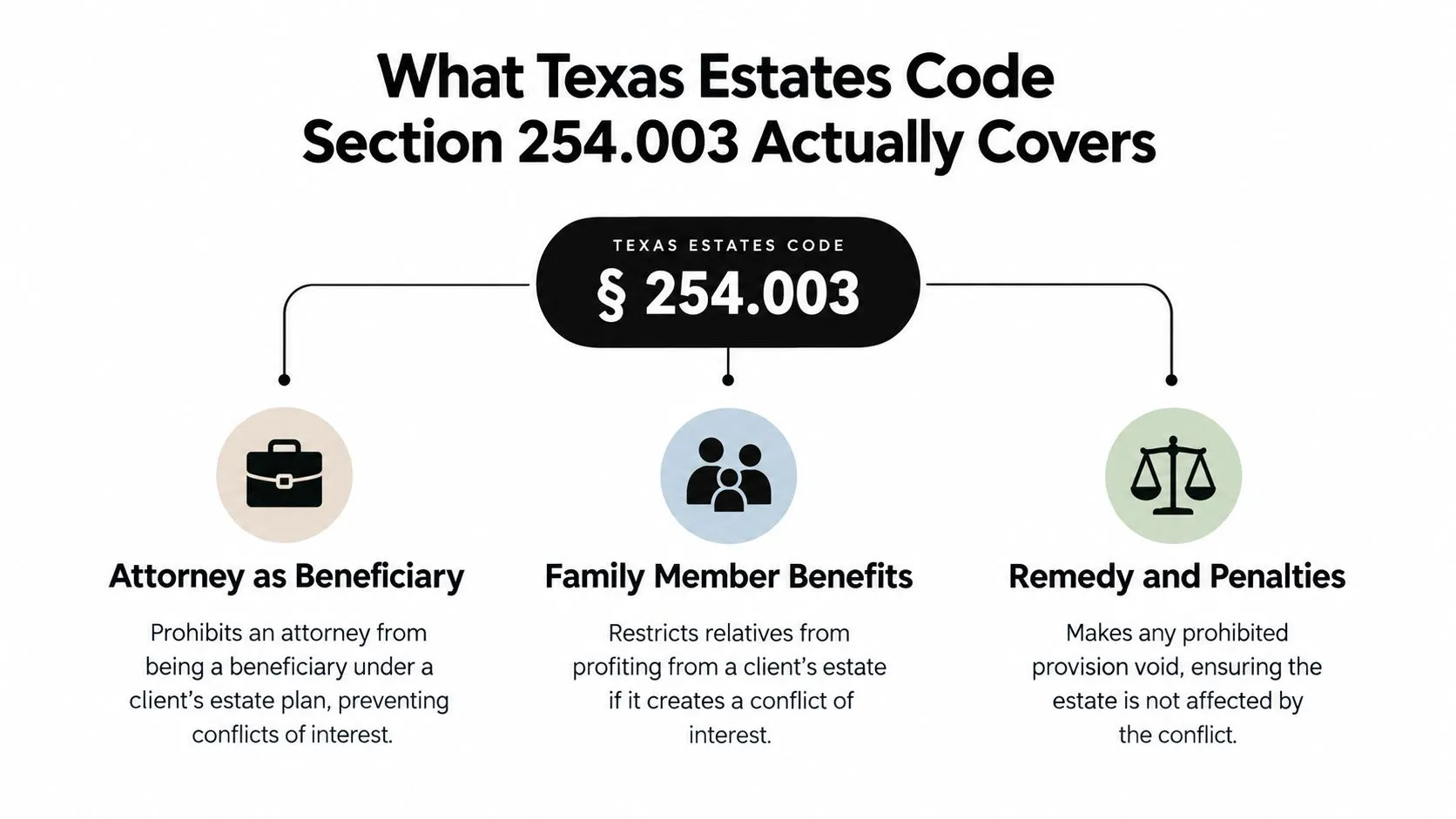
Section 254.003 is a targeted rule about gifts involving the lawyer who prepared or supervised preparation of a will. In plain English, the law is concerned that an attorney might influence a client's estate plan for the attorney's own benefit, or for the benefit of people closely connected with the attorney.
The statute's structure supplies a useful screening method. Subsection (a) identifies three categories of potentially void devisees:
- The attorney who prepared or supervised the will. A gift to that attorney may be void.
- Certain people connected to the attorney. This includes the attorney's parent, a descendant of a parent, or an employee.
- The spouse of the attorney or related person. The statute also addresses a spouse within the covered attorney-related group.
“Void” means the gift generally has no legal effect under the statute. It doesn't mean that the entire will automatically disappears. The legal consequence may focus on the particular devise, while the rest of the estate plan requires separate analysis.
The exceptions change the result
Section 254.003 also creates two principal groups of exceptions. The first protects certain family relationships between the testator, the person who made the will, and the beneficiary. The rule doesn't apply when the beneficiary is the testator's spouse, ascendant, descendant, or a person related to the testator within the third degree by consanguinity or affinity. Consanguinity generally refers to a blood relationship, while affinity generally refers to a relationship through marriage.
The second exception protects a bona fide purchaser for value. In simple terms, a person who acquires property from a devisee for value may retain protection even if the original devise later becomes subject to a validity dispute. The statute preserves that purchaser's rights under the circumstances described in the law.
| Question | Section 254.003 focus |
|---|---|
| Who receives the gift? | The drafting or supervising attorney, certain connected people, or a spouse within the covered group |
| What is the concern? | Whether an attorney-related devise is legally valid |
| What exceptions matter? | Specified family relationships and bona fide purchasers for value |
| Is this a no-contest statute? | No |
The statute appears in Title 2, Subtitle F, Chapter 254 of the Estates Code, a chapter concerning certain provisions in and contracts relating to wills. Its wording and placement support a narrow reading. It's a rule about attorney-connected gifts, not a general test for enforcing a forfeiture provision.
Families comparing this issue with Dying Without a Will in Texas: Intestate Succession should keep the distinction clear. That resource addresses how Texas law distributes an estate when there is no will, while Section 254.003 addresses a specific kind of gift made through a will.
The Real Law Behind In Terrorem and No-Contest Clauses
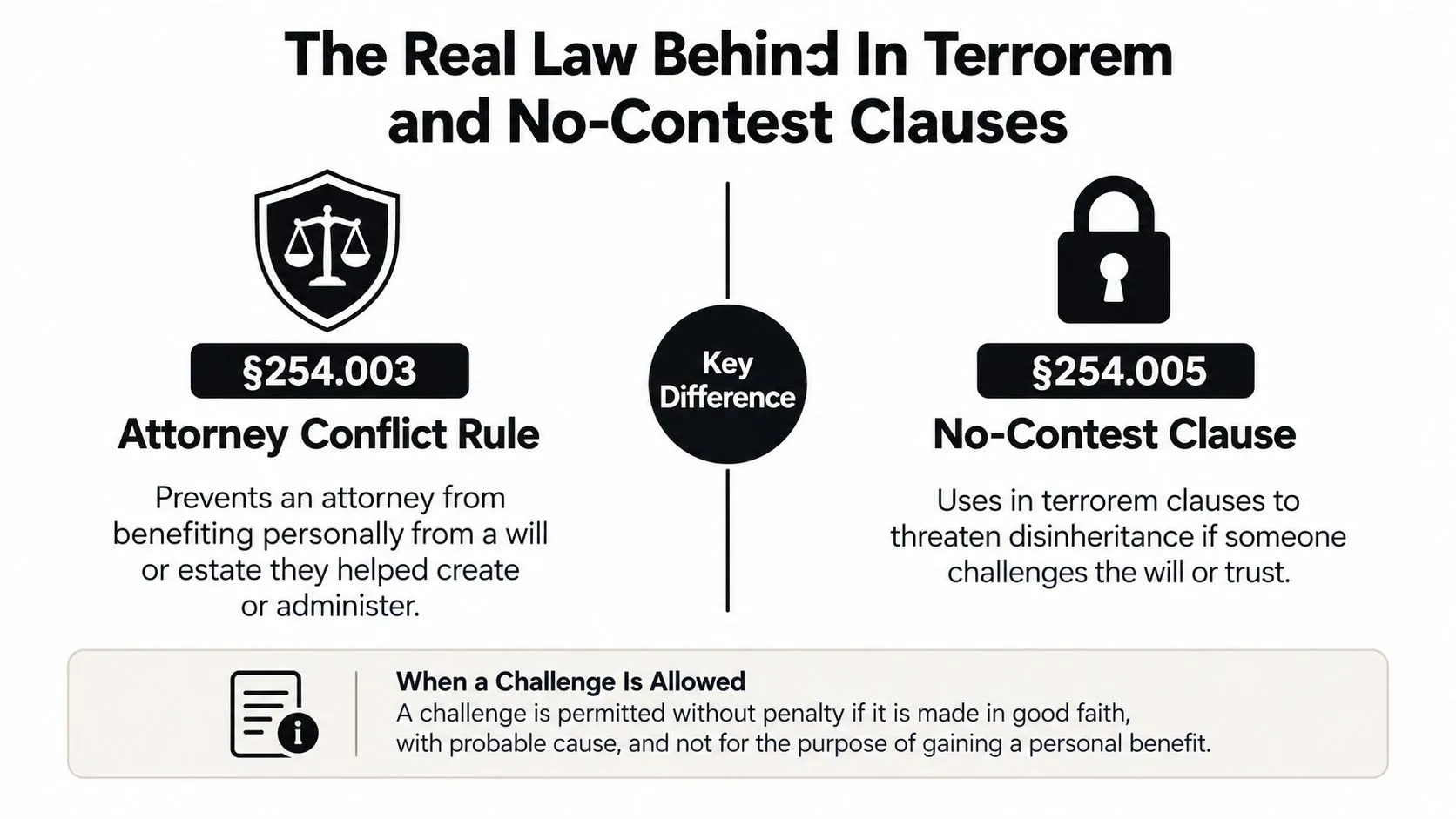
The Texas statute specifically addressing a forfeiture clause is Texas Estates Code § 254.005. A no-contest clause attempts to discourage a beneficiary from bringing certain actions against the will or estate plan. If the clause applies and the beneficiary cannot satisfy the statutory requirements, the beneficiary may risk losing the gift provided by the will.
The analysis should proceed carefully:
- Read the exact clause. Determine what conduct the will identifies as a contest or prohibited action.
- Identify the proposed or completed action. A petition to invalidate a will is different from a request to interpret an unclear provision, although the clause's wording and the facts remain decisive.
- Examine the beneficiary's reasons. The beneficiary may need to establish just cause and good faith.
- Preserve proof. Documents and witness information can become important if another party seeks forfeiture.
- Analyze the burden of proof. The beneficiary must satisfy the legal standard in the proceeding that determines whether forfeiture applies.
Under Section 254.005, a beneficiary who brought an action contrary to the forfeiture clause may avoid forfeiture only by proving, by a preponderance of the evidence, both that just cause existed for bringing the action and that the action was brought and maintained in good faith. The statute and a Texas appellate decision discussing the rule are available through Texas Estates Code § 254.005 and the related appellate opinion.
What the burden means in practice
“Preponderance of the evidence” is a courtroom phrase meaning the facts are more likely true than not true. It isn't proof beyond all possible doubt. Still, a beneficiary can't rely only on a sincere feeling that something was wrong. The evidence should explain why the challenge had a reasonable foundation and why the beneficiary pursued it in good faith.
Relevant proof may include communications about the will, medical records, financial records, witness information, and documents showing what the beneficiary knew before filing. A family member who noticed a sudden change in a loved one's estate plan may need to preserve the circumstances surrounding that change rather than merely alleging that it felt unfair.
A Texas Probate Lawyer may assist with probate and estate administration while the parties determine whether the dispute concerns attorney-related validity, forfeiture, or another probate issue.
For a focused discussion of the separate forfeiture issue, see no-contest clauses in a Texas will. The central point remains simple: Section 254.003 asks whether a particular attorney-connected gift is valid, while Section 254.005 addresses whether a beneficiary's conduct triggers a forfeiture clause.
The Good Faith Gray Area in Texas Estate Litigation
Good faith is important, but it isn't a magic phrase that automatically protects every beneficiary. Texas authorities recognize in terrorem clauses and generally require courts to construe them strictly. That means a court should examine the precise words of the provision rather than broadly treating every disagreement with an executor or every court filing as a prohibited contest.
The unresolved issue is how far the protection for good faith and probable cause extends. Scholarly analysis reports that the Texas Supreme Court hasn't definitively resolved whether good faith and probable cause always prevent forfeiture. A clause may even state that forfeiture applies regardless of good faith or probable cause, yet the enforceability of that language remains materially uncertain under Texas law. The discussion appears in this analysis of Texas in terrorem clause authority.
That uncertainty can be frightening. It also means that two simplistic statements are unsafe: “Any will contest causes forfeiture,” and “Good faith always prevents forfeiture.” Neither statement captures the need to read the will, examine the proceeding, and evaluate the evidence.
Conduct that may not fit an easy label
A beneficiary may want information without trying to destroy the estate plan. For example, the beneficiary might request an accounting, investigate possible fiduciary misconduct, oppose an accounting, seek construction of an ambiguous will, or defend against another person's contest. Whether that conduct violates a no-contest clause depends heavily on the clause's wording and the nature of the proceeding.
A request to clarify what the will means may seek to enforce the estate plan rather than invalidate it. A challenge to the executor's handling of assets may concern administration rather than the validity of the will. But a court may still need to decide whether the beneficiary's specific claims and requested relief fall within the language of the forfeiture provision.
Read the verbs in the clause. Words such as “contest,” “challenge,” “object,” or “seek to invalidate” may matter, but the court will also consider what the beneficiary actually asked the court to do.
Beneficiaries should avoid treating an informal family dispute as harmless merely because no petition has been filed. Emails, accusations, demands, and negotiations may later become part of the record. That doesn't mean a beneficiary must remain silent. It means communications should be accurate, measured, and informed by the actual language of the will.
Anyone considering a challenge should review will contests in Texas, including grounds, evidence, and deadlines before taking action. A careful evaluation can distinguish a legally justified inquiry from conduct that creates unnecessary forfeiture risk.
A Realistic Scenario of Overlapping Estate Disputes
Suppose Maria dies in Texas, leaving a will that names her longtime attorney, Daniel, as executor. The same attorney prepared the will. Maria's will leaves a particular piece of property to Daniel and includes a clause stating that a beneficiary who contests the will forfeits that person's inheritance.
Maria's daughter, Elena, believes Daniel exerted undue influence when Maria became dependent on others for daily care. Elena also notices that the will contains a gift to Daniel. She wants to challenge the suspicious devise, but she's afraid that asking questions will cause her own inheritance to disappear.

Elena's situation involves two separate legal tracks. First, Section 254.003 may require the probate court to examine whether the devise to Daniel is void because Daniel prepared or supervised preparation of the will. The court must also examine the statutory exceptions. If Daniel is within an exempt relationship to Maria, or if another exception applies, the result may differ.
Second, the no-contest provision raises a Section 254.005 question. If Elena brings an action contrary to the clause, she may need to prove by a preponderance of the evidence that she had just cause and acted and continued to act in good faith. Her concern about undue influence could be relevant, but she'd need to develop facts supporting the concern.
How the court process may unfold
The parties may begin by admitting the will to probate and addressing Daniel's appointment as executor. Elena could then investigate the will's execution, Maria's medical condition, communications with Daniel, financial transactions, and the circumstances surrounding the gift. The court may need to decide whether Daniel can continue serving while the conflict is examined, depending on the pleadings and facts.
Elena shouldn't assume that challenging one devise automatically means she is attacking every part of the estate plan. The exact relief she requests matters. She may seek to invalidate a specific gift, contest the will, obtain information, or ask the court to interpret unclear language. Each path carries different procedural and forfeiture concerns.
Families who are also learning how assets held through a trust work may find a plain-language resource on trust corpus estate planning basics useful for background. That information doesn't replace advice about the Texas will, but it can help identify which assets may require separate administration.
The scenario illustrates why a beneficiary shouldn't rely on a search result that labels Section 254.003 as Texas's no-contest statute. One estate can contain an attorney-beneficiary issue and a forfeiture issue at the same time, but the court must analyze them independently.
Practical Steps for Executors and Beneficiaries
A probate dispute is easier to handle when the family preserves facts before arguing about conclusions. Executors and beneficiaries should begin with the complete documents and the will's exact language, especially because an attorney-related gift issue under Section 254.003 and a no-contest issue under Section 254.005 require separate analysis.
Start with the governing documents
Obtain the complete will, every codicil, any written amendment, and relevant trust documents. Do not rely on a transcription, a relative's summary, or a clause copied into a text message. Mark provisions addressing contests, forfeiture, executor authority, attorney fees, and gifts to the drafting lawyer or connected people.
Build a timeline beside those documents. Record when the will was signed, who attended, what medical or financial concerns existed, and when important conversations occurred. A dated timeline separates confirmed facts from disputed recollections and identifies records that still need to be found.
Preserve evidence before memories fade
Evidence may later bear on whether a beneficiary acted with just cause and good faith, so preserve it in its original form:
- Communications: Save emails, letters, text messages, and other written discussions about the will, the decedent's wishes, or estate administration.
- Medical information: Keep records that may relate to capacity or vulnerability, subject to applicable privacy and access rules.
- Financial records: Gather account statements, deeds, transaction records, and documents concerning significant transfers.
- Witness details: List people who observed the decedent's condition, relationships, conversations, or will-signing process.
Do not edit original files or send accusations in anger. A beneficiary can request information without alleging misconduct. An executor should answer proper requests, follow court orders, and keep estate property separate from personal property.
Move carefully from discussion to formal action
Before filing anything, have counsel review the proposed claims and the forfeiture language. The legal risk may differ depending on whether the filing seeks to invalidate the will, interpret unclear terms, enforce a provision, challenge administration, or respond to another party's proceeding. A request for information or clarification may also require different treatment from a direct contest.
Executors should track notices, filing deadlines, inventories, accountings, and communications with beneficiaries. This probate notice to beneficiaries in Texas resource can provide background on why notice supports orderly administration, although it does not replace advice about a particular estate.
While researching firms online, you may encounter a guide for growing practices about custom law-firm website design. Treat that business material as background only, not as advice about your no-contest clause or the steps in your probate case.
The Law Office of Bryan Fagan, PLLC is one option for families seeking advice about probate administration, estate disputes, and related planning. Whatever counsel you choose, seek guidance before signing a settlement, waiving rights, distributing disputed property, or filing a pleading that could trigger a forfeiture provision.
Key Takeaways and Your Next Steps
The most important correction is also the simplest:
Key Insight: Texas Estates Code § 254.003 concerns certain attorney-related gifts in a will. Texas Estates Code § 254.005 addresses the burden a beneficiary may face when a no-contest or forfeiture clause is invoked.
Section 254.003 generally addresses a devise to the attorney who prepared or supervised the will, certain related or connected people, and a spouse within the covered group. The statute contains exceptions involving the testator's spouse, ascendants, descendants, specified relatives, and bona fide purchasers for value. The relationship and transaction details matter.
Section 254.005 requires a beneficiary seeking to avoid forfeiture to establish, by a preponderance of the evidence, both just cause and good faith. That isn't a universal guarantee that a beneficiary can sue without risk. Texas courts strictly construe in terrorem clauses, but important uncertainty remains regarding good faith, probable cause, clauses that attempt to eliminate those protections, and proceedings that seek information or clarification rather than invalidation.
If you're administering an estate, preserve the documents and communicate carefully. If you're an heir, don't assume that silence is your only safe option, and don't file a contest before reviewing the will's exact language and the facts supporting your position.
For broader planning and administration needs, families can review resources on the Texas Probate Process, Guardianship, Wills & Trusts, and Probate Litigation. A compassionate legal consultation can help you understand your options without treating a painful family disagreement as a simple internet answer.
If you're facing probate in Texas, our team can help guide you through every step, from filing to final distribution. The Law Office of Bryan Fagan, PLLC can evaluate attorney-beneficiary issues, no-contest clause risks, and related probate disputes with clear, practical guidance. Schedule your free consultation by visiting Law Office of Bryan Fagan, PLLC today.


