 Skip to content
Texas Estates Code §33.101 mandates transferring a probate case when venue is determined to be in another Texas county. The clerk must transmit the file, and the receiving court continues the proceeding as if it had been filed there originally.
A grieving family can face this problem before anyone has had time to understand what probate requires. An executor may file in the county that seems most convenient, only to learn that the decedent lived elsewhere or that another relative has started a competing proceeding. The resulting uncertainty can feel like the entire estate must begin again. Under Texas law, that isn't necessarily what happens.
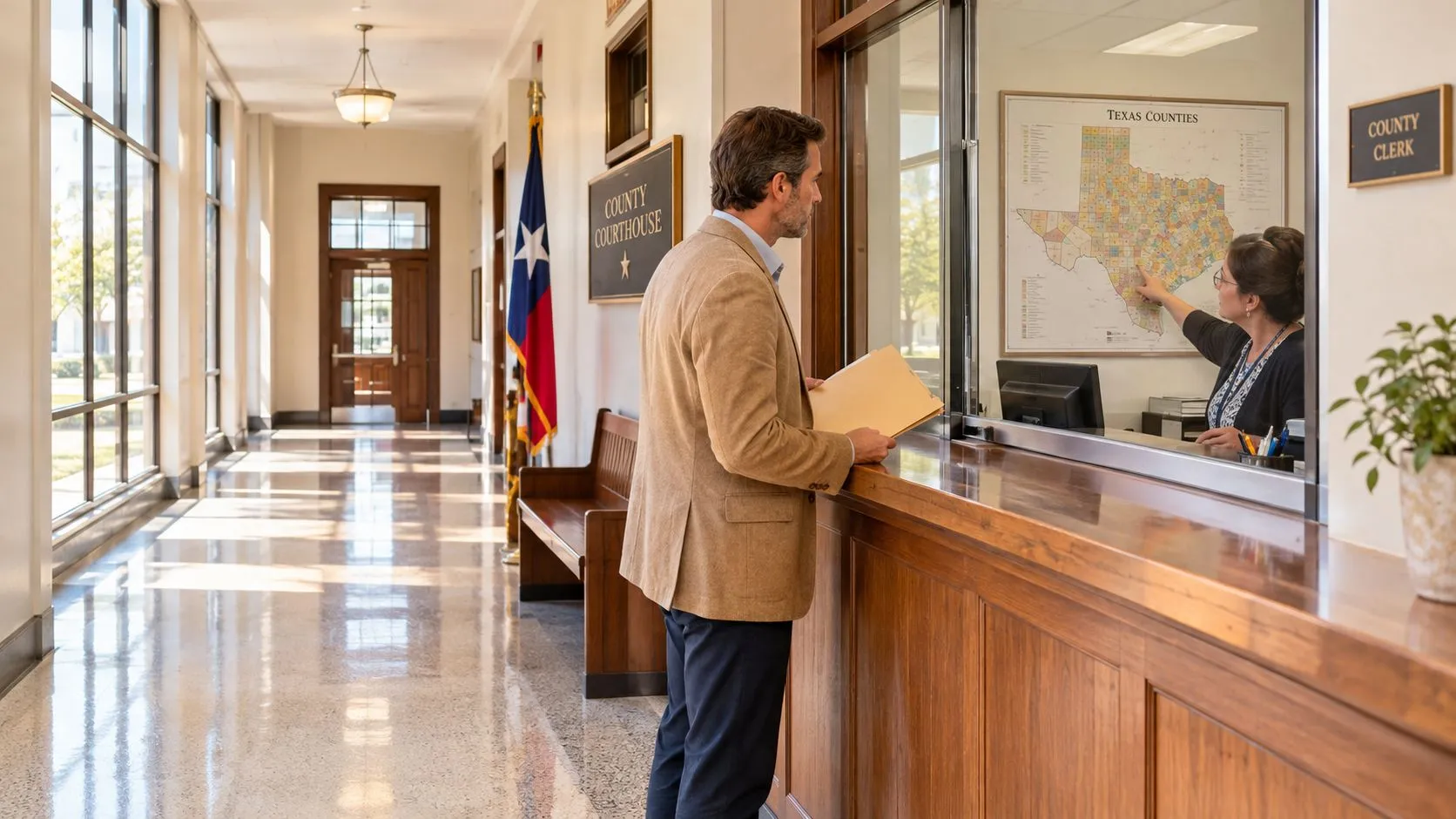
When Probate Starts in the Wrong County
Consider an executor who files in Harris County because the executor lives nearby and expects the process to be easier there. The decedent, however, lived in Dallas County at death. Before the first hearing, another family member begins probate proceedings in Dallas County, or the court raises a question about whether Harris County is the proper venue.
That situation creates more than a mailing problem. The family may worry about conflicting applications, duplicated court filings, competing requests for appointment, and delay in dealing with property, accounts, debts, or a residence. An out-of-state executor may be especially concerned because traveling to Texas and coordinating with multiple clerks can make an already difficult responsibility feel unmanageable.
Texas Estates Code §33.101 provides a structured answer when probate proceedings involving the same estate have been commenced in more than one county. Once the court determines that another county is the legally proper venue, the law requires the clerk to transmit the proceeding file under the statutory procedure. The receiving court then handles the matter as though it had originally been filed there. The family isn't automatically required to discard every step already taken and start over.
Why venue disputes arise
Venue means the proper county for a particular court proceeding. Families sometimes select a county based on the executor's residence, the location of one asset, or the county where a lawyer's office is located. Those facts may not control. The decedent's residence and the estate's legal circumstances matter more than convenience alone.
The practical objective is to place one estate under the supervision of one proper court. If you need a fuller explanation of the filing mechanics, the firm's guide to transferring a probate case in Texas provides related context. A venue transfer can preserve the existing court file while moving authority to the county that should conduct the proceeding.
Practical rule: Don't treat a venue concern as proof that the estate has failed. Treat it as a procedural issue that must be addressed promptly and accurately.
What Texas Estates Code 33.101 Actually Requires
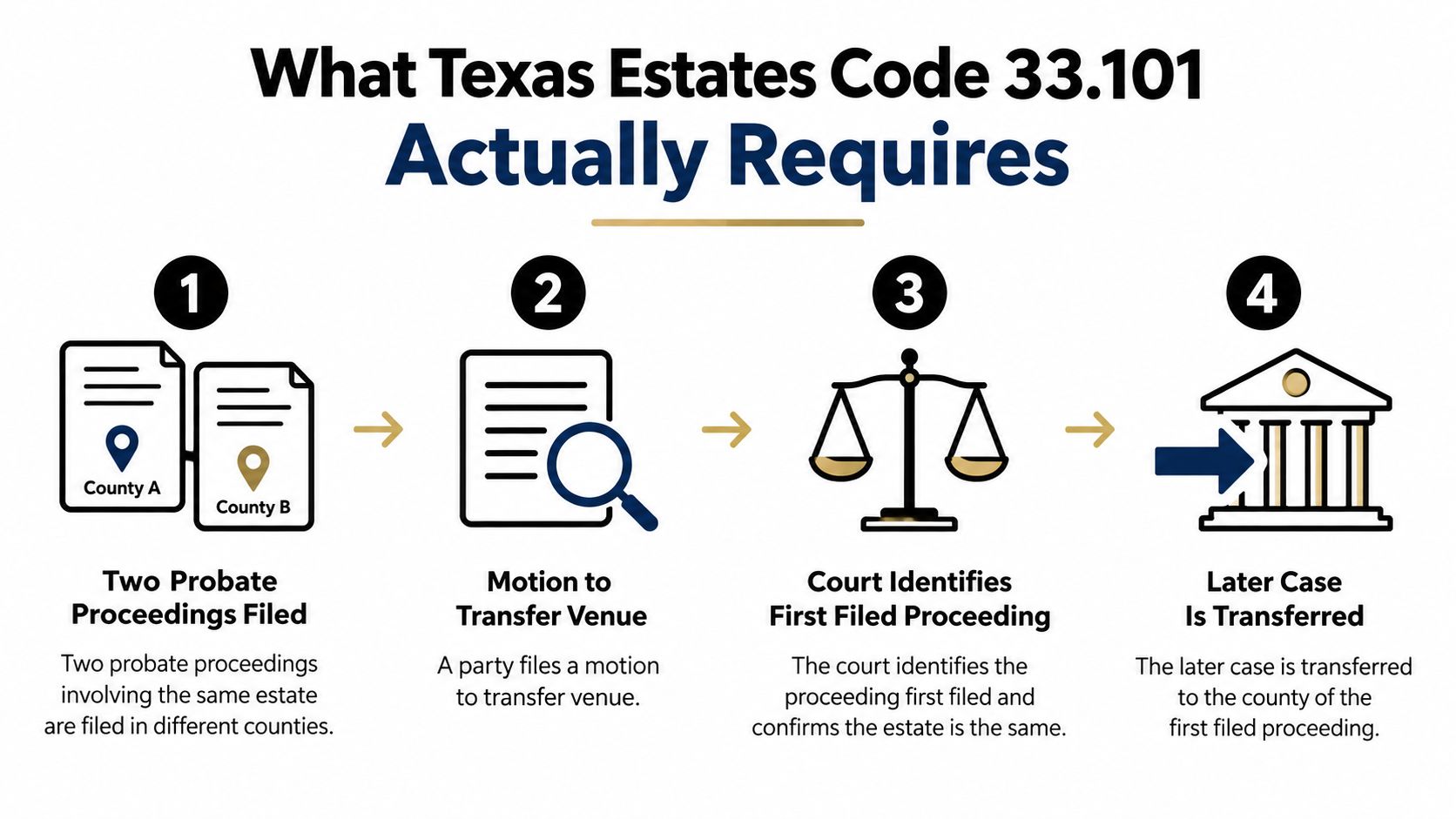
Texas Estates Code §33.101 is more than a general suggestion about where a probate case belongs. When proceedings involving the same estate are commenced in more than one county, the statute creates a mandatory transfer mechanism. The court determines the proper venue under §33.053. If another county is legally proper, the clerk must transmit the file under §33.105 to that county's court.
The receiving court must conduct the matter in the same manner as though the probate proceeding had originally been filed there. That language matters because it makes the venue decision operational. The proper county doesn't merely receive a recommendation while competing proceedings continue elsewhere. The statutory process is designed to prevent parallel probate cases from remaining active in competing counties.
The role of the connected statutes
Section 33.101 works with the venue rules in §33.053 and the file-transmission procedures in §33.105. In plain English, one provision helps identify the proper county, another supplies the mechanism for moving the record, and the receiving court continues the administration without treating the transferred matter as a brand-new probate proceeding.
The statute was added by the 82nd Texas Legislature in Senate Bill 1198, Chapter 1338, Section 2.04, with an effective date of January 1, 2014. The Legislature later amended it through provisions taking effect September 1, 2021, and September 1, 2023. Those dates are part of the history of the modern transfer structure, which practitioners now read together with the current version of the Estates Code. The statutory text is available in the Texas Estates Code Title 2 and Title 3 provisions.
For a family, the key point is simple. If the court determines that another Texas county has priority or is legally proper, the clerk's transmission of the file is mandatory under §33.101. A Texas Probate Lawyer may help an executor understand how the transfer affects the pending application, notices, evidence, and future administration.
Who Can Request a Transfer and on What Grounds
A transfer request normally comes from someone with a legitimate interest in the estate or the pending proceeding. That can include an executor, administrator, heir, beneficiary, or another interested person. The court may also address venue on its own when the filings or evidence show that the proceeding belongs elsewhere.
A person can't obtain a transfer just because another county would be more convenient. The request needs a legal basis tied to proper venue and, when relevant, another pending probate proceeding involving the same estate. Section 33.053 supplies the venue determination, while §33.101 addresses the consequences when competing proceedings exist.
A practical sequence
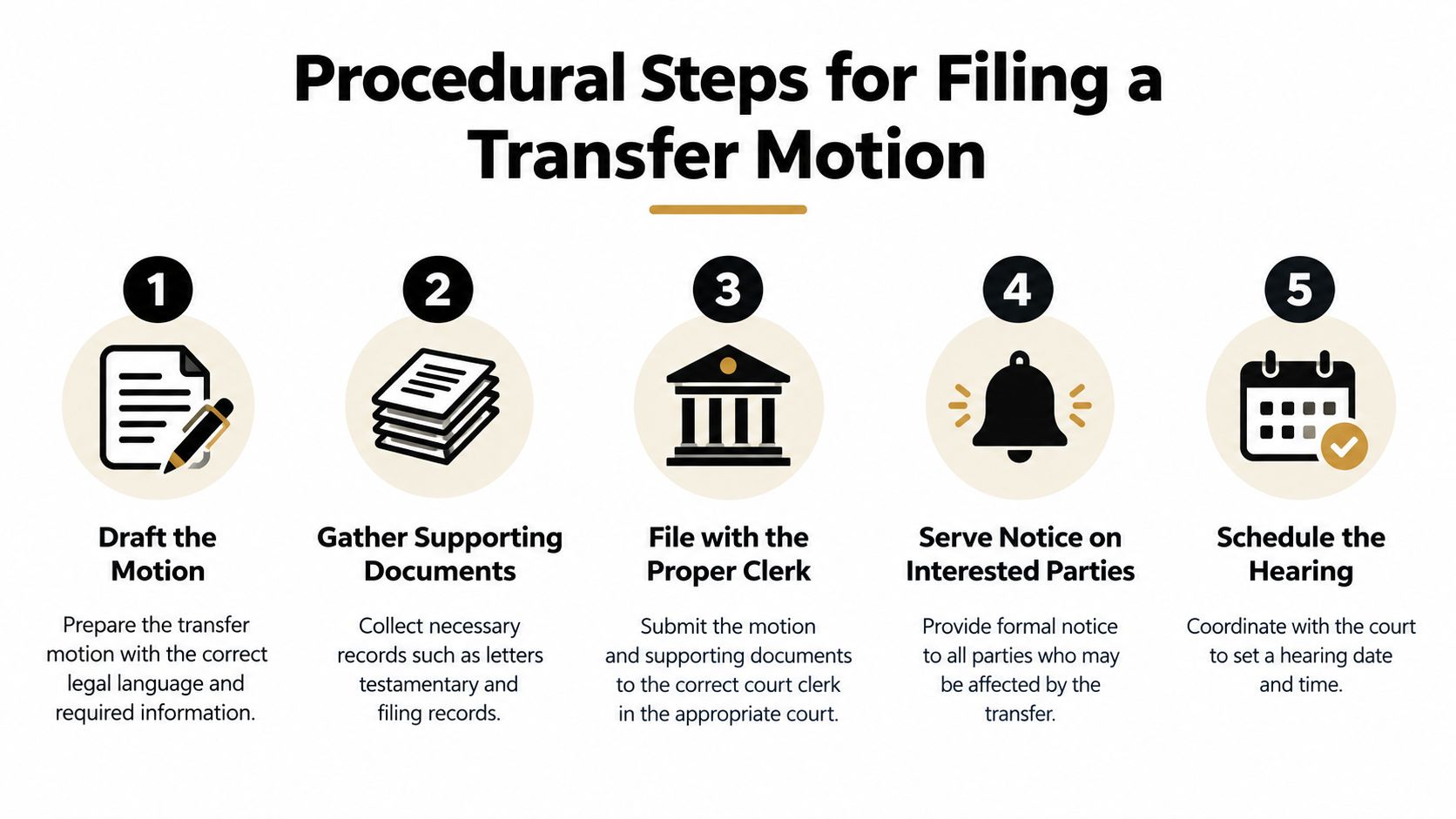
Identify the estate and the competing filings. Obtain copies of each application, docket information, filing records, and any orders already signed. Confirm that the proceedings concern the same decedent and estate.
Determine the legal venue. Gather evidence addressing the decedent's county of residence at death and any facts relevant to the venue analysis. A mailing address alone may not resolve the issue, particularly when a residence sits near a county line.
File the request with supporting facts. The motion should identify the competing proceeding, explain why the other county is proper under §33.053, and request the statutory transfer required by §33.101. Affidavits or records may be needed to establish residence, filing history, or the relationship between the proceedings.
Provide notice. Interested parties must receive notice under the applicable court rules and orders. Notice gives heirs and other participants an opportunity to respond rather than allowing a venue dispute to proceed without their knowledge.
Ask the court to direct transmission under §33.105. If the court finds that the proceeding belongs in another county, the order should address the clerk's duty to transmit the file and identify the receiving court.
A venue challenge can fail when the movant relies only on convenience, hasn't shown that the proceedings concern the same estate, or hasn't supplied enough evidence to establish the other county as proper. The purpose of §33.101 is to prevent duplicate administration, not to create a tactical delay.
Venue vs Jurisdiction in Texas Probate
Jurisdiction and venue answer different questions. Jurisdiction asks whether a court has legal authority to hear a type of matter. Venue asks which county is the proper place for that proceeding within the court system.
A useful analogy is a hospital network. Jurisdiction is whether the network can treat the condition at all. Venue is which facility should handle the patient. Moving the file to the proper county doesn't necessarily mean the original court lacked all authority. It means the law assigns this particular estate to another location.
In probate, venue may depend on facts such as the decedent's domicile at death or the location of estate property. Families should avoid assuming that the executor's county, the heirs' county, or the county with the most convenient courthouse automatically controls. The applicable Estates Code provisions must be matched to the estate's facts.
| Concept | Definition | Can It Be Challenged? | Effect of Transfer |
|---|---|---|---|
| Venue | The proper Texas county for the probate proceeding | Yes, when supported by the Estates Code and evidence | The file moves to the legally proper county |
| Jurisdiction | The court's authority to hear and decide the probate matter | Yes, but it raises a different legal issue | A venue transfer doesn't by itself erase the court's general probate authority |
This distinction helps explain why a transfer needn't invalidate every prior filing. Section 33.101 directs the clerk to transmit the proceeding file, and the receiving court conducts the matter as though it began there. For a focused discussion of the court's authority, review probate court jurisdiction in Texas.
Venue is about location. Jurisdiction is about legal power. Confusing the two can lead a family to pursue the wrong remedy.
Procedural Steps for Filing a Transfer Motion
A transfer motion should give the judge a clean factual record. Avoid presenting the dispute as a family disagreement about convenience. The court needs to know which estate is involved, where the competing proceedings were filed, why one county is proper, and what relief the statute requires.
Prepare the record before filing
Start by collecting the initiating applications, clerk-stamped file information, death certificate, will if one exists, and evidence concerning the decedent's residence. If an executor has already received authority or an order has been entered, include those details so the court can understand what must be transmitted and what remains unresolved.
The motion should cite §33.101, identify the venue analysis under §33.053, and request file transmission under §33.105. Attach affidavits when personal knowledge is necessary, such as testimony about residence, possession of the original will, or the circumstances surrounding the competing filings.
File and notify the right people
File the motion in the pending probate matter according to the clerk's procedures and the court's standing orders. Serve the required notice on interested persons, including parties who filed or appeared in the competing proceeding. An out-of-state representative may coordinate with Texas counsel, use authorized electronic filing services, and attend hearings remotely when the court permits it, but the representative must still comply with Texas filing and notice requirements.
The other side may agree that one county is proper, contest the factual record, or argue that the proceedings are not duplicative. The court may set a hearing before deciding the motion. The timing depends on the court's docket, notice requirements, and whether a party files a response.
After the order
If the court grants the transfer, the clerk transmits the file under §33.105. The receiving court then proceeds with the matter as though it had originally been filed there. Confirm the receiving court's case number, filing requirements, hearing dates, and any outstanding requests after transmission.
The firm's resource on the Texas probate forms update may help identify forms that need attention, but forms alone don't resolve a disputed venue. The strongest filing combines accurate documents with a clear explanation of the statutory basis.
Relevant Case Law and Practical Scenarios
A court deciding venue looks at the actual record, not just the county named in a family's preference. The important questions are whether the proceedings involve the same estate, whether the requested county is legally proper, and whether the movant has supplied evidence supporting the requested action. A motion that merely says another county is easier is unlikely to present the issue effectively.
Texas probate practice also requires caution with edge cases. A family may dispute where the decedent was domiciled, disagree about whether a temporary stay changed anything, or file related proceedings involving different assets. Those facts can affect the analysis, and §33.101 shouldn't be treated as an automatic answer to every disagreement involving multiple counties.
A realistic decision pattern
Suppose an executor files in Harris County, while an heir files a competing application in Dallas County. The executor says the Harris County filing happened first. The heir presents evidence that the decedent maintained a Dallas County home as the primary residence at death. The judge will need to evaluate the venue facts and the relationship between the two cases, rather than deciding solely on which family member acted first.
A practical preparation matrix looks like this:
| Situation | Useful response |
|---|---|
| Same decedent and estate, with a supported basis for another county | Request transfer and assemble the evidence for §33.053 |
| Different proceedings involving different estates or distinct legal issues | Analyze whether §33.101 applies before seeking transfer |
| Disputed residence or domicile | Prepare records and sworn testimony addressing the decedent's actual connection to each county |
| Immediate concerns about debts or taxes | Coordinate probate counsel with a resource addressing help with tax debt after death |
A successful transfer doesn't decide every later dispute among heirs. It establishes where the probate matter should proceed. Once the receiving court assumes the file, the executor still must follow the court's instructions, maintain estate records, protect assets, and communicate with interested parties.
Sample Motion Language and Next Steps
A motion should be factual, restrained, and specific. It shouldn't accuse relatives of misconduct unless the evidence supports that allegation. The court needs a concise explanation of the estate, the competing proceeding, the venue facts, and the statutory relief requested.
Adaptable motion structure
The following language is a starting point, not a substitute for case-specific legal drafting:
Applicant states that the pending probate proceeding concerns the estate of the same decedent involved in a proceeding commenced in another Texas county. The evidence establishes that the other county is the proper venue under Texas Estates Code §33.053. Applicant requests relief under §33.101 and asks the Court to direct the clerk to transmit the proceeding file under §33.105 to the proper county, where the matter may continue as though originally filed there.
Attach the documents that support each factual statement. Identify the competing cause number or filing information, explain the residence evidence, and state whether any hearing, appointment, or order has already occurred. The motion should also comply with local filing, service, and hearing procedures.
Choosing the next step
If the facts clearly support another county and a duplicate proceeding exists, pursuing a transfer may protect the estate from parallel administration. If the evidence is mixed, a lawyer can help assess whether the dispute concerns venue, jurisdiction, standing, or a different probate objection. If a family member has already been appointed, assets are at risk, or heirs disagree about the will, prompt advice can prevent an avoidable procedural error.
The broader probate process still matters after venue is resolved. Families may need support with the Texas Probate Process, Guardianship, Wills & Trusts, or Probate Litigation, depending on the estate's circumstances.
Key Insight
Texas Estates Code §33.101 turns a proper venue determination into a required administrative action. When the statute applies, the original county's clerk transmits the file, and the proper county continues the proceeding. That structure can preserve the work already completed while placing the estate under the supervision of the appropriate court.
If you're facing probate in Texas, our team can help guide you through every step, including a venue dispute under Estates Code §33.101, file transmission, and continued administration in the proper county. Contact Law Office of Bryan Fagan, PLLC to discuss the facts of your estate and schedule a free consultation.


