 Skip to content
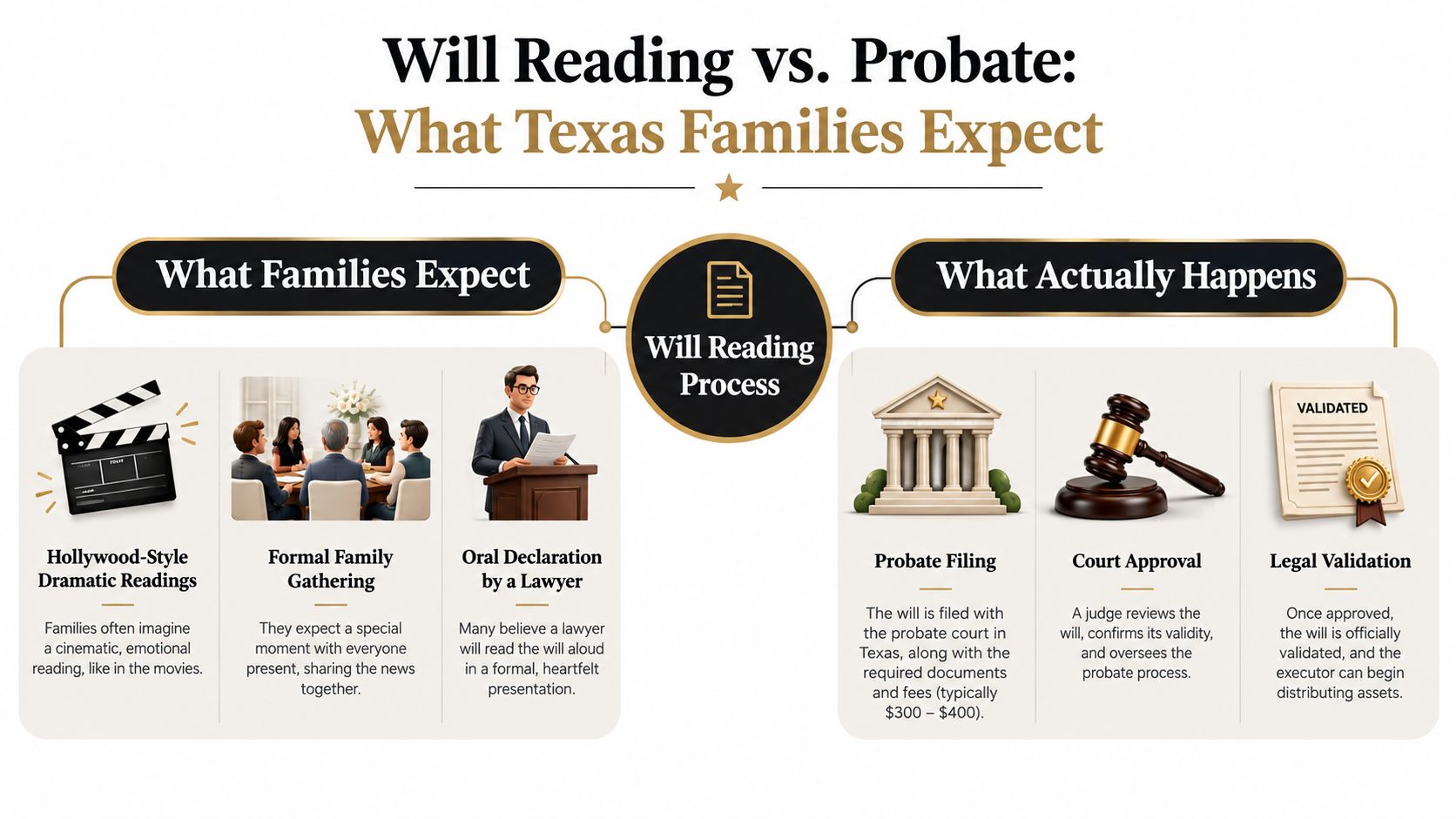
If your family is waiting for a lawyer to gather everyone in one room and read a will aloud, you're probably waiting for something Texas probate law doesn't require. In a Houston estate, that confusion can keep children, spouses, and out-of-state heirs frozen in place, unsure whether they're supposed to wait for a ceremony, sign something, or call the court. The process is calmer, and more useful, than the movie version. In Texas, the estate moves forward through filings, notice, a hearing, and court orders.
The old image of a dramatic reading comes from another era. Texas probate is built around the original will, the court record, and the judge's authority to admit the document and appoint the person who can act for the estate. Once you understand that, the process stops feeling mysterious. It becomes a sequence of concrete steps, each with a purpose and a deadline.
Why Texas Families Confuse the Will Reading With the Probate Process
A daughter calls her brothers after their father dies, and everyone assumes the attorney will schedule a formal reading. They picture a silent room, a folded document, and a lawyer explaining who gets what. Then the lawyer says something different, the original will has to be located, filed with the court, and brought into probate before anyone has legal authority to distribute anything. That's the point where many families realize the will reading process they expected is not the process Texas law uses.
Why the movie version sticks
The old public reading developed in eighteenth- and nineteenth-century England, when many people couldn't travel easily and copies weren't simple to obtain. That history matters because it explains the emotional expectation, but it doesn't control modern Texas probate. Today, the important events are the filing, the hearing, the order admitting the will, and the issuance of authority to the executor, not a dramatic oral announcement in a living room.
Texas guidance makes the same point in plain language. Probate is court-centered, and the will becomes part of the record once filed. If you want a broader plain-English overview of what families usually ask first, the senior living blog can be a helpful place to compare related end-of-life topics without getting lost in legal jargon.
Practical rule: If the court has not admitted the will, the named executor still can't just start moving money or selling property.
A few terms that keep the conversation clear
A testator is the person who signed the will. A beneficiary is someone named in the will to receive property. An heir is someone who may inherit under the law if there's no valid will, or if the will doesn't cover everything.
A personal representative is the court-approved person who handles the estate. In many Texas estates, that person is the executor named in the will. Those labels sound formal, but the job is simple to describe, the person gathers, protects, accounts for, and distributes estate property under court authority.
For families trying to orient themselves, a good plain-English guide is the internal resource on who reads the will after death. The next steps are usually simpler than they feel on the day of the funeral, because the process follows a sequence, not a surprise announcement.
The rest of the process makes more sense once you stop waiting for the reading and start looking for the original will, the court file, and the deadlines.
Locating the Will and Preparing to File for Probate
A Texas probate case usually starts in a file cabinet, not a courtroom. The first job is to locate the original will and keep it safe for filing. A signed copy can help you confirm the contents, but it does not replace the original in most cases, and waiting for a family gathering will only slow the estate down.
Start with the places where people leave important papers, a home safe, a desk drawer, a safe deposit box, or the drafting lawyer's office. If your family has only a photocopy, treat that as a signal to keep searching. The court generally wants the original, because that is the document the judge can review for filing and later admit to probate.
What to gather before filing
The paperwork should be assembled before anyone heads to the courthouse. A complete filing usually includes the death certificate, the original will, any codicils, a list of assets, and basic beneficiary information. If you know the drafting attorney's name, the witnesses' names, or have clear photos of each page, keep those with the file as well. Those details help if the clerk or court later asks questions about execution or completeness.
Texas generally requires an application to probate a will to be filed within four years after the decedent's death under Texas Estates Code Chapter 256, with limited exceptions. That deadline is measured from the date of death, so time spent waiting for a dramatic “reading” can work against the estate.
If your family's records are scattered, a simple household file system can keep the original will findable when the court asks for it, as described in this guide to use Standby Self Storage for archives.
Keep the original safe, and don't staple, clip, or alter it unless you know exactly why it is being handled that way.
Filing in the right county
In most estates, the application is filed in the county where the decedent lived. That filing choice matters because the court with authority over the estate needs the application before any hearing can happen. Once the application is on file, the clerk's stamp starts the clock on your hearing date, and interested people can be notified under the probate rules.
A simple example shows why this matters. A niece in Collin County finds her aunt's original will after e-filing the application. The county requires the original will within three days after e-filing, and the hearing generally will not be set until it is received. That is why the original should be tracked down before the family assumes the estate can wait.
If you need a plain-English reference while you gather paperwork, the page on how to get a copy of a will in Texas explains why copies and originals are treated differently.
The Probate Hearing and Admitting the Will
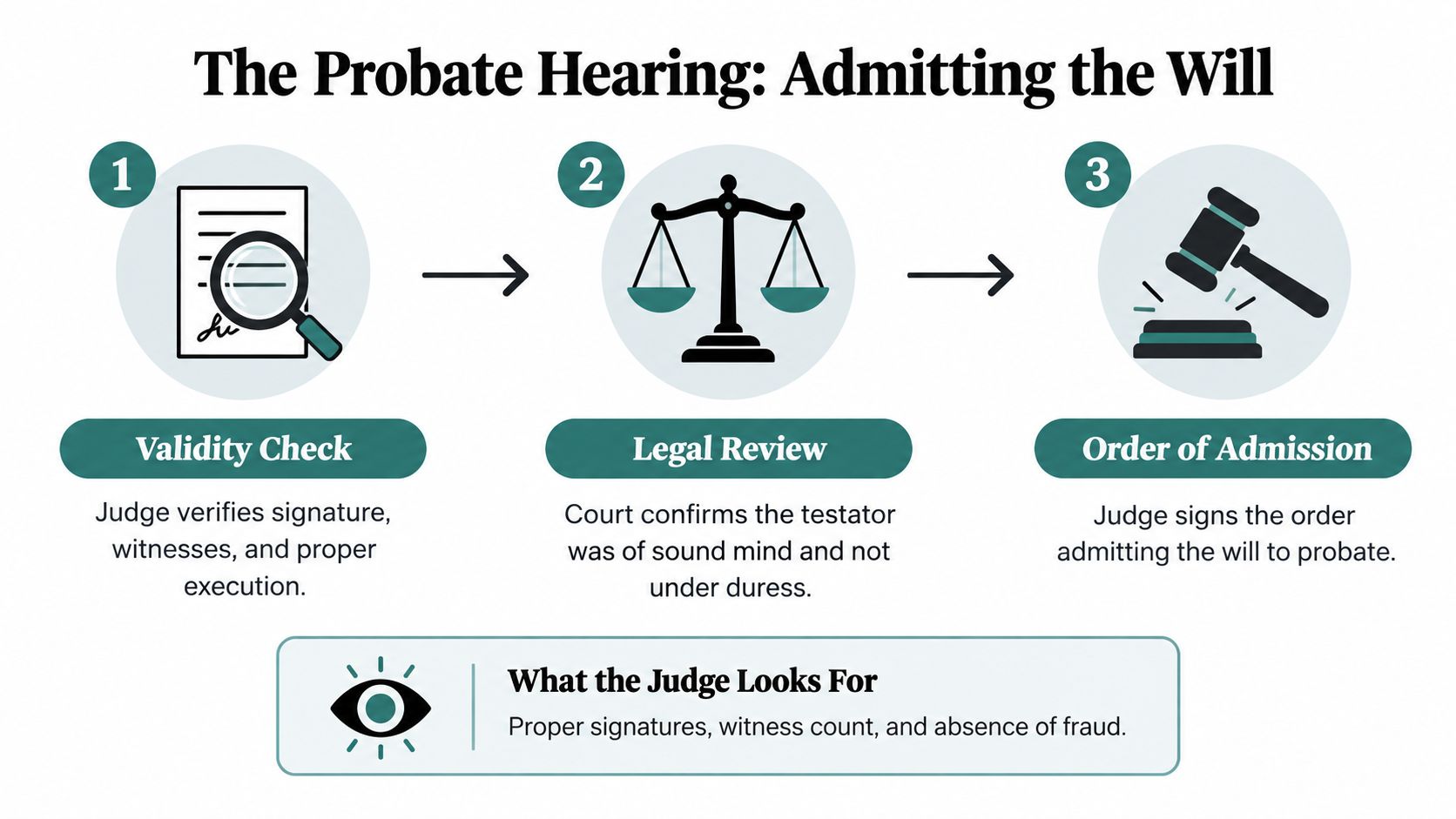
The hearing is where the process becomes real. A judge does not host a family reading session, instead the court examines whether the will was properly executed, whether it appears valid, and whether anyone has raised a legal objection. In plain English, the court is checking whether the document can be trusted enough to control the estate.
What the judge is looking for
Texas law generally expects an ordinary written will to be signed by the testator and attested by two credible witnesses. A wholly handwritten will may qualify without witnesses, but families should never assume a handwritten page is automatically enough. The court also considers whether the testator had testamentary capacity and whether undue influence may have affected the document.
A self-proving affidavit helps because it usually reduces the need to track down witnesses later. If the affidavit is attached properly, the court has an easier path to admission because the formal execution requirements are already supported in the file. That doesn't erase every possible dispute, but it makes an uncontested hearing much smoother.
What a typical uncontested hearing feels like
In many county courts at law, the hearing is brief and orderly. The attorney presents the original will, the application, and the supporting proof, and if no one objects, the judge can admit the will to probate. An independent administration is often the simpler path, because the executor may act with less ongoing court supervision than in a dependent administration.
For a grieving family, that distinction matters. Independent administration usually means less repeated court involvement, while dependent administration generally requires more court approval along the way. The right path depends on the will and the court's order, not on what the family assumes should happen.
Practical rule: Admission to probate is the gateway, not the finish line. It authorizes administration, but it doesn't yet distribute the estate.
If you want a focused explanation of the documents that let an executor act, the internal page on how to get Letters Testamentary in Texas fits here naturally. Once the judge signs the order admitting the will, the executor still has to qualify and receive those letters before banks and title companies will usually recognize the authority.
After admission, the case moves from “is this will valid?” to “who can act, what exists in the estate, and what has to be done next.”
Here's a short video overview that can help families visualize the hearing stage.
Letters Testamentary, the Inventory, and Executor Duties
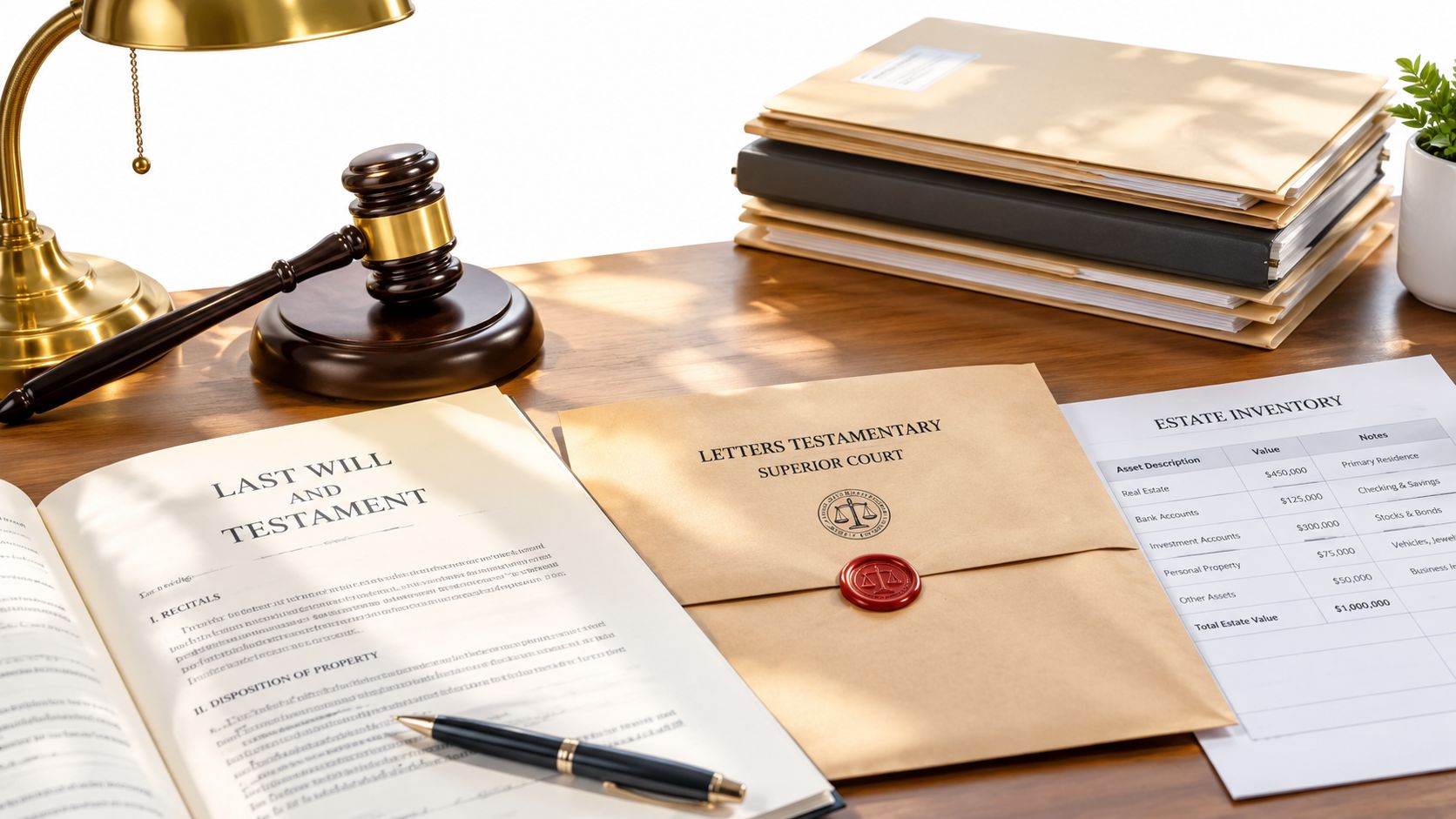
After the court admits the will, the named executor must still qualify before acting for the estate. Under Texas Estates Code Section 306.001, the court generally must grant Letters Testamentary to a qualified executor within 21 days after probate. The letters serve as the clerk's official proof that the executor has qualified and may deal with third parties for the estate.
A will names the person the decedent selected. The letters show that the court has recognized that person's authority. That distinction explains why banks, title companies, brokerage firms, and similar institutions commonly request the letters before releasing funds or changing ownership. They need evidence that the person making the request can act for the estate.
A practical explanation of how to get Letters Testamentary in Texas can help families understand the qualification step. Until the court issues the letters, the named executor generally cannot treat the estate's accounts, real property, or other assets as personal property to manage.
Once qualified, the executor gathers estate property, identifies valid debts, protects assets, and keeps organized records. Those duties require more than locating the will. Statements, deeds, vehicle records, business documents, and appraisals can help establish what belonged to the decedent and what may pass outside probate.
Texas probate courts also expect a verified inventory under Chapter 309. The inventory generally must be filed within 90 days after qualification, unless the court grants more time. It should identify estate property, including real estate, vehicles, accounts, and business interests, while separating assets that pass outside probate, such as certain insurance proceeds or pay-on-death accounts.
For example, if an independent executor receives Letters Testamentary on March 1, the inventory is ordinarily due around May 30 unless the court extends the deadline. Creating the file early makes that deadline easier to manage and gives the executor a record to use when questions arise.
The executor also has a notice duty. Texas Estates Code Section 308.002 generally requires written notice to known or reasonably ascertainable beneficiaries no later than the 60th day after the order admitting the will to probate. Notice is part of the legal process, so missing or delaying it can create additional work before the estate can proceed.
Notifying Heirs and Beneficiaries the Right Way
Families often use “heir” and “beneficiary” as though they mean the same thing. Texas probate law separates them. A beneficiary is named in the will. An heir is someone who would inherit under Texas law if no valid will controlled, or if the law must determine who inherits property the will does not cover. That difference affects who may need notice and how the representative documents the effort.
What the notice must say
As covered above, Section 308.002 sets the 60-day clock. What trips executors up is what the notice itself has to contain. The notice should identify the decedent and personal representative, state that the will was admitted to probate, and identify the recipient as a beneficiary named in that will. It also must include either a copy of the will and probate order or a detailed summary containing the court, docket number, and relevant dates.
| Required Notice Contents Under Texas Estates Code Section 308.002 | ||
|---|---|---|
| Element | What Must Be Included | Deadline Trigger |
| Identity | Decedent and personal representative | After the order admitting the will to probate |
| Probate status | Confirmation that the will was admitted to probate | After the order admitting the will to probate |
| Recipient status | The person is a beneficiary named in the will | After the order admitting the will to probate |
| Supporting detail | Either the will and order, or a detailed summary with court, docket number, and relevant dates | No later than the 60th day after the order |
Receiving the will does not require a beneficiary to sign away rights or agree immediately with every provision. It confirms that the probate process has reached the point where the beneficiary should receive the required information. An incomplete notice, missing attachment, or delivery problem can delay distribution while the representative corrects the record.
Why address tracing matters
Consider an out-of-state grandson who moved twice and never updated his address with the family. The executor sends notice to his last known apartment, but the envelope returns unopened. The returned mail does not end the obligation. The representative should make reasonable efforts to locate the beneficiary and keep records showing the addresses checked, the contacts made, and what happened to each mailing.
Plain-English takeaway: Notice is not a single family conversation. It is a paper trail the court can later review.
For a long-distance estate, this work may feel tedious, especially while relatives are grieving. It gives beneficiaries the information the law requires and gives the executor evidence that the notice process was handled carefully. Keep copies of the notice, attachments, returned envelopes, address research, and delivery records together in the estate file.
If beneficiaries cannot be located, or if a blended family disputes who should receive information, address those problems before distributing estate property. Clear notice cannot prevent every disagreement, but it keeps the discussion tied to the will, the court record, and documented efforts rather than family rumor.
When the Will Reading Process Hits a Snag
A family can do everything right and still run into trouble once probate starts. The original will may be missing, a witness may be hard to locate, or a relative may object to the document itself. These problems do not stop the estate forever, but they do change the path the court must follow.
Common problems that derail families
A photocopy-only will is one of the most common headaches. Texas courts usually want the original, and a copy often sends the case into a proof problem instead of a simple filing. If the original will cannot be produced, talk to counsel about the proof Texas courts require for a lost or destroyed will before filing, because a premature application can put you in default.
Missing witnesses create a different kind of delay. The court may need testimony or other proof that the will was signed correctly, and that means more documents, more coordination, and more waiting. Claims of lack of capacity, undue influence, or creditor disputes can slow the file in the same way, because the judge has to sort out evidence before the estate can move ahead.
A missed deadline can be just as serious. Texas probate has time limits, and waiting too long can limit the options available to the family. In some cases, a muniment-of-title filing may still be available if the applicant was not in default, but that route is narrower and not a fit for every estate.
What an objection actually changes
An objection does not always defeat the will. It often means the court must hear evidence before the executor can be appointed or before the estate can be distributed. That is why the original will, the witnesses' names, and the execution details should be preserved from the start, like keeping the key records in one file instead of scattered across the house.
A simple rule helps families avoid trouble later. Act quickly. Keep records. Do not assume silence means approval. If the will seems shaky, if someone is upset about its terms, or if the deadline is close, the safer move is to get legal help before the file becomes harder to fix.
Key Takeaways: Acting on the Will Reading Process in Texas
Texas has no routine courtroom ceremony where a will is read aloud to the family. The will reading process is a court-centered sequence: locate the original will, file it in the proper county, attend the probate hearing, obtain the order admitting the will, and have the executor qualify. Only then can the estate administration proceed with authority.
Keep these points in view:
- File within four years of death under Texas Estates Code Chapter 256.
- Protect the original will, because a copy may not be enough.
- Prepare for a hearing where the judge considers whether to admit the will.
- Wait for Letters Testamentary before asking banks or title companies to accept the executor's authority.
- Track the 90-day inventory deadline and the 60-day beneficiary notice requirement.
The practical next step is to gather the original will, death certificate, asset information, and likely heir and beneficiary details. If the family must clear a house or sort personal property before distribution, this guide for overwhelmed homeowners addresses that non-legal work.
If you are unsure whether independent administration, muniment of title, or a contested probate strategy fits the estate, the Law Office of Bryan Fagan, PLLC can explain the available path and deadlines.
Schedule a free consultation through the Law Office of Bryan Fagan, PLLC for help with a Texas probate filing and the steps that follow.


