 Skip to content
After a loved one dies, families often gather around a kitchen table expecting a scene from television: someone opens an envelope, reads the will aloud, and everyone immediately learns what happens next. In Texas, that scene usually isn't part of the legal process. What follows are more practical matters: Who has the original will? Where must it go? Who receives formal notice? And when can someone legally act for the estate?
Texas probate can feel unfamiliar at a painful time, but the process becomes easier to understand when you separate ceremony from legal authority. This guide explains who reads the will after death in Texas, what happens to the original document, and how a family can protect the estate before an executor receives court approval.
What Really Happens to a Will After Someone Dies in Texas
A Houston family may expect a grandmother's will to be read aloud at a family meeting. Texas law generally doesn't require that kind of official gathering, and there's no automatic legal requirement that an executor, attorney, or relative conduct a ceremonial reading. The important event is probate, the court process used to determine whether a will is valid and who may administer the estate.

The original will matters because it's the document presented to the probate court. A scan or photocopy may help the family understand the decedent's wishes, but relatives shouldn't distribute property based only on a copy, a conversation, or someone's memory. The original should be preserved without markings or alterations and delivered through the proper legal channel.
A useful way to understand the process is to follow the document:
- Someone possesses the original will. That person may be a relative, the named executor, a lawyer, a bank, or another custodian.
- The will is delivered to the proper county clerk. Texas law places a custody responsibility on the person holding the will after learning of the death.
- An applicant files for probate. The application asks the court to admit the will and, when appropriate, issue Letters Testamentary.
- The court provides formal notice and holds a hearing. Interested people receive procedural notice, and the judge decides whether the will should be admitted.
- The qualified executor receives authority. Letters Testamentary serve as official proof that the executor may act for the estate.
The Texas State Law Library explains that a will becomes a public record after it's filed, and beneficiaries or potential heirs are generally notified individually of probate proceedings. Families looking for the document should focus on county probate filings and court notices rather than waiting for a private announcement. Guidance about where wills are filed in Texas can help identify the proper filing location.
Practical rule: The legal “reading” is usually the filing, notice, hearing, and access to the probate record, not a single family ceremony.
Probate may also affect real estate questions that arise later. If a property must be sold or transferred, families may need to understand expenses connected with title work, including this title insurance cost breakdown for Texas buyers. That resource addresses a related transaction issue, while the probate court determines who has authority to handle the property.
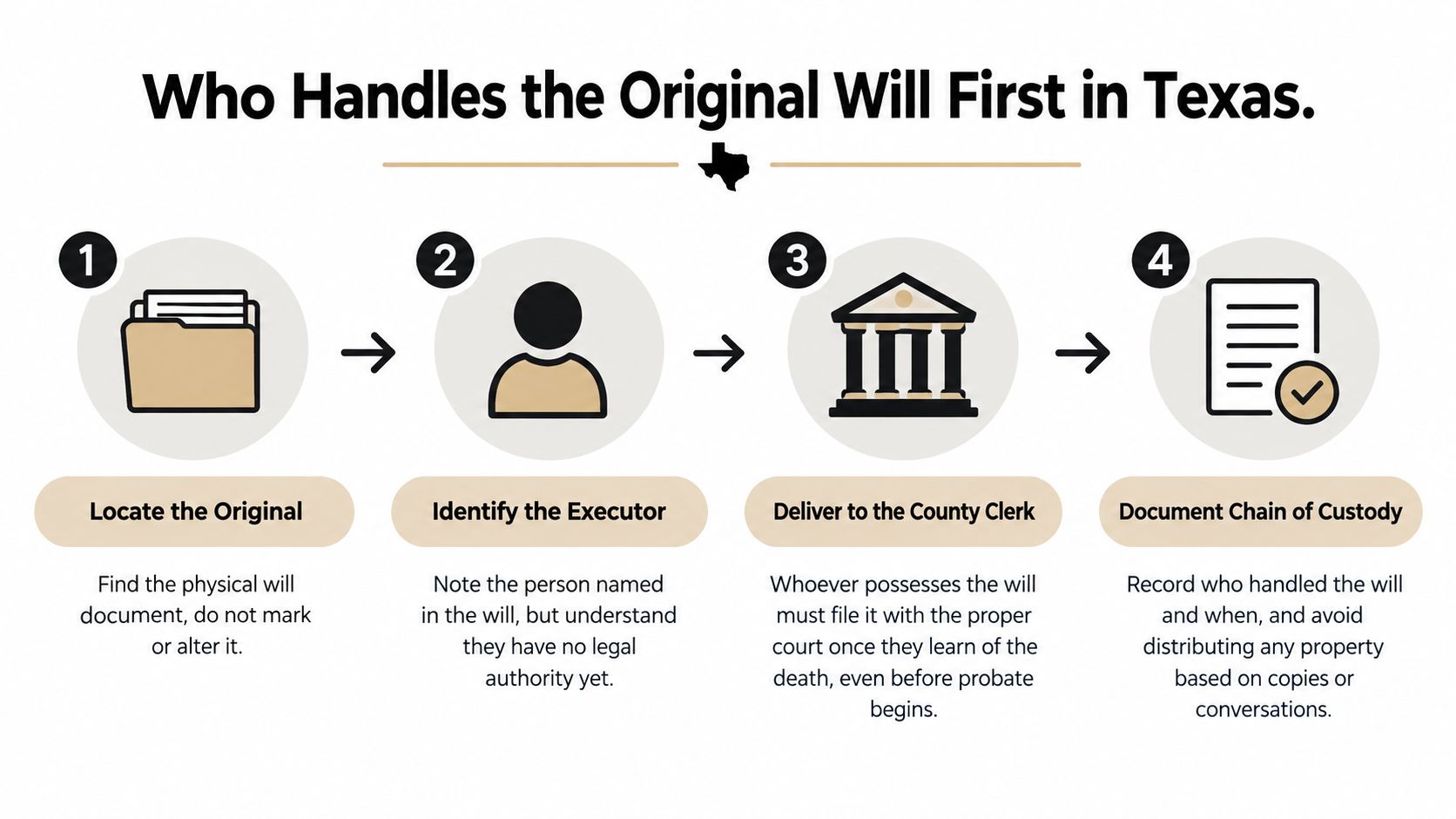
Who Handles the Original Will First
The first person responsible for the will usually isn't the executor named inside it. It's the person who physically possesses the original after receiving notice that the decedent has died.
Texas Estates Code Section 252.201 requires a person who possesses a deceased person's will and has been notified of the death to deliver it to the clerk of the court with jurisdiction over the estate. The named executor doesn't have to begin probate before this custody duty applies. The custodian may give the original to the named executor, file it for probate, or deliver it directly to the county clerk. The statute appears in the Texas Estates Code custody provision.
That rule creates a clear chain of responsibility:
- The will-holder preserves and delivers the original.
- The named executor decides whether to apply for appointment, often with legal advice.
- The probate attorney may prepare the application, organize documents, and guide the applicant through the court process.
- The county clerk accepts and maintains the filed document and handles procedural notices.
- The probate judge decides whether the will is valid and whether the proposed executor may serve.
Being named executor is a nomination, not a self-activating job title. Until the court approves the appointment and issues Letters Testamentary, the named person generally can't use the nomination alone to collect estate assets, close accounts, sell property, or distribute inheritances.
What the family should do with the document
During the first days after death, families should keep the steps simple and deliberate:
- Locate the original will and any codicils, which are later amendments to a will.
- Avoid writing on, stapling, removing pages from, or otherwise altering the document.
- Record who had possession, when the document changed hands, and where it was stored.
- Identify the decedent's county of residence and the likely probate court.
- Contact the named executor and a Texas probate attorney if the family expects disagreement or difficult assets.
- Don't divide personal property or transfer funds based solely on a copy or informal conversation.
Financial institutions, law offices, and remote family members should treat the original as a document requiring careful custody. For organizations that manage sensitive files across locations, information about how virtual staff handle law firm records illustrates why access logs, document security, and controlled transmission matter.
Some estates may qualify for Muniment of Title in Texas, the lightest-touch probate option for clearing title. Whether that route fits depends on the estate and the will, so families shouldn't assume the existence of a will automatically means a full administration is necessary.
How the Court Officially Reviews the Will
Consider a common Texas situation. A will names one daughter as executor and leaves the family home equally to two children. After the parent dies, one child expects the daughter to call a family meeting and announce the division. Instead, the daughter must first take the legal steps that give her authority to handle the house and the rest of the estate.
She or her attorney generally files an application to probate the will and issue Letters Testamentary. The original will is filed with the county clerk. The clerk issues citation and posts notice of the application, creating a formal process for people with a legal interest to participate or object. A probate hearing then gives the court an opportunity to determine whether the will is authentic and valid and whether the proposed executor is qualified.
The court's review generally follows this sequence:
- Application: The applicant asks the court to admit the will and appoint the executor.
- Citation and notice: The clerk provides the notice required by law to interested parties.
- Hearing: The judge considers the will, evidence, and any objections.
- Admission and qualification: If the court accepts the will and approves the executor, the administration may proceed.
- Letters Testamentary: The executor receives official court documents proving authority to act for the estate.
Letters Testamentary are best understood as the executor's legal credentials. A bank, title company, creditor, or government office may ask to see them before allowing the executor to manage estate business. The person named in the will may be the intended representative, but the court's approval is what changes that person from nominee to authorized executor.
Texas Estates Code Section 306.001 provides that the court must grant Letters Testamentary to a qualified executor appointed by the will no later than the 21st day after the will is probated, as explained by the Texas Bar's probate guidance.
The two children in the example probably won't receive the house or sale proceeds immediately. The executor must identify and protect the property, investigate liens and expenses, address valid debts and taxes, and follow the will's terms. One child's expectation of an equal share doesn't eliminate the administration work that must happen first.
Families seeking a more detailed explanation of the filing process can review admitting a will to probate in Texas. The central point remains the same: court filing and notice replace the television-style announcement.
Independent Versus Dependent Administration in Plain English
After the will is admitted and the executor qualifies, the estate may follow an independent or dependent administration. The difference is the level of court supervision, not whether the executor owes duties to beneficiaries and creditors.
Independent administration is generally the more efficient path. Texas Estates Code Chapter 401 permits a will to direct that no further court action occur beyond probating and recording the will and filing required inventory, appraisement, and claims information. The same chapter also permits a will to prohibit independent administration.
Under independent administration, the executor can usually handle ordinary estate transactions without asking the court to approve every step. That doesn't mean the executor can act casually. The executor still must protect estate property, pay valid obligations, keep appropriate records, and distribute what remains according to the will.
Dependent administration involves closer court supervision. The executor may need court approval for significant actions, and the process can require more filings or hearings. It may be appropriate when the will requires it, when beneficiaries don't agree to an alternative, or when disputes and complicated assets call for added oversight.
Independent vs Dependent Administration at a Glance
| Factor | Independent Administration | Dependent Administration |
|---|---|---|
| Court involvement | Less involvement after probate, subject to required filings and fiduciary duties | More frequent supervision and approval |
| Executor's routine decisions | Usually made without separate approval for every transaction | Often require court authorization |
| Beneficiary oversight | Beneficiaries retain rights and may raise concerns | Court involvement provides an additional supervisory structure |
| Practical fit | Estates with clear instructions and manageable administration | Estates needing closer oversight or facing substantial disagreement |
Both paths require the executor to identify assets, address debts and taxes, and distribute the remaining property. Independent administration doesn't erase fiduciary duties, which are responsibilities to act carefully, and for the benefit of the estate and those entitled to receive property.
For a fuller comparison of the two options, families can review Texas independent versus dependent administration. The right path depends on the will, the assets, the family's level of agreement, and the risks involved.
Protecting the Estate Before Anyone Is Officially in Charge
There's often a vulnerable period between death and the issuance of Letters Testamentary. During that gap, family members may know what needs attention but lack full authority to access, sell, insure, or distribute estate property.
The safest approach is preservation, not premature administration. A relative may secure a vacant home, arrange emergency maintenance, notify an insurer that a death occurred, and protect valuable personal property. That person should avoid selling assets, closing accounts, signing contracts for the estate, or treating estate funds as personal money unless legal authority permits the action.
A calm first-response checklist
- Secure the property: Lock the home, protect vehicles and valuables, and address urgent risks such as leaks or unsafe conditions.
- Preserve coverage: Notify insurers of the death and ask what steps are needed to keep property and liability coverage in place.
- Communicate with institutions: Tell banks, lenders, and service providers that probate may be opened, but don't assume a family member can access or transfer funds.
- Protect digital information: Preserve phones, computers, password records, and account notices without deleting or changing information.
- Keep receipts: Document reasonable preservation expenses and who paid them.
- Avoid personal commingling: Don't mix estate money with personal accounts or pay large estate obligations from personal funds without legal advice.
County procedures can affect the practical timeline. For example, Collin County requires the original will to be filed within three days after e-filing an application and won't set a hearing until it receives the original. That local requirement illustrates why broad national probate advice may not fit a Texas estate.
Texas law generally requires a will to be filed for probate within four years after the decedent's death. After that period, the estate is usually treated as though there were no will, although limited exceptions may apply, including certain late uses of a will to prove title to real estate when the beneficiary wasn't at fault. The Texas State Law Library's probate guidance explains the general deadline and exceptions.
An out-of-state executor should contact a Texas probate attorney early. Remote administration may be manageable, but the executor still needs to understand the county's filing practices, representation requirements, property issues, and the limits of acting before appointment.
Common Myths That Derail Texas Families
Grieving families often rely on television, an older relative's experience, or probate rules from another state. Those sources can create understandable but costly confusion.
Myth: The executor can start immediately. Being named in a will doesn't automatically grant authority. The nominee must apply to the probate court, obtain approval, and receive Letters Testamentary before acting as the estate's authorized representative.
Myth: A private reading satisfies the law. It doesn't. Texas law focuses on filing, court notice, and the probate hearing. A family meeting may help people communicate, but it doesn't replace the court process.
Myth: A copy has the same status as the original. The original should be preserved and delivered to the proper clerk. A copy may provide useful information, but families shouldn't distribute property based only on a scan or photocopy.
Myth: Beneficiaries receive money right away. The executor must first protect assets, identify property, address valid debts and taxes, and determine what can be distributed. A named beneficiary has an interest under the will, but that doesn't always mean immediate possession.
Myth: A disinherited relative can be ignored. Texas Estates Code Section 258.001 requires the county clerk to issue citation to interested parties when an application to probate a written will is filed. Formal notice gives people with a legal interest an opportunity to participate or object, and it's separate from informal family communication. The statutory notice rule is available in Texas Estates Code Section 258.001.
A difficult family conversation is not the same thing as legal notice. The probate record and court procedure control the formal process.
When relatives disagree about authenticity, capacity, undue influence, or the executor's conduct, early legal advice can help preserve evidence and reduce avoidable escalation. Probate litigation may become necessary, but clear custody records and timely filings give the family a stronger foundation.
Key Takeaways and How Our Firm Can Help
After a death, the will's path resembles a chain of custody more than a family ceremony. The practical sequence is:
- Secure and preserve the original will.
- Identify the named executor and any probate attorney.
- Deliver the original to the proper county clerk.
- File the application to probate the will.
- Watch for citations, court notices, and the hearing.
- Obtain Letters Testamentary before taking significant action for the estate.
- Complete administration and distribute property according to the will.
Texas generally requires the will to be filed within four years after death, subject to limited exceptions, as explained in this resource about the four-year probate deadline in Texas. Until the court appoints someone, there may be a gap in authority. Preserve the original, protect estate property, and get advice before making an irreversible decision.
The Law Office of Bryan Fagan, PLLC assists Texas families with probate, independent and dependent administration, affidavits of heirship, muniment of title, and matters involving out-of-state executors. Families and law firms handling remote administrative work may also find LATAM legal virtual assistants relevant to document and support workflows. Legal decisions should remain with qualified Texas counsel.
Whether you are an out-of-state executor or a family member facing probate in Harris, Dallas, or Collin County, our team offers free consultations in person or virtually. Visit our website or call the Law Office of Bryan Fagan, PLLC to discuss your family's situation and determine the next step.


