 Skip to content
A loved one has died, and someone has found a will in a desk drawer. Family members may be asking whether everyone should gather to hear it read, who can see the document, and whether the person named as executor can start handling accounts. It's normal for these questions to feel urgent and confusing while you're grieving.
In Texas, “reading a will” usually means carefully reviewing the document and understanding what happens next through probate. A private family meeting can help people communicate, but it doesn't replace the court process. The practical work is to identify the right document, understand who it names, determine who must receive notice, and find out what must be filed.
What It Really Means to Read a Will in Texas
The familiar scene of relatives gathered for a formal reading is largely a historical tradition, not a standard legal requirement. In earlier times, reading a will aloud helped communicate its contents when literacy was limited, mail was unreliable, and making copies was difficult. Today, probate systems generally use formal filings, notices, and court procedures instead. Texas probate guidance on the history of the will reading describes this shift, and current legal commentary reports that no U.S. state universally requires a ceremonial reading.
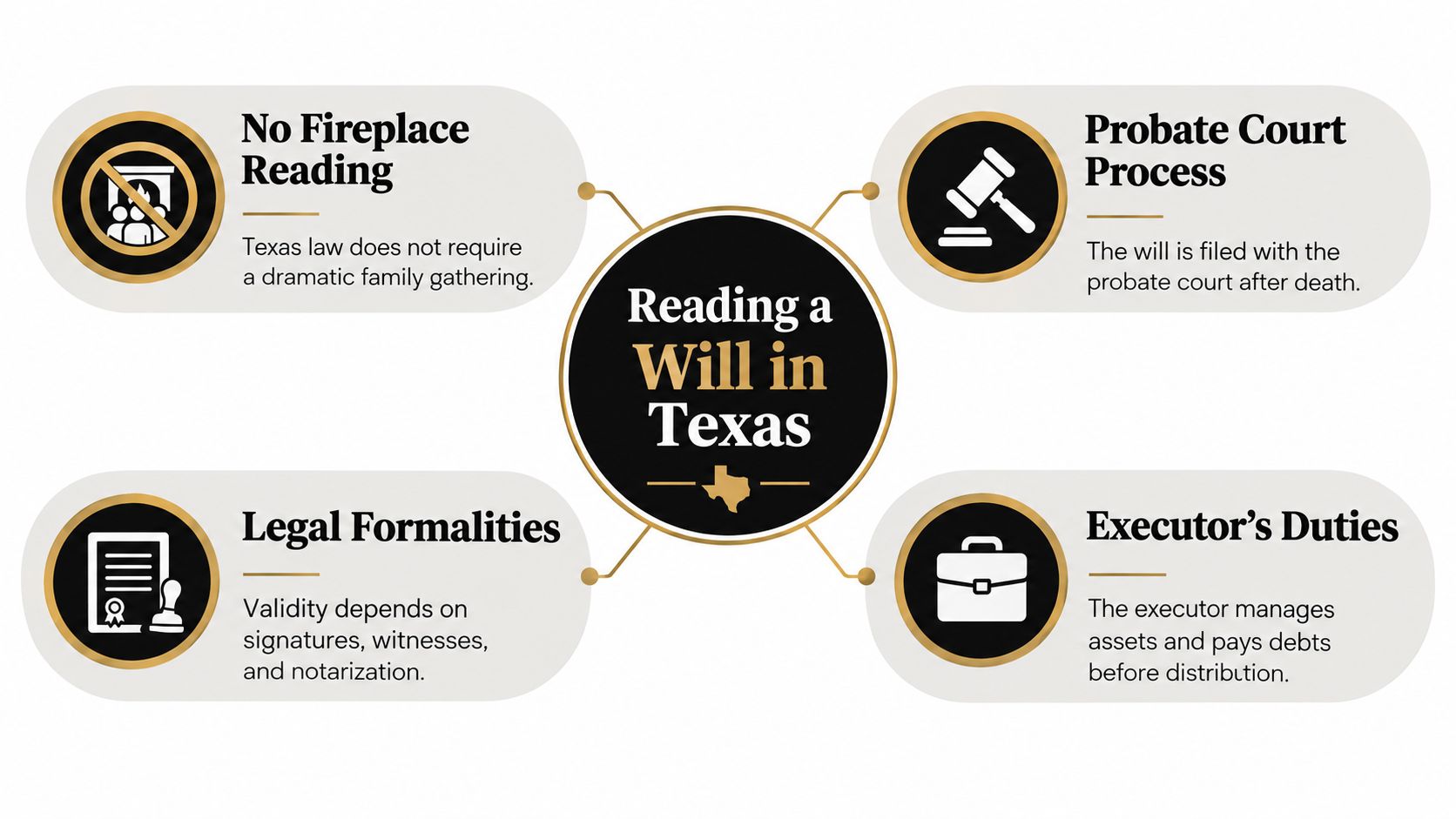
In Texas, the legally meaningful event is generally the will being offered to the probate court. Probate is the court process that determines whether the will can be accepted and, when applicable, authorizes a personal representative to administer the estate. A family's private reading doesn't transfer property, appoint an executor, or satisfy any required court notice.
Start with three practical questions. Is this the latest, complete document? Who does it name as executor and beneficiary? Does the estate need a probate filing, and what procedure may apply? Those questions help a family move from uncertainty to a manageable review.
Practical rule: Preserve the original as you found it. Don't write on it, rearrange pages, or remove an attached affidavit while you're trying to understand it.
Texas Estates Code provisions in Titles 2 and 3 govern will execution and probate procedures. The will's terms matter, but so do court requirements and the ownership records for each asset. For business owners thinking about planning before a crisis, wills and trusts for business owners offers a useful overview of how estate documents can fit into business planning.
Finding the Will and Knowing Who Must Be Notified
Before interpreting a clause, locate the complete document and any later amendments, often called codicils. Check a home safe, filing cabinet, safe deposit box, attorney's records, and any digital vault or cloud storage the person used. A family member may know where the will is, but don't assume the first copy you find is the final one.
Then identify the people whose legal interests may be affected. Under Texas Estates Code §258.051, an applicant generally must arrange formal notice to each heir whose address can be found with reasonable diligence, unless an exception applies. An heir is a person who would inherit under Texas law if the will weren't admitted. The court's citation is a formal notice of the probate proceeding, not the same thing as a phone call or an invitation to a family meeting. Texas probate law on obtaining a will copy can help families understand how to locate or request the document.
Consider a blended family. A parent's will leaves everything to a surviving spouse and names that spouse as executor, but the parent also has adult children from an earlier relationship. Those children may be heirs under Texas law even if the will doesn't leave them property. The executor shouldn't treat a private gathering of close relatives as a substitute for identifying who is entitled to statutory notice.
An heir may be able to avoid separate service by filing an affidavit with the required statement and confirming that the heir doesn't object to probate. Whether that's appropriate depends on the circumstances, so don't assume a casual text or verbal agreement is enough.
Before reviewing the will, make a simple contact list:
- Named executor: The person the will nominates to handle estate duties.
- Named beneficiaries: People or organizations receiving gifts under the document.
- Potential heirs: People who may inherit if the will isn't admitted.
- Document sources: The attorney, custodian, or family member who may have another original or amendment.
A Step-by-Step Workflow for Reviewing the Document
Begin by checking the will's execution details and attachments. Texas Estates Code §251.104 addresses a self-proving affidavit, a sworn statement by the testator and witnesses before an authorized officer. Confirm that the affidavit is attached or annexed, signed, and accompanied by the officer's certificate and official seal. If a will is properly self-proved, subscribing witnesses generally don't have to testify to prove execution. Self-proving status streamlines that proof; it doesn't settle whether the will was later revoked or whether its terms are clear.
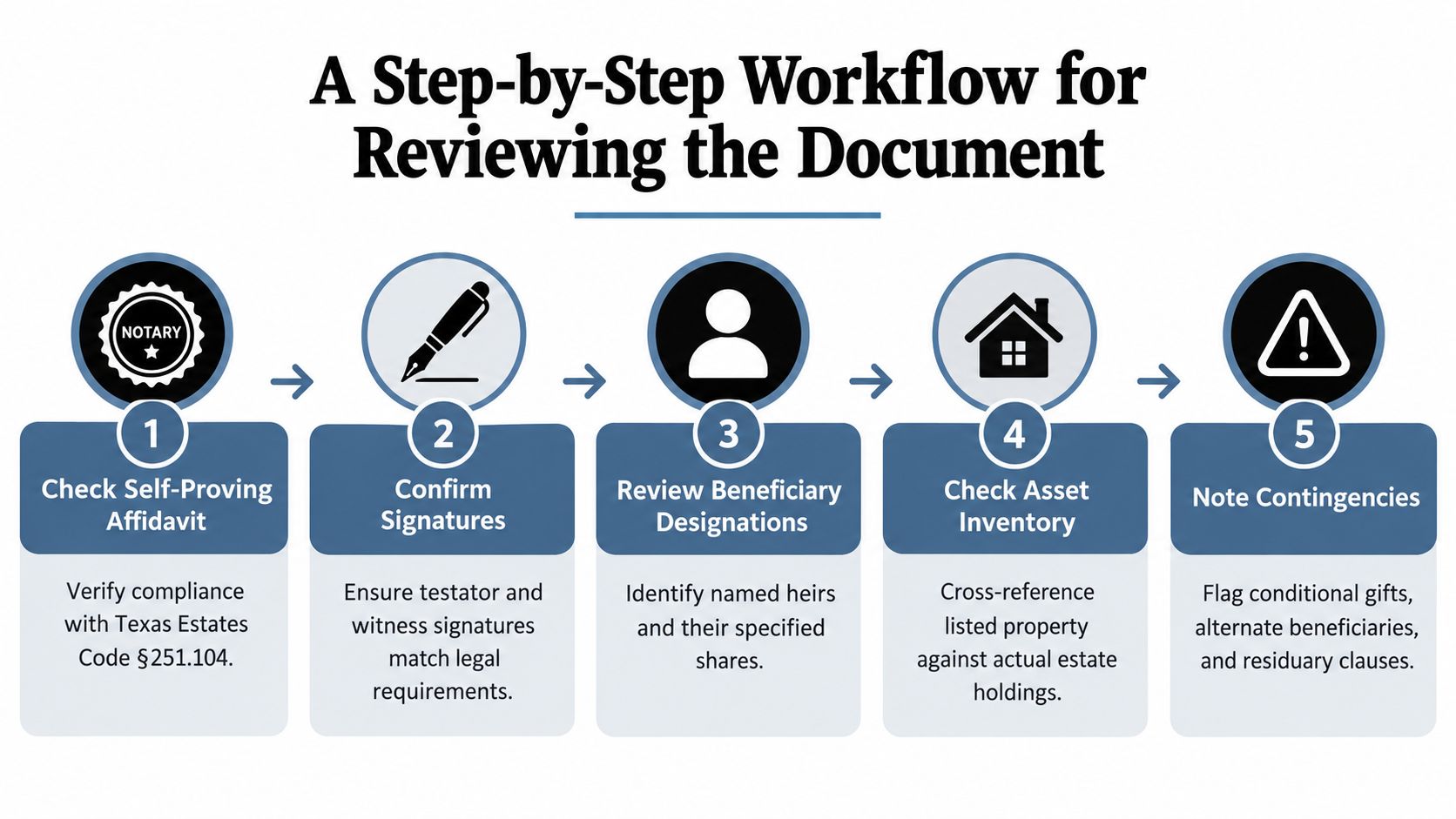
Next, read in the order the document presents its provisions. Note the testator's name, date, signatures, witnesses, and any revocation language that may cancel an earlier will. Look for definitions of family members, specific gifts, and the residuary clause, which explains where property goes if it isn't given away elsewhere. Then check survivorship conditions and alternate beneficiaries in case someone named in the will dies before the testator.
| Issue | Self-Proved Will | Non-Self-Proved Will |
|---|---|---|
| Proof of execution | May be admitted without subscribing-witness testimony if the affidavit meets legal requirements | May require other evidence to prove proper execution |
| What to inspect | Attachment, signatures, sworn acknowledgments, officer's certificate, and seal | Testator and witness signatures, witness information, and evidence needed for proof |
| What it resolves | Helps streamline proof that the will was executed | Does not provide the same affidavit-based shortcut |
| What it doesn't resolve | Ambiguity, later revocation, fraud, undue influence, or asset ownership | The same substantive questions still require review |
Continue with executor powers, directions about debts and taxes, and any governing-law or no-contest language. Separate dispositive provisions, which say who receives property, from administrative provisions, which explain how the representative may manage the estate. An unusual phrase may need legal interpretation, but don't infer incapacity or improper influence from wording alone.
A concise working summary can keep the review organized:
- Document and proof: Date, testator, witnesses, affidavit, amendments, and any competing version.
- People and gifts: Executor, beneficiaries, specific gifts, residuary beneficiaries, and contingencies.
- Assets and questions: Property named, title or beneficiary records to compare, and clauses needing follow-up.
Keep the original safe and use a separate working copy for notes. Texas Estates Code §256.003 generally requires an application to probate a will within four years after death, subject to limited statutory circumstances. That deadline makes it important to identify the right document and get advice about timing rather than leaving a confusing will untouched.
Reading Executor Powers and Letters Testamentary
A will can nominate an executor and grant that person powers, but being named in the document doesn't automatically let them withdraw money, sell estate property, or act for the estate at a bank. Letters Testamentary are court-issued documents showing that the court has appointed the executor and authorized them to act. Banks, title companies, and other institutions may ask for these letters before allowing the representative to handle an account or transfer property. Texas probate guidance on Letters Testamentary and Letters of Administration explains how these court documents establish a representative's authority.
Suppose Jordan is named executor and the will says Jordan may collect assets and pay valid debts. Jordan can read those instructions, but a bank may still refuse to close the decedent's account until the court admits the will, appoints Jordan, and issues Letters Testamentary. After appointment, the representative typically gathers estate assets, pays valid debts and expenses when funds are available, and distributes what remains under the will and court process.
Being named in the will identifies the person the decedent wanted to serve. The court appointment and issued letters are what establish the representative's formal authority.
Independent and dependent administration
The will or applicable Texas procedure may point toward different kinds of administration. In plain language, independent administration usually involves less ongoing court supervision, while dependent administration involves more court oversight of the representative's actions. The appropriate path depends on the will, the estate, and the legal requirements, not just on what the executor prefers. Texas families can review the procedural differences in Independent Administration in Texas.
As you read the powers clause, note whether it addresses selling property, managing investments, paying claims, or distributing assets. Then compare the language with the authority the court grants. The distinction is important: a will may describe what the executor is allowed to do during administration, but it isn't a substitute for the probate appointment and the documents a third party may require.
The Digital Asset Gap Most Wills Miss
A will can name who inherits property without explaining how the executor can locate or access it. Digital property may include online financial accounts, cryptocurrency, cloud-stored files, social media profiles, and paid subscriptions. Recent survey reporting estimated average digital assets at nearly $200,000, while fewer than 15% of respondents had an estate plan that covered those assets (survey reporting on digital property and estate planning). Those figures are not Texas-specific, but they highlight why a paper will may not tell an executor what exists or how to handle it.

Letters Testamentary can help establish the executor's role, but they don't necessarily provide a password or override a service provider's account procedures. Access can depend on the type of account, the provider's rules, the decedent's instructions, and whether the representative has the documents the provider requires. A cryptocurrency wallet with no recoverable key, for example, may present a different problem from an online bank account with an established estate process.
Keep credentials out of the filed will
A will filed with the probate court generally becomes accessible as a court record. Don't place passwords, private keys, or recovery phrases in a document that may be filed. Instead, keep a separate digital-asset inventory in a secure location and tell the appropriate person how to find it. A Texas guide to probate and digital assets provides additional context for this part of estate administration.
Record account names, account types, custodians, and any instructions for locating secure recovery information. Don't assume that naming a beneficiary in a will automatically gives that person lawful access to the account itself. The estate plan should address both who receives an asset and how the representative can identify and handle it.
Warning Signs That a Will May Be Challenged
A person's disappointment with an inheritance doesn't, by itself, prove that a will is invalid. A challenge generally needs evidence tied to a legal concern, such as lack of testamentary capacity, undue influence, fraud or forgery, improper execution, or a later revocation. These are fact-specific questions, and an unusual gift or family dispute alone doesn't answer them.
For example, a will signed late in life may leave most property to a caregiver who recently became closely involved in the testator's affairs. That change may prompt questions, but it doesn't establish wrongdoing on its own. Relevant evidence could include witness accounts, medical records, handwriting analysis, the circumstances of signing, a self-proving affidavit, and whether a later document revoked or replaced the will.
What to preserve before drawing conclusions
If something seems inconsistent, keep the original safe and write down what you know without altering the document. Record when the will was found, who had access to it, whether a codicil exists, and what other documents may show the testator's intentions. Texas Estates Code §256.003 generally sets a four-year period after death to apply for probate, subject to limited exceptions, so ask a Texas probate attorney promptly about the deadline and any relevant facts.
Don't accuse a relative or caregiver based only on suspicion. A careful review should separate what the document says, what independent records show, and what remains uncertain. For a broader, non-Texas comparison of will-contest issues, guidance on contesting an unfair will in California can provide general context, but Texas law and procedure govern a Texas estate.
Key Takeaways and Your Next Step in Texas
You don't need to hold a formal ceremony to move forward. Start with the original document, protect it, and review its execution details and any attached self-proving affidavit. Identify the named executor, beneficiaries, and potential heirs who may need notice under Texas Estates Code §258.051.
Make a clause summary, compare the will with account titles and beneficiary records, and keep digital-asset information separate from the will filed with the court. Calendar the general four-year probate deadline under §256.003, but don't treat that as a reason to delay seeking advice. The timing and available procedure depend on the facts of the estate.
Key insight: A will is an important guide, but it doesn't do every job on its own. The court process confirms its legal effect, formal appointment gives the executor authority, and separate records help clarify how assets pass.
Confusion during this period is normal. A consultation can help you understand the Texas Probate Process, Guardianship, Wills & Trusts, or Probate Litigation and identify what deserves attention first.
If you're facing probate in Texas, our team can help guide you through every step, from filing to final distribution. The Law Office of Bryan Fagan, PLLC offers guidance on reviewing wills, probate administration, and estate disputes, and you can contact the Law Office of Bryan Fagan, PLLC to schedule your free consultation.


