 Skip to content
You've just been appointed to handle a loved one's Texas estate. You're grieving, sorting through paperwork, and trying to understand what the probate court needs from you. Then the clerk tells you that you must post a probate bond before you can fully act. It's a common moment of confusion, but the requirement isn't a punishment or a statement that the court distrusts you.
A probate bond is a court-supervised financial safeguard. It helps protect heirs, beneficiaries, and creditors if an executor or administrator mishandles estate property, fails to pay valid debts, or breaches fiduciary duties. The exact requirement depends on the will, the beneficiaries, the estate's circumstances, and the judge's orders under the Texas Estates Code.
Understanding Probate Bonds in Plain English
Suppose Maria is named executor in her father's will. The probate court accepts the will and appoints her, but the clerk says Maria must obtain a bond before she receives full authority to manage the estate. Maria worries that she'll have to place the entire value of the estate into a separate account. That isn't how the bond works.
A probate bond is a surety instrument, not a cash deposit equal to the estate's value. The court requires it to create a financial backstop for people who depend on the estate being handled properly. The court is the party requiring the bond, Maria is the person whose conduct is covered, and a surety company guarantees payment if a valid covered loss occurs.

Think of the bond as a security deposit for responsible estate administration. A landlord may require a security deposit before allowing someone to occupy property. In probate, the surety bond gives heirs and creditors a potential source of recovery if the personal representative improperly handles someone else's assets. It doesn't replace the executor's legal duties, and it doesn't authorize careless conduct.
Practical rule: A bond protects the estate, but it doesn't protect an executor from personal responsibility for wrongdoing.
A personal representative still must identify and safeguard assets, address valid debts, follow court orders, and distribute property correctly. Families who need a broader overview of the court-supervised process can review what probate involves in Texas, while remembering that bond rules can vary with the administration type and specific facts.
Texas Estates Code Chapter 305 defines the bond required of a person appointed to serve as a personal representative. In plain English, it's part of the qualification process before the executor or administrator receives full authority to act. Texas law generally allows a will to waive bond, but the court may still require protection when the statute and circumstances support it.
Types of Probate and Fiduciary Bonds in Texas
The bond's name usually follows the fiduciary role. “Fiduciary” means a person trusted to manage property or money for someone else. Start by identifying the role the probate court has given you.
Executor and administrator bonds
An executor bond applies to a person named in a will who is appointed to administer the estate. An administrator bond generally applies when the person died without a will or when the court appoints someone to manage the estate under the applicable probate procedure. A probate manual preserved in Oregon archival materials describes bonding as a long-standing court safeguard, with historical records identifying the surety, bond amount, bond date, and probate judge's signature. Those records show that courts have used this kind of financial accountability for generations. (Oregon archival probate records)
Texas law generally requires an executor to post bond unless the will waives it or the court finds waiver appropriate. Even an independent executor may face a bond requirement because “independent” describes the level of court supervision, not an automatic exemption from every safeguard.
For a practical explanation of the responsibilities that create fiduciary risk, see An Executor's Duties in a Texas Probate. The role includes handling estate property according to law and the court's authority.
Guardian and trustee bonds
A guardian bond may apply to a guardian managing property or financial affairs for a minor or an incapacitated person. The protected person isn't merely another beneficiary. The guardian has a legal duty to preserve and use property for that person's benefit, which can justify a separate fiduciary bond.
A trustee bond relates to trust administration when a court requires security from someone managing trust property. Its purpose is similar, but the governing documents and court orders may differ from those in an ordinary estate administration.
The key question is not which label sounds familiar. It's what role the court appointed you to perform, what property you control, and what the governing documents say about security.

How Texas Courts Calculate Bond Amounts
Texas judges don't set bond amounts as a personal judgment about an executor's character. Under Texas Estates Code Section 305.151, the amount must be sufficient to protect the estate and its creditors. The judge also considers the circumstances surrounding the administration, including the property the representative will control and the potential exposure to unpaid obligations.
That means the amount is tied to risk, not to a standard charge. A modest estate containing readily identified property may present a different risk profile from an estate involving multiple properties, business interests, disputed ownership, or substantial creditor issues.
Texas law includes an important exception. If the person receiving letters testamentary or letters of administration is entitled to the entire estate after debts are paid, the bond must protect creditors only, rather than heirs who won't receive a separate share after administration.
What influences the judge's decision
The judge may review information such as:
- Estate property: The value and type of assets under the representative's control.
- Creditor exposure: Debts and claims that must be addressed before distribution.
- Administration complexity: Multiple properties, business interests, or unresolved ownership issues can require closer attention.
- Distribution risk: The court may consider whether beneficiaries could be harmed by premature or incorrect distributions.
- The governing documents: The will and the application may affect whether bond is waived or required.
The following table uses qualitative categories rather than invented dollar estimates. Texas law does not impose one universal bond amount for every estate.
| Estate Scenario | Estimated Estate Value | Typical Bond Range | Key Factors |
|---|---|---|---|
| Modest estate with straightforward property | Modest | Set by the judge as adequate | Clearly identified assets, limited creditor exposure, uncomplicated distribution |
| Estate with several financial accounts and debts | Moderate | Set by the judge as adequate | Account control, creditor notices, payment decisions, and recordkeeping |
| Complex estate with multiple properties or business interests | Significant or complex | Set by the judge as adequate | Valuation questions, management duties, potential disputes, and longer administration |
| Representative entitled to the entire estate after debts | Varies | Focused on creditor protection | The statutory exception under Section 305.151 can narrow the protection required |
Ohio law illustrates how some probate systems tie bond sizing to controlled property and expected real-property rentals, while Texas uses the standard of an amount the judge finds adequate under all circumstances. (Ohio fiduciary bond statute) Texas families should rely on the Texas court's order and the facts of their own estate, not an amount copied from another state.
When Can a Probate Bond Be Waived in Texas
A bond may be avoidable, but waiver isn't automatic. Texas procedure focuses on the will, the people entitled to receive the estate, and the judge's determination of what protects the estate.
The main waiver paths
A will may waive bond. If the will clearly says the executor doesn't have to post bond or security, that language can support waiver. The court still examines the application and circumstances rather than treating the provision as a guarantee that no bond will ever be required.
All distributees may consent. If the will names an executor but doesn't waive bond, the court may waive it when all distributees consent in the probate application or through separate written consents, and the waiver is in the estate's best interest. Unanimous agreement matters. One beneficiary's consent can't substitute for everyone whose consent the statute requires.
The judge may find waiver appropriate. The court retains authority to evaluate the situation. A waiver request should explain why the estate and creditors remain protected without a bond, rather than merely stating that the family prefers to avoid the expense.

A small estate isn't automatically exempt from every bond issue just because it feels manageable. The court must apply the relevant Texas procedure and determine whether the proposed administration protects interested parties.
A waiver is a court-approved result, not a family assumption.
Intestate estates, meaning estates without a will, commonly create more uncertainty because there's no will provision directing the court to waive security. A creditor's objection or complaint can also make waiver less realistic. In an independent administration, the court may still require bond unless it waives the requirement under the applicable law. You can read more about the procedural framework for independent administration in Texas before deciding whether a waiver request fits your situation.
A careful attorney can help identify who must consent, confirm whether the will contains effective waiver language, and present the request in a way that addresses creditor protection rather than focusing only on cost.
How to Obtain a Probate Bond in Texas
The clock starts when the court enters a bond order specifying the amount. The next steps are procedural, not optional. Before the personal representative receives or uses the authority granted by the court, the bond must come from a surety company and be filed with the probate clerk.
Follow the court's order first
Read the order carefully. It should state the required bond amount and may include filing or qualification instructions. Use that amount when applying. A guess based on the estate's estimated value can create delays if the judge has already set different terms.
Contact a surety company that handles probate bonds. The application commonly calls for the court order, estate information, and personal or financial details about the proposed representative. The surety assesses the possibility of a covered loss, then may seek reimbursement from the person responsible for that loss.
Credit history, estate size, administration complexity, and unresolved concerns can affect approval. An out-of-state executor may need to coordinate signatures, identification, filing, and communication from another state. Residency by itself does not determine whether the judge requires a bond or whether the surety approves the application.
Understand the cash-flow mechanics
The executor generally does not deposit the full penal amount in cash. Instead, the executor pays a premium for the bond. Market guidance places premiums around 0.5% to 3% of the bond amount annually, with the actual rate depending on the applicant and the estate's risk factors. Probate bonds are also often issued for one-year terms, so an estate that remains open may require renewal and continued premium payments. (probate bond rates and premium factors)
That premium can create an immediate cash-flow problem. Estate funds may be unavailable while the representative is arranging the bond, leaving the fiduciary to pay upfront and later request reimbursement if the expense is properly chargeable to estate administration. Keep the receipt, confirm who paid it, and ask counsel how reimbursement should be documented.
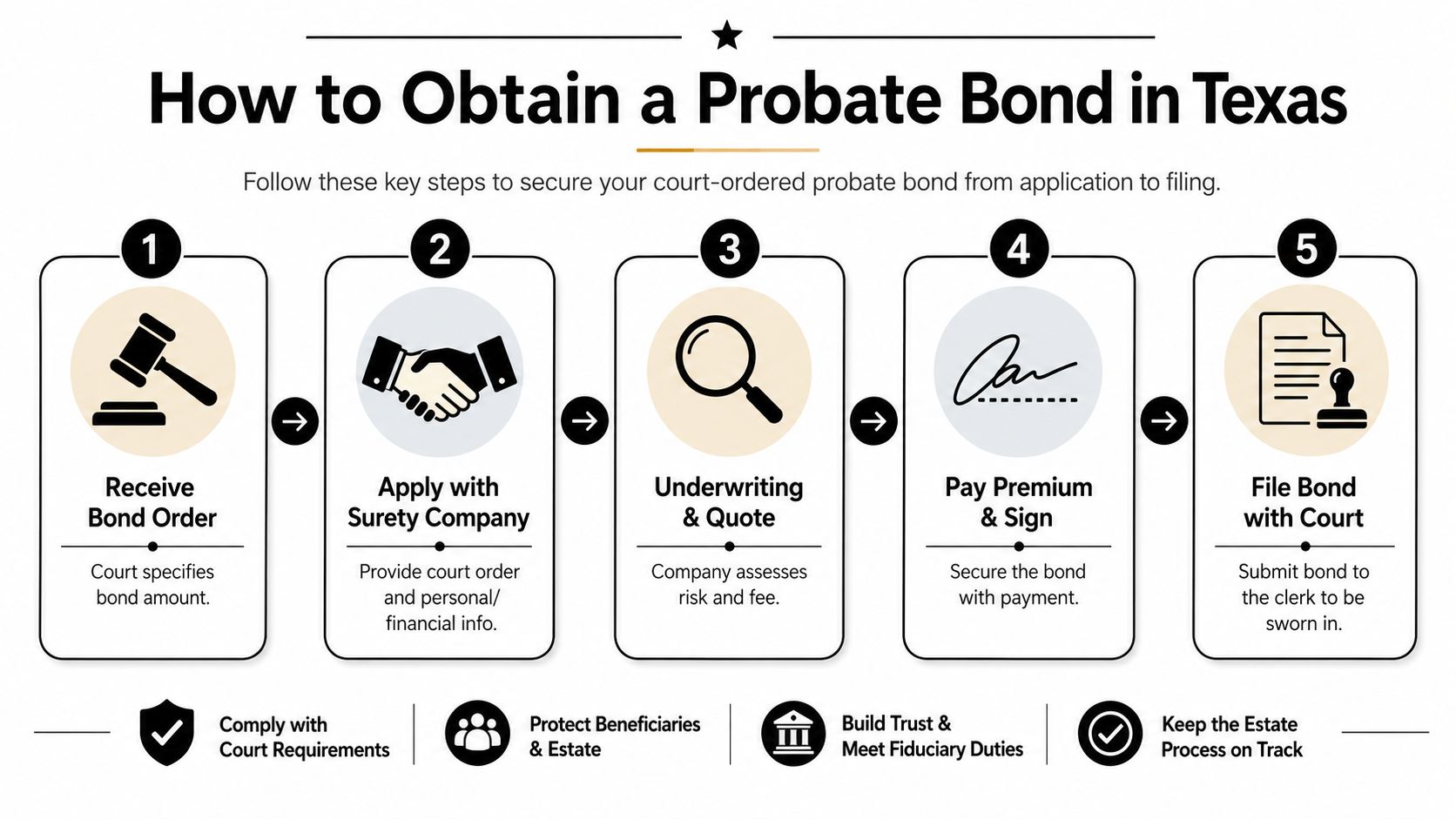
A practical sequence looks like this:
- Receive the bond order: Confirm the amount and filing requirements.
- Apply with a surety: Provide the order and requested information.
- Complete underwriting: Answer questions about finances and the estate.
- Pay the premium and sign: Review the bond documents before signing.
- File with the court: Submit the approved bond so qualification can proceed.
Texas probate forms and filing requirements may be easier to organize with counsel, particularly when the representative lives outside Texas or cannot attend each step in person. Reviewing Texas probate forms can help identify the paperwork involved, but forms do not replace legal advice about the bond order, payment, or filing process.
Common Probate Bond Pitfalls and How to Avoid Them
Consider James, an out-of-state executor administering his mother's Texas estate. He obtains the bond, receives authority, and assumes the requirement is finished. Months later, the surety asks for renewal information because the estate remains open. James misses the deadline, and the court cannot treat an expired bond as continuing protection.
The solution is simple but important: record the bond's renewal date as soon as it's issued, communicate with the surety before expiration, and confirm that the court receives whatever renewal documentation it requires.
Problems that appear during administration
A second problem arises when the representative discovers an asset that wasn't reflected in the original information considered by the court. The additional property may change the risk profile or require a revised bond. The executor shouldn't sell, distribute, or move the asset casually. Notify the probate attorney, review the inventory and court order, and ask whether the judge needs updated security.
A third scenario involves a creditor complaint. Under Texas Estates Code Section 403.060, a creditor in an independent administration may file a written complaint and cause distributees, heirs, and others entitled to estate property to be cited. The court may require a bond equal to the creditor's claim or the full estate value shown by the inventory and list of claims, whichever is smaller, with conditions requiring payment of debts established against the estate. (Texas Estates Code Section 403.060)
That mechanism can arise after appointment. An executor who believed independent administration meant no further bond issues could be caught off guard when a creditor seeks protection before assets are distributed.
Protective habit: Don't distribute estate property while a material creditor concern remains unresolved. Ask counsel what the court requires before taking the next step.
Other mistakes include commingling estate and personal funds, failing to preserve transaction records, and treating the bond as permission to act without court authority. Keep a separate estate account, save invoices and payment confirmations, and maintain regular communication with the attorney, clerk, beneficiaries, and surety.
Key Takeaways and Next Steps for Texas Executors
A probate bond is a financial safeguard connected to the personal representative's duties. Texas courts set the amount to protect the estate and creditors, and Section 305.151 can limit the focus to creditors when the representative is entitled to the entire estate after debts are paid.
Your next steps are practical:
- Review the will: Look for bond-waiver language.
- Confirm consent: Determine whether every required distributee can provide written consent.
- Read the order: Use the judge's bond amount when applying to a surety.
- Plan cash flow: Account for the premium, renewals, and possible upfront payment.
- Watch creditor activity: A complaint can create additional bond procedures.
- Keep records: Treat every transaction as part of your fiduciary responsibility.
Families often need support with more than bond paperwork. Depending on the circumstances, they may also need guidance involving Guardianship, Wills & Trusts, or Probate Litigation. Those legal decisions should be handled carefully, just as firms use thoughtful legal services marketing strategies to communicate clearly with the people they serve.
The Law Office of Bryan Fagan, PLLC helps Texas families address probate administration, fiduciary duties, bond questions, and related estate matters with step-by-step guidance.
If you're facing probate in Texas, our team can help guide you through every step, from filing to final distribution. Schedule your free consultation with the Law Office of Bryan Fagan, PLLC to discuss bond requirements, waiver options, creditor concerns, or an out-of-state executor's responsibilities.


