A parent dies. The funeral has barely passed, and someone in the family finds an envelope with a will, a deed, a bank statement, and a stack of papers no one understands. Suddenly, one person is expected to “handle probate,” even though they've never filed anything in probate court before.
That's where most families start. Not with legal confidence, but with grief, uncertainty, and a lot of questions.
Texas probate forms can look deceptively simple. The names sound formal, the blanks seem straightforward, and online templates make it easy to assume this is mostly paperwork. In practice, the form you need depends on the legal path the estate qualifies for, the county where the case is filed, whether there is a will, whether debts exist, and whether the court expects attorney involvement. If the estate includes a house, it also helps to understand what is probate for inherited homes before making decisions about title transfer, sale timing, or occupancy.
The good news is that probate in Texas is often more flexible than people expect. The hard part is choosing the right route early, then filing the right documents in the right order.
Your Guide Through Texas Probate Paperwork
A common example looks like this. An adult daughter is named executor in her mother's will. She assumes the next step is to “get probate papers,” but she quickly runs into unfamiliar terms like Application for Probate, Letters Testamentary, Inventory, and Affidavit of Heirship. She doesn't know which of those are required, which are optional, and which are only used in certain situations.
That confusion is normal. Texas Estates Code Titles 2 and 3 govern much of what families deal with after a death, including wills, estate administration, and alternatives to full administration. In plain English, probate is the court process used to recognize a will when needed, identify who has authority to act, address debts and taxes, and transfer estate property to the right people.
What matters most is this. There is no single packet of Texas probate forms that works for every estate.
Practical rule: The right form is the one that matches the estate's legal path, not the one that seems easiest to download.
Some estates need a formal probate filing and court hearing. Some qualify for a Small Estate Affidavit. Some can use Probate of Will as a Muniment of Title. Others require heirship work because no will exists, or because too much time has passed.
Families usually feel better once the process is broken into manageable steps:
- Identify the estate type
- Choose the proper probate path
- Prepare the required opening filing
- Meet follow-up deadlines
- Use county-approved forms whenever available
That's how probate paperwork becomes manageable. One form at a time, in the right sequence.
Choosing Your Path The Four Main Roads of Texas Probate
A family often calls after a funeral with one urgent question: “Which probate forms do we need?” The answer depends on the legal path the estate qualifies for. Choose the wrong path, and the clerk may reject the filing, the judge may require different pleadings, or the hearing gets delayed while the paperwork is corrected.
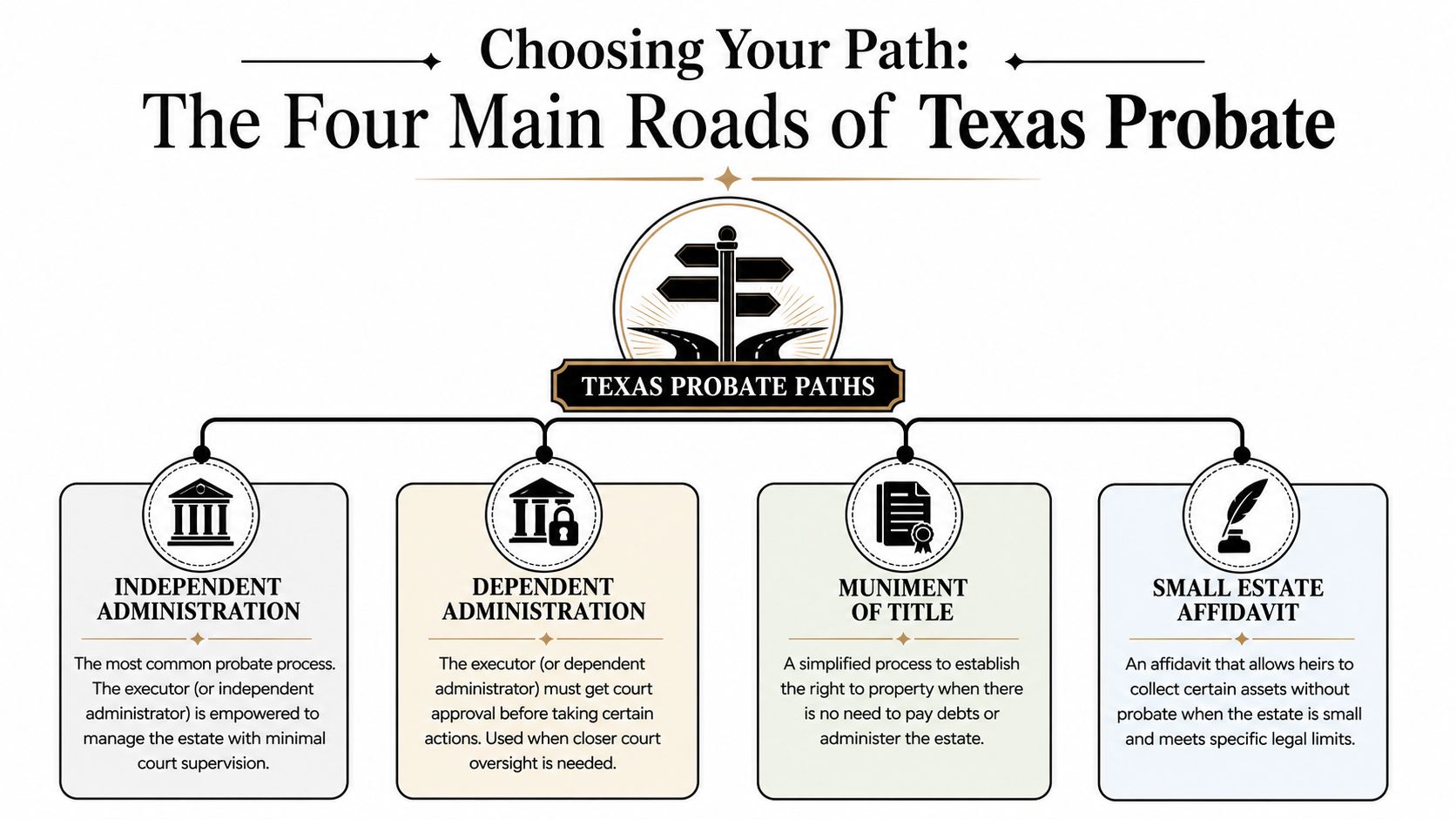
The practical question is not which option sounds easiest. It is which option fits the facts, the county's filing expectations, and the judge's usual requirements. Families who understand that early usually avoid the most common probate paperwork mistakes. A more detailed look at filing a probate application in Texas can help once you know which path applies.
Independent administration
Independent administration is often the best fit when there is a valid will authorizing it, or when the distributees can agree to it. Why does that matter? Because once the court appoints the personal representative, that person can usually handle many estate tasks without returning to court for approval each time.
This path is often more efficient, but it still has rules. Courts still expect a proper application, proof that the applicant is qualified, and timely follow-up filings. In practice, families get into trouble when they assume “independent” means informal. It does not. It means less court supervision after the appointment, not less care in the initial paperwork.
Dependent administration
Dependent administration is used when closer court supervision is needed. That usually happens when the will does not permit independent administration, interested parties are in conflict, creditor issues are serious, or the court wants tighter control over what the representative can do.
The trade-off is clear. More oversight can protect the estate, but it also means more pleadings, more orders, and more chances for delay if a form is incomplete. Some counties are especially exacting on these files, and generic forms often fail because they do not match the local court's preferred wording or required attachments.
Muniment of title
Probate as a muniment of title works in a narrower set of cases, and it is often misunderstood. This option is used when there is a valid will and no need for full administration of the estate. The main reason to use it is usually practical: property, often real estate, needs to pass under the will, but there is no ongoing estate business that requires an executor to act.
Why do courts reject muniment applications? Usually for one of three reasons. The estate has unpaid debts that go beyond secured debt on real property. Someone really does need authority to collect, sell, or manage assets. Or the filing does not give the judge enough factual support to find that full administration is unnecessary.
Small Estate Affidavit
A Small Estate Affidavit can be a useful option, but only when the estate fits the statute closely. It is generally available for certain intestate estates with limited assets, and courts often review these filings carefully because families use them hoping to avoid a formal probate.
Here, the “when and why” matters most. A Small Estate Affidavit may save time and expense when the estate meets the qualifications. It can also waste both if the decedent left a will, if the asset mix does not fit the statute, or if the affidavit leaves out complete heirship information. Many rejections happen because the family focuses on the lower filing burden and misses the strict eligibility rules.
A quick comparison helps:
| Probate path | Best fit | Typical paperwork focus |
|---|---|---|
| Independent administration | Valid will or agreement for independent administration | Application, oath, letters, inventory or affidavit in lieu |
| Dependent administration | Court supervision is required | Ongoing court filings, approvals, and accountings |
| Muniment of title | Valid will, no need for full administration | Application, will, and proof that administration is unnecessary |
| Small Estate Affidavit | Modest intestate estate meeting strict rules | Specialized affidavit, asset details, and complete heir information |
The right path usually becomes clear once three questions are answered: Was there a will, is someone going to need authority to act, and does the estate qualify for a simplified procedure under Texas law? That is why the form choice comes second. The legal fit comes first.
The Starting Line Initial Application Forms
For a formal probate case, the opening document usually sets the tone for everything that follows. If it's incomplete, inaccurate, or filed in the wrong form, the case can stall before the hearing is ever scheduled.
What the court expects in the application
Under the Texas Estates Code, an Application for Probate of Will must include specific information, including the decedent's date of death, a list of known heirs, and the original will. After Letters Testamentary are issued, a sworn Inventory, Appraisement, and List of Claims typically must be filed within 90 days, unless an Affidavit in Lieu of Inventory is used where permitted, as outlined in this Texas probate application guide.
That sounds technical, so here is the plain-English version. The court wants enough information to answer basic questions:
- Who died
- When and where the death occurred
- Whether there is a valid will
- Why this county has authority over the case
- Who the heirs and beneficiaries are
- What kind of property may be involved
- Who is asking to be appointed
The documents that usually travel with the application
Families often focus on the application itself and overlook the attachments. That's where many rejections begin.
A formal probate filing commonly requires:
- The original will or a certified copy if allowed in the circumstances
- A certified death certificate
- A proposed order for the judge to sign
- An executor's oath, depending on county practice and timing
- Supporting notices or local cover sheets if the county requires them
If you're trying to understand how courts expect the opening filing to be assembled, this practical resource on filing a probate application in Texas is a useful companion to the statute.
A simple example of how accuracy matters
Suppose Linda files an application stating her father died in Dallas County and owned a home there. The will is attached, but the application leaves out two adult children from a prior marriage because the family assumes “they aren't inheriting anyway.” That omission can create immediate problems. The court still needs accurate heir information, even when the will seems straightforward.
Here's the kind of basic content the application must get right:
Decedent: John A. Ramirez
Date of death: January 8, 2026
County of domicile: Travis County, Texas
Applicant: Maria Ramirez, named as Independent Executor in the will
Known heirs: surviving spouse and all children, including adult children from prior relationships
Why the first filing deserves extra care
The application is not just an intake form. It is the legal foundation for the court's authority and for your authority.
Mistakes that cause delays include:
- Wrong county selection
- Missing original will
- Incomplete heir information
- Unclear request for independent administration
- Failure to prepare for the inventory deadline that follows
That's why careful drafting matters early. Fixing a defective opening filing is usually harder than doing it correctly the first time.
The Small Estate Affidavit A Simplified Path
A family often asks about this form after finding out there is no will, the estate is modest, and the main concern is a house or bank account that no one can access. In the right case, a Small Estate Affidavit can save time, filing costs, and a full administration. In the wrong case, it gets rejected and delays everything.
This option is available only for a narrow group of intestate estates. Texas courts generally look for these facts:
- no will
- limited nonexempt assets within the statutory cap, excluding the homestead and exempt property
- no pending application for appointment of a personal representative
- a complete and accurate list of heirs
- enough information to show the estate can handle allowed debts
The practical question is not just whether the estate is "small." The question is whether this form solves the family's problem. It works best when the goal is to collect a bank account, transfer a homestead interest, or give a third party clear proof of who inherited property without opening a full probate administration. The guide to the small estate affidavit form in Texas is useful if you want to see how the affidavit is organized and what supporting details are usually required.
Courts reject these affidavits for predictable reasons. Families leave out a child from a prior relationship. They misclassify assets. They assume the homestead counts against the cap, or they ignore nonexempt property that does count. Judges and clerks see those problems constantly, especially when the family uses a generic form without checking local county requirements.
A common example helps. A mother dies without a will. She leaves a homestead, one car, household items, and a checking account. Her children assume they need full probate because the house is involved. Often, they do not. The homestead is treated differently from countable nonexempt assets, so the better question is whether the other property fits the statute and whether the heirs can prove the family history cleanly.
The affidavit still requires careful work. Every heir must be identified correctly. Debts must be disclosed accurately. The property description has to match what the bank, title company, or county records will recognize.
Use this form after the assets, debts, and family tree have been verified. That is usually the difference between a smooth approval and a rejected filing that costs the family more time than a simpler probate route would have.
Probate as a Muniment of Title The Express Lane for Clear Wills
When there is a valid will and no need for full estate administration, Probate of Will as a Muniment of Title can be a very efficient tool. It is not a shortcut for every estate. It is a specialized procedure for a narrow set of facts.
Why people choose this route
Muniment of Title is often attractive when the main goal is to transfer title to property, especially real estate, under the will. Instead of appointing an executor for a broader administration, the court admits the will to probate for title purposes.
That can work well when the estate is simple, the will is clear, and there are no unresolved claims that require an active personal representative.
The debt and Medicaid issues that matter
For a Probate of Will as a Muniment of Title, the applicant must prove there are no unpaid debts. An important complication is that if the decedent received Medicaid benefits after March 1, 2005, this option is generally unavailable unless the estate provides for repayment, as explained in the Harris County probate court FAQ on Muniment requirements.
That point gets missed in many generic discussions of Texas probate forms. Families may think, “There's a will and we only need to transfer the house, so muniment should work.” But if there are unpaid debts, or if Medicaid recovery is implicated, the court may not allow that route.
A detailed discussion of this path is available at Muniment of Title in Texas.
A practical example
Assume a widower dies with a valid will leaving his home to his daughter. He has no credit card debt, no unresolved tax issues, and no need for someone to collect and distribute multiple estate assets. In the right case, a muniment proceeding may allow the daughter to use the probated will to establish title without opening a full administration.
Now change one fact. The decedent received qualifying Medicaid benefits after the statutory date, and the estate does not address repayment. That single issue can change the legal path completely.
When this route tends to fail
Muniment filings are commonly rejected or delayed when:
- Debt disclosures are incomplete
- The applicant assumes secured and unsecured debts are treated the same
- The hearing proof is not prepared carefully
- The Medicaid question is ignored
A will does not automatically make Muniment of Title available. The estate still has to fit the statute.
Essential Follow Up Probate Documents
Getting the court to open the case is only part of the work. Once an executor or administrator has authority, the estate enters the housekeeping phase. These documents matter because they show the court, the heirs, and creditors that the estate is being handled responsibly.
The oath and letters
The Executor's Oath is the sworn promise to carry out the job faithfully. It is simple in appearance, but legally important. Once the court admits the will and the executor qualifies, the clerk can issue Letters Testamentary, which are the formal proof that the executor has authority to act for the estate.
Banks, title companies, and other institutions often ask for certified copies of those letters before they will deal with the executor.
The inventory and its alternative
The Inventory, Appraisement, and List of Claims is the estate's accounting of what the decedent owned and what claims may exist. In plain English, it tells the court what is in the estate and provides transparency about assets and liabilities.
For some independent administrations, an Affidavit in Lieu of Inventory may be available. That option can provide more privacy because detailed asset information does not become part of a full public inventory filing in the same way. Whether it is appropriate depends on the administration type and the facts of the estate.
Creditor notice and recordkeeping
The estate may also need formal or practical notice steps for creditors. This is one area where families often underestimate the risk. Debt issues don't disappear just because the estate is otherwise cooperative.
A workable follow-up checklist often looks like this:
- Qualify quickly: Sign and file the oath so letters can issue without delay.
- Gather records early: Pull deeds, account statements, vehicle titles, and tax documents before inventory preparation begins.
- Track deadlines: Probate cases are deadline-driven, especially after letters are issued.
- Separate estate funds: Keep estate money distinct from personal funds to avoid confusion and allegations of mishandling.
These follow-up filings are where calm administration is built. A well-prepared opening case can still become difficult if the executor ignores the paperwork that comes next.
County Variations and Finding Official Forms
A family often does everything right, downloads a Texas probate form from a court website, fills it out carefully, and still gets told by the clerk that the packet is incomplete. That usually happens because Texas probate law is uniform, but probate filing practice is not. The Estates Code sets the rules. Each county still has its own expectations about wording, attachments, signatures, proposed orders, and even the order in which documents should be submitted.
That difference matters most at the beginning of a case. The right form filed in the wrong county format can delay a hearing. A generic application may be legally sound but still draw a rejection if the court expects a local cover sheet, a particular notice form, or county-specific language in the oath or order.
How to find the right forms
Start with the probate court, county court at law, or constitutional county court in the county where the decedent lived, or where venue otherwise belongs. Then look for the court's own forms and filing instructions, not just statewide samples.
Useful items to check include:
- Local probate forms approved or preferred by that county
- Standing orders, local rules, or filing checklists
- Posting and hearing instructions
- Requirements for attorney-filed versus self-represented matters
- County-specific instructions for heirship, muniment of title, or small estate filings
If a county publishes its own form, use it unless there is a good reason to draft a custom pleading. In practice, local forms reduce avoidable problems because they already track what that judge and clerk expect to see.
What to confirm before you submit anything
Three points deserve a close review before filing:
- The court is the correct one for venue and case type
- The form is the current version used by that county
- The requested probate procedure fits the actual facts of the estate
The third point causes more trouble than families expect. A form may look simple, but the procedure behind it may be wrong. For example, a county may provide a Small Estate Affidavit packet, but that does not mean the estate qualifies to use it. A muniment of title application may also be available online, yet the will, debts, or timing may make that route a poor fit. The form is only part of the decision. The harder question is when that form should be used and why the court would approve it.
Probate can also expose related legal issues that need separate attention. An estate may raise trust administration questions, concerns about a surviving adult's capacity, or a dispute over who has authority to act. Those issues are real, but they do not change the practical first step here. Get the correct county forms, confirm the procedure, and match the paperwork to the facts before filing.
Online form libraries are helpful starting points. They are not final answers. Courts reject probate paperwork every week for small county-specific defects that a generic template never mentions.
Common Mistakes When Filing Texas Probate Forms
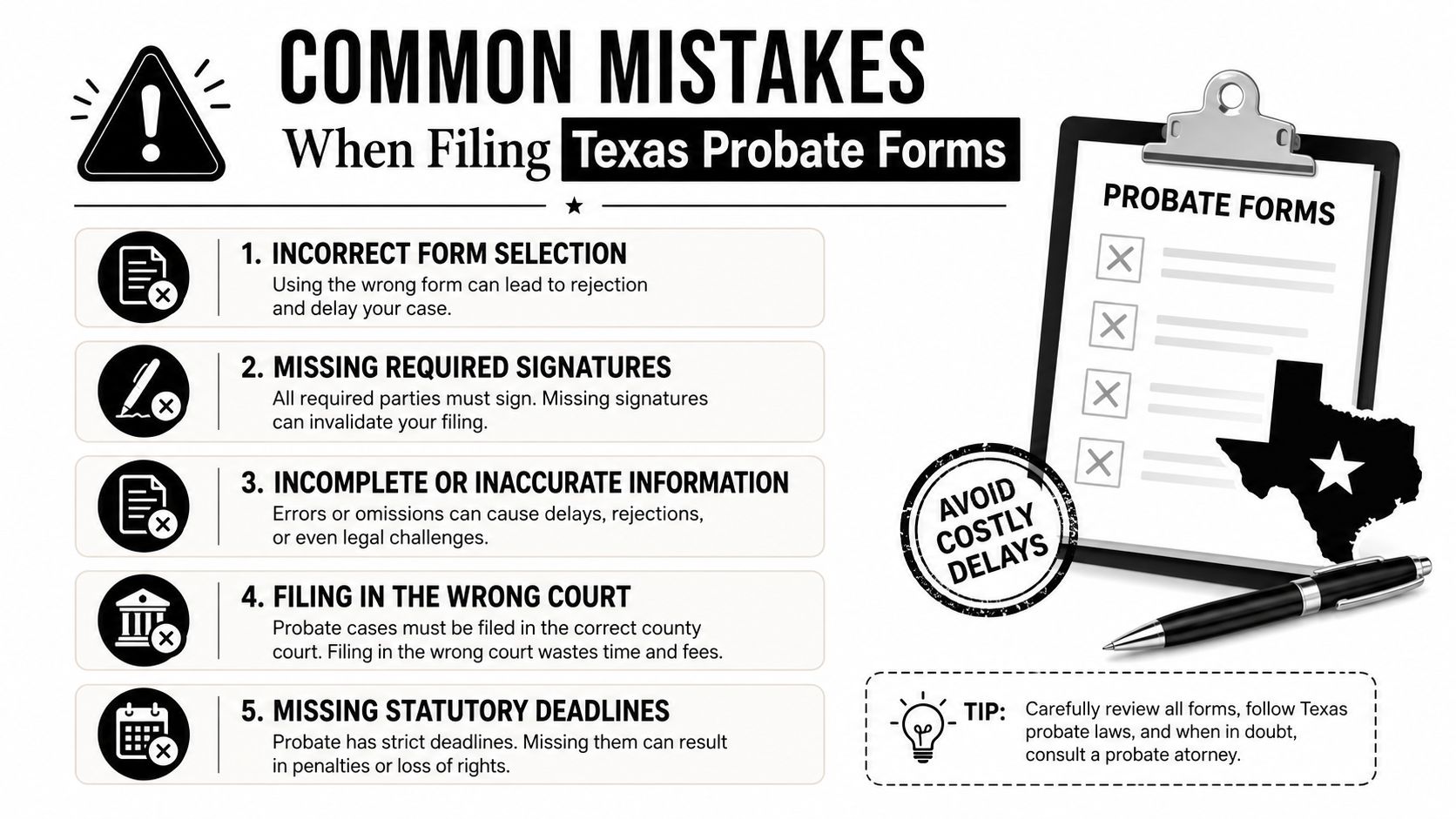
A son finds a will in his mother's desk on Friday, fills out forms over the weekend, and files them Monday morning. Two weeks later, the clerk sends him back for corrections because the application names the wrong court, the family history is incomplete, and the will was attached without the local cover documents the judge expects. That kind of setback is common. Probate delays often start with paperwork that looks close enough, but is not close enough for the court.
The biggest filing errors
Families usually run into trouble for one reason. They focus on what form to fill out before deciding when that form should be used and why the court would approve that procedure.
Many formal probate matters in Texas require a lawyer, and self-filed cases often stall where heirship, notice, or sworn proof is involved. The practical point is not just whether a form exists online. The key question is whether the filing asks the court for relief that must be presented through counsel. This Texas probate FAQ article addressing attorney requirements explains that issue in plain terms.
The mistakes I see most often are these:
- Choosing the wrong probate path: A family files for administration when a muniment of title might fit, or tries a Small Estate Affidavit even though the estate includes facts that disqualify it.
- Listing incomplete heir information: The court needs the full family picture, including prior marriages, deceased children, adopted children, and heirs no one has heard from in years.
- Using a form that is legally close but procedurally wrong: A generic template may track Texas law in broad terms but still fail because it leaves out county-specific verifications, notices, or proposed orders.
- Submitting unsworn or improperly signed papers: Many probate filings need notarization, verification, or witness support. A typed signature often is not enough.
- Opening the case and then missing the next filing: Inventories, affidavits in lieu of inventory, proofs of publication, and similar follow-up documents are where estates often lose time.
Here is a short video that highlights why probate procedure often becomes more complicated than families expect:
Why DIY probate often goes sideways
Probate forms can make the process look clerical. It is a court proceeding that transfers authority, affects title to property, and determines who must receive notice and who may object.
Heirship filings show the problem clearly. The form itself may only be a few pages, but the court is relying on it to identify every person with a possible inheritance right. If the witnesses are not qualified, if dates do not line up, or if a branch of the family is omitted, the judge may require amended filings, additional testimony, or a different case entirely.
County practice also matters in ways families do not expect. One court may want a proposed order in a very specific format. Another may reject a filing that omits a local checklist, a self-addressed envelope, or a setting request. Those are small details. They still stop cases.
What helps avoid rejection
The safest approach is practical, not complicated:
- Start with the estate facts, not the form packet: Was there a will, are there unpaid debts, is real property involved, and does anyone dispute who should inherit?
- Build the family tree before drafting anything: Courts reject probate filings over missing relatives more often than families expect.
- Read each form as a request for a specific legal result: If you cannot explain why this procedure fits this estate, the court may reach the same conclusion.
- Prepare the next required filing at the same time: Many delays happen after the hearing because the personal representative is still gathering information that should have been collected earlier.
Law Office of Bryan Fagan, PLLC is one example of a Texas firm that handles probate filings, administration questions, heirship issues, and contested estate matters. For many families, a short review before filing costs less than correcting the wrong case after the court rejects it.
Key Insights Your Probate Forms Takeaway
If you print only one part of this guide, print this section.
Your working checklist
- Identify the estate type first: Will, no will, debts, real estate, and family structure determine the path.
- Choose the correct procedure second: Independent administration, dependent administration, muniment, or small estate options are not interchangeable.
- Use current county forms: State law controls the substance, but local courts often control the format.
- Prepare for follow-up filings immediately: Don't wait until after letters issue to start gathering asset and debt records.
- Ask for legal help when the facts are messy: Blended families, Medicaid issues, late probate, and title problems usually need closer review.
Key insight
The form itself is rarely the hardest part. The hard part is knowing why that form applies, when it doesn't, and what the court expects to see with it.
Probate paperwork becomes manageable when you treat it like a sequence, not a stack. Start with the legal path. Confirm the county's requirements. File with complete information. Then stay ahead of the next deadline. That approach protects the estate, reduces avoidable delay, and helps honor your loved one's wishes with less confusion.
Frequently Asked Questions About Texas Probate Forms
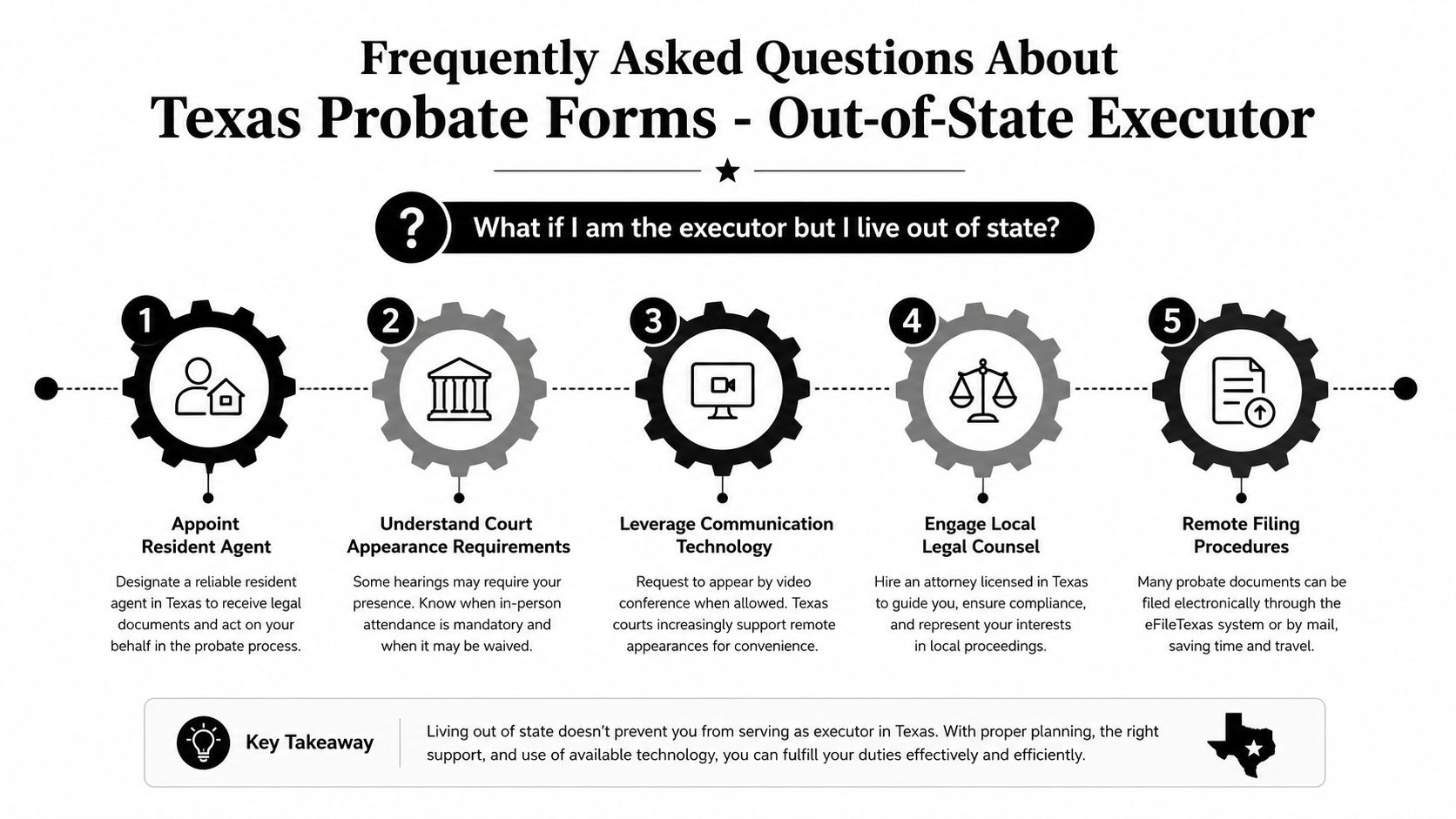
What if I am the executor but I live out of state
Being an out-of-state executor doesn't automatically prevent you from serving, but it can create practical hurdles. Some courts may require additional steps, and local practice matters. Travel, document signing, coordination with the clerk, and access to local institutions can all be harder from outside Texas.
What happens if I make a mistake on a form I already filed
Many probate errors can be corrected, but waiting usually makes the problem worse. The court may allow an amended filing, a supplemental pleading, or additional proof. The right fix depends on whether the mistake affects jurisdiction, notice, the requested relief, or a sworn statement already on file.
Are guardianship forms part of the probate process
Not usually. Probate concerns the estate of someone who has died. Guardianship concerns decision-making for a living person who is incapacitated or otherwise needs legal protection. The court system may overlap, but the proceedings are different, and the forms are different.
Three short reminders help most families:
- Don't assume all probate forms are interchangeable
- Correct mistakes early
- Treat guardianship and probate as separate legal matters unless a lawyer advises otherwise
If you're facing probate in Texas, our team can help guide you through every step, from filing to final distribution. Schedule your free consultation today.