 Skip to content
A family member dies, and the questions arrive before the grief has settled. Can the house be sold? Who can access the bank account? Does someone need to go to court? Many Texas families discover that even a modest estate may need legal administration because one important asset was owned only in the deceased person's name.
This guide explains how to avoid probate in Texas updated, using an asset-by-asset approach. The goal isn't to make every estate completely court-free. The goal is to understand which property can pass outside probate, which documents must be recorded or updated, and what paperwork may still be required after death.
What Probate Really Means for Texas Families
A Houston father dies with a home, a checking account, and a valid will. His children expect the will to let them sell the house immediately. Instead, the family learns that a Texas court must first recognize the will, establish who has authority, address debts, and authorize the transfer of property.
That process is called probate. In plain English, probate is the court-supervised system for identifying a deceased person's property, confirming the person entitled to act, paying valid debts, and distributing what remains to the proper heirs or beneficiaries. The court may validate a will, appoint an executor, and issue the authority needed to deal with banks, buyers, creditors, and county records.
The basic administration steps
A typical estate process may involve:
- Filing the necessary application and documents with the proper Texas probate court.
- Proving the will, if the deceased left one.
- Appointing an executor or administrator, the person responsible for handling the estate.
- Gathering and identifying assets, including real estate, accounts, vehicles, and personal property.
- Addressing debts and claims before distributing property.
- Transferring the remaining assets to beneficiaries or heirs.
Texas often allows independent administration, which gives the executor more freedom to manage the estate with limited court supervision when the will or heirs support that method. Dependent administration involves closer court oversight and may arise when there is no will, disagreements exist, or the estate requires more supervision. The right procedure depends on the documents, the property, the debts, and the family's circumstances.
Probate can last several months or longer than a year, depending on the estate's complexity, creditor issues, title problems, disputes, and court requirements. It can also create a public record and make grieving families coordinate with institutions while they're still trying to manage daily life.
Some estates also involve claims connected to the death itself. For example, a family handling a potential wrongful-death matter may need separate guidance about filing a survival action for mesothelioma, because that claim is distinct from transferring estate property.
Practical perspective: Avoiding probate isn't the same as avoiding every legal task. It means choosing lawful transfer methods before death so fewer assets require a court process afterward.
Why a Will Alone Will Not Avoid Probate
A will is essential for many Texas families, but it usually doesn't keep property out of probate. A will is an instruction document that tells the probate court how the deceased wanted property distributed. The court still generally must admit the will, appoint the person authorized to act, and provide the legal path for transferring probate assets.
That doesn't make a will unimportant. A will can name beneficiaries, nominate guardians for minor children, identify an executor, and provide instructions for property that wasn't transferred through another method. But a will works through probate rather than replacing probate.
The six tools families should understand
Texas estate plans commonly combine several methods:
- Revocable living trusts: Property properly transferred into the trust can pass through successor-trustee administration instead of probate.
- Payable-on-death and transfer-on-death designations: Bank, retirement, and investment accounts may transfer to named beneficiaries under the account contract.
- Transfer-on-death deeds: A Texas real estate owner may name a beneficiary who receives the property at death if the deed meets Chapter 114 requirements.
- Small estate affidavits: Qualifying smaller estates may use a simplified process under Chapter 205 rather than full administration.
- Muniment of title: A court may admit a will as a muniment of title when the estate doesn't need full administration under Chapter 257.
- Joint ownership with survivorship rights: Properly structured ownership can allow an asset to pass automatically to the surviving owner.
A Texas Probate Lawyer may assist with Texas probate and estate administration, but legal help can't correct an asset plan that was never coordinated. A trust doesn't control an account that remains individually titled. A beneficiary form doesn't transfer a house. A will doesn't automatically override a deed or account contract.
Probate avoidance is a system
Think of an estate plan as a set of connected title instructions. Each asset needs its own answer:
- Who owns the asset now?
- Does a beneficiary designation apply?
- Should the asset be retitled into a trust?
- Does a survivorship agreement control it?
- Is a will-based court procedure still necessary?
The plan succeeds only when those answers line up. One sole-owned checking account, vehicle, business interest, or parcel of real estate can send that asset back into probate even when the rest of the estate was carefully arranged.
Living Trusts and Beneficiary Designations That Work
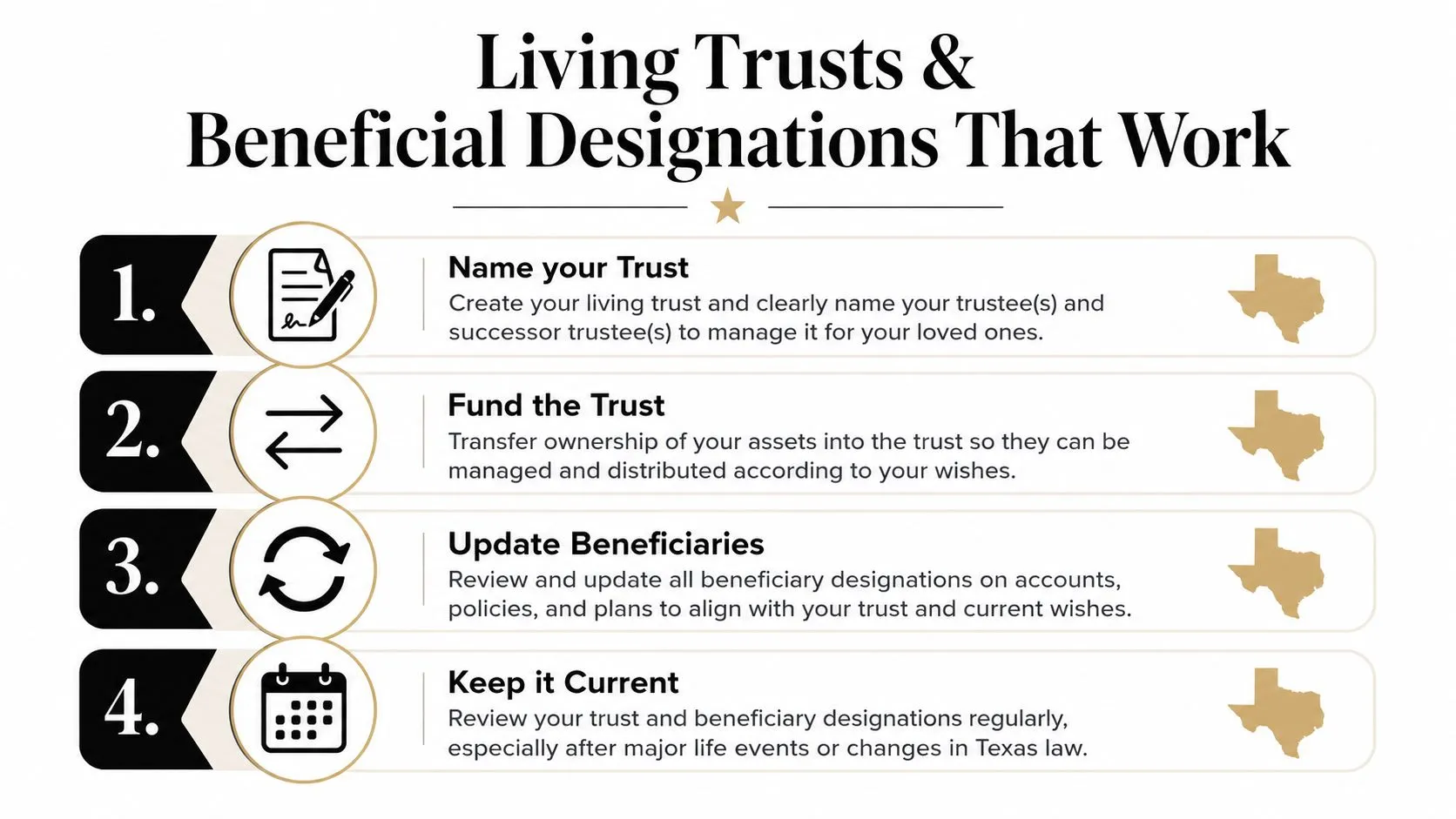
A revocable living trust can be a flexible probate-avoidance tool, but creating the document is only the beginning. The person who creates the trust usually names a trustee to manage property during life and a successor trustee to handle distribution after death. The trust can be changed or revoked during the creator's life, subject to its terms and applicable law.
The most important task is funding. Funding means changing ownership records so the trust owns the assets intended to be governed by it. Texas guidance emphasizes that every probate asset must be reviewed and retitled where appropriate, including bank accounts, investments, vehicles, and real estate. An unfunded trust may exist on paper while the deceased person's property remains individually owned.
A practical funding sequence
Start with a complete asset list, then work through each category:
- Create the trust and name the successor trustee.
- Retitle appropriate bank accounts in the trust's name.
- Coordinate brokerage and investment accounts with the trust or a beneficiary designation.
- Review vehicles and personal property to determine whether trust ownership or another transfer method fits.
- Record real estate documents when ownership is being transferred to the trust.
- Review retirement accounts and insurance policies, which often use beneficiary forms rather than trust title.
- Keep a written inventory showing how each asset should pass.
Payable-on-death, or POD, designations can direct bank funds to named beneficiaries. Transfer-on-death, or TOD, designations can serve a similar function for certain investment accounts. These designations operate alongside a trust, but they must be coordinated. A beneficiary form that conflicts with the trust may produce a different result from the one the family expected.
A Dallas couple provides a useful hypothetical. They establish a revocable living trust and transfer their home and investment account into it. They also update their retirement beneficiaries. But they leave one checking account in their individual names without a POD designation. After the first death, that account may still require probate even though the couple believed the trust covered everything.
The funding rule: A trust avoids probate only for property properly connected to the trust or otherwise assigned a valid non-probate path.
For a practical look at the setup process, families can review how to set up a living trust in Texas. Texas estate planning also operates within the broader structures of Title 2, which addresses estates of decedents, and Title 3, which addresses guardianship and related protective proceedings. The documents should be coordinated with powers of attorney and incapacity planning, not treated as isolated paperwork.
Texas Transfer on Death Deeds for Real Property
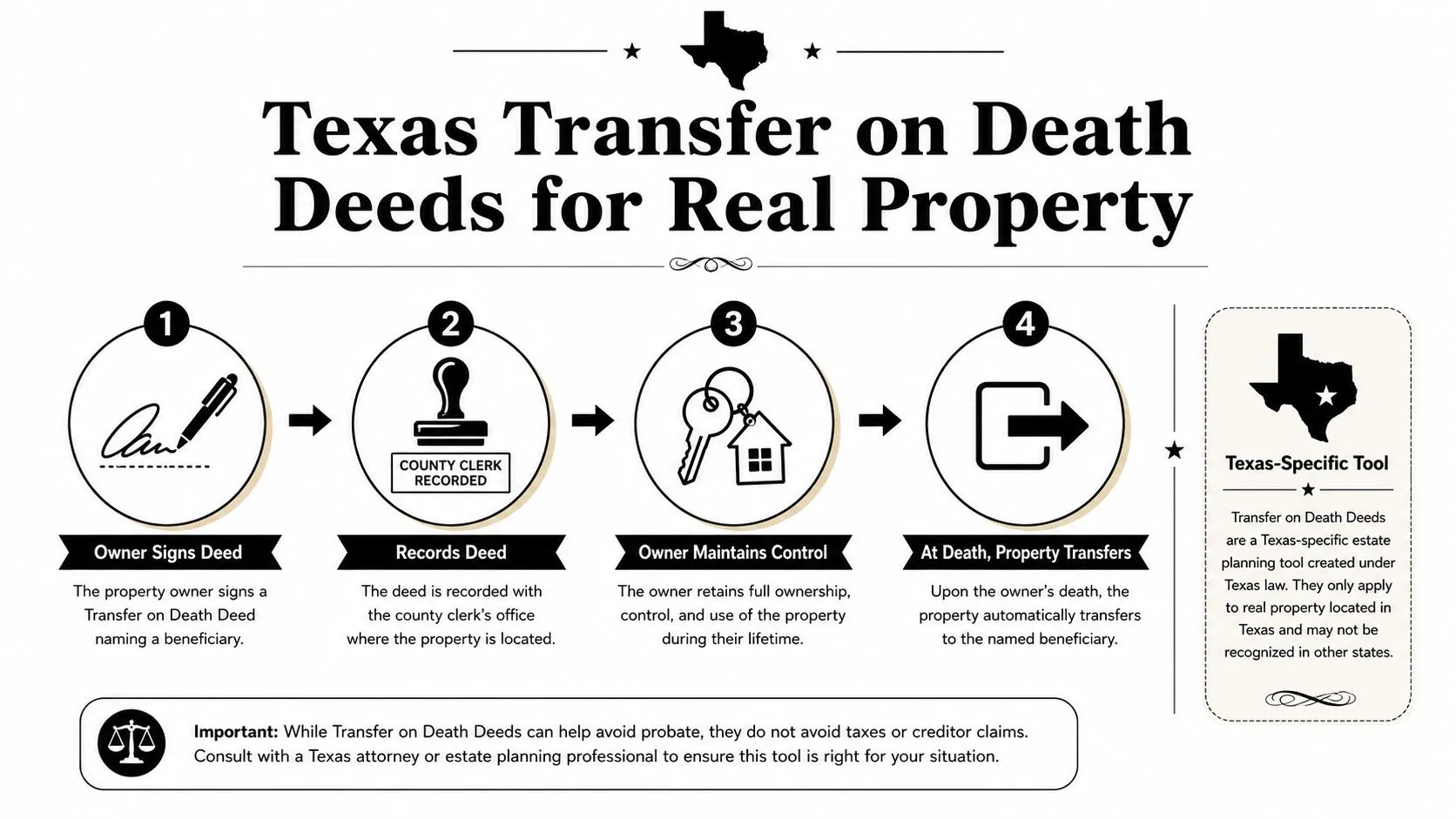
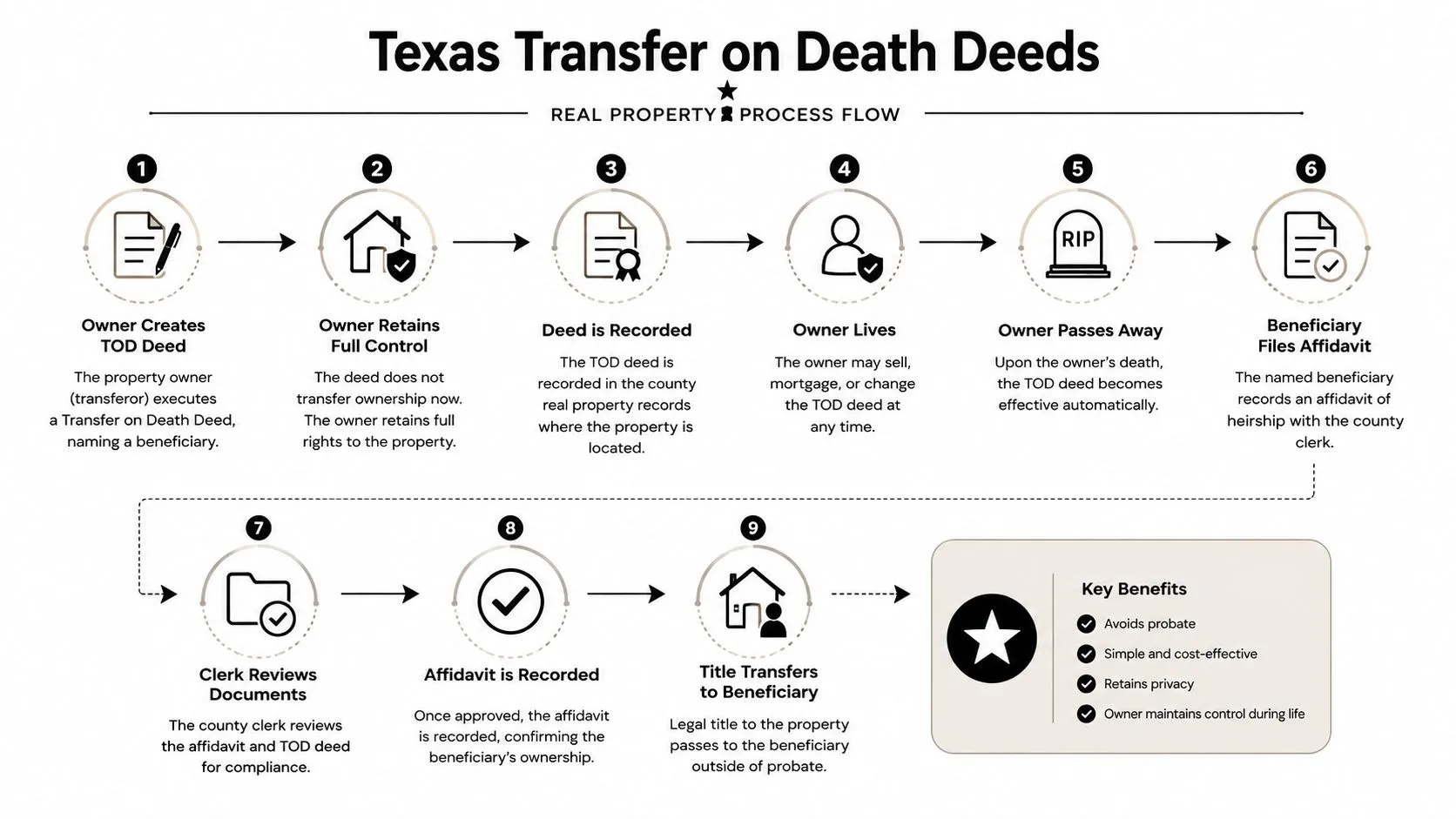
For a Texas home or other real property, a transfer on death deed, often called a TODD, can provide a direct probate-avoidance route. The owner signs and records the deed during life, names a beneficiary, and keeps control of the property while alive. The beneficiary receives the property at death if the deed was properly executed and recorded before death.
Chapter 114 of the Texas Estates Code created this statutory tool through the Texas Real Property Transfer on Death Act. The law became effective September 1, 2015, and applies to deeds executed and acknowledged on or after that date by transferors who die on or after that date. The official statute is available through the Texas Estates Code Chapter 114 provisions.
How the deed works
The owner should approach the deed as a title project, not merely a form:
- Identify the exact parcel covered by the deed.
- Prepare the deed with the correct legal description and beneficiary information.
- Execute and acknowledge it using the required formalities, including signing before the appropriate witnesses and a notary.
- Record it in the county where the property is located, before the owner dies.
- Keep a copy with the estate records and tell the future beneficiary where the document can be found.
- Review the deed after major life events, such as marriage, divorce, death, or a change in family intentions.
The owner retains control during life. The beneficiary doesn't become the present owner because the deed was signed. The deed covers only the parcel identified in it, so it won't transfer bank accounts, vehicles, business interests, or other property.
Texas also imposes a 120-hour survival rule. The beneficiary must survive the transferor by 120 hours for the transfer to take effect. If the beneficiary doesn't meet that requirement, the beneficiary's share can lapse and pass under statutory fallback rules as though the transfer were a devise in a will. Concurrent interests transfer in equal, undivided shares without a right of survivorship under the cited provision.
After death, the paperwork shifts. The beneficiary may need to file an affidavit of death and a death certificate so the county title records reflect the transfer. If the deed wasn't recorded before death, the transfer fails and the property may pass through probate instead. Families considering this tool can review Texas transfer-on-death deed guidance before signing or recording anything.
Small Estate Affidavits and Muniment of Title Compared
Not every family needs a full estate administration. Texas provides simplified procedures, but each one has specific eligibility rules. Choosing the wrong shortcut can create delays, so families should compare the estate's assets, debts, real property, will status, and level of agreement among heirs.
A small estate affidavit is generally associated with estates that meet the Chapter 205 requirements. The Texas State Law Library explains that the process may apply when there is no will, no one has applied for administration, total assets are $75,000 or less, excluding the homestead and exempt property, and the other statutory conditions are satisfied. Those conditions include restrictions concerning real property, sufficient assets for debts, and agreement among all heirs.
The affidavit must be presented for court approval. Once approved by the statutory probate court judge, it must be maintained or recorded as directed, with the legal effect described by Section 205.007. The process isn't a private family letter that a bank must accept automatically.
Muniment of title is different. It is a will-based procedure under Chapter 257. When the court is satisfied that there are no unpaid debts other than a lien on real estate, or that formal administration isn't otherwise needed, the court may admit the will as a muniment of title. The court order gives the people holding estate property legal authority to transfer it without appointing an administrator for ongoing administration.
| Feature | Small Estate Affidavit | Muniment of Title |
|---|---|---|
| Governing framework | Chapter 205 of the Texas Estates Code | Chapter 257 of the Texas Estates Code |
| Will required | Generally used when there is no will | Requires a valid will |
| Asset threshold | Total assets of $75,000 or less, excluding the homestead and exempt property, subject to statutory conditions. Texas Estates Code Section 114.002 | No stated small-estate threshold in the governing concept |
| Debt setting | Must meet the statute's debt requirements | Estate generally has no unpaid debts other than a real-estate lien, or no need for formal administration |
| Family agreement | All heirs must agree | The court evaluates the will and estate circumstances |
| Real property | Limited, including a homestead passing to a surviving spouse or minor children under the guide's conditions | Can transfer property under the court order |
| Court involvement | Court approval remains necessary | Court order remains necessary, but full administration may be avoided |
Families comparing these paths can review probate versus a small estate affidavit in Texas and then match the facts to the applicable Estates Code provisions.
Common Mistakes That Send Estates Straight Back to Court
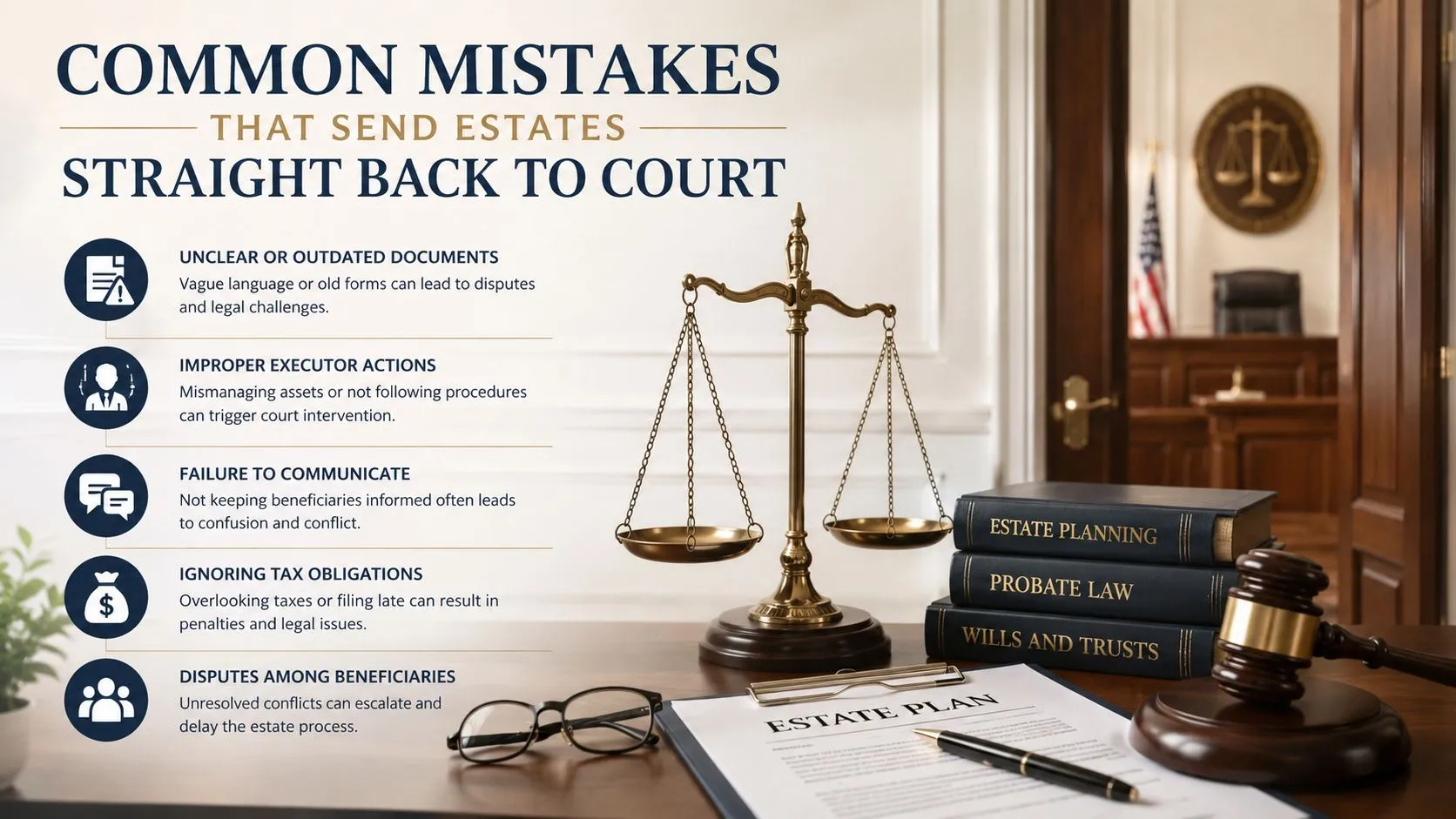
Probate avoidance fails most often at the connection points. A family may sign thoughtful documents, but if the account titles, deeds, and beneficiary forms don't match, the court may still be needed for the asset left outside the plan.
The oversights that matter most
An unfunded trust is a common example. The trust document may name a successor trustee, but an individually titled home or account isn't automatically governed by the trust. The family must check the actual ownership record, not rely on memory.
Old beneficiary designations can create another problem. A bank account may still name a deceased beneficiary, or a retirement account may contain instructions made before a divorce or family change. The institution follows its governing records, subject to applicable law and account terms, not the family's assumptions.
Joint ownership can conflict with the rest of the plan. A survivorship arrangement may transfer an asset to the surviving owner rather than under the will or trust. That may be exactly what the owners intended, or it may unintentionally disinherit someone the will was meant to protect.
Community property requires careful review. Families shouldn't assume that community-property status alone answers who receives an asset or how title transfers. The deed, account agreement, survivorship language, beneficiary designation, and estate documents all need to be examined together.
Out-of-state heirs, caregivers, and remote executors face additional practical hurdles. Banks and county clerks may require original documents, recorded affidavits of death, certified death certificates, or Texas-specific forms. Avoiding probate doesn't mean avoiding paperwork. It often changes the paperwork from a court administration into title, account, and beneficiary processing.
Use an asset audit before death
Create a spreadsheet or written inventory with these categories:
- Home and land: Confirm the owner, legal description, recorded deed, trust title, or TODD.
- Vehicles: Check title ownership, survivorship arrangements, and transfer requirements.
- Bank accounts: Identify sole ownership, joint ownership, POD designations, and trust ownership.
- Brokerage and retirement accounts: Confirm current primary and contingent beneficiaries.
- Business interests: Review governing agreements and restrictions on transferring ownership.
- Digital assets: Record where important accounts are held and how authorized people may access them.
- Debts and liens: Identify obligations that may affect a simplified procedure or transfer.
- Family documents: Store wills, trusts, deeds, beneficiary confirmations, and powers of attorney where the right people can find them.
Audit question: If the owner died today, which specific document would the bank, county clerk, vehicle office, or business manager rely on to transfer this asset?
That question exposes gaps faster than asking whether someone has “done estate planning.”
Key Takeaways and Your Next Step
The central lesson is simple. Probate avoidance is asset-by-asset, not document-by-document. A will can guide a court, while a trust, beneficiary designation, survivorship arrangement, TODD, small estate affidavit, or muniment of title may provide a different transfer route.
Texas tools also have technical rules. A TODD must be properly executed and recorded before death. A trust must be funded. A small estate affidavit has eligibility requirements, including the $75,000 asset framework described by Texas law and guidance. Muniment of title still requires a court order, even though it can avoid full administration.
Paperwork usually shifts rather than disappears. After death, a beneficiary may still need to provide a death certificate, record an affidavit, communicate with financial institutions, resolve debts, or address a title issue. Families looking for additional perspectives on probate avoidance strategies should still compare any general discussion against the actual Texas Estates Code and the facts of the estate.
Key Insight: Probate avoidance works when ownership, beneficiary designations, recorded deeds, and backup documents form one coordinated system. One overlooked probate asset can require court involvement even when every other asset transfers smoothly.
Questions families often ask
Can a transfer-on-death deed be revoked?
A TODD is not permanent merely because it was recorded. Revocation and replacement must follow the applicable Texas requirements, and the owner should make sure a later deed or revocation is properly prepared and recorded.
How does community property affect TODD planning?
Community-property ownership can involve both spouses' interests and should be reviewed with the deed, survivorship language, and broader estate plan. One spouse shouldn't assume a TODD controls property without confirming who has authority to sign and what interest the deed covers.
What should we do first if someone died without a plan?
Secure the original documents, identify the home and accounts, avoid selling or distributing property prematurely, and determine whether a will, small estate affidavit, muniment of title, or administration may apply. A prompt review can prevent an heir from taking an action that creates a title or creditor problem.
If you're facing probate in Texas, the Law Office of Bryan Fagan, PLLC can review your asset titles, beneficiary designations, trust funding, and available probate procedures, including small estate affidavits and muniment of title. Visit Law Office of Bryan Fagan, PLLC to request a free consultation and receive step-by-step guidance for your family's situation.


