 Skip to content
After a funeral, the hardest part is often not the paperwork, it's the quiet moment when one child opens the kitchen drawer and realizes the family's main asset is the house. The bills are still coming in, the keys are still on the counter, and everyone is asking the same question: how do we put the home in the right names without dragging the family through a full probate case?
In Texas, there's a specific probate path built for that kind of situation. It's called muniment of title, and when the facts fit, it can transfer property under a will without a full administration. For many families, it is the lightest-touch probate option for clearing title, especially when the estate is centered on real estate and the court doesn't need to appoint a personal representative. Muniment of Title in Texas captures that idea well, and the legal mechanics sit inside Texas Estates Code Chapter 257 (Cornell's summary of muniment of title).
When a Texas Family First Hears About Muniment of Title
A family usually hears about muniment of title at a very ordinary moment, and that is part of what makes the legal question feel so heavy. Someone has died, the will has been found, and the house may be the main asset everyone is trying to place in the right hands without spending months in a full probate case.
The term may sound technical, but the decision families face is simple. Does the estate need a court-appointed person to gather assets, pay claims, and keep the process open, or is the will enough to move title to the beneficiaries named in it? That question often decides whether muniment of title belongs in the picture at all.
Muniment of Title in Texas is the phrase families often hear first when the estate appears narrow and the home is the main concern. Under Texas law, the court's order can serve as the authority that lets the person holding estate property transfer it to the beneficiaries named in the will, and that order can be recorded in the county property records to establish the chain of title for real estate (Cornell summary). Title companies, lenders, and later buyers care about that recorded history.
Practical rule: if the estate is simple, the will is valid, and there is no need to appoint an executor, muniment of title may be the cleanest path.
That is why families with a house and little else often hear about this procedure first. It is not a shortcut that skips the law. It is a Texas probate procedure built for estates that do not need the heavier machinery of a full administration. The court still reviews the will, still checks eligibility, and still issues an order, but it does so without creating an ongoing court-supervised estate.
The legal issue behind the grief is usually plain enough. Does this estate need someone appointed to gather assets and pay claims, or is the will enough to move title into the beneficiaries' names? If the answer is the second one, muniment of title may be the right fit.
Families are often relieved to learn that Texas has a process built for this kind of estate. The appeal is easy to understand. Fewer court steps, a title-clearing order, and a recorded document that helps real property move into the right names. For a family already dealing with loss, that can mean less time in court and fewer moving parts.
The harder question is whether the estate fits the statute. A house alone may point one way, but debt, Medicaid recovery claims, or later-discovered assets can change the answer quickly. A case that looks simple at the kitchen table can become something else once those issues come into view.
What a Muniment of Title Does
Muniment of title gives a will the legal force needed to move property into the names of the people who inherit under it. The phrase sounds old, but the practical result is easy to grasp. The court admits the will, signs an order, and that order becomes the document a county clerk or title company can rely on to see how title should pass.
The will becomes the proof
Once the court admits the will as a muniment of title, the will and the court's order work together as the proof that the property may be transferred according to the will. The order can then be recorded in the county property records, which helps preserve the chain of title for real estate passing through the estate.
That is the core function of the procedure. It does not appoint an executor. It does not open the door to an ongoing, court-supervised administration. It gives the family a court-backed record that says the will may be used to transfer title.
A full probate hands authority to a personal representative. Muniment of title keeps the process narrower and ties the transfer power to the will once the court has admitted it and the order has been recorded correctly. That narrower scope is what makes the procedure useful for an estate that does not need a larger probate process.
What is left out of full administration
The difference from ordinary probate is what makes muniment of title easier to understand. There is no executor appointment, no Letters Testamentary, and no continuing estate administration with the same reporting and supervision that a full probate can require. The court's role is limited to confirming the will and entering the order that lets title move.
That does not make the process informal. It still depends on sworn facts, notice, a hearing, and proper compliance after the order is signed. The family still has to follow the procedure carefully, but they avoid much of the administrative burden when the estate does not need that extra machinery.
The order only helps if the title records support it. For real estate, recording the will and the order in the county deed records is what turns the court paper into something a title company can rely on.
Who Qualifies and Who Does Not
Families usually reach this point with one question in mind, can this shortcut fit our situation, or will it cause trouble later? Muniment of title only works in a narrow set of estates, so the court looks for a few specific conditions before it will use this procedure. If the estate misses even one of them, the family usually needs a different probate path.
Gate one, a valid will must exist
Texas uses muniment of title only when the person died with a valid will. An estate with no will at all usually cannot use this procedure. The same problem comes up if the will cannot be proven or the facts do not support admitting it.
That is the first practical checkpoint. If the family cannot point to a real will that the court can admit, muniment of title is off the table.
Gate two, no need for a full administration
The court also has to see that there is no need for a full administration. A full probate exists for estates that need someone to collect property, deal with claims, and keep managing the estate after the court gets involved.
If the estate has disputes, unresolved creditor issues, or a need for a personal representative to act over time, muniment of title usually stops being the right tool. Families sometimes hear the word “simple” and assume that means the court will stay out of the way, but that is not the test. The central question is whether a larger probate process is needed to finish the job.
Gate three, no unpaid debts except liens on real property
This is the gate that often changes the answer. Texas allows muniment of title only if the estate has no unpaid debts other than debts secured by a lien on real property. Credit cards, medical bills, and other unsecured debts can keep the court from using this procedure. Possible Medicaid recovery claims can also complicate the decision, especially when a family is trying to keep a house in the estate and is not sure what debts still exist.
A good way to sort it out is to ask a plain question, does the estate owe money that is not tied to the house? If the answer is yes, muniment of title may no longer fit, even if the will itself is perfectly valid.
The practical question families need answered is not just whether the will exists. It is whether the estate can be transferred without opening a broader administration, and whether debts or claims make that impossible.
A separate compliance step often comes up here as well. A muniment of title compliance affidavit can help confirm what happened after the order was signed, including whether the estate stayed within the limited rules the court expected.
Plain-English test: if the estate cannot be wrapped up without paying unsecured claims, muniment of title may stop being the right tool.
Documents Required and How the Filing Moves
A family usually reaches muniment of title with a stack of papers and one practical question, what does the court need before it will let the property pass? The answer is specific, and it helps to gather the right documents before the filing goes in. That way, the process stays focused on transferring title instead of stalling over missing facts.
What the application must say
The application needs concrete information about the decedent and the estate. It should identify the applicant's name and domicile, the testator's death information, venue facts, a general description and probable value of the property, the date of the will, the names of any executor and subscribing witnesses, and a statement that the estate owes no unpaid debt other than a lien on real estate (Farren Sheehan law summary).
That detail matters because the court is not just checking whether a will exists. It is deciding whether this simplified probate path fits the estate as a whole. A will with the wrong paperwork can still slow everything down, just as a clean deed cannot fix a missing title history.
Families usually do better when they collect the following before meeting with counsel:
- Applicant information, including name and domicile.
- Death facts, so the court can identify the decedent correctly.
- Venue facts, showing why the case belongs in that county.
- Property description and probable value, especially for real estate.
- Will details, including date, executor name, and subscribing witnesses.
- Debt statement, confirming no unpaid debt other than a lien on real property.
The filing timeline in order
The application is filed with the county clerk. In Bexar County, the clerk posts citation for 10 days, then a hearing follows (Bexar County guide). After the hearing, if the judge is satisfied, the court signs the order admitting the will as a muniment of title.
After that, the order and will should be recorded in the county deed records where the property is located so the chain of title is complete. A separate post-admission filing is still part of the process. Texas practice expects a sworn statement showing fulfillment of the will's terms by the deadline described in county guidance, and families often look to this 180-day muniment compliance guide to understand why that step still matters after the judge signs the order.
A simple rule helps here. If the order is not recorded, title records stay incomplete. If the post-admission affidavit is missed, the file can still have a compliance problem even after the hearing is over.

| Milestone | Statutory Reference | Typical Timeframe |
|---|---|---|
| File application | Texas Estates Code Chapter 257 | At the start of the case |
| Citation posted | Bexar County muniment guide | 10 days in Bexar County |
| Hearing held | Texas Estates Code Chapter 257 | After citation period |
| Order signed and recorded | County deed records guidance | After the hearing |
| Fulfillment affidavit filed | Bexar County muniment guide | By the 181st day, unless waived |
For families trying to sort out probate help for Texas families, a useful outside overview is probate help for Texas families from Cremation.Green, especially for readers comparing general probate paths before they narrow the issue down.
Muniment of Title Compared to Other Texas Probate Options
Families usually compare muniment of title with four other paths, even if they don't know the legal names yet. The core question is not which option sounds easiest, it's which one fits the estate's facts.
Side-by-side differences
| Option | Best fit | Main limitations |
|---|---|---|
| Muniment of title | A valid will, clear title transfer, and no unpaid unsecured debts | No administration if the estate needs a representative or has disqualifying debts |
| Independent administration | Will-based estates that need a personal representative but want less court supervision | Still requires administration steps and court authority |
| Dependent administration | More complex estates with closer court oversight | Heavier court involvement and more formal process |
| Affidavit of heirship | Situations without a will where family ownership needs to be established | It's not a will-based probate procedure and is more limited in use |
| Small estate affidavit | Small, intestate estates that fit statutory limits | Not the same as probate of a will and often doesn't solve every real-estate issue |
For families trying to sort out probate help for Texas families, a useful outside overview is probate help for Texas families from Cremation.Green, especially for readers comparing general probate paths before they narrow the issue down.
The comparison matters because the presence or absence of a will changes everything. If there's a valid will and no unsecured debt, muniment may be the leanest route. If the estate needs a representative to handle claims, distribute assets, or manage complications, an independent or dependent administration may be more appropriate.
A quick way to think about the choice
Muniment of title is about title transfer. Independent administration is about estate management with less court supervision than a dependent case. Dependent administration is for estates that need stronger court control. Affidavit of heirship and small estate affidavit are different tools entirely, usually used when there is no will.
If you want a deeper comparison between heirship paperwork and probate, this Texas affidavit of heirship comparison is a helpful read for families trying to figure out whether they're in a probate case at all.
Key insight: the right path depends less on what sounds simplest and more on whether the estate can legally move without a personal representative.
A Realistic Texas Scenario From First Call to Recorded Deed
A Harris County daughter calls after her father's funeral. He left a valid will, the family home is paid off, and there is a small savings account the children expect to divide. On paper, the estate looks like the kind of file that might fit muniment of title.
The first conversation usually starts with the same practical questions a family would ask any trusted adviser. Is there a will? Is there unsecured debt? Are there other assets besides the house and that savings account? Those answers decide whether muniment is still the right tool or whether the estate has already drifted into a different probate path.
The first pass looks simple
The attorney reviews the will and asks the question that matters most, whether any unsecured debt exists. The daughter says no, at least as far as she knows. The application is prepared, filed, and taken through the citation period, then the court hearing follows. The judge admits the will as a muniment of title, and the family records the order in the county deed records where the house is located.
That is the appeal of this procedure. It can transfer the house without a full administration, and it can clear the title record for a later sale or refinance. For families who only need a court order to move real estate, it often feels like the shortest legal path through a hard time.
Then the hidden debt appears
A few days later, a credit card statement arrives in the mail. It is not secured by the house, and nobody saw it when the filing began. That single piece of paper changes the analysis because the no-unsecured-debt requirement is part of the rule, not a suggestion.
If that debt had been known earlier, the family may have needed a different probate route from the start. Instead of a straightforward muniment case, they may have needed an administration that could deal with claims, notice, and the rest of the estate in a controlled way. For a fuller look at what families often spend across different probate paths, this guide to Texas probate costs gives useful context.
The point is not that muniment failed. The point is that once the debt came to light, it stopped being the right tool for the job.
Families also ask how wills and trusts fit into this picture, especially when a house is involved. For broader estate-planning context, Parkview's guide to estate trusts helps explain why some families try to reduce probate problems before death rather than sort them out afterward.
Likely Costs, Common Mistakes, and Hidden Edge Cases
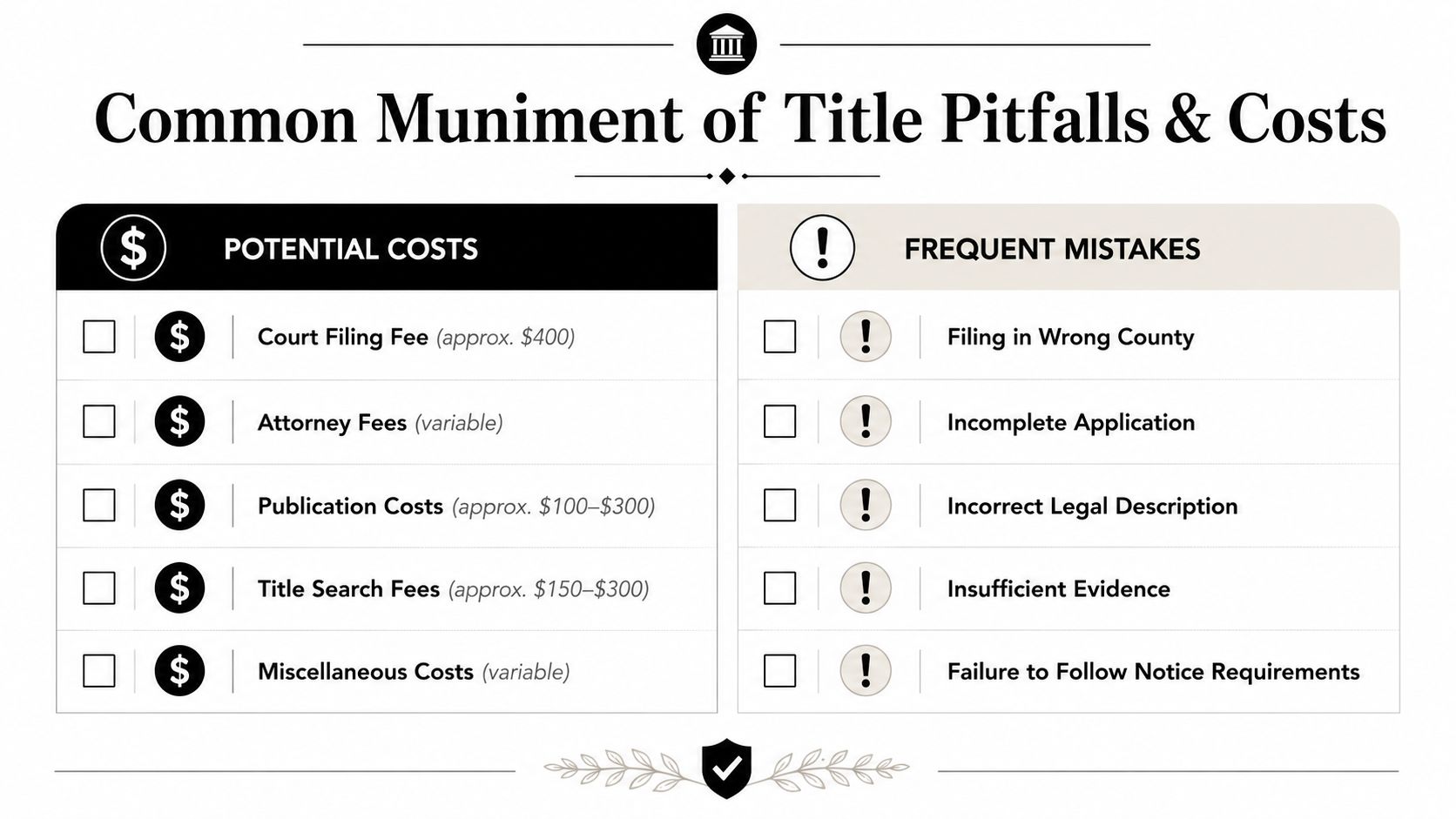
Families often want to know what this process really costs before they file. The honest answer is that the price usually comes from court filing fees, citation costs, recording fees, and attorney fees. A clean muniment case is typically less expensive than a full administration because it needs fewer court steps and no ongoing personal representative work.
Where people get tripped up
The common mistakes are predictable, but they're still expensive when they happen.
- Filing with unsecured debt present, which can knock the case out of muniment status.
- Skipping the post-order affidavit, which Texas requires unless the court waives it.
- Not recording the order in the county where the property sits, which leaves the title record incomplete.
- Missing the four-year filing problem, which can make late probate harder to justify.
- Overlooking Medicaid recovery issues, which can turn a simple case into a different one.
One of the biggest surprises is the debt issue. Families may know about the house, but not about a credit card, a medical bill, or a state recovery claim. If those exist, the estate may not qualify for muniment of title at all.
Edge cases that deserve attention before filing
Out-of-state heirs can complicate coordination, especially when multiple people need to sign or receive documents. Unmatured creditor claims can also matter, because a debt that isn't fully resolved can still affect the court's decision. Retirement accounts and business interests may pass outside probate in some situations, but they can also create confusion if families assume everything follows the same rule.
For a broader view of cost drivers in Texas probate, this probate cost guide is a useful companion to the muniment question, because it helps families compare the lighter filing path with more involved administration work.
If you're handling a Texas estate and trying to decide whether muniment of title is the right fit, the Law Office of Bryan Fagan, PLLC can help review the will, debts, title issues, and filing options with you. Visit Law Office of Bryan Fagan, PLLC to talk through your situation and get guidance that's grounded in Texas probate practice. If you're facing probate in Texas, our team can help guide you through every step, from filing to final distribution. Schedule your free consultation today.


