 Skip to content
You're holding a court order in one hand and a stack of questions in the other. The hard part usually feels finished by the time a Texas judge admits a will as a muniment of title, but one important obligation still sits on the calendar, the 180-day compliance affidavit. If you miss that post-order filing, you may not undo the title transfer, but you can create avoidable problems for later sales, refinancing, and court compliance.
For families already grieving, this step can feel unfairly technical. Texas built it that way on purpose, though, because the law wants the transfer to stay efficient while still leaving a paper trail that shows the will's directions were carried out. That balance is the heart of the Texas Muniment of Title Compliance Affidavit 180 Days rule, and it's the part many people overlook until the deadline is close.
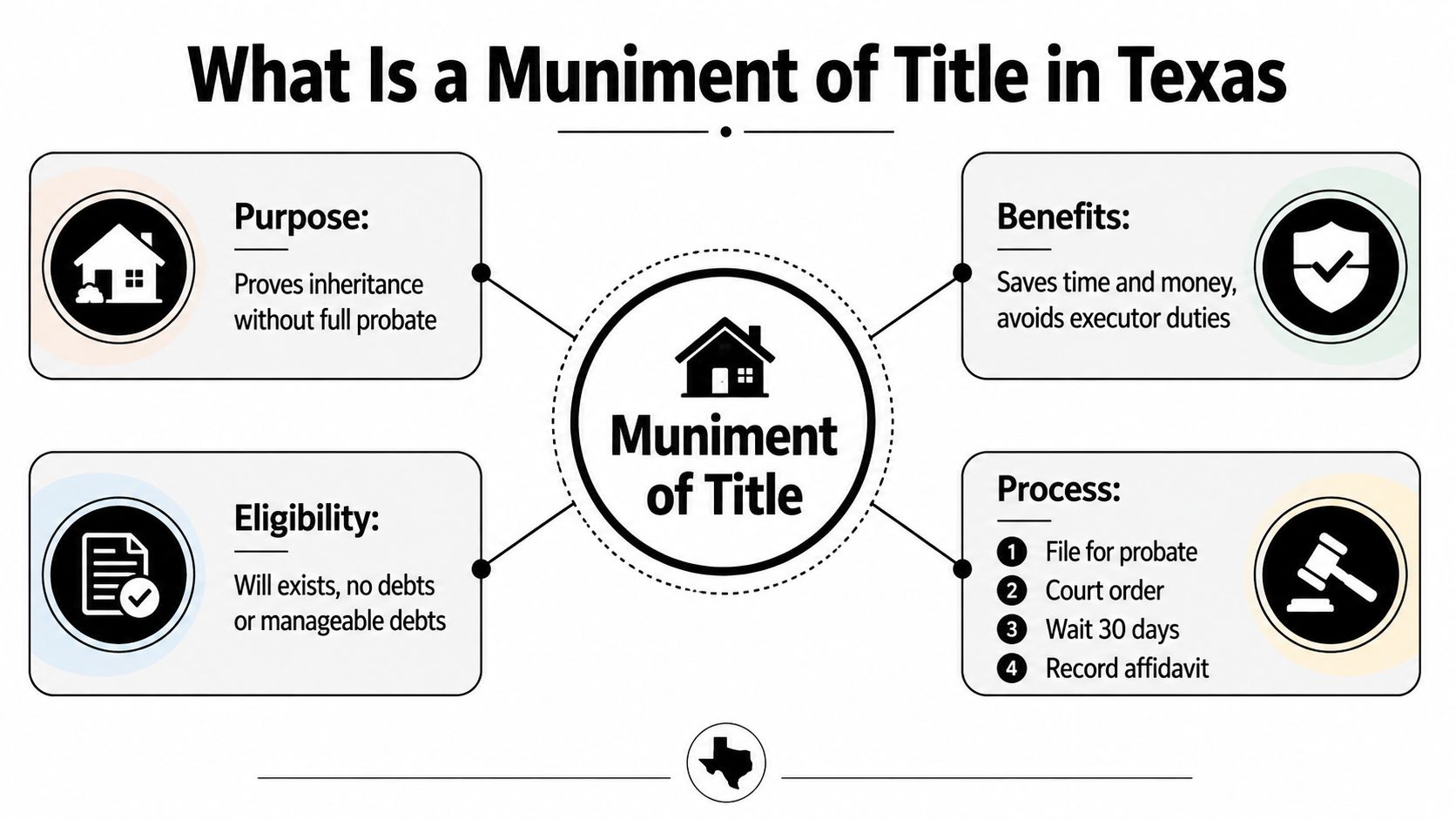
What Is a Muniment of Title in Texas
A muniment of title is Texas's lighter probate path for proving who inherited property under a valid will. Instead of opening a full estate administration, the court admits the will as evidence of ownership, then issues an order that can be recorded to help transfer title. Texas families often choose it when the estate is straightforward and there isn't a need for a court-supervised executor process.
The practical value is simple. If the goal is to clear title to a house, account, or other asset named in the will, muniment of title can do that without the heavier machinery of independent or dependent administration. For a plain-English overview of how title questions come up in inherited property matters, ownership questions with INTELLI can help readers think through why clean record title matters after a death.
When this route usually fits
Texas Estates Code Chapter 257 allows this path when the court finds the will qualifies for admission as a muniment of title. In everyday terms, that means the will exists, the estate is not burdened by a full administration need, and the process can move without appointing a formal executor. The court is not saying every issue is resolved forever, only that the will can serve as the legal vehicle for transferring title.
Practical rule: If the order is already signed, your next job is not to restart probate. Your job is to preserve the paper trail that shows the will was carried out.
A Houston widow often sees this in action with a single-family home. Her husband's name is still on the deed, and she needs to refinance or retitle the house after his death. Muniment of title can clear that path, which is why some families look first to Muniment of Title in Texas when the estate is narrow and the property issue is the main concern.
Why the 180-Day Compliance Affidavit Exists
The affidavit exists because Texas wants a transfer that is not an invisible one. Texas Estates Code § 257.103 creates a post-order reporting duty, and the Texas Supreme Court's muniment instructions make the timing clear, the sworn affidavit cannot be signed until at least 30 days after death, and it must describe which terms of the will were fulfilled and which were not, with the filing due within 180 days of the signed order unless the court waives it. The point is to let title move efficiently while still preserving a documented compliance step. Texas Supreme Court muniment instructions
That extra filing is not random paperwork. It tells the court and the record what happened after the order was entered, which helps confirm that the simplified probate path was used for its intended purpose. In county practice, that same idea shows up clearly in Bexar County's probate guide, which says the affidavit must be filed before the 181st day after the will is admitted as a muniment of title unless the requirement is waived. Bexar County's muniment guide
What the affidavit needs to say
The affidavit is a sworn statement, so accuracy matters. It should identify which provisions of the will have been carried out and which still remain unfulfilled. Independent legal guidance also explains that the filing is commonly framed as a sworn confirmation that distributions or other will terms have been completed, while noting that a late filing does not, by itself, undo the title transfer already accomplished by the order. Texas muniment compliance guidance
That detail matters because families sometimes assume the affidavit is what transfers title. It isn't. The order does the heavy lifting, and the affidavit functions as the compliance checkpoint that follows after the transfer path is already open. That's why the deadline feels strict, but not because the court is trying to trap grieving families. The law is trying to keep a record that is both fast and complete.
If you're already dealing with the post-order stage, think of the affidavit as the final receipt for the probate file. The transfer happened, now the record has to show what was done with the will's directions. In that sense, the 180-day mark is less about ceremony and more about keeping Texas title records clean.
A Realistic Scenario Showing the Deadline in Action
A Dallas County family gets the order signed in early spring after the mother's will is admitted as a muniment of title. Her daughter now needs to move the rental property into her name and sort out a brokerage account that was listed in the estate plan. The order solves the ownership question, but the calendar has already started moving toward the affidavit deadline.

The first thing the daughter does is wait out the required 30-day period from the date of death before signing anything that needs to be sworn. That pause can feel strange, especially when everyone wants the file closed, but the law makes it part of the process. During that time, she gathers papers showing which gifts were already delivered, which bills were paid, and which terms of the will still need attention.
The part families usually feel in real life
The pressure doesn't usually show up on day one. It shows up when the family realizes the probate order is in hand, but one more sworn filing still has to be completed before the 181st day. That's when people start checking calendars, calling banks, and looking for copies of the order they thought they could file away.
A clean file is easier to live with later. If the affidavit is ready early, there's less panic when a lender, title company, or county clerk asks for proof that the estate was handled correctly.
A family in this position does not need a dramatic legal fight. It needs organization, patience, and a clear sense of which terms of the will were already satisfied. That is why the 180-day requirement matters so much to executors and heirs who are trying to finish the job without creating new obstacles. The court order got the property moving, and the affidavit keeps the trail intact.
Preparing the Compliance Affidavit Step by Step
Start with the signed order and work backward from the date it was entered. Mark the 180-day deadline on a calendar the same day you find the order, then confirm the date of death so you know when the 30-day waiting period ends. Those two dates drive the rest of the process, and if either one is wrong, the filing can get messy fast.
A practical checklist for the affidavit file
- Check the order: Confirm the court admitted the will as a muniment of title and note the signing date.
- Mark the deadline: Count 180 days from the order date and keep the 181st day in mind as the point you do not want to cross.
- Confirm the waiting period: Make sure at least 30 days have passed since death before the affidavit is sworn.
- Inventory what happened: List the assets, known debts, and specific gifts in plain terms so you can see what the will already accomplished.
- Separate fulfilled from unfulfilled terms: Write down which provisions were carried out and which still need attention, because the affidavit has to say both.
After that, draft the sworn statement in language that matches the court's requirement. The affidavit should be signed before a notary, because it's a sworn filing, not a casual letter. Then file it with the same probate court that entered the muniment order, along with whatever local paperwork the clerk requires.
A useful way to think about this file is to keep the original order, the affidavit, and any proof of compliance together in one folder. Families often scatter those papers across email, a desk drawer, and a file cabinet, then spend a stressful afternoon trying to reconstruct the timeline. If you're gathering lender paperwork or planning a refinance, the same kind of organized preparation that helps families beat the clock with loan prep can help here too.
Who should actually sign
Usually, the person filing the affidavit is the applicant or another person with knowledge of the will's performance. The key is not the title on the envelope, it's whether the signer can truthfully state what parts of the will were completed and what parts were not. If the family is unsure who has enough personal knowledge, that's the moment to pause and get legal help.
If you need a form base before drafting, the firm's Texas probate forms page can be a practical starting point for understanding what probate paperwork usually looks like in Texas. That said, the form itself still has to match the facts of the estate, and no template can fix a wrong deadline or a false statement.
What Happens If You Miss the 180-Day Deadline
Missing the deadline is not the same thing as losing title automatically. The better way to say it is this, the title transfer already occurred through the muniment order, but the court expected a sworn compliance filing within the statutory window. A late filing can still be handled, yet it is easier to explain than to excuse.
Late affidavits are often filed with a motion that explains why the delay happened. Courts may waive the requirement in some situations, but that waiver is discretionary, not automatic. A missed filing can also become a problem later if a buyer, lender, or title company wants a clean probate trail before closing.
Why the risk is bigger than the missed date itself
The immediate issue is recordkeeping. The deeper issue is how the omission can look in a later dispute, especially if a beneficiary complains, a creditor challenges the file, or the court sees a pattern of poor administration. Independent guidance notes that failing to file does not, by itself, undo the title transfer, but the omission can still be used against the person handling the estate.
That's why a late filing should not be treated casually. It may be corrected, but the correction takes time, and that time can matter if the family is trying to sell or refinance property. A clean filing is the easiest way to avoid making a routine transaction harder than it has to be.
| Stage | Day Mark | Required Action | Risk If Skipped |
|---|---|---|---|
| Order signed | Day 0 | Record the signing date and calculate the deadline | The family loses track of the filing window |
| Waiting period | After death, before day 30 | Do not swear the affidavit until at least 30 days have passed | The affidavit may not satisfy Texas timing rules |
| Compliance period | Up to day 180 | Prepare and file the sworn affidavit with the probate court | Late filing can trigger extra motions or waiver requests |
| After deadline | Day 181 and later | File late only with an explanation or request for waiver | Later title work can become harder |
If there's one point to keep in mind, it's this. A missed deadline doesn't usually erase the probate result, but it can complicate the next transaction. That's why executors should treat the affidavit like a closing document, not a back-burner task.
Muniment of Title vs Other Texas Probate Options
Muniment of title is usually the lightest-touch path when the will is valid and the estate doesn't need a full administration. A small estate affidavit can fit different facts, usually when the estate is simple and the law allows that shortcut, while dependent administration brings the most court supervision and formal steps. Independent administration sits in the middle, with an appointed executor acting without constant court oversight.
Side-by-side practical differences
| Method | Practical use | Court involvement | Best fit |
|---|---|---|---|
| Muniment of Title | Proves ownership through the will | Low after the order | Clear title with limited estate issues |
| Small Estate Affidavit | Streamlined transfer in qualifying cases | Low | Simple estates that fit the statutory route |
| Dependent Administration | Court supervises estate actions | High | Disputes, creditor issues, or tighter oversight |
| Independent Administration | Executor manages estate with less supervision | Moderate | Estates needing an acting representative |
For families comparing options, the key question is not which route sounds easiest. It is which route matches the facts. A will that needs title cleared after death may fit muniment of title, while a more complicated estate with disputes or unresolved obligations may need a different path. If you're weighing those choices, the firm's page on Probate vs Small Estate Affidavit in Texas can help frame the decision.
Muniment of title is often the right answer when the main goal is to get property recordable quickly and the estate does not call for ongoing estate management. If there are unresolved creditor problems, business assets that need active management, or arguments among heirs, a more involved probate route may be the safer choice. The name of the process matters less than the fit of the facts.
Practical Tips and a Compassionate Wrap-Up for Texas Families
Keep the order, the affidavit, and every proof document in one folder, physical or digital. Put a calendar reminder beside the order date, not just the date of death, because the 180-day clock starts with the signed order. If multiple family members are involved, let them know when the affidavit will be filed so nobody is surprised later when a lender or title company asks for it.
Here are the habits that save the most stress:
- Track dates immediately: Write down the date of death, the order date, and the target filing date in one place.
- Keep certified copies together: Store the signed order and the filed affidavit with the same set of estate papers.
- Tell beneficiaries what's pending: Explain which will terms were already completed and which still need attention.
- Ask for help early: If any gift, deed transfer, or account distribution looks impossible, involve a Texas probate attorney before the deadline gets tight.
Key Insight: The muniment order transfers title, but the compliance affidavit protects the record. If you treat it as a final housekeeping step, you're more likely to finish cleanly and avoid problems later.
For families grieving a loss, this is one of those tasks that feels small until it suddenly isn't. The safest approach is to assume the affidavit matters, because later transactions often depend on a clear probate trail. If the file feels uncertain, do not wait for the deadline to force the issue.
If you're facing probate in Texas, the Law Office of Bryan Fagan, PLLC helps families handle muniment of title filings, compliance affidavits, and the paperwork that follows a court order. Visit Law Office of Bryan Fagan, PLLC to schedule a free consultation and get practical guidance before the deadline becomes a problem.


