 Skip to content
A routine, uncontested Texas probate typically totals $3,000 to $7,000, and attorney fees usually make up the largest share. If the estate qualifies for a Small Estate Affidavit, the total can drop to about $300 to $2,000.
That's the range most worried families want first, because the bill often lands before the grief has even settled. If you're staring at a house, a bank account, and a stack of unopened mail after a parent's death, the primary question isn't just whether probate is needed, it's which path makes the most sense for the estate and the family.
What Texas Families Realistically Pay for Probate in 2026
A Harris County executor calling around for quotes may hear a number that feels shockingly high. A flat quote can make sense, but it can also hide why probate costs vary so much, the procedure chosen, the court involved, and whether anyone starts fighting.
Texas does not use one fixed statewide price schedule for probate, so the same estate can be relatively affordable in one county and far more expensive in another. For a routine, uncontested estate with a valid will, independent administration commonly falls in the $3,000 to $7,000 range, while a contested or complex matter can go beyond $10,000 and, in some breakdowns, reach $20,000+ when litigation and court supervision pile up (Texas probate cost breakdown, Texas probate pricing guide).
Families usually get the clearest answer when they match the estate to the right probate path. A Small Estate Affidavit may cost about $300 to $2,000, and a Muniment of Title is often estimated at $1,500 to $4,000 (Texas probate cost breakdown). Those lower-cost routes can work like a shorter checkout line at a busy store, but only if the estate qualifies. If the facts do not fit, forcing the cheaper path can create delays and extra expense later.
Practical rule: the more the court has to supervise, the more the bill tends to grow.
Before you sign anything, ask which path the lawyer is pricing. A quote for contested probate is not the same thing as a quote for a clean, valid-will administration, and that difference matters more than almost any other line item. For a Texas-specific overview of how those fees are usually framed, you can also review this guide on the cost of probate in Texas.
The rest of the bill usually comes from a stack of smaller charges, court costs, attorney time, bond, appraisals, notices, and tax work. Once you can name each piece, you can start spotting which ones are necessary and which ones are driving the total up.
The Main Cost Line Items in a Texas Probate
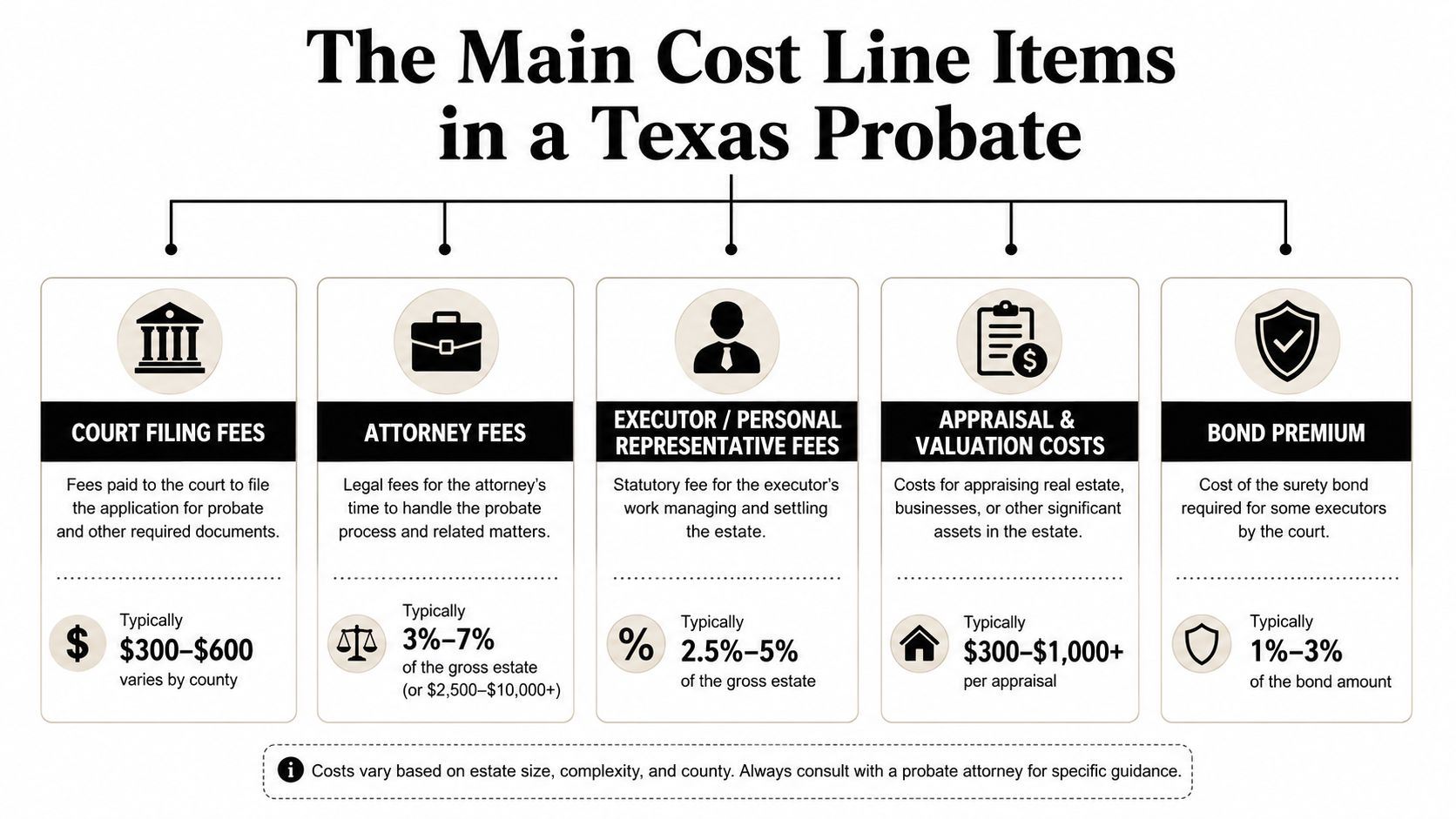
There usually is not one single line on a probate bill labeled “probate fee.” Families tend to see several smaller charges stacked together, and each one covers a different part of the process. Once those categories are clear, it becomes much easier to tell whether a charge is required, optional, or just higher because the estate is more complicated.
Court filing fees and the courthouse side of the case
Court filing fees in Texas are often roughly $300 to $600, depending on the county (Texas probate pricing guide). That payment opens the case, gets the petition on file, and starts the court process. If you are reading a local quote, ask whether the filing fee is included or billed separately. That small detail changes how the total looks on paper, even when the work is the same.
Attorney fees, the biggest moving part
Attorney fees usually make up the largest share of the cost. Texas probate has no statewide statutory attorney fee schedule, so lawyers generally bill by flat fee or hourly rate rather than by a court-set percentage (Texas probate pricing guide). In routine cases, flat-fee arrangements are common, and more complex matters often shift into hourly billing.
That is why two families can start with what sounds like the same probate case and end up with very different legal bills. A straightforward matter with clear heirs, a valid will, and little friction usually takes less attorney time than a file with disputes, missing records, or asset questions.
Executor or personal representative compensation
The executor or administrator may be paid for the work of managing the estate, but that does not mean every estate will pay a large amount. Sometimes the family waives it, especially when the executor is also an heir. In practical terms, this line item matters most when there are many tasks, many heirs, or a long administration. The more paperwork, calls, and decisions involved, the more this role can resemble a part-time job instead of a simple family duty.
Bond, appraisal, publication, and tax work
Under Texas Estates Code Title 2, a surety bond may be required in some administrations, especially when the court wants extra protection. Appraisal and inventory costs increase when the estate includes real property, business interests, or hard-to-value assets. Publication costs cover notice to creditors, and accounting or final-report preparation becomes more expensive if records are incomplete or the estate has multiple transactions.
A careful lawyer will also make sure tax obligations are handled, including the deceased person's final federal income tax return and any Texas franchise tax clearance that may apply. For a plain-language snapshot of the fee categories, What Does Probate Cost in Texas? is a useful reference for the fees and attorney costs involved in a Texas probate.
A clean file lowers cost faster than almost anything else. Good records reduce back-and-forth, and back-and-forth is where time gets expensive.
Four Texas Probate Paths and Their Cost Profiles
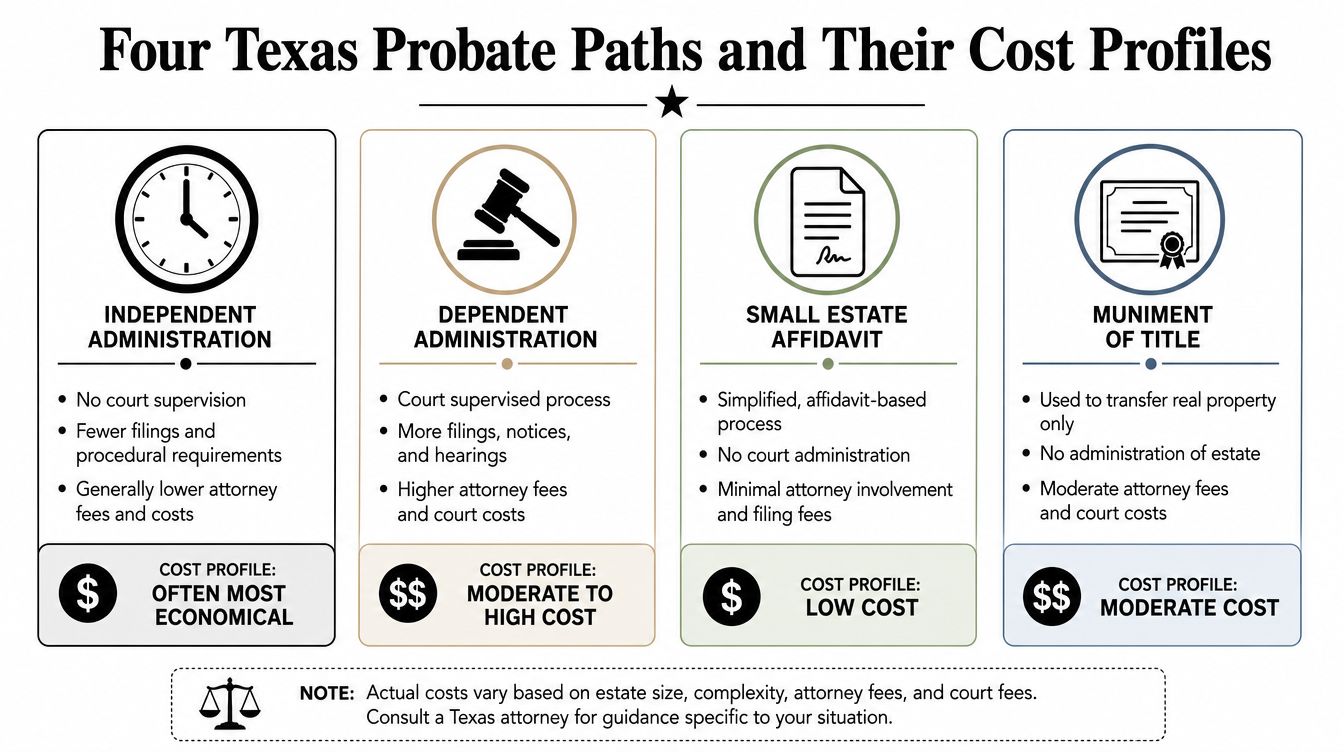
A Texas probate bill is not one fixed number. It changes with the path the estate can legally use, much like the route home changes when traffic, toll roads, or closures force a different road. The court process, the paperwork load, and the amount of supervision all affect what the family pays.
Independent administration
For a valid-will estate, independent administration is often the least expensive option. The will may waive bond and give the executor broader authority, which reduces court oversight and usually keeps attorney time lower. Routine independent administrations commonly land around $3,000 to $7,000 total.
That range fits many estates where the executor can gather assets, pay valid debts, and distribute what remains without repeated court approval. When the facts are straightforward, the file behaves more like a managed checklist than a courtroom fight.
Dependent administration
Dependent administration is more expensive because the court stays involved at nearly every step. The administrator usually needs approval for many actions, and each hearing, motion, and filing adds lawyer time.
Guides commonly place this route around $8,000 to $20,000+. That higher bill often makes sense only when disputes, debt problems, or family conflict mean the estate needs close supervision. In practical terms, the process works like a supervised lane at a busy intersection, slower, but sometimes necessary to keep everyone moving in the same direction.
Small Estate Affidavit
A Small Estate Affidavit is the low-cost option many families hope will fit, but it only works when the estate qualifies under Texas Estates Code §205.001. When it does fit, the total often lands around $300 to $2,000.
This path can be a good answer when the estate is modest and the paperwork is organized. It is also a reminder that the cheapest route is only available when the legal boxes are checked. If the estate misses even one requirement, the family may have to use a more formal process instead.
Muniment of Title
A Muniment of Title is a simplified probate method used when the estate has no debts, apart from what the law allows, and the main goal is transferring title, especially to real estate. It is commonly estimated at $1,500 to $4,000.
That route can work well when the family mainly needs to clear title and does not need a full administration. The key question is practical, can the estate use a shorter path without creating trouble later. If the answer is yes, the process can save time and reduce the bill.
The estate's facts decide the path, not the family's preference alone. A probate lawyer can compare the available procedures to the actual facts before the costs start to rise.
Three Real Texas Scenarios From Filing to Final Distribution
A probate bill makes more sense when it is tied to a real family situation. The total changes with three things that families often feel right away, whether everyone agrees, whether the property is easy to move into the right name, and whether someone pushes back during the case.
A Harris County home, a valid will, and two adult children
A parent dies with a paid-off home, a valid will, and two adult children who agree on the plan. The executor files for independent administration, gets the case moving, handles the inventory, and distributes the property without drama. In a clean matter like that, the total often lands in the $3,000 to $7,000 range (Texas probate cost breakdown).
This is the kind of case many families hope for. The work is still real, because papers must be filed, notices handled, and title transferred correctly, but the file does not get weighed down by fights or court supervision.
A Hill Country ranch with no meaningful disputes
Three siblings inherit a ranch, nobody is fighting, and the only goal is getting title transferred. If the estate qualifies, a Muniment of Title can keep the process more direct and less expensive, often in the $1,500 to $4,000 band (Texas probate cost breakdown). That shorter route is especially useful when the family wants to move the land without a full administration.
The reason the cost stays lower is simple. The court is asked to do less, so the estate usually spends less on ongoing administration, hearings, and extra paperwork. Families sometimes hear that phrase and expect a shortcut with no rules, but the legal requirements still have to fit the facts.
A contested Dallas County estate
Now change the facts. A will is challenged, one asset is missing from the inventory, and a creditor claims money from the estate. That kind of conflict pushes the case toward dependent administration, and once hearings, discovery, and court supervision enter the file, the total can move well past $15,000 and sometimes higher (Texas probate pricing guide, Texas probate costs guide).
That higher total is not from one single fee. It comes from many layers of work, more lawyer time, more court involvement, more back-and-forth, and more room for delay while the dispute gets sorted out.
Cost lesson: the lawsuit inside the probate usually costs more than the paperwork around it.
The Texas Estates Code sections tied to administration, creditor claims, and title transfer matter here, but the practical point is easier to see. Agreement keeps costs down. Conflict makes them rise.
How Attorneys and Executors Get Paid in Texas
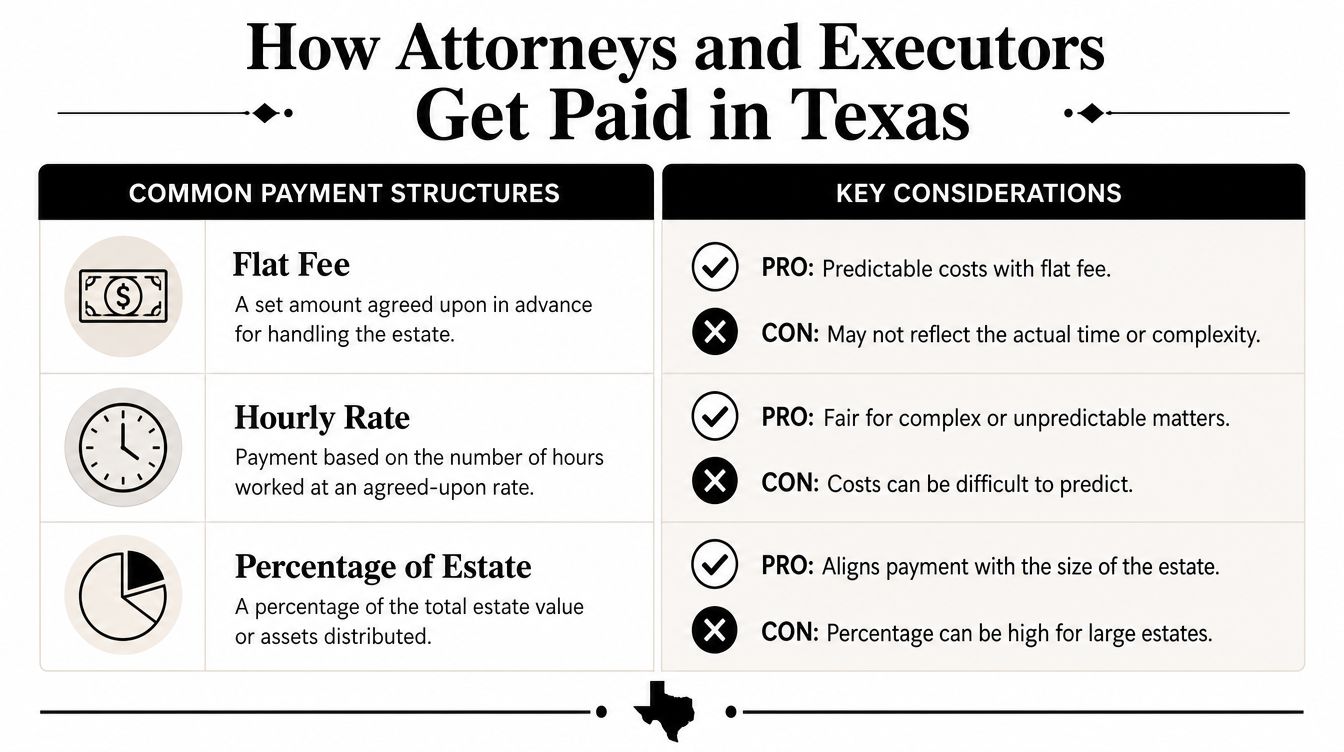
Jacksonville forensic audit cost insights help explain a simple truth. Professional fees tend to rise when the work requires more tracing, review, and documentation. Probate works the same way. A small estate with clear records usually takes less attorney time than a file with missing paperwork, creditor issues, or disputed instructions.
Common payment structures
| Structure | What it usually means | Cost feel |
|---|---|---|
| Flat fee | One set amount for a routine, uncontested administration | Predictable |
| Hourly rate | The lawyer bills for time spent on hearings, calls, drafting, and negotiations | Flexible, but less certain |
| Percentage of estate | Less common in Texas probate practice, but sometimes discussed in special arrangements | Can feel expensive on larger estates |
For routine probate work, families often hear that attorney costs in Texas may fall in the $2,500 to $5,000 range (Texas probate guide). More involved matters are often billed by the hour, and the rate can vary with the complexity of the case. Texas has no statewide mandatory attorney fee schedule, so the fee must be reasonable, clearly explained, and tied to the work being done (Texas probate pricing guide, Texas probate costs guide).
Executor compensation is separate from attorney fees. That difference matters because families sometimes assume the lawyer and the executor are paid under the same rule. They are not. One role is legal representation, while the other handles the estate's day-to-day administration.
For a fuller discussion of billing questions, probate attorney fees in Texas is a useful place to begin. If you are choosing counsel, ask for the fee structure in writing, ask which tasks are included, and ask what work triggers extra charges.
Practical Ways Texas Families Can Lower Probate Costs
The cheapest probate is usually the one that begins with clean records. Families cut costs by reducing the lawyer's cleanup work, because every missing deed, unclear account, or unanswered question adds time to the file.
Start with the documents that matter
Before you hire anyone, gather the will, death certificate, recent account statements, deeds, and a plain list of assets and debts. A lawyer who can see the full picture early spends less time chasing details and more time moving the case forward. That usually keeps the bill lower, because fewer follow-up calls and draft revisions are needed.
Use the shortest lawful path
If the estate qualifies, a Small Estate Affidavit or Muniment of Title can keep the total below the cost of a full administration. A family with a simple home transfer and little or no debt does not need the same court process as a disputed estate with several accounts and multiple heirs. For families planning ahead, how to avoid probate in Texas explains ways to structure property so less of it has to pass through court later.
Reduce the work before the filing starts
Handle small debts early, cancel subscriptions, and identify every known asset before the first petition goes in. That prevents extra creditor research and avoids the kind of paperwork scramble that raises fees. If the will and the court allow bond to be waived, that can also remove a cost that serves no practical purpose in some cases. When an estate includes several parcels or accounts, a clear asset list helps the lawyer avoid spending time tracking down missing records.
Keep family communication steady
Clear communication with heirs can stop suspicion before it turns into a fight. Mediation usually costs less than motion practice, especially when siblings disagree over one item of property or one distribution choice. If a disagreement has already hardened, the matter can move into probate litigation, and the focus shifts from saving money to protecting the estate and keeping the process orderly.
Families often save the most by choosing the right path at the start. A simple, well-documented estate may fit a shorter procedure, while a more complicated one needs a plan that anticipates creditor issues, heir questions, and court involvement. That is why early guidance matters. It helps the family match the case to the process instead of paying for a heavier process than the estate needs.
For families thinking about planning beyond the probate case, the firm also handles Wills & Trusts and Guardianship. Good planning now can leave your family with fewer court steps, fewer surprises, and less to sort out later.
Key Takeaways on Texas Probate Costs
A Texas family can see very different probate bills depending on the path the estate takes. A Small Estate Affidavit often falls around $300 to $2,000, a Muniment of Title usually lands around $1,500 to $4,000, a routine independent administration commonly totals $3,000 to $7,000, and a contested or dependent case can move beyond $10,000.
The size of the bill usually turns on court involvement, the amount of lawyer time, and whether anyone objects along the way. A simple case is a bit like a short checkout line, it moves with fewer stops and fewer added charges. A disputed case is more like a line that keeps getting sent back for another review, and each extra step adds work. A clearer walk-through of those paths is available on the firm's Texas Probate Process page.
The most useful time to control cost is before the first filing goes in. Once a case starts, changing course gets harder and the bill usually reflects that. The goal is to avoid surprise bills, unnecessary conflict, and avoidable delays.
Frequently Asked Questions About Texas Probate Costs
Why do probate costs vary so much by county? Court practices, filing fees, and scheduling speed can differ from one county to another, and those differences affect attorney time. Texas probate is also shaped by the estate's complexity, which means two cases in different counties can cost very differently even when the assets look similar.
Can an out-of-state executor lower travel costs? Yes, by using local counsel, organizing documents digitally, and limiting unnecessary court appearances when the procedure allows it. If the estate starts to involve disputes, a probate litigation lawyer can help reduce wasted travel and duplication.
Can Medicaid estate recovery affect probate expenses? It can add pressure to the administration because the estate may need to address repayment issues before closing. That doesn't automatically make the case expensive, but it can create extra legal work and delay final distribution.
How long should tax clearance take before final distribution? It varies with the estate's tax situation and whether the final return is simple or complicated. When tax issues are tied to broader asset or debt problems, the administration may need more time before anything is safely distributed.
If you're sorting out a loved one's estate, the next step is to get a clear estimate tied to your actual facts, not a generic range. The Law Office of Bryan Fagan, PLLC helps Texas families with probate, estate administration, and related planning so they can move forward with fewer surprises and a clearer path. Visit Law Office of Bryan Fagan, PLLC to talk through your situation and get practical guidance before you sign anything.


