 Skip to content
Straightforward uncontested Texas probate usually takes 6 to 12 months. If the estate qualifies for a faster route, a Small Estate Affidavit can finish in under a month, a Muniment of Title often ends in 1 to 3 months, and dependent administration can stretch to 1 to 3+ years.
When a family sits down after a loss, that timeline question comes with a second worry, what do we do right now. Bank accounts are frozen, bills keep arriving, and someone has to figure out whether the will can even be filed. In Texas, the answer depends less on grief and more on procedure.
A Houston family may have the same first thought as a ranch family in Kerr County or a condo family in Dallas. They want to know if probate is going to take weeks, months, or years, and whether they can still start at all. The honest answer is that how long does probate take in Texas complete timeline depends on the probate path, the assets involved, and whether everyone is cooperating.
The First Question Every Texas Family Asks After a Loss
A week or two after a father dies, the kitchen table often turns into a paper trail. There's a will, a mortgage statement, two bank letters, maybe a car title, and one exhausted adult child asking when the family can access anything. That first question is rarely really about law, it's about survival.
Probate feels urgent because life doesn't pause for grief. The house payment still comes due, insurance needs to be renewed, and someone has to keep up with the mail. For many families, the immediate concern is whether the estate needs a court case at all, or whether one of Texas's simpler probate paths can solve the problem faster.
Practical rule: the timeline usually starts with the paperwork, not the funeral. If the records are organized early, the process tends to move with fewer stops and fewer surprises.
The hard part is that Texas doesn't give one universal clock for every estate. A simple, uncontested estate and a contested one can look nothing alike by the time they reach court. The right answer comes from the facts, who died, what they owned, whether there was a valid will, and whether the heirs agree on the next step.
That's why families need a decision-tree approach instead of a single headline number. Some estates can move through a simplified process. Others need formal court oversight, creditor notice, and extra hearings before anyone can distribute property.
What Probate Actually Does in Texas
Think of probate as a court-supervised checklist. The court is not there to make grief harder, it's there to make sure the right person has authority, the will is valid, debts are handled, and the remaining property goes to the right people. That structure is built into Texas probate law, especially the rules in Titles 2 and 3 of the Texas Estates Code, which govern wills, administrations, and estate procedures.
At a basic level, probate does four things. First, it confirms whether the will is legally effective. Second, it appoints an executor or administrator, the person who gets authority to act for the estate. Third, it gives creditors a chance to make claims and lets the estate pay valid debts. Fourth, it transfers what's left to heirs or beneficiaries.

A will doesn't automatically avoid probate. In most Texas estates, the will still has to be filed and recognized by a court before the executor can legally act. That's why a family can have a clear written plan and still need a probate case.
The path matters from the start. Independent administration usually means less court supervision after the executor is appointed. Dependent administration means the court stays involved at nearly every major step. Muniment of Title is a route for some estates with a valid will and no need for a full administration. Small Estate Affidavit is another shortcut for simple situations.
The practical value of understanding those differences is huge. A family that picks the wrong path can add months of delay before they ever get to distribution. A family that picks the right one can keep the process focused and manageable. The Texas Probate Lawyer service reflects that kind of representation through Texas probate and estate administration.
Every Texas Probate Path and Its Typical Timeline
The fastest route is not always the right route, but the right route almost always saves time. That's why the timeline question starts with classification. Is there a will? Are there debts? Is there real property? Do the heirs agree? Those facts usually point to the proper procedure.
Comparing the main pathways
| Probate Type | Best For | Typical Timeline |
|---|---|---|
| Independent Administration | Uncontested estates with a valid will or agreed heirs | 6 to 12 months |
| Dependent Administration | Disputes, creditor issues, or court-supervised estates | 18 months to 3+ years |
| Muniment of Title | Estates with a valid will and no need for full administration | 1 to 3 months |
| Small Estate Affidavit | Very simple estates that qualify under Texas procedure | Under a month |
| Summary Proceedings | Certain small estates handled through streamlined court steps | Fast, but fact-specific |
Independent administration is the route many Texas families hope for because it usually keeps the court's role limited after appointment. It's common when the will names an executor and the family isn't fighting. That's why many uncontested estates close in the 6 to 12 month range.
Dependent administration is slower because the court must approve more of the process. Each major action can require a filing or hearing, which is why the timeline often stretches into 18 months to 3+ years. It's the route that most often surprises families who expected the court to move faster.
Muniment of Title is often used when the will is valid and the estate doesn't need a full administration. It can be much faster because the court's job is narrower. Small Estate Affidavit is faster still in simple qualifying cases, which is why some families finish in under a month.
A Texas probate attorney often helps families sort through these options before the first filing goes in. That early choice matters because it shapes everything that follows, including how many hearings, notices, and approvals the estate needs.
A Stage-By-Stage Walk Through Independent Administration
Independent administration is the path many families picture when they ask about a normal Texas probate. It still takes work, but it avoids the constant court check-ins that slow other cases down. In a clean case, the executor can often move the estate forward with much less friction.
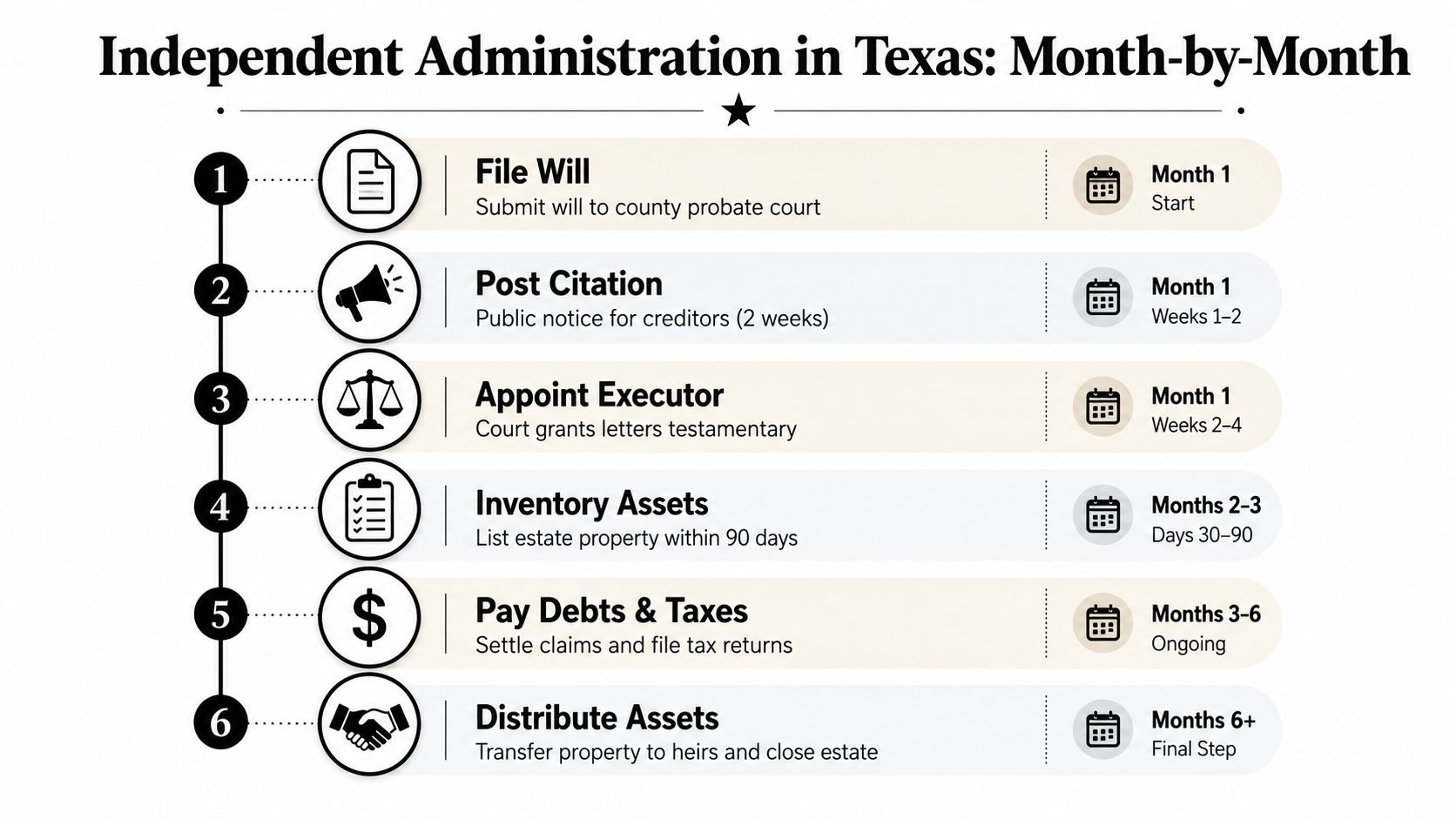
Month 1, filing and notice
The process begins by filing the will and application in the proper county court. The court then posts citation, which is public notice that probate has been opened. Texas practice includes a waiting period before the hearing, and families often hear this described as about two weeks.
At that stage, no one can just step in and act for the estate. The court must first decide who has authority. That's where the hearing comes in, and it's where the executor receives Letters Testamentary, the document that gives legal power to manage the estate.
Months 2 to 3, authority and creditor notice
Once letters are issued, the executor can begin collecting information and dealing with the estate. Creditors have a notice period, and the executor must treat that seriously because debt handling is part of probate, not a side issue. This is also when the executor starts gathering account statements, deeds, titles, and insurance information.
The executor's authority starts on paper, then becomes real only when institutions accept those letters.
Months 4 to 6, inventory and valuation
Texas law expects the executor to prepare an inventory and appraisal of estate assets within 90 days of Letters Testamentary. That means the estate has to be identified, organized, and valued early. If the decedent owned a home, vehicles, or investment accounts, this is the stage where those assets get documented.
Months 7 to 12, debts, taxes, and distribution
After the inventory, the executor works through debts, taxes if any are due, and any sale or transfer needed to carry out the will. The final accounting and distribution come last, once the executor can show the estate has been handled properly. If the file is clean and the heirs cooperate, this stage is where an independent case often closes.
You can see the same route in a practical overview at https://txprobatelawyer.net/independent-administration-texas/. For a visual sense of the workflow, this video also walks through the process:
Filing Deadlines and the Factors That Slow Texas Probate Down
Families often hear the date range first and miss the deadlines underneath it. That's where confusion starts. There's a difference between the date the court case can begin, the date the executor can act, and the date the estate can finally close.
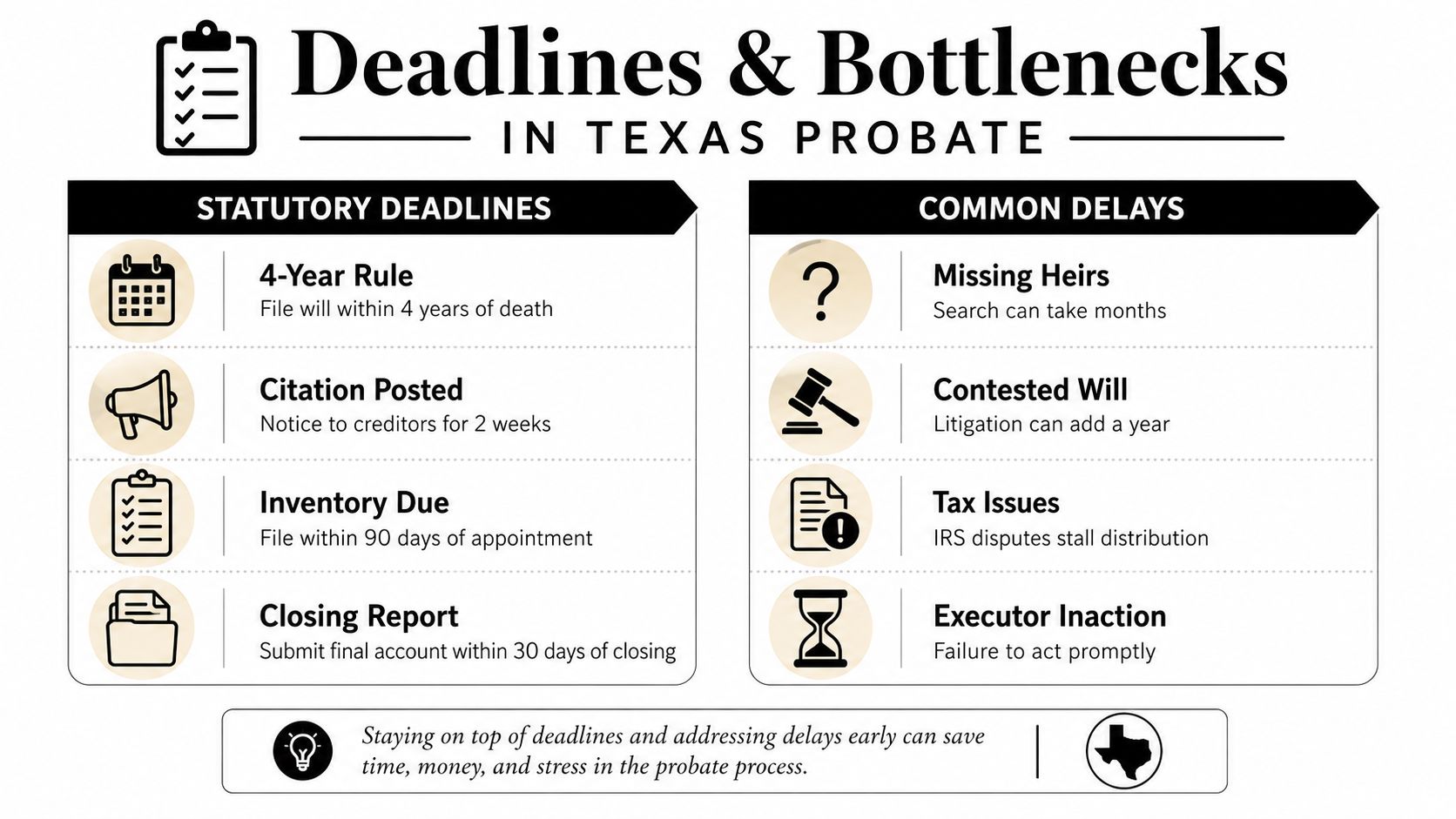
The biggest deadline many families overlook is the 4-year period to file a will for probate under Texas Estates Code §256.003. The Texas State Law Library explains that after that period, property may be treated as if there were no will. That can change the entire path of an estate, so families shouldn't wait too long just because they're still deciding what to do.
The other common friction points are procedural and practical. Creditors have a notice window, and the inventory deadline keeps the executor moving. If the estate owns real property, the transfer process can require extra steps. If an heir can't be found, the case slows while notice and service issues get sorted out. And if the will is contested, the case can turn into litigation, which changes the timeline dramatically.
Hard rule: filing deadlines and court authority are not the same thing. A family can be within the filing window and still face a long administration if the estate is messy, disputed, or heavily documented.
This is also where the court-filing timeline and the full estate-closing timeline diverge. A family may get the will admitted relatively quickly, then spend months paying claims, clearing title, and handling transfer documents. That's why the phrase how long does probate take in Texas complete timeline only makes sense when you separate the first court step from the finish line.
If a deadline has already been missed or the family is close to missing one, the legal issue shifts from planning to damage control. The overview at https://txprobatelawyer.net/what-happens-if-you-miss-a-probate-deadline-in-texas/ is a useful reference point for that situation.
An Executor's Practical Checklist for Faster Administration
The fastest probate cases usually aren't lucky, they're organized. An executor who starts with a clear file, clear communication, and the right probate method can keep the estate moving without avoidable pauses. That matters because every missing record becomes another phone call, another follow-up, and another delay.
The first week matters most
- Gather the original will and death certificate: The court and financial institutions both need clean documents before anyone can act.
- Secure the property: Change nothing unnecessary, but make sure the home, vehicles, mail, and insurance are protected.
- Find every account statement: Bank accounts, retirement accounts, and investment records help map the estate quickly.
- Open an estate account: Keep estate money separate from personal funds so the paper trail stays clean.
- Tell heirs what's happening: Early communication prevents suspicion and reduces conflict later.
Keep the case from stalling
- Use the right probate path up front: Independent administration, muniment of title, or a small estate process can save time if the facts fit.
- Work from one document system: A single checklist keeps the lawyer, executor, and heirs from duplicating work.
- Move on appraisals early if needed: Delays often start when nobody can agree on the value of property.
- Avoid informal sales or transfers: Those shortcuts can create title problems later.
- Ask for legal review before filing: A rejected filing usually costs more time than a careful first draft.
A good example of this “organize first, delay less” approach shows up outside probate too. Families sorting through an estate that includes inherited precious metals often need a second set of records for tax and basis questions, and the 2026 gold tax guide is a reminder that asset documentation matters long after the initial sale or transfer.
For a detailed paper trail, the estate checklist at https://txprobatelawyer.net/estate-administration-checklist/ can help an executor keep the file in order. That's exactly where careful administration saves time, because the estate doesn't bog down when every document has a place.
A Realistic Texas Probate Scenario From Start to Finish
Mrs. Castillo in San Antonio had the kind of estate that gives families hope. Her husband left a valid will naming her as independent executrix, and the estate included a house, two cars, three bank accounts, and modest investments. The only debt was a small mortgage, and the children agreed with the plan.
She didn't wait long. The will was filed in Bexar County within three weeks, and the hearing moved forward in the ordinary course. By roughly two months, she had Letters Testamentary, which let her start dealing directly with the banks and other institutions.
The estate stayed on track because the facts were clean. By month four, she had the inventory ready. By month seven, the mortgage and creditor claims were settled. The house took longer because real property often needs its own paperwork and sale process, so that step ran into month nine.
By month eleven, the remaining property was ready for final distribution to the children. That's a very ordinary Texas result for a simple, uncontested estate, and it shows how the 6 to 12 month range plays out in real life. No one rushed the system, but no one had to fight it either.
A case like this also shows why families should ask two questions instead of one. They shouldn't just ask how long the probate will take. They should also ask whether the estate qualifies for a faster route, or whether the facts point to a longer administration from the start.
Key Takeaways and When to Call a Texas Probate Attorney
The method chosen matters more than almost anything else. Small Estate Affidavits and Muniment of Title can finish in weeks to a few months, a typical independent administration often runs 6 to 12 months, and dependent administration can stretch for years. The 4-year filing rule is a real deadline, not a suggestion, so families should not let uncertainty push them past it.
If there's a will, probate is still often needed. If an executor lives out of state, that doesn't automatically stop the case, but it does make organization and communication more important. If the estate includes real property, court involvement or title work is often part of the process even when the rest of the estate is simple.
If the family is arguing, the estate has debts, or the paperwork is incomplete, it's time to get help before the delay gets worse.
A lawyer is especially helpful when the family is unsure whether probate has to start, which probate path fits, or whether the filing deadline is getting close. That's the point where families usually stop guessing and start saving time.
If you're facing probate in Texas, our team can help guide you through every step, from filing to final distribution. Schedule your free consultation today.
If you're facing probate in Texas, the Law Office of Bryan Fagan, PLLC can help with the full estate process, from choosing the right probate path to preparing filings and moving the case toward distribution. Visit Law Office of Bryan Fagan, PLLC to schedule your free consultation and get clear guidance for your family's next step.


