 Skip to content
The mail often changes first.
A sympathy card sits beside a hospital statement. A credit card bill arrives in your loved one’s name. Then a collection letter shows up, and you realize being named executor means more than gathering family photos and planning a funeral. It also means handling debt, deadlines, and decisions that can feel uncomfortably technical while you’re still grieving.
That moment rattles a lot of families. It also creates a common fear: “Am I personally responsible for all of this?”
Usually, the answer is no. The estate may owe valid debts, but Texas probate law gives executors a structured process for dealing with them. You are not expected to guess. You are expected to follow the rules, document what you do, and protect the estate for the people who inherit from it.
When families search for unsecured creditor claims texas probate, they’re usually trying to answer a few urgent questions at once. Which bills matter? Which ones can wait? Which ones have to be challenged? And what happens if the executor lives outside Texas and is trying to manage everything from another state?
Those are practical questions, not abstract legal ones. Texas law has answers, especially in the Estates Code provisions that govern notice, claim handling, and payment priority.
An Executor's Duty When the Bills Arrive
Maria had just been appointed executor for her father’s estate. She expected to deal with the house, the car title, and the bank account. She did not expect the stack of envelopes on the dining room table: a medical invoice, two credit card statements, a utility shutoff warning, and a personal loan notice.
That’s a very ordinary probate problem.

If you’ve just stepped into this role, it helps to know that not every bill has the same legal status, and not every creditor gets paid just because they sent a statement. Texas probate requires a process. A creditor may need to present a claim properly. The estate may have defenses. Some assets may be protected. Some debts rank low in priority. You can read a general discussion of debt after death in Texas in this guide on what happens when someone dies with debt.
What your job actually is
As executor or administrator, your duty is not to pay bills as they arrive out of panic or courtesy. Your duty is to:
- Identify debts carefully: Separate recurring mail from actual estate liabilities.
- Protect estate property: Don’t distribute assets too early.
- Follow Texas probate procedure: Creditors have rights, but so does the estate.
- Keep records: Every notice, every response, every payment decision should be documented.
Practical rule: Treat every debt notice as something to investigate, not something to pay immediately.
That mindset protects heirs, and it protects you. Many executors assume that if a bill looks official, it must be valid and urgent. Sometimes it is. Sometimes it isn’t. Probate is where that gets sorted out.
Understanding Unsecured vs Secured Creditor Claims
The first distinction that matters is whether a debt is secured or unsecured. If you understand that one difference, the rest of the claim process becomes much easier to follow.
The easiest way to think about it
A secured debt is attached to a specific piece of property. The property stands behind the debt.
A mortgage is the classic example. The lender’s rights are tied to the house. A vehicle loan works the same way. If the debt isn’t handled, the creditor may have rights in that car or truck.
An unsecured debt is different. It isn’t backed by a particular asset. The creditor is not pointing to one house, one vehicle, or one account and saying, “That property secures our loan.” Instead, the creditor is asking to be paid from general estate funds.
Credit cards, medical bills, signature loans, and many ordinary service balances usually fall into that unsecured category.
Why that difference matters in probate
Texas law treats these debts differently because the creditor’s position is different.
A secured creditor starts with collateral. An unsecured creditor does not. That means the executor has to evaluate unsecured claims more carefully in the general probate process, because those claims compete for whatever money remains after higher-priority obligations are addressed.
This overview of secured creditor claims in Texas probate can help if you’re trying to sort mixed debts in the same estate.
Common examples families see
Here’s a plain-English comparison:
| Type of debt | Usually secured or unsecured | Why it matters |
|---|---|---|
| Home mortgage | Secured | Tied to the house |
| Car loan | Secured | Tied to the vehicle |
| Credit card balance | Unsecured | No specific collateral |
| Hospital bill | Unsecured | Paid, if valid, from estate funds |
| Personal signature loan | Unsecured | Depends on claim process and estate funds |
| Utility bill | Usually unsecured | General claim against the estate |
A realistic example
Suppose your brother dies owning a home with a mortgage, a pickup with a loan, and several credit card balances.
The mortgage company is in a different legal position from the credit card issuers. The lender on the home has rights tied to the house itself. The card companies do not. They are unsecured creditors.
That doesn’t mean unsecured debts disappear. It means they move through probate under different rules, and they do not automatically outrank the estate’s other obligations.
Some executors get confused because all debts feel equal emotionally. Texas law does not treat them as equal legally.
A word about modern debts
Executors now run into debts that don’t arrive in obvious paper statements. Online subscription services, app-based financing, buy-now-pay-later accounts, and digital wallet obligations may all be part of the estate picture. They still need to be categorized.
If the debt is not backed by specific collateral, it generally belongs in the unsecured bucket for probate analysis. The challenge is often finding it. Check email, auto-pay records, bank statements, phone app stores, and the decedent’s password manager if one exists. Digital debt is still debt, even when it doesn’t come in an envelope.
The Executor’s Power The 120-Day Notice Rule
One of the most useful tools available to an executor in an independent administration is the ability to force known unsecured creditors to act promptly.

Under Texas Estates Code § 308.054, executors in independent administrations may send permissive notice by certified mail to known unsecured creditors. Once the creditor receives that notice, the creditor has 120 days to present a properly authenticated claim, and practitioners often plan for 121 days from the date of notice to account for mailing nuances. If the creditor misses that deadline, the claim is permanently barred. Once a claim is filed, the personal representative has 30 days to approve or reject it, as explained in this discussion of Texas debt discovery and claim limitations.
Why this rule matters so much
Without that notice, unsecured claims can hang around far longer and complicate distributions. With proper notice, the executor creates a defined window for action.
That changes the conversation from “we might hear from someone later” to “creditors had their chance, and the deadline ran.”
For grieving families, that matters because probate often becomes stressful when uncertainty drags on. For executors, it matters because delay can create pressure from heirs who want distributions before the debt picture is clear.
A simple example
Assume you locate an old hospital bill and two major credit card accounts. You don’t want to distribute money to beneficiaries and then learn months later that one of those creditors is demanding payment.
If your administration is independent, you may be able to send permissive notice by certified mail to those known unsecured creditors. If one of them ignores the notice and fails to present a proper claim within the statutory period, the estate may no longer have to deal with that claim.
Executor’s advantage: The notice rule lets you move from reactive debt management to a scheduled process.
What you should do in practice
The rule sounds simple, but execution matters. An executor should work carefully on:
- Identifying known unsecured creditors: Review mail, email, statements, and credit reports if available.
- Using the right delivery method: The statute allows permissive notice by certified mail.
- Keeping proof: Save mailing records, delivery confirmation, and copies of the notice.
- Tracking response dates: Put the deadlines on a calendar the day notice goes out.
Out-of-state executors often underestimate the paperwork side of this. If you live in Colorado, Florida, or overseas and the estate is in Texas, you still need a clean record showing what was sent and when it was received.
A short explanation of the process can help before you review claim forms and deadlines:
What happens after a claim comes in
Once a creditor presents a claim, the personal representative has a legal duty to decide whether to approve or reject it within the statutory period noted above. That means you cannot ignore a properly presented claim and hope it disappears.
You and your attorney may ask questions such as:
- Is the debt that of the decedent?
- Is the amount accurate?
- Was the claim presented in the required form?
- Has the debt already been paid or partially credited?
- Is the creditor trying to collect something outside the estate process?
Those are legal and factual questions. They deserve a calm, methodical answer, not a rushed one.
How Different Types of Probate Affect Creditor Claims
The way unsecured claims work depends heavily on the type of probate proceeding. Families often think “probate is probate,” but Texas has several pathways, and creditor treatment changes with the path you’re on.
Independent administration
This is often the most practical route when it’s available. The executor acts with less day-to-day court supervision, which usually makes administration more efficient.
Executors in independent administrations have the strategic option to send permissive written notice to unsecured creditors, creating a firm claim deadline. According to this discussion of the probate process unfriendly for creditors, using that tool can accelerate estate closure by 30-50% on average compared to dependent administrations.
That doesn’t mean independent administration is casual. It means the executor has room to act, provided the executor follows the Estates Code carefully.
Dependent administration
Dependent administration involves closer court oversight. That can be useful in estates with conflict, uncertainty, or serious management concerns.
For creditor issues, that extra supervision also means more formality. Claim handling is usually less flexible and more court-centered. An executor in dependent administration should expect a more rigid process for review, approval, and dispute resolution.
If the family is already fighting, or if someone is accusing the personal representative of mishandling debt, the court’s closer involvement can protect the process. It can also slow it down.
More supervision can reduce some risks, but it usually increases the number of procedural steps.
Muniment of title
Muniment of title is an efficient probate option, but it has a strict practical limit that matters here. It generally isn’t the right tool if unsecured debts are piling up.
Families sometimes ask for the fastest route because all they want is to transfer a house. But if there are meaningful unsecured obligations, muniment may not fit the estate’s reality. An attorney should evaluate that early, before the wrong filing creates trouble.
Small estate affidavit
A small estate affidavit can be helpful in the right case, but it is not a magic shield against debt.
If heirs receive estate property through a simplified process, valid debts may still matter. That’s one reason families shouldn’t treat simplified probate as “debt-free probate.” The paperwork may be lighter, but the legal analysis still matters.
A side-by-side look
| Probate path | Court supervision | Creditor handling impact |
|---|---|---|
| Independent administration | Lower | Executor may use permissive notice to control unsecured claims |
| Dependent administration | Higher | More formal claims process and closer court involvement |
| Muniment of title | Limited | Usually not suitable where unsecured debt is a real issue |
| Small estate affidavit | Simplified | Debts still require careful review before assets are treated as free and clear |
A realistic decision problem
Suppose your aunt died owning a homestead, one checking account, and several medical and credit card balances. Her children want the quickest probate option possible. One beneficiary lives in Texas. Another lives out of state and wants everything handled remotely.
The right answer depends on more than convenience. If unsecured claims need active management, an independent administration may give the executor stronger tools than a less complex procedure that assumes debt won’t be a problem.
That’s why probate choice and creditor strategy should be discussed together. They are not separate decisions.
For families already dealing with vulnerable relatives or estate-related incapacity issues, the broader legal picture can overlap with guardianship matters in Texas, especially when finances and authority are already disputed before death.
The Priority Ladder Who Gets Paid from the Estate
When an estate doesn’t have enough cash to pay every bill, Texas law decides who stands first in line. Many families feel relief, because the law does not put ordinary unsecured debt at the front.
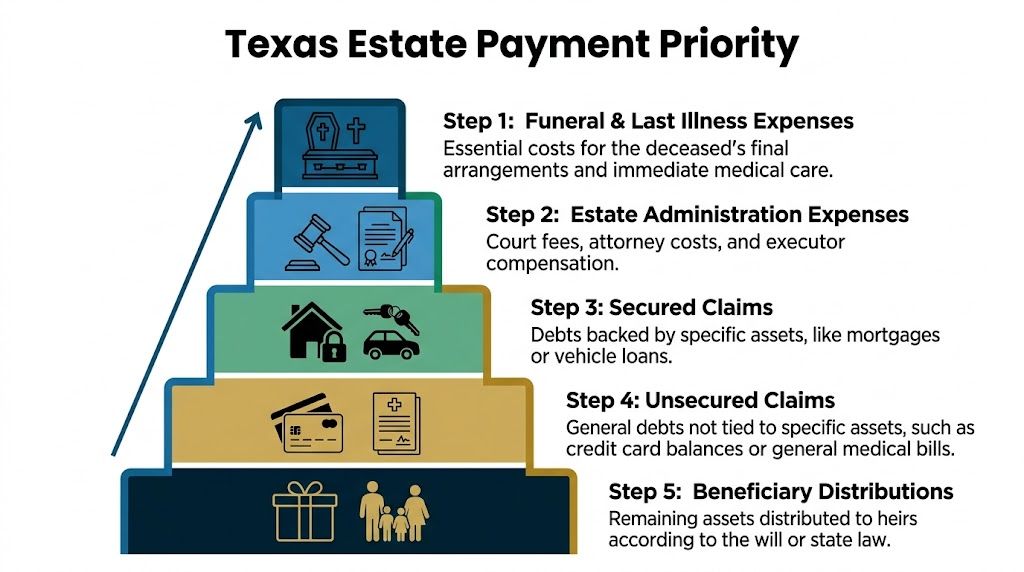
The estate does not pay everyone equally
Under Texas Estates Code § 355, unsecured debts like credit cards and medical bills are Class 8 claims. That places them at the bottom of the payment hierarchy, after higher priority classes such as funeral expenses, administration costs, secured claims, and exempt family protections, as described in this overview of running out of money in the estate.
For families, that has a practical meaning. A credit card company is not automatically entitled to be paid before the costs of administering the estate or before protected family interests are addressed.
The ladder in plain English
Think of estate payment as a ladder. The estate climbs from the top rung downward.
- Higher rungs first: Funeral costs and administration expenses are addressed before lower claims.
- Protected interests matter: Family protections and exempt assets can limit what unsecured creditors can reach.
- Secured debt has its own footing: A lender with collateral is different from a general creditor.
- Unsecured claims sit low: They are paid only if there is money left after higher obligations are handled.
The law is designed to settle the estate in an orderly way, not to let the loudest creditor grab funds first.
A practical example
Suppose an estate has a house, some exempt property, a vehicle loan, legal fees connected to probate, funeral costs, and several credit card balances.
An executor should not look at the pile of debt and assume all bills should be paid proportionally. The estate must respect the statutory ranking. If money runs short before the estate reaches lower-priority unsecured claims, those claims may receive only limited payment or none at all.
That’s often the part families don’t hear from creditors. A collection department may write as though full payment is expected immediately. Probate law may say otherwise.
Why this protects families
This hierarchy reflects a policy choice. Texas gives priority to the basic costs of burial, administration, and protected family interests before it pays general unsecured creditors.
That doesn’t excuse an executor from diligence. It does mean the executor should make decisions based on the Estates Code, not pressure from billing departments.
A Practical Guide for Managing Unsecured Claims
Most executors need a checklist more than a lecture. If you’re handling unsecured creditor claims in a Texas probate estate, a steady process usually works better than trying to solve each bill as it appears.

Start with collection, not payment
Before you send money to anyone, gather information.
- Collect the paper trail. Open mail, sort statements, pull bank records, and review email for billing notices.
- Look for auto-pay activity. Streaming services, cloud storage, subscription apps, online lenders, and phone-based financing can continue charging after death.
- Create a debt log. Use a spreadsheet or a notebook. List creditor name, account number, amount claimed, date received, and whether the debt appears secured or unsecured.
This early organization helps you see whether you’re dealing with one old hospital bill or a larger pattern of unsecured debt.
Verify what is real
Some claims are legitimate. Some are outdated. Some are missing support. Some are sent before the creditor has properly presented anything in probate.
Reviewing a claim means asking for substance, not just reading the balance due.
- Check identity: Is the debt in the decedent’s name?
- Review statements: Does the claimed balance match the available records?
- Watch for duplicate billing: Medical and collection accounts sometimes overlap.
- Confirm status: A creditor letter is not always the same thing as a properly presented probate claim.
If you need to understand the creditor’s side of that process, this guide on how to file a probate claim in Texas is useful background.
Handle deadlines and responses deliberately
Once a proper unsecured claim arrives, don’t let it sit in a pile. A timely response matters.
Create a simple workflow:
| Task | What to do |
|---|---|
| Log the claim | Record when it arrived and from whom |
| Save proof | Keep envelopes, emails, attachments, and account records |
| Review support | Compare the claim to estate documents |
| Get legal advice if needed | Especially if the amount seems wrong or the estate may be insolvent |
| Approve or reject properly | Follow the probate procedure, not informal email shortcuts |
Keep one file, digital or paper, for each creditor. If a dispute later lands in court, your file becomes your memory.
Special issues for out-of-state executors
Remote administration adds friction, but it’s manageable.
If you live outside Texas, pay close attention to:
- Certified mail logistics: Don’t substitute ordinary mail because it’s easier.
- Court filing procedures: Your county may require specific filing methods and formatting.
- Time zone and travel issues: Build extra time into responses and hearing preparation.
- Local property issues: A Texas house, vehicle, or storage unit may require local help even if the executor lives elsewhere.
Remote executors should also be careful with signatures, mailing records, and document retention. Scanned copies are helpful, but keep originals when the original matters.
Digital debt deserves a separate review
Modern estates often include obligations that family members don’t know about until they start checking devices and statements.
Search for:
- Subscription charges: Streaming, software, storage, news, and membership accounts
- Fintech balances: App-based lending, installment plans, digital wallets
- Online business tools: Website hosting, payment processors, ad accounts
- Crypto-related issues: Exchange fees, account access problems, or loans tied to digital holdings
These items can affect both cash flow and notice strategy. They may not look like traditional probate debt, but they can still create unsecured claims or administration complications.
In practice, many executors use a combination of a probate attorney, a CPA, and organized digital recordkeeping. One available option for legal guidance is the Law Office of Bryan Fagan, PLLC probate services, which handles estate administration and creditor-related probate issues in Texas.
Key Insights on Texas Creditor Claims
If you feel overloaded, keep these points in front of you while you work through the estate.
Takeaway
- Not every bill should be paid immediately. An executor’s job is to review and verify, not react emotionally to the first demand letter.
- Secured and unsecured debts are not treated the same. That distinction drives strategy from the start.
- Unsecured claims are low priority under Texas law. That matters most when estate funds are limited.
- The executor can challenge weak claims. If a debt is inflated, unsupported, or improperly presented, you may have grounds to reject it.
- Good records protect everyone. Keep copies of notices, mailing receipts, account statements, and every written response.
- Remote administration requires more discipline. Out-of-state executors should be especially careful with certified mail, filing proof, and deadline tracking.
- Digital debts can’t be ignored. Subscription platforms, online lenders, and app-based accounts may be easy to miss and costly to overlook.
Passive executors create avoidable problems. Careful executors preserve assets and reduce conflict.
A grieving family often feels pressure to “clear all debts” before doing anything else. That instinct is understandable, but it can be legally wrong. A better approach is measured: identify, categorize, verify, and respond according to the Estates Code.
If a creditor pushes hard, that doesn’t necessarily mean the creditor is right. It may only mean the creditor wants to be paid before the estate has finished its legal review.
When to Consult a Probate Attorney
Some estates are manageable with organized paperwork and a straightforward plan. Others cross into legal risk quickly.
You should strongly consider speaking with a probate attorney if the estate may be insolvent, if a claim looks inflated or suspicious, if a creditor threatens suit, or if heirs are fighting over whether a debt should be paid at all. Those situations involve more than administrative cleanup. They involve judgment, procedure, and risk management.
Signs you should not handle alone
A few common red flags stand out:
- The estate may not have enough money: Payment priority becomes critical.
- A creditor’s paperwork is weak: You need to know whether the claim is defective or just incomplete.
- You live outside Texas: Remote compliance mistakes can cause delay and confusion.
- The estate includes a business, digital assets, or disputed records: Informal handling often breaks down fast.
- A beneficiary is pressuring you to distribute assets early: That can expose you to later problems if valid claims remain.
Why legal help matters
An attorney doesn’t just answer questions. A probate lawyer can help you decide whether notice should be sent, review presentment issues, respond to claims properly, and defend the estate if litigation starts.
That protects three different groups at once. It protects the estate, the beneficiaries, and you as the personal representative.
Families often think hiring counsel means the case has become hostile. Usually, it means the executor is taking the role seriously. That is exactly what Texas probate expects.
You may also need related guidance if the estate plan itself is unclear. Questions about Wills & Trusts in Texas or active probate litigation in Texas often overlap with creditor disputes.
If you’re facing probate in Texas, our team can help guide you through every step, from filing to final distribution. Schedule your free consultation today.
If you need clear guidance on unsecured creditor claims, executor duties, probate timelines, or estate disputes, contact the Law Office of Bryan Fagan, PLLC. We help Texas families and personal representatives understand their options, respond to creditor issues, and move probate forward with confidence and care.


