 Skip to content
You've just lost someone you love, and the paperwork is probably the last thing you want to think about. Still, the courthouse doesn't wait for grief to get lighter. If your family is trying to figure out who can pay bills, transfer the house, or collect bank accounts in Texas, the first question isn't which form to fill out. It's which probate path fits the estate.
That choice matters because Texas probate isn't one process. It's a set of routes, and the route you choose affects the timeline, the court's level of supervision, and how much paperwork you'll carry from start to finish. For many families, the work begins with a simple but important decision, whether the estate can move through a lighter process or needs full court administration. A good starting point is understanding when probate is required in Texas, especially before anyone files at the courthouse, which is why many families first read a guide like when is probate required in Texas.
When a Texas Family Has to Face Probate
A Houston daughter may be sitting at her mother's kitchen table with a folder of bills, a copy of the will, and a deed to a small ranch outside Fredericksburg. Her first instinct is often to ask, “Can we just sign something and move on?” Sometimes the answer is yes, but often Texas law still requires court involvement so the family can validate the will, name a legal representative, settle debts, and pass property to the right people.
That's the purpose of probate. It gives the court a way to confirm who died, whether there was a valid will, and who should have authority to act for the estate. Texas probate law is built around those tasks, and the Texas State Law Library explains that probate is the legal process used to distribute a person's property after death, with court approval validating the will, paying debts, and passing the rest to heirs when there is no will or when property still needs court handling. The basic framework comes from the Texas Estates Code, especially the parts dealing with wills, administration, intestacy, and guardianship.
Why the first decision matters
The first real decision is not about forms. It's about path selection. A family that can use a simpler route may avoid months of extra reporting, while a contested or debt-heavy estate may need closer court supervision.
Practical rule: before you file anything, ask whether the estate can move through a simplified Texas probate path or whether it needs a full administration.
That question affects everything that comes next, including whether the court issues Letters Testamentary, whether an inventory is required, and how quickly the family can deal with property. If the wrong path is chosen, the case can stall before authority is ever granted. If the right path is chosen early, the family can move with less stress and fewer surprises.
What You Need Before You File Anything
A family usually reaches the courthouse after the hard part has already started, so the first job is to gather the facts in one place. Texas probate works better when the file is organized before the application goes in. That means the original will, not a photocopy, a copy of the death certificate, names and addresses of heirs, a rough list of assets, and a basic sense of whether anyone is likely to disagree about who should serve as personal representative. A decedent is the person who died, a testator is the person who made the will, and a beneficiary is someone named to receive property. Those words sound formal, but the court uses them because it needs to know exactly who is involved.
The probate application also needs a picture of what the person owned at death. That can include a house, mineral interests, bank accounts, vehicles, or personal property, but the point is not to value every item perfectly on day one. The point is to give the court enough information to decide whether probate is needed and which probate path fits the estate. Texas probate guidance says the application should identify the decedent, whether there was a will, the decedent's domicile at death, the property owned at death and its approximate value, the family relationships and heirs, the proposed personal representative, and why an administration is needed, because those facts tell the court whether probate is necessary and who should manage the estate.
Family agreement changes the path
Heirs often ask whether everyone has to agree. The answer depends on the probate path. If the family can agree on a representative, independent administration may be available. If they cannot agree, the court may need to keep closer control.
That choice affects how much paper the family needs before filing. It also shapes whether the court can move with less supervision or whether every major step will need court approval. Families who sort out that question early usually avoid filing the wrong kind of application.
If there is no will at all, the family may need to look at how Texas law distributes property when there is no will. For a plain-English overview, many readers also find the guide on Dying Without a Will in Texas: Intestate Succession helpful because it explains how Texas law distributes an estate when there is no will.
A practical checklist should also include beneficiary designations on retirement accounts or life insurance, because those assets may pass outside probate. That is often where families get confused, because they see the account and assume the court must control it, but some property transfers by contract, not by probate. The goal at this stage is not to solve every issue. It is to gather the facts that tell you whether Texas probate is even the right lane, and whether the estate may fit a simpler filing process.
For forms and filing basics, many families also keep the Texas probate forms guide nearby while they assemble the paperwork.
Keep the original will somewhere the executor can find it. A safe place is useful only if the family knows where that place is.
Choosing the Right Probate Path in Texas
A family can have the right paperwork and still start in the wrong place. In Texas probate, the first decision is not which form to sign. It is which probate path fits the estate. That choice depends on whether there is a valid will, whether creditors need to be handled, whether the heirs agree, and whether the estate is small enough for a simplified filing. Once that path is chosen, the rest of the case becomes easier to understand.
The main routes are independent administration, dependent administration, muniment of title, and the small estate affidavit. TexasLawHelp explains that independent administration usually fits estates that can move with limited court supervision, while dependent administration keeps the court involved at each major stage. The simplified routes can work when the estate meets the legal requirements, and a muniment of title can be available when there is a valid will and no unpaid debts. For a fuller comparison of those two administration styles, families often review independent vs dependent administration, which is better in Texas.
Texas Probate Paths at a Glance
| Path | Best When | Typical Timeline | Court Supervision |
|---|---|---|---|
| Independent administration | A valid will or agreement supports a low-supervision process | Often begins with fast initial court approval, then paperwork continues after appointment | Limited after appointment |
| Dependent administration | Heirs cannot agree, or the court needs tighter control | Slower because more motions and approvals are needed | Ongoing court control |
| Muniment of title | There is a valid will and no unpaid debts | Can finish in as little as 30 days when the estate qualifies (first steps to take for probate in Texas) | Narrow, focused court order |
| Small estate affidavit | Intestate estate is $75,000 or less, excluding homestead and exempt property, and 30 days have passed since death (Texas LawHelp) | Often faster than formal administration | Minimal |
Independent administration is often the least burdensome formal route. TexasLawHelp says it generally requires notice to creditors and beneficiaries, plus a sworn inventory or an affidavit in lieu within 90 days. Dependent administration works differently because the court supervises more of the process, including accountings and bond requirements. That extra oversight can protect the estate, but it also adds work for the family.
Muniment of title is narrower. It is designed for a valid will, no unpaid debts, and a quicker way to clear title to property without appointing a full executor. A small estate affidavit is different again. It can help when there is no will, the estate is modest, and enough time has passed after death for the statute to apply.
A path that seems simple can still create trouble if it does not fit the facts. For example, a family worried about creditors may need more structure than a small estate process can provide, while a family with a clear will and no debt may not need full administration at all. If wage collection pressure is part of the picture, families sometimes also look for ways to stop wage garnishment in Texas, because those debts can affect how the estate is handled.
Bottom line: the best probate path is the one that matches the estate's facts, not the one that sounds easiest on paper.
Filing the Application and Getting Your Authority
Once the path is clear, the filing itself is straightforward in concept, even if the paperwork feels heavy. In Texas, the probate application is filed in the county where the decedent resided, and the court then issues process from that county's probate court or county clerk to start the case. That venue rule matters. A family doesn't file where the house is located if that isn't where the person lived, and they don't pick a county just because it's convenient.
The application has to give the judge enough information to make a real decision. That includes the decedent's identity, whether there was a will, the decedent's domicile at death, the property owned at death and its approximate value, the family relationships and heirs, the proposed personal representative, and why an administration is needed. Those facts help the court decide whether probate should move forward and who should have authority to act.
What the first hearing usually does
In many independent-administration cases, a brief hearing often follows within about 1 to 3 weeks after filing, and the executor may then receive Letters Testamentary to act for the estate. Those letters are the court's official permission slip. Without them, the executor may be named in the will, but still can't legally collect assets or act for the estate.
If there is no will, the court may issue Letters of Administration instead. The label changes, but the purpose is the same, to give someone legal authority to manage the estate. Texas practice also distinguishes the path by supervision. A dependent administration may require bond, while independent administration often does not.

A family with debt pressure may also need to know that court-approved authority can matter outside probate too. If bills have piled up and a creditor is pushing hard, the right Texas legal help can sometimes keep the situation from snowballing. For people dealing with tax or collection pressure at the same time, a resource on stop wage garnishment in Texas can be useful context, even though it's a separate issue from probate.
If the court approves the filing, the executor leaves with authority, not with the finish line. That authority is what lets the estate start collecting property, notifying creditors, and moving toward distribution.
Executor Duties After the Court Says Yes
The appointment order is the beginning of the work. Texas law gives the executor a 90-day reporting milestone. An independent executor must file an Inventory, Appraisement, and List of Claims, or an Affidavit in Lieu of Inventory, within that window. Texas Estates Code § 309.056 allows the affidavit option in place of the formal inventory, which is helpful when the court permits it.
An inventory is just a snapshot. It lists what the person owned and what it was worth, in plain terms. Families often picture this as a giant accounting project, but at the start it's more like building a reliable map of the estate. That map tells the executor what exists, what may be missing, and what can be safely distributed later.
The everyday tasks that follow
Executor duties usually include three recurring jobs. First, protect the assets. That means securing houses, vehicles, financial accounts, and personal property so nothing disappears or gets mixed into personal funds. Second, notify creditors. A creditor notice is a formal warning that the deceased owed money and the creditor must make a claim within the legal process. Third, keep records that make sense to beneficiaries and the court.
Texas guidance also distinguishes independent and dependent administration here. Independent administration usually focuses on creditor or beneficiary notice and the inventory or affidavit in lieu, while dependent administration requires annual or final accounts and closer court control. That's why some executors feel like they're carrying a stack of paperwork for months. The duties really are different depending on the route chosen earlier.
The executor's job is not to “fix” the estate. It's to preserve it, document it, pay valid claims, and pass what remains to the right people.
The good news is that these duties are manageable when handled in order. You do not have to do everything at once. Start with authority, then inventory, then notice, then collection and payment, then distribution. If the estate includes real property, loans, or family tension, careful records matter even more because every decision can affect the final transfer.
Pitfalls, the Four-Year Rule, and When Things Get Hard
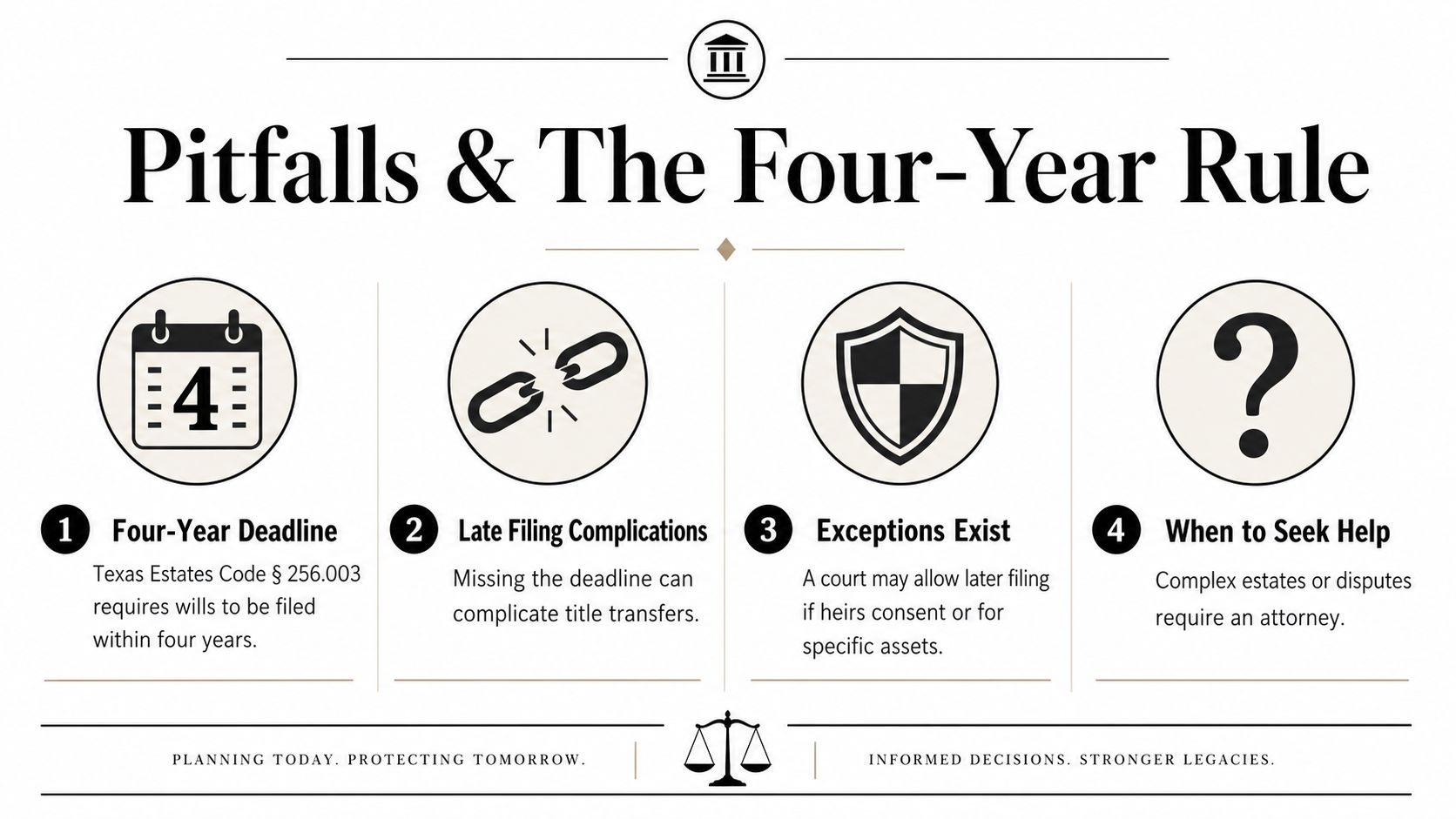
The hardest probate problems usually don't come from the first filing. They come from timing mistakes, missing documents, and families who assumed they had more flexibility than they do. Texas has a hard timing rule, a will generally must be offered for probate within four years of death. The Texas State Law Library also warns that after that period the will may be treated as if there was no will, which is why families often move quickly even while they are still grieving.
That deadline is only one trap. Another is a missing original will. If only a copy exists, the court may require more proof, including evidence about why the original cannot be located and testimony that supports the copy's authenticity. Families with blended households, estranged heirs, or out-of-state relatives can also run into extra notice issues, because the court needs confidence that the right people were told about the case.
Common mistakes that slow cases down
- Missing the inventory deadline: The 90-day filing deadline for the inventory or affidavit in lieu is easy to miss if the executor waits too long to gather records.
- Using the wrong procedure: A small estate affidavit or muniment of title only works when the estate fits the statute. If it doesn't, the filing can fail.
- Mixing estate money with personal money: That creates recordkeeping problems and can trigger disputes.
- Distributing too early: Debts and claims need to be handled before final distribution, or the executor may have to unwind transactions.
The four-year rule is especially important when a family discovers a will late or after a conflict has already started. That's where legal advice matters, because the facts can change the route, the evidence, and whether the court will still accept the filing. Texas probate is generous in some ways, but it is not casual about deadlines.
Key Takeaways and Your Next Step in Texas Probate
Key insight, the first decision controls the whole case. Independent administration, dependent administration, muniment of title, and a small estate affidavit are not just different labels. They create different burdens, different levels of court supervision, and different timelines for the family.
A few practical checkpoints stand out. If heirs disagree, if the estate includes real property, if there's no clear will, or if the four-year deadline is closing in, it's time to get legal help before filing. Local rules can also vary from county to county, and courts in Harris, Dallas, Travis, and Bexar counties may each have their own filing practices and forms. That's one reason a county-specific review matters before anything is submitted.
Families who want to stay organized usually benefit from a Texas probate checklist, especially when they are juggling funeral arrangements, bank calls, and property questions at the same time. A checklist won't solve a dispute, but it can keep the case from drifting.
If you're trying to decide whether your situation calls for independent administration, muniment of title, a small estate affidavit, or a full probate filing, the safest next step is a calm review of the facts with a Texas probate lawyer. The Law Office of Bryan Fagan, PLLC helps families with probate process questions, guardianship matters, wills and trusts, and probate litigation, and that kind of support can make the process feel much less overwhelming.
If you're facing probate in Texas, our team can help guide you through every step, from filing to final distribution. Schedule your free consultation today.


