 Skip to content
You're sitting at the kitchen table with a death certificate, a vehicle title, and a stack of unopened mail. Your spouse or parent has died, there's no will, and every bank or title office seems to want a court document before it will release property. The question feels simple, but the answer depends on more than the value of the house or the amount in a checking account.
For Texas families, the small estate affidavit limit current threshold is $75,000 in qualifying estate value. The calculation excludes homestead and exempt property, but it still requires careful review of debts, beneficiary designations, jointly owned assets, vehicles, retirement accounts, and property that may not be obvious at first.
What the Texas Small Estate Affidavit Limit Means Today
Texas Estates Code Section 205.001 permits a small estate affidavit when the decedent's qualifying property is $75,000 or less, after excluding homestead and exempt property. Texas Law Help explains the current $75,000 ceiling, and the Texas State Law Library describes the same limit while noting that the estate must have enough assets to pay certain debts.
The number is a hard statutory ceiling. It isn't adjusted because property values have risen or because a family believes the estate is modest compared with local housing prices. A small overage can move the family out of the affidavit process and into another form of probate administration.
What the affidavit can accomplish
A qualifying affidavit can help heirs transfer property without having a court appoint an administrator. It may also reduce the need for repeated court filings and help a family deal with titled assets more directly. The process can be more efficient than formal administration, although the county clerk and the institutions holding the assets still have to review the paperwork.
The affidavit isn't a shortcut around every probate issue. It generally applies to estates without a will, and it won't resolve a serious dispute among heirs, complicated creditor questions, or ownership problems that require litigation.
This article focuses on the Texas threshold, eligibility rules, asset valuation, filing mechanics, common errors, and alternatives. It doesn't address federal estate tax calculations, preparation of joint-tenancy deeds, or every pleading used in full probate.
A practical way to approach the calculation
Start with a complete inventory. Separate property that passes outside probate from property held only in the decedent's name. Then remove homestead and exempt property, identify qualifying debts, and compare the remaining balance with the statutory limit.
Practical rule: Don't decide whether the estate qualifies by looking only at the home, the bank account, or the vehicle. The answer comes from the whole filtered balance sheet.
If you're unsure whether a court proceeding is required, review this explanation of when probate is required in Texas. The purpose isn't to make you memorize probate law. It's to help you organize the facts well enough to choose the right path with confidence.
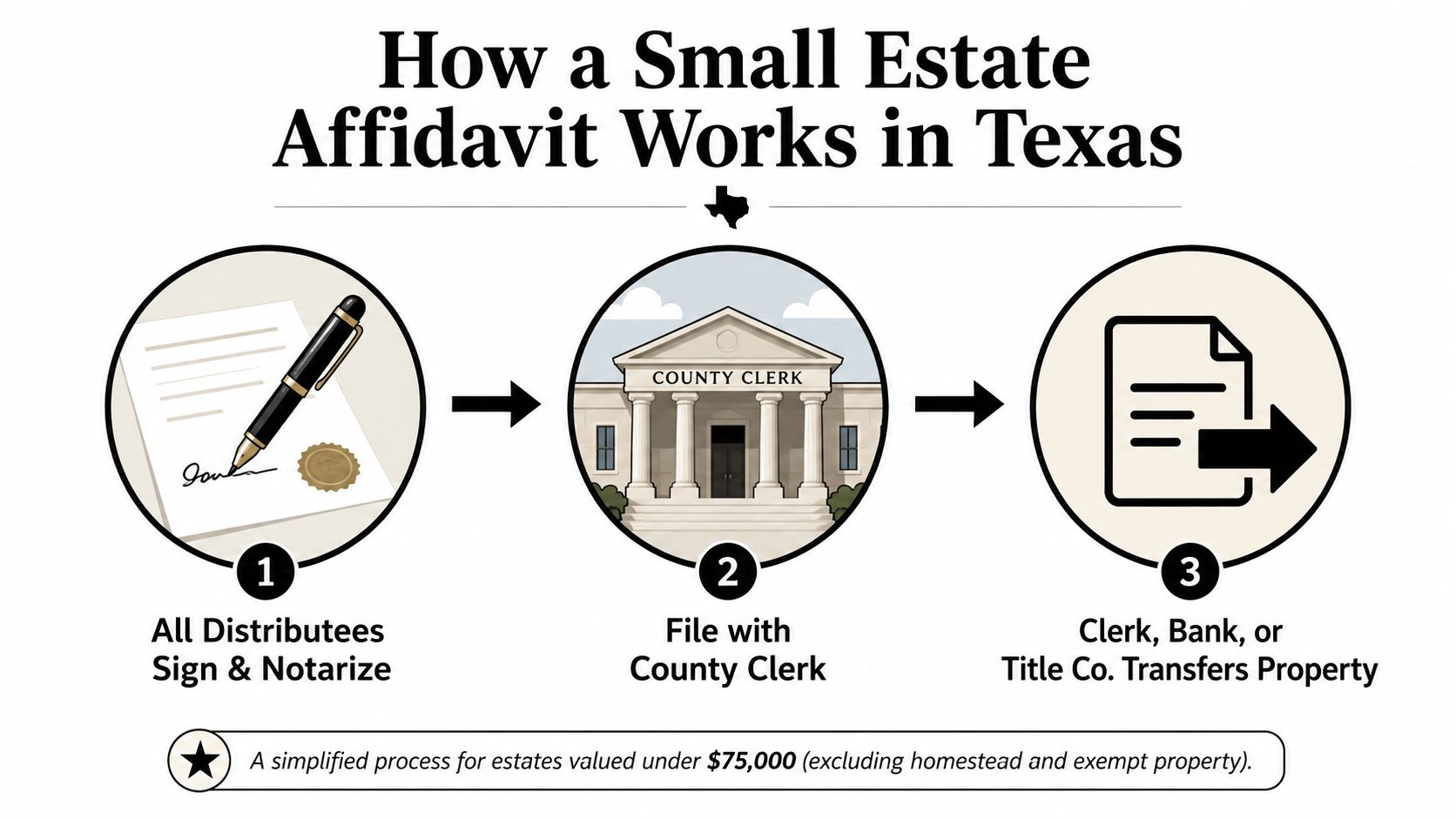
How a Small Estate Affidavit Works in Texas
A small estate affidavit is a sworn document. In plain English, the people entitled to inherit tell the court and the asset holders who died, what property exists, what debts must be addressed, and who should receive the remaining property.
The affidavit is generally signed by all distributees, meaning the people legally entitled to the estate. Those distributees usually inherit under Texas intestacy law when there's no will. The document is notarized and supported by witness signatures, so it's more than an informal family agreement.
Where this fits in the probate process
Texas probate options range from taking no court action for assets that already transfer automatically, to using a small estate affidavit, to opening a full administration. The affidavit sits in the middle. It can provide court authority without requiring the family to manage every feature of a traditional estate administration.
The county clerk reviews the filing under local procedures. Once the affidavit is accepted, heirs can present certified copies to a bank, the vehicle title office, or another institution holding property. Those institutions may have their own requirements, so the court filing doesn't guarantee an immediate transfer.
Every distributee must understand the document before signing. If one heir refuses to sign, cannot be located, or disputes the proposed distribution, the affidavit route may not be workable.
For a straightforward overview, The Small Estate Affidavit in Texas describes this as a simplified path for modest estates with no will.
What the affidavit doesn't do
The affidavit doesn't replace a will. It also doesn't erase valid debts or guarantee protection from every later creditor claim. People receiving estate property can remain responsible for proper distribution and creditor obligations under applicable law, so signing without investigating debts can create personal risk.
The most important question is not, “Can we get the account transferred?” It's, “Have we accurately identified the people, property, and debts that Texas law requires us to disclose?”
Understanding the Current $75,000 Threshold
The $75,000 limit applies to qualifying probate assets, not necessarily everything the decedent owned during life. Probate assets are property held in a way that requires legal authority before ownership can be transferred.
A home needs special treatment. The decedent's qualifying homestead is excluded from the threshold calculation, along with exempt property. A mortgage or lien also affects the value of an asset when determining the estate's net position. That doesn't mean families should ignore the home or the mortgage. It means they should identify both and classify them correctly.
Assets that usually belong in the calculation
Property held solely in the decedent's name generally deserves close attention. That can include a personal bank account without a beneficiary designation, a vehicle titled only to the decedent, non-homestead real estate, mineral interests, personal property, and debts owed to the decedent.
Retirement accounts and life insurance often pass outside probate when a valid beneficiary is named. Joint property with a right of survivorship can also transfer separately. Payable-on-death accounts, trust property, and assets passing through a recorded transfer-on-death deed may likewise fall outside the probate estate.
The documentation matters. A family shouldn't assume an account has a beneficiary because someone remembers completing paperwork years ago. Obtain current statements and ask the institution how the account is titled.
Comparison of common asset categories
| Asset Type | Treatment | Example |
|---|---|---|
| Homestead | Excluded when it qualifies as homestead property | The decedent's primary Texas residence |
| Solely owned bank account | Generally counted | A checking account with no payable-on-death beneficiary |
| Retirement account with named beneficiary | Generally passes outside the estate | An IRA naming a daughter directly |
| Solely titled vehicle | Counted | A truck titled only in the decedent's name |
| Joint property with survivorship rights | Generally passes outside probate | A jointly held account that transfers to the surviving owner |
| Mineral interest | Counted when held solely by the decedent | A producing or nonproducing interest shown in county records |
| Trust property | Generally passes under the trust | An account owned by a revocable trust |
The debt test matters too
The dollar ceiling is only part of the analysis. Tarrant County probate materials describe the balance-sheet requirement, including the requirement that non-homestead, non-exempt assets exceed applicable non-exempt debts.
That distinction can surprise families. An estate with assets below the cap may still fail if qualifying unsecured debts consume the available property. Secured obligations tied to exempt property, including a homestead, are treated differently, but they still need to be disclosed and addressed.
Who Qualifies and Which Assets Are Excluded
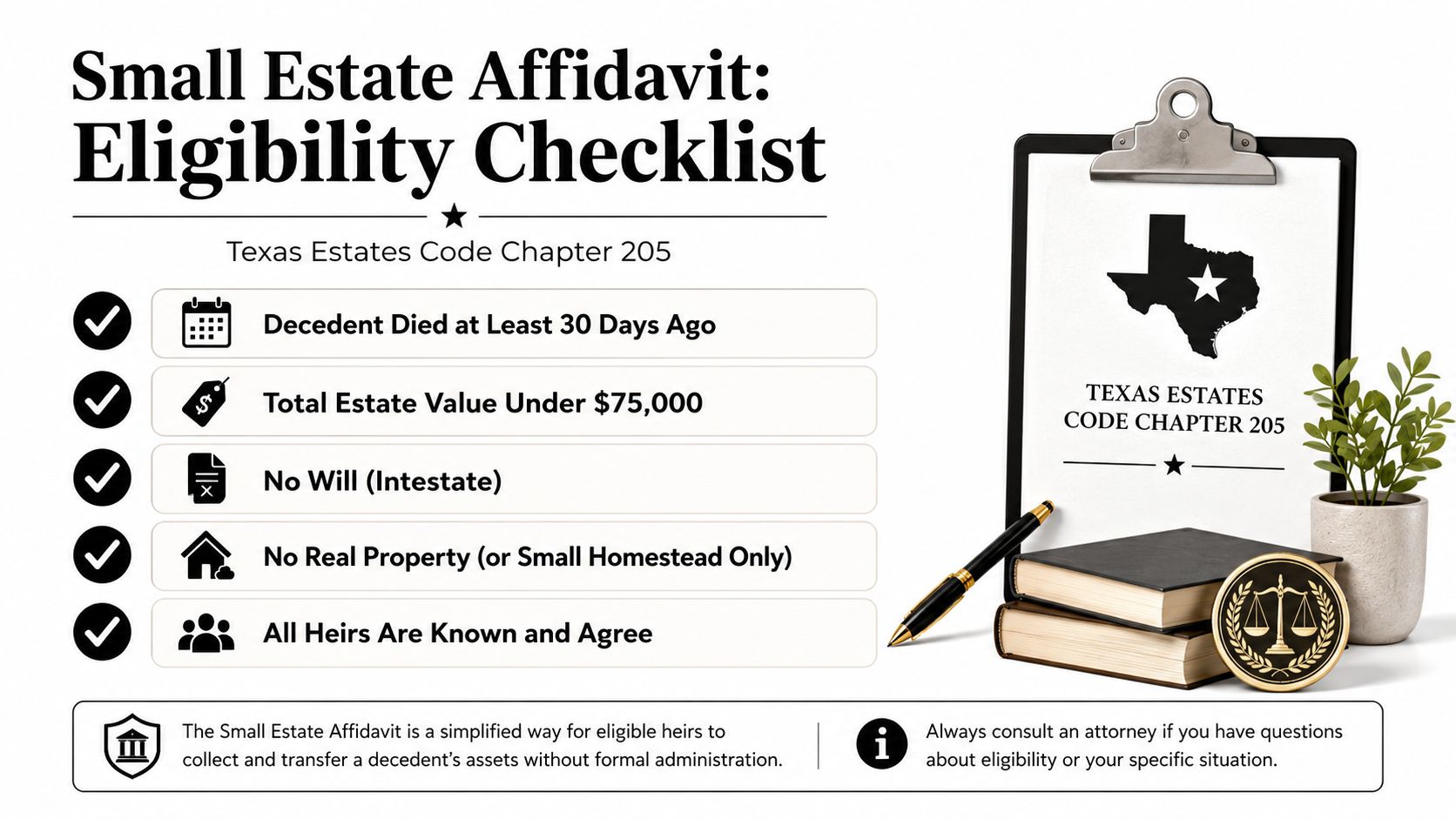
Eligibility starts with the family situation, not the form. A Texas small estate affidavit generally requires no will, at least 30 days since death, no pending or completed administration, and agreement among the people entitled to inherit.
Texas Estates Code Chapter 205 provides the framework. The decedent must have died without a will being used to control the estate, or any related proceeding must already be resolved in a way that permits the affidavit. A valid will usually points the family toward probate of the will rather than an intestate small estate affidavit.
Apply the checklist carefully
- Check the waiting period: At least 30 days must have passed since death before filing. Tarrant County's affidavit instructions identify this as a gatekeeping rule.
- Confirm there's no will: A valid will generally prevents use of the intestate affidavit process.
- Identify the distributees: A surviving spouse, child, other heir, or qualifying creditor may have a role, but the correct people must be identified under Texas law.
- Confirm the estate is not already in administration: A pending or granted administration can prevent the affidavit route.
- Review the debt position: Qualifying assets must be sufficient to address applicable non-exempt debts.
Separate excluded property from counted property
Homestead property and exempt personal property receive special treatment under Texas law, including protections associated with Texas Constitution Article XVI, Section 50. Certain life insurance proceeds, retirement accounts with named beneficiaries, payable-on-death accounts, joint property with survivorship rights, and trust assets may pass outside the probate estate.
By contrast, non-homestead real estate, mineral interests, vehicles titled solely in the decedent's name, and solely owned financial accounts without beneficiary directions may count. The family should verify title and beneficiary information instead of relying on memory.
Tax-deferred and federally regulated assets may have transfer procedures controlled by the institution or federal rules. Don't assume an affidavit alone will suffice.
A Realistic Example of Counting a Mixed Estate
Marta, a Houston widow, dies without a will. Her family finds a homestead valued at $230,000, a Ford F-150 valued at $42,000 with a $12,000 loan, an IRA worth $45,000 naming her daughter Maria as beneficiary, a community checking account holding $6,000, and a $4,000 credit card balance.
At first glance, the family sees a gross collection of assets worth $280,000 if the homestead, truck, IRA, and checking account are all added together. That total is not the small estate calculation, however, because the homestead and the beneficiary-designated IRA receive different treatment.
Estate A stays under the threshold
The homestead is set aside as excluded property. Maria's IRA passes through the beneficiary designation rather than through the small estate affidavit. The truck and checking account remain for analysis.
For the worked example requested, the family's qualifying asset calculation is:
$42,000 truck + $6,000 bank balance = $48,000
That amount is below the $75,000 threshold. The credit card debt still must be disclosed and addressed, and the truck loan must be handled according to its secured status and the lender's requirements. The family can't omit either obligation because it hopes to use the faster procedure.
| Asset or Debt | Estate A, Qualifies | Estate B, Over Cap |
|---|---|---|
| Homestead | Excluded | Excluded |
| Ford F-150 | $42,000 | $42,000 |
| Community checking account | $6,000 | $6,000 |
| IRA with Maria as beneficiary | Outside the estate | Outside the estate |
| Mineral interest | Not discovered | $30,000 |
| Qualifying asset total | $48,000 | $78,000 |
| Result | Under the cap | Over the cap |
Estate B reveals the danger of incomplete records
Suppose the family later discovers a $30,000 mineral interest that Marta owned separately. That interest belongs in the qualifying calculation. The revised total becomes:
$42,000 truck + $6,000 bank balance + $30,000 mineral interest = $78,000
That result exceeds the statutory cap. The family would need to consider full probate administration, such as an independent administration if the facts permit, instead of relying on the affidavit.
This is why county deed records, mineral records, old tax statements, and financial files matter. Out-of-state property and overlooked mineral interests can change the result after the family thinks the inventory is complete.
Filing the Affidavit Step by Step
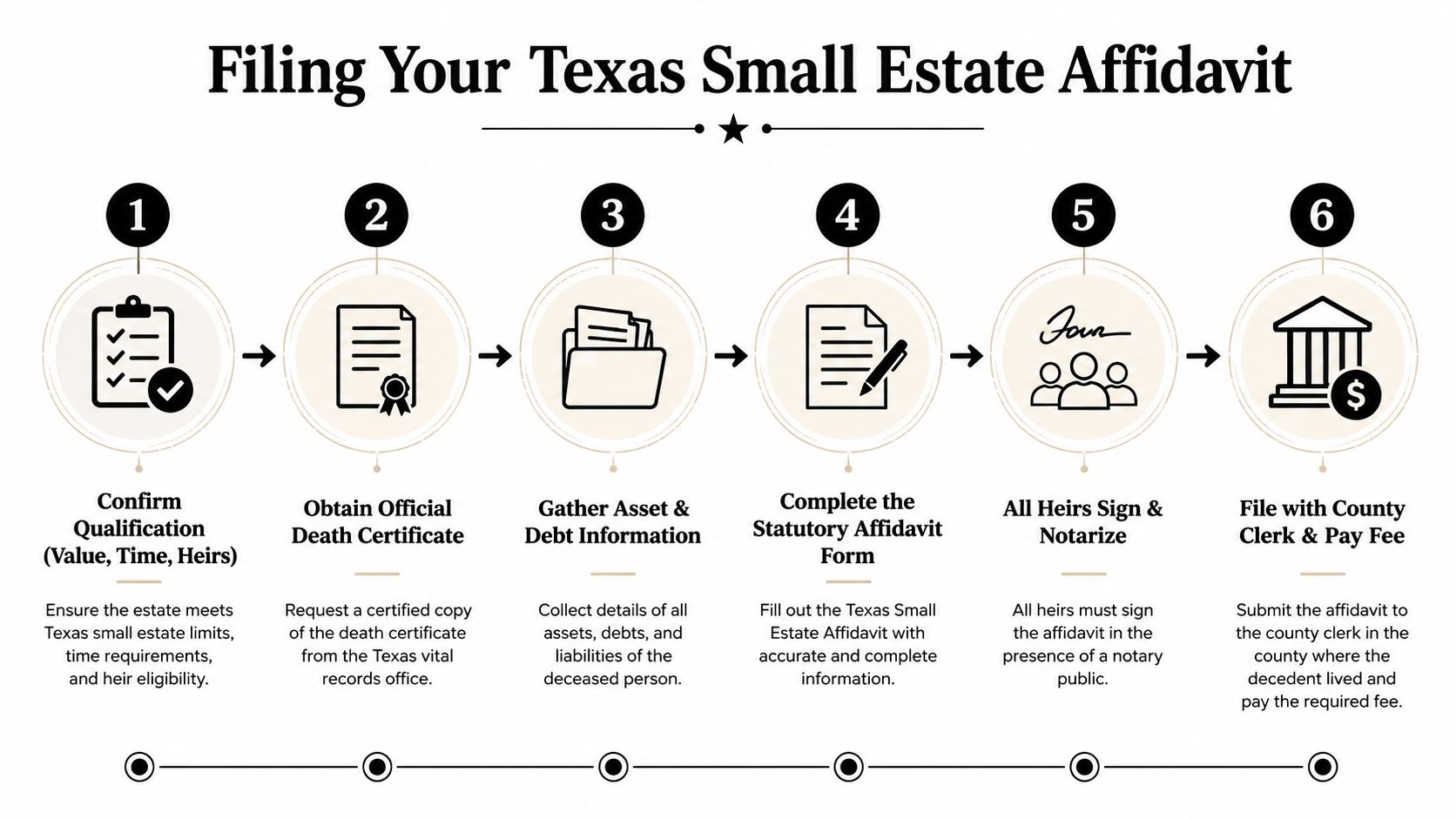
A small estate affidavit works like a chain. The waiting period, inventory, signatures, filing, and transfers must connect in the right order. A rushed inventory or missing signature can send the family back to the beginning.
1. Confirm eligibility and wait
Count at least 30 days from the date of death before filing. Use that period to locate the death certificate, check for a will, identify every heir, and determine whether another probate case has already been filed. These facts shape whether the affidavit is available at all.
2. Build a documented inventory
Collect the certified death certificate, heirs' addresses, account statements, vehicle information, real-property records, and debt documents. Assign supportable values to assets included in the calculation. A recent appraisal can support a property value, market evidence can help with land or mineral interests, and a reliable vehicle valuation can support a title estimate.
Keep excluded property on a separate worksheet. Record why the homestead, beneficiary account, retirement plan, or jointly held asset does not enter the qualifying total. That explanation helps prevent a bank, title office, or clerk from treating every item in the household as probate property.
3. Prepare and sign the affidavit
Texas Estates Code Section 203.002 addresses the affidavit's requirements. The affiant swears before a notary that the information is accurate. Complete every required signature, confirm that the witnesses meet the applicable requirements, and let all distributees review the proposed distribution before anyone signs.
4. File in the proper county
Texas Law Help explains that the affidavit is filed in the county where the decedent lived at death. County procedures may affect the filing location, review process, and number of copies, especially if the decedent owned real property in another county.
5. Obtain certified copies and transfer property
After acceptance, request certified copies. Take them to the vehicle title office, record them when required for real-property matters, and provide them to banks or brokerage firms. Each institution may ask for identification or additional ownership records.
County practices differ. A clerk may accept the document for review, request corrections, or send the family to probate court. Acceptance does not authorize distribution without continued attention to debts and other legal obligations.
Distributees may remain responsible for later creditor issues during the applicable limitations period. Keep the inventory, notices, receipts, and transfer records together. For a filing-focused explanation, review the Texas small estate affidavit process.
Common Mistakes That Disqualify Otherwise Valid Filings
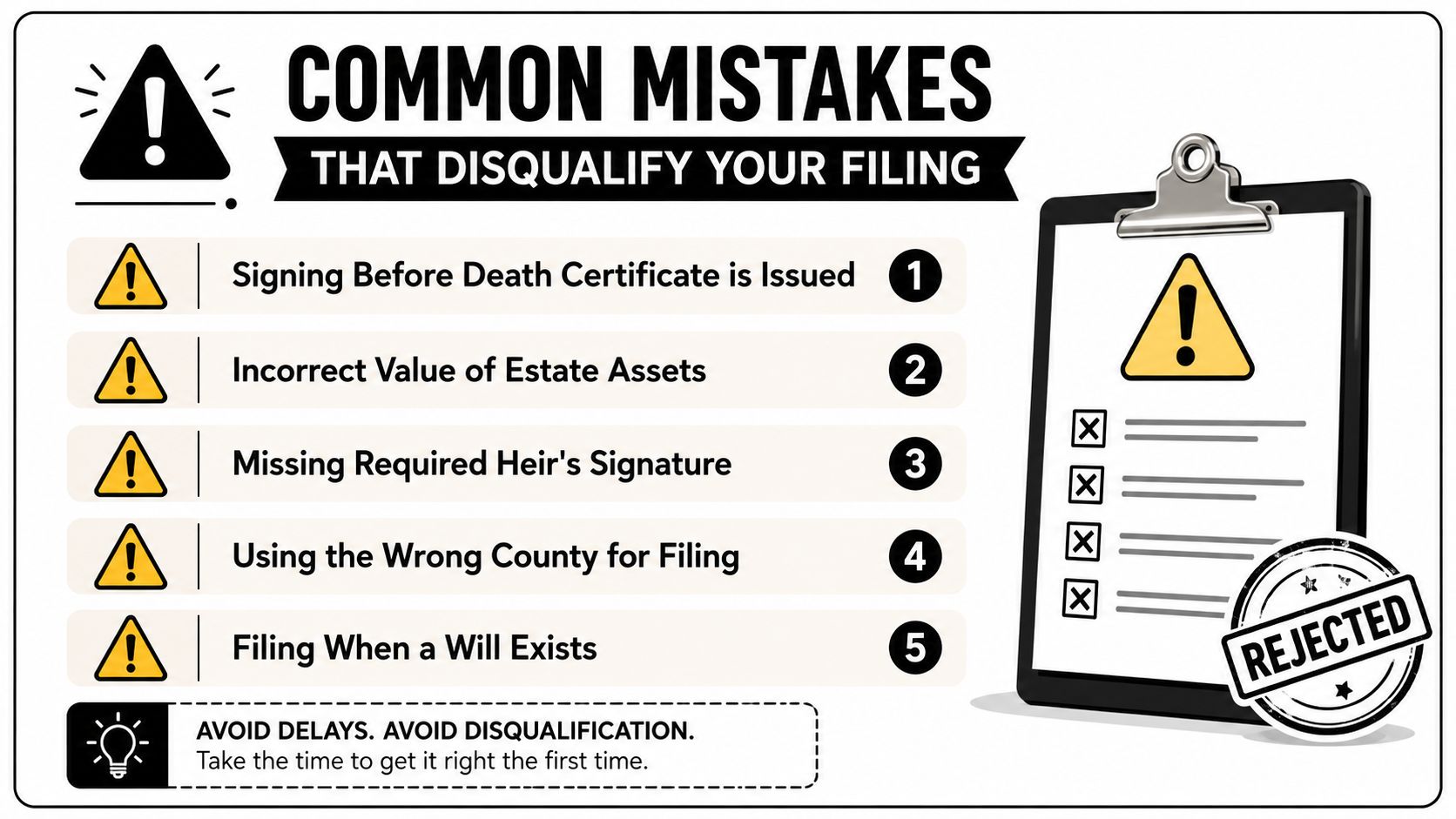
Families often assume that a completed form is enough. It isn't. The clerk is reviewing a sworn legal statement, and a missing fact or signature can affect the entire filing.
Errors that deserve a second review
- Signing too early: Don't sign before the required waiting period has passed.
- Using the wrong value: A tax value may not reflect fair market value. Real estate and mineral interests need careful review.
- Counting excluded property: A beneficiary-designated retirement account may not belong in the probate calculation, but the family should verify the designation.
- Leaving out a creditor: Known debts must be disclosed and handled. Medicaid or other government-related claims may require additional attention.
- Missing a required signature: Every distributee and required witness must sign correctly, and the notary block must be completed.
- Filing in the wrong county: The filing location matters, particularly when the decedent lived in one county and owned property elsewhere.
- Proceeding despite a will: A valid will generally changes the available probate route.
A surviving spouse or minor child remaining in the home also requires careful homestead analysis. Don't assume that the home's market value automatically disqualifies the family, and don't assume the homestead exclusion resolves every debt or title issue.
If a defective affidavit is recorded, correction may require preparing the process again rather than adding a quick handwritten fix. Have the documents reviewed before everyone signs.
Alternatives Worth Comparing Before You File
The fastest-looking form isn't always the best legal route. Your decision should reflect whether there's a will, whether debts are manageable, whether heirs agree, and whether property must be sold rather than transferred.
| Option | Best For | Key Requirement | Main Limitation |
|---|---|---|---|
| Small estate affidavit | A modest intestate estate with cooperative heirs | Qualifying assets remain within the statutory limit and other Chapter 205 requirements are met | It isn't designed for estates with a will, disputes, or unresolved complexity |
| Muniment of title | Transferring real estate under a valid will | The will supports the proceeding and debts are limited as Texas law permits | It may not provide the broad administration authority needed to pay or negotiate every obligation |
| Independent administration | Estates with a will and an appropriate executor structure | The will waives bond or the court authorizes the arrangement | The executor still must identify assets, address debts, and distribute property properly |
A muniment of title can make sense when the central task is transferring real estate under a will. Independent administration may fit better when an executor needs authority to collect assets, pay obligations, and complete distribution with limited court supervision.
A family disagreement changes the analysis. So does a debt that exceeds available non-exempt property, a missing heir, out-of-state real estate, or a need to sell property before distribution.
The firm's explanation of probate versus a small estate affidavit in Texas can help organize those decision points. Estate planning also has a human side. Families may find value in learning how to preserve family stories with estate planning, alongside preparing legal documents that identify who should receive property.
Key insight
The current Texas small estate affidavit limit is $75,000, but the number only makes sense after you filter the estate correctly. Exclude qualifying homestead and exempt property, separate non-probate transfers, include solely owned assets and mineral interests, and address applicable debts. If the facts don't fit cleanly, a different probate option may protect the family better.
If you're facing probate in Texas, the Law Office of Bryan Fagan, PLLC can help review the estate inventory, identify the right probate path, and prepare the filings needed for property transfer. Visit Law Office of Bryan Fagan, PLLC to request a free consultation and discuss your family's situation.


