A parent dies, the family is still reeling, and then someone asks the question nobody wanted to face, “Who signs for the estate if the only child is 10 and there's no guardian?” In Texas, that one fact changes everything. The estate may still need probate, but the court also has to protect the child's inheritance before anyone can move money, sell property, or close the case.
That usually means two court tracks start running at the same time. One track identifies the heirs and opens the estate. The other puts a legal adult in charge of the child's share, because a minor generally can't receive or manage inherited property directly. If the estate is simple, families often expect a short path, but once a sole minor heir has no guardian, the process becomes more supervised and more formal.
For Texas families, the hard part is often not the law itself. It's the sequence. Who can act first, who can sign today, and what happens to estate money before a guardian is appointed are the questions that keep families stuck. A helpful starting point is understanding how courts think about a child's inheritance, and why the court steps in even when everyone in the family agrees on what should happen next. For a plain explanation of the child-protection concept behind this, see what a ward of the state can mean in Texas.
When the Only Heir Is a Child the Court Has Never Met
A common Texas probate case can look straightforward at first. A father dies without a will, he leaves one child, and that child is 9 years old. The family may already know who should inherit, but the probate court still cannot hand over the checkbook or the deed to a minor and call the matter finished.
The first problem is authority
If no guardian already exists, nobody automatically steps into the child's shoes. A grandparent, aunt, uncle, or even the surviving parent may want to help, but helping is not the same as having legal authority. The court needs to know who can sign, who can hold the funds, and who can answer for them later.
Practical rule: if a child is the sole heir, the inheritance usually needs a legal adult structure before distribution. Family agreement alone does not replace court authority.
That is why this situation feels heavier than a routine probate case. The estate may still need to be opened under the Texas Estates Code, but the judge is also looking at the child's safety, not just the decedent's paperwork. If the estate has no guardian in place, the court can require extra steps before the child's share is touched.
Families also get tripped up by the word “minor.” It does not mean the child cannot inherit at all. It means the child usually cannot personally control the inherited property, so the court has to decide how that property will be held and managed until adulthood.
Consider the estate as ready to close while the child's share waits for a legal container. That container might be a guardianship, a trust, or another court-approved fiduciary setup, but one must exist before the property changes hands. For a plain explanation of the court's protective role, see what a ward of the state can mean in Texas.
Why Texas Law Treats a Minor Heir Differently
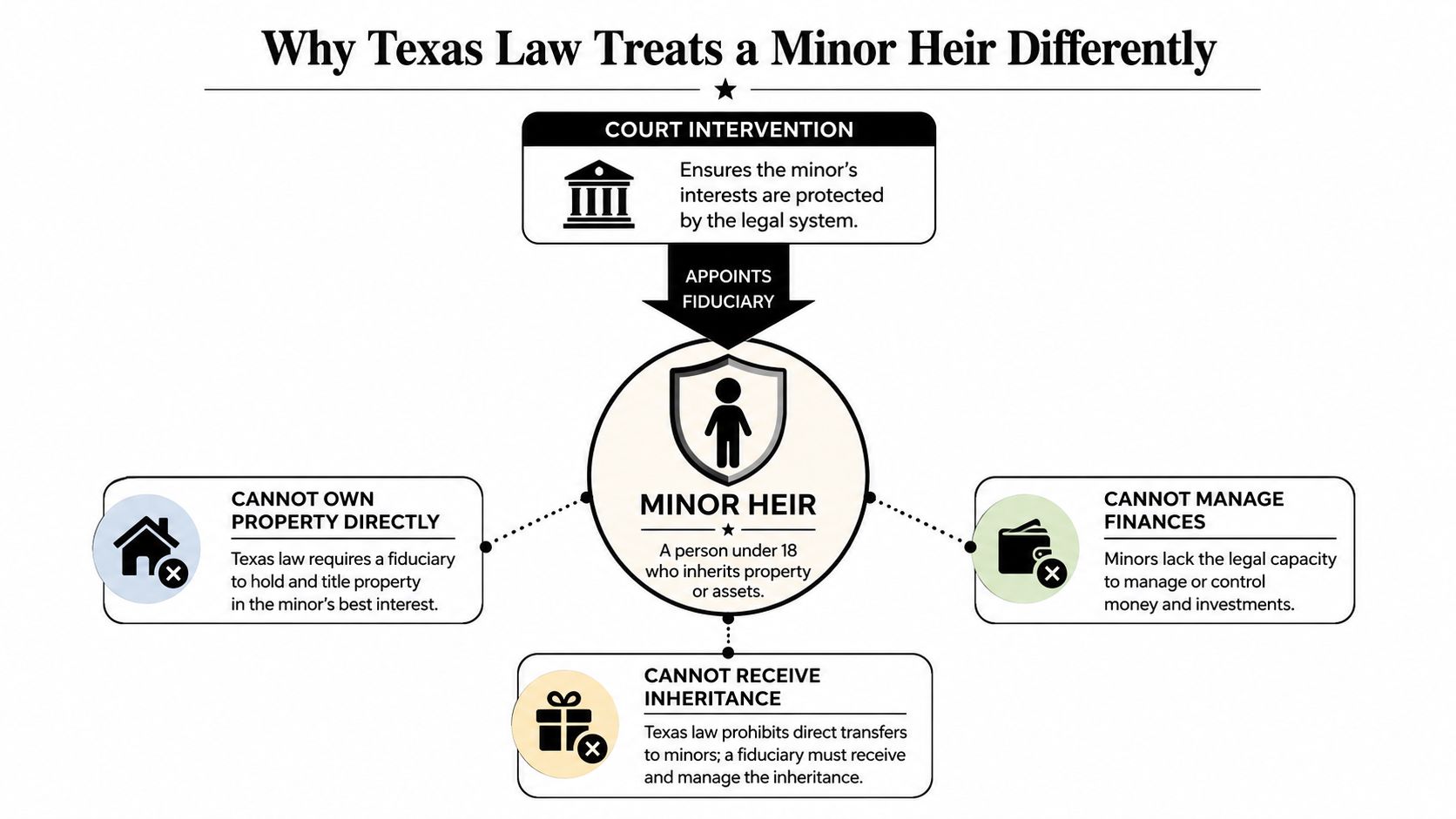
Texas law separates two ideas that families often blur together. Inheritance entitlement means the child is legally entitled to receive property. Legal capacity means the child is old enough and legally able to manage it. A minor can have the first without having the second.
The Texas Estates Code framework for heirship matters here, especially Chapter 201 when there is no will and the court must determine who inherits. The court then has to make sure the inherited property is protected until the child can legally manage it. That protection can involve guardianship rules under Texas probate law, because the judge can't ignore the child's inability to act for themself.
The court acts like a safety net
The best plain-English analogy is this. The court doesn't take the child's inheritance away. It puts a safety net under it. That net may be a guardian of the estate, a testamentary trust, a custodial arrangement, or an independent trustee handling the property until the child reaches adulthood.
The age of access matters too. Texas guidance says minors generally don't get full control until 18, though some trust or custodial structures can delay access to 21 or later. That doesn't change who owns the inheritance in a legal sense, but it does change who can use it and when.
The probate deadline still matters even when a child is involved. The will, if there is one, generally must be filed within four years of death, and a will can sometimes be probated as a muniment of title only when there are no debts except secured debt or another reason administration is unnecessary, according to Texas guidance on informal probate methods. If there's no will, the court still has to sort out heirship first, then decide how to protect the child's share before distribution.
The key point is simple. A minor heir changes the court's job from “identify the heir” to “identify the heir and protect the inheritance.”
Choosing the Right Probate Path for a Minor Heir
When the sole heir is a child, the estate rarely gets the fastest Texas shortcut. The court usually has to choose a path that leaves room for supervision, and that changes what the personal representative can do without asking permission first. If you've heard people talk about “simple probate,” this is the situation where that label starts to break down.
| Probate path | What it looks like | Why it works or fails here |
|---|---|---|
| Dependent administration | Full court supervision | Often the likely path when a minor heir is involved and no guardian exists |
| Independent administration | Less court oversight | Usually unavailable when there are minor child heirs and no waivers or consents from all heirs |
| Muniment of title | A shortcut to transfer title | Only sometimes available, and Texas guidance says it's tied to situations where administration is unnecessary |
A Texas county court guide says that if any heirs are minors, the court will not grant independent administration when an estate is opened without a will, making dependent administration the only available administration route when administration is needed. That's consistent with the Harris County probate FAQ, which says independent administration is typically granted only when there are no minor child heirs and all determined heirs or beneficiaries have signed waivers and consents. If you want a deeper look at the supervised route, see Dependent Administration in Texas.
Why the shortcuts usually close off
A small estate affidavit is another place families often get stopped. Texas LawHelp notes that it's only available when there's no will, no more than $75,000 in non-exempt property, no administration is needed, and all heirs sign or someone with legal authority signs for them. Texas guidance also says some courts won't approve a small estate affidavit if any heir is a minor.
That's why the probate lane often shifts from fast and informal to formal and supervised. The judge wants a legal path that can hold the child's property safely, not just a paperwork shortcut. For families, that means more hearings, more filings, and more waiting before anything can be distributed.
How Texas Courts Appoint a Guardian for the Heir
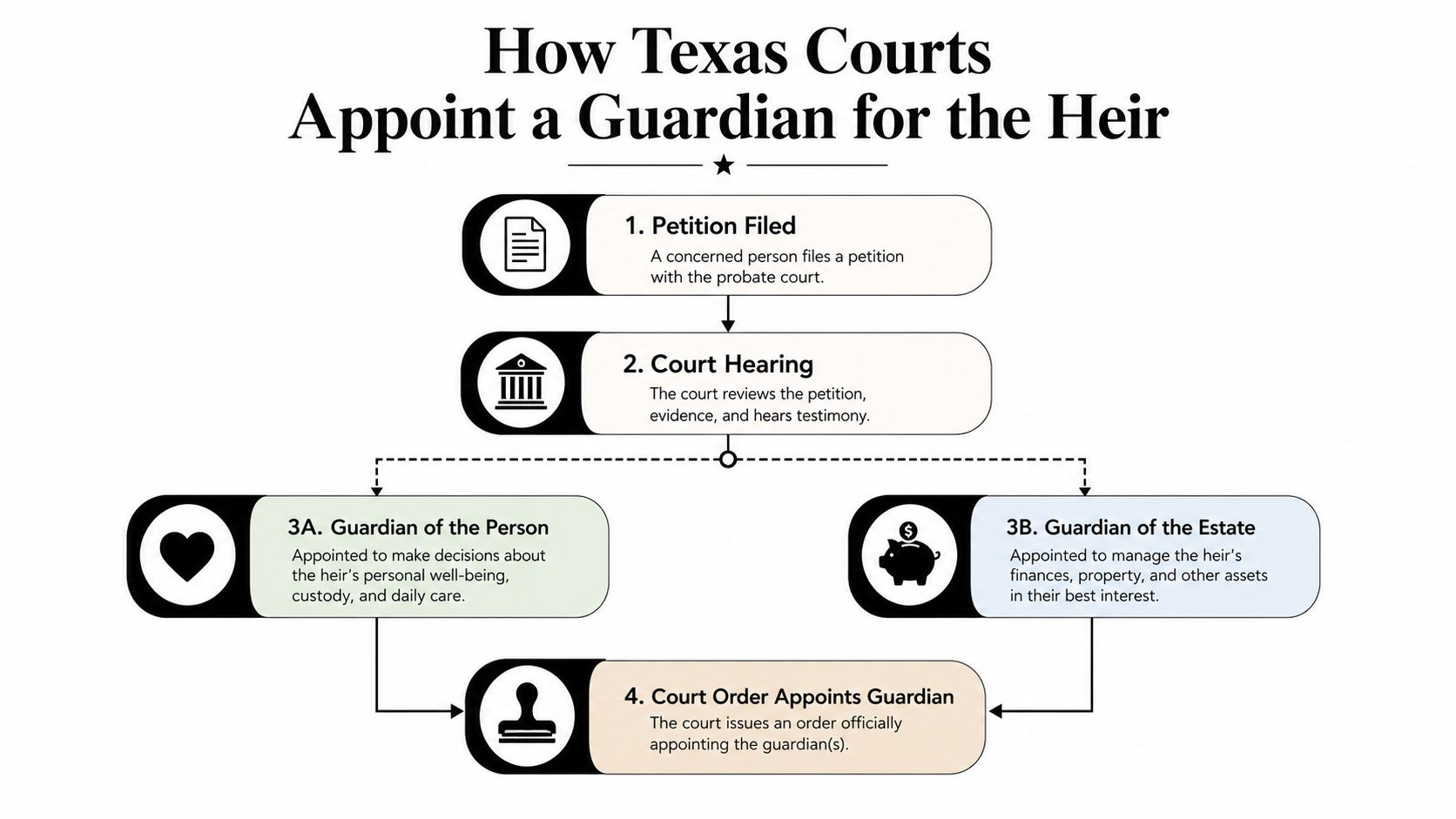
The guardianship side of the case is where many families feel lost. Probate identifies the inheritance, but guardianship decides who can legally hold and manage it for the child. Texas recognizes different kinds of guardians, and the one that usually matters for inherited property is the guardian of the estate.
Person versus estate
A guardian of the person handles daily care and custody decisions. A guardian of the estate handles money, property, and financial decisions. In a sole-heir probate case, the estate side is usually the critical part because the court needs someone authorized to receive and protect the inheritance.
The process starts with a guardianship application. The proposed ward must be personally served, and an attorney ad litem is appointed to represent the child's interests. If the court appoints a guardian, that guardian must post bond and later file annual reporting. The issued Letters of Guardianship expire after 16 months and must be renewed through reporting and a new bond, so this is not a one-time formality.
If a family member needs to start the process, the practical move is to file the guardianship application as soon as possible and ask the probate lawyer handling the estate how the two cases should be coordinated. For a step-by-step overview of that filing process, see how to apply for guardianship.
Practical note: if cash is already sitting in the estate and no guardian exists yet, courts often prefer that the money stay protected rather than informally handed to a relative. The court's priority is preserving the child's share until a lawful fiduciary is in place.
Guardianship of the Estate Versus UTMA and Management Trusts
Families usually ask the same practical question once they learn a guardianship might be required. Is there a less burdensome way to hold the child's inheritance? Texas law gives a few structures that can work, but they don't all fit the same situation.
Here's a simple comparison.
| Structure | Court oversight | Control until | Best fit |
|---|---|---|---|
| Guardianship of the estate | Full court supervision, including reporting and bond | Usually until adulthood, with access generally at 18 | Larger or more complex inheritances that need direct court protection |
| UTMA or UGMA custodianship | Less court involvement than guardianship | Often until 21 in Texas-style custodial planning | Smaller inheritances where a simpler custodial account is acceptable |
| 1301 management trust or testamentary trust | Private administration with limited court oversight depending on the structure | Can delay access to 21 or later | Families that want flexibility and a trustee instead of a full guardianship |
For many Texas families, the main difference is control. A guardianship of the estate gives the court direct oversight, which can feel restrictive but also provides strong protection. A trust can avoid a full guardianship in many situations, because the trustee manages the child's share without forcing the family back to court for every decision. If you want a deeper walkthrough of trust setup, see how to set up a trust fund.
Where the choice usually gets made
The right structure often depends on the size of the inheritance, whether there's real estate, and how much supervision the family can tolerate. A small cash inheritance may fit better in a custodial account. A house, mineral interest, or mixed estate may point toward a trust or a formal guardianship.
If the family expects disagreement, a trust can reduce day-to-day friction. If the court is worried about accountability, guardianship gives the judge more direct control.
This is also where the firm's estate planning and probate work often overlaps. In some cases, a family may use a will or trust to avoid this exact problem in the future, while a current probate case still needs a guardian appointed today. One legal option, the Law Office of Bryan Fagan, PLLC, handles probate and guardianship matters for Texas families, including dependent administration, guardianship applications, and trust administration.
Typical Timelines, Costs, and Court Filings in Texas
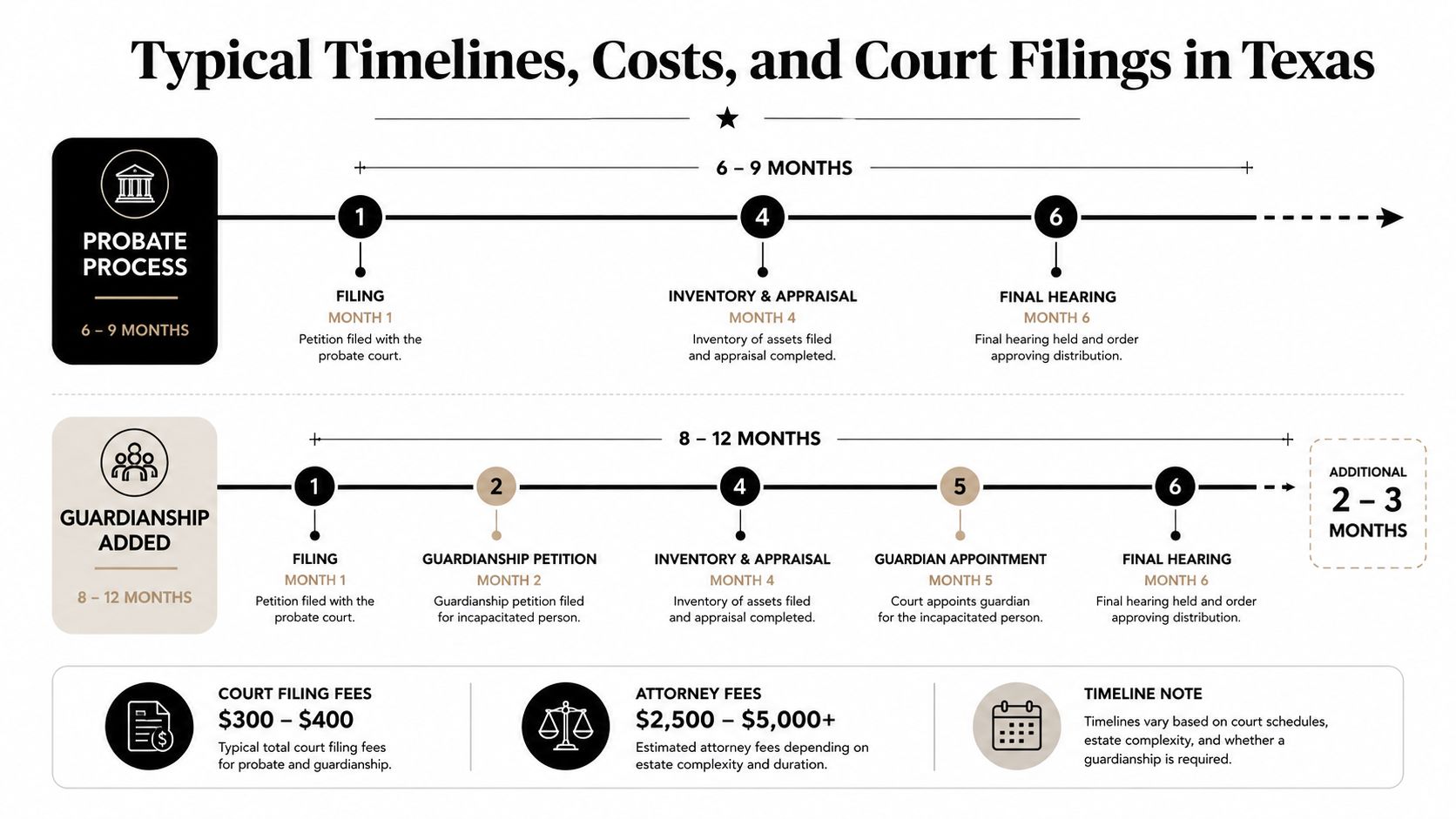
The timeline changes quickly once the sole heir is a minor with no guardian. A standard Texas probate may take about 6 to 9 months, but cases involving minor heirs often extend to 12 to 24 months because of court review, guardianship steps, and trust administration. That extra time is usually not wasted time, it's the court making sure the child's share is protected before anyone gets access.
The filings also stack up. In a typical estate, the executor or administrator still has to file the will if one exists, submit the death certificate, inventory assets, notify creditors, and pay valid claims before distribution is made. Add a minor heir, and you may also be dealing with a guardianship petition, bond paperwork, annual reporting, and accountings.
Where families usually feel the cost
Court fees, attorney fees, and bond premiums are the most obvious expenses. Guardianship also adds a layer of long-term compliance, because the guardian has to keep reporting to the court. If the estate includes property that must be held or sold later, that can create even more legal work before the child's share is safe to transfer.
The financial impact isn't only about legal bills. Delays can make it harder for a surviving parent or caretaker to use estate property for immediate family needs, especially if the court has restricted access to the funds. That's one reason families often need a plan that addresses both probate and guardianship at the same time.
A practical example helps. If the estate includes a bank account and a small piece of land, the family may need probate to identify the heir, then guardianship or a trust to hold the child's share, then later court-approved distribution when the legal structure is in place. If land is part of the inheritance, families sometimes also need advice on how to dispose of it later, and a resource like sell my inherited land fast can be useful when they're evaluating options.
Common Pitfalls When a Minor Is the Sole Heir
A family can run into trouble fast when they assume the court will let the estate pass by informal agreement. Once a minor is the only heir, Texas courts usually want the money, property, and paperwork placed under a lawful structure before anyone treats the inheritance like it is available for everyday use.
The first mistake is reaching for the easiest shortcut. A Small Estate Affidavit may work in some Texas cases, but if an heir is a minor, that shortcut may not be available at all, so the filing strategy has to be checked before anyone counts on it.
The next problem is missing the probate deadline. If there is a will, the four-year filing rule still applies, even though the beneficiary is a child. A minor does not pause the deadline, and waiting too long can remove options that would otherwise be available.
Families also get into trouble when a relative starts handling estate money without a formal appointment. A grandparent, aunt, older sibling, or surviving parent may be trying to help, but if no guardian or trustee has been named, there may be no one with authority to sign, receive, or manage the child's share.
That gap matters more than many people expect. Probate decides who the heir is, but guardianship or another lawful structure decides who can control the child's property. Until those pieces line up, the court may treat the money as something that needs protection, not something that can be handed over for informal use.
Another common mistake is treating probate and guardianship as separate files with separate timelines that never touch. In real cases, they have to fit together like two parts of the same lock. If one case moves ahead without the other, the estate can sit in limbo while everyone waits for the proper legal path to be in place.
Important: if the court does not see a lawful fiduciary, it may refuse to let the money move. That can feel slow and frustrating, but the court is trying to keep the child's inheritance from being misused, mixed up, or spent by the wrong person.
The operational gap is where many families get stuck. They know a guardian may be needed, but they do not know who can sign before that appointment happens, where the funds should be held, or whether the child's share belongs in the court registry, a trust, or another protected setup in the meantime. Coordinated representation matters because the probate file and the guardianship file have to support each other, not compete with each other.
Families that are also trying to assemble the right support team around a file may find law firm staffing resources useful while they sort out the legal and administrative work that comes with a minor heir.
Key Takeaway and Your Next Steps in Texas
When the sole heir is a minor and no guardian exists, Texas probate and guardianship become one interlocking process. The court has two jobs at once, identify the rightful heir under the Texas Estates Code and make sure the child's inheritance is protected before anyone controls it. That's why the case often moves toward dependent administration, guardianship of the estate, or a trust-based alternative instead of a fast informal shortcut.
The most useful things to remember are straightforward. The probate filing deadline still matters if there's a will. Independent administration usually depends on the absence of minor heirs and proper consents. A guardian of the estate, a trust, or a custodial structure may be needed before the child's share can be distributed. If no guardian already exists, the sequence of filings becomes the issue, because the estate can't safely move forward until the child's property has a lawful home.
Families also need to think beyond the immediate case. If you're planning for a child's inheritance, trust-based planning can reduce the chance of a future guardianship fight. If you're already in probate and need to understand the likely path, the right legal team can help line up the estate and the guardianship so neither one blocks the other.
Useful service pages include the firm's Texas Probate Process, Guardianship, Wills & Trusts, and Probate Litigation resources. If you're dealing with inherited real estate and need to understand options for future sale or transfer, the earlier land resource can help you think through the property side too.
If you're facing probate in Texas, our team can help guide you through every step, from filing to final distribution. Schedule your free consultation today. The Law Office of Bryan Fagan, PLLC can help you sort out probate, guardianship, and inheritance questions in a way that protects your family and keeps the court process moving. Visit Law Office of Bryan Fagan, PLLC to get started.