You're dealing with a very specific kind of loss: a loved one lived outside Texas, left behind what may look like a small mineral interest, and now there's a royalty check sitting in suspense because no one at the operator will move without recorded Texas title papers. Families are often shocked by how formal this gets. The good news is that the process has a name, a path, and a courthouse that handles it, even when the decedent was never a Texas resident.
The two questions that matter most are simple to say and hard to answer without guidance. First, does Texas ancillary probate apply when the only Texas asset is mineral rights. Second, once the court signs off, what gets the county recorder and the operator to recognize the new ownership so the payments can finally resume.
A lot of families also discover that the estate has an IT trail that matters more than they expected. Old owner records, operator portals, tax notices, and division-order correspondence often determine whether the paperwork reaches the right desk the first time. If a family needs help gathering those records, a practical resource like Technovation LLC DFW oil and gas IT can be useful for understanding how legacy system records, account histories, and document access issues can affect the paper trail around mineral ownership.
For families trying to sort out an out-of-state property issue, the first step is learning how Texas treats these interests and what the Texas court can, and can't, do by itself. The next step is understanding why a second proceeding in Texas is usually required for mineral rights, even when the home-state probate is already finished. A helpful overview of the out-of-state property issue is also available in this Texas probate guide for property outside the state.
When Out-of-State Families Discover a Texas Mineral Interest
The call usually comes after the funeral, after the bank accounts are settled, and after everyone thinks the estate is basically done. Then someone finds a deed, an old division-order letter, or a county tax notice showing that a parent, sibling, or spouse owned a Texas mineral interest. Sometimes it's only a fraction of royalties, and that's exactly why families miss it for years.
That discovery can feel minor at first, but Texas treats mineral, oil, and gas interests as property that can't just be transferred by memory, family agreement, or a death certificate alone. Texas probate guidance specifically lists mineral, oil, and gas interests among the assets that commonly trigger ancillary probate, because the filing has to happen in the Texas county where the property is located. A Texas-focused explanation of that point appears in the guidance on ancillary probate in Texas.
Start with the two practical questions
First, ask whether the decedent was a Texas resident. If the answer is no, and the only Texas asset is mineral rights, you're usually in secondary probate territory, not a simple paperwork fix. Texas ancillary probate is not the main estate case, it's the follow-up proceeding that gives a Texas court authority over Texas-sited property.
Second, ask what needs to happen after the court order. In mineral cases, the goal is often not just “clear title.” It's getting the county records updated and getting the operator's division-order department to lift the payment hold. That operational step is where families get stuck.
Practical rule: A Texas court order is important, but in mineral cases it's often only the first gate. The county filing and the operator packet matter just as much.
Families also run into confusion because the interest may be tiny, but the legal treatment isn't. Even a small royalty interest can carry title consequences, and Texas courts still expect the paper trail that proves who now owns it. If the family only wants the checks to resume, that doesn't eliminate the need for proper Texas title recognition.
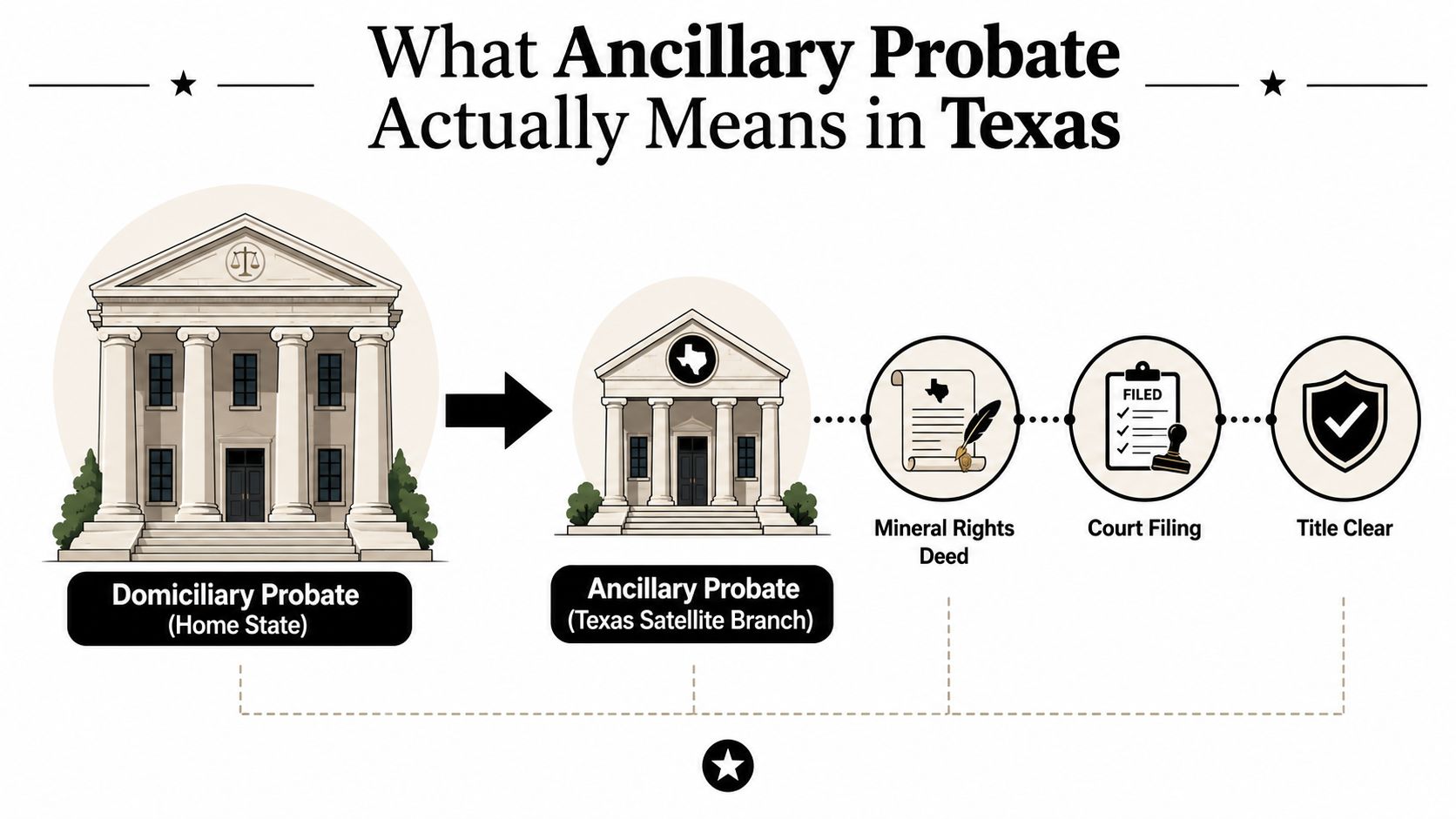
What Ancillary Probate Actually Means in Texas
Think of the home-state probate as the main office and the Texas case as the satellite branch. The home court handles the decedent's estate where they lived. The Texas court only steps in because the property is in Texas and the home-state judge doesn't have power to directly transfer Texas property.
That's why ancillary probate is a secondary proceeding filed in the Texas county where the property is located. Texas probate guidance specifically says mineral, oil, and gas interests are among the assets that commonly trigger this process, which is why even a non-resident with only a mineral interest can end up in a Texas courthouse. A concise description of that setup appears in the Texas ancillary probate guidance from Ryan Reiffert, and Texas Estates Code Chapter 358 gives the representative authority to work with mineral documentation once appointed under Texas law.
Why Texas treats mineral rights like real property
Mineral rights aren't treated like an ordinary bank balance that can be reissued after death. They're tied to land, title, and recorded ownership. That means the Texas court's job is to recognize the transfer in a way the county records and operators can rely on.
Title changes in the mineral world are paperwork-driven. If the operator can't see a recorded court order, it often won't change its records, and that keeps payments suspended. A Texas Probate Lawyer listing for Representation through Texas probate and estate administration fits naturally here because this is exactly the kind of county-level title issue probate lawyers handle.
What the Texas court is really doing
The Texas judge is not re-litigating the whole estate from scratch. The court is recognizing the foreign probate authority and then issuing Texas documents that can be recorded locally. That's the point where a paper interest becomes a recordable title instrument.
Texas ancillary probate exists to connect the home-state probate to the Texas property records. Without that connection, the operator has no safe basis to change the payee.
For families, the important takeaway is simple. The case is not about proving the loved one owned something in a general sense. It's about getting Texas to recognize who now has authority over that specific mineral interest.
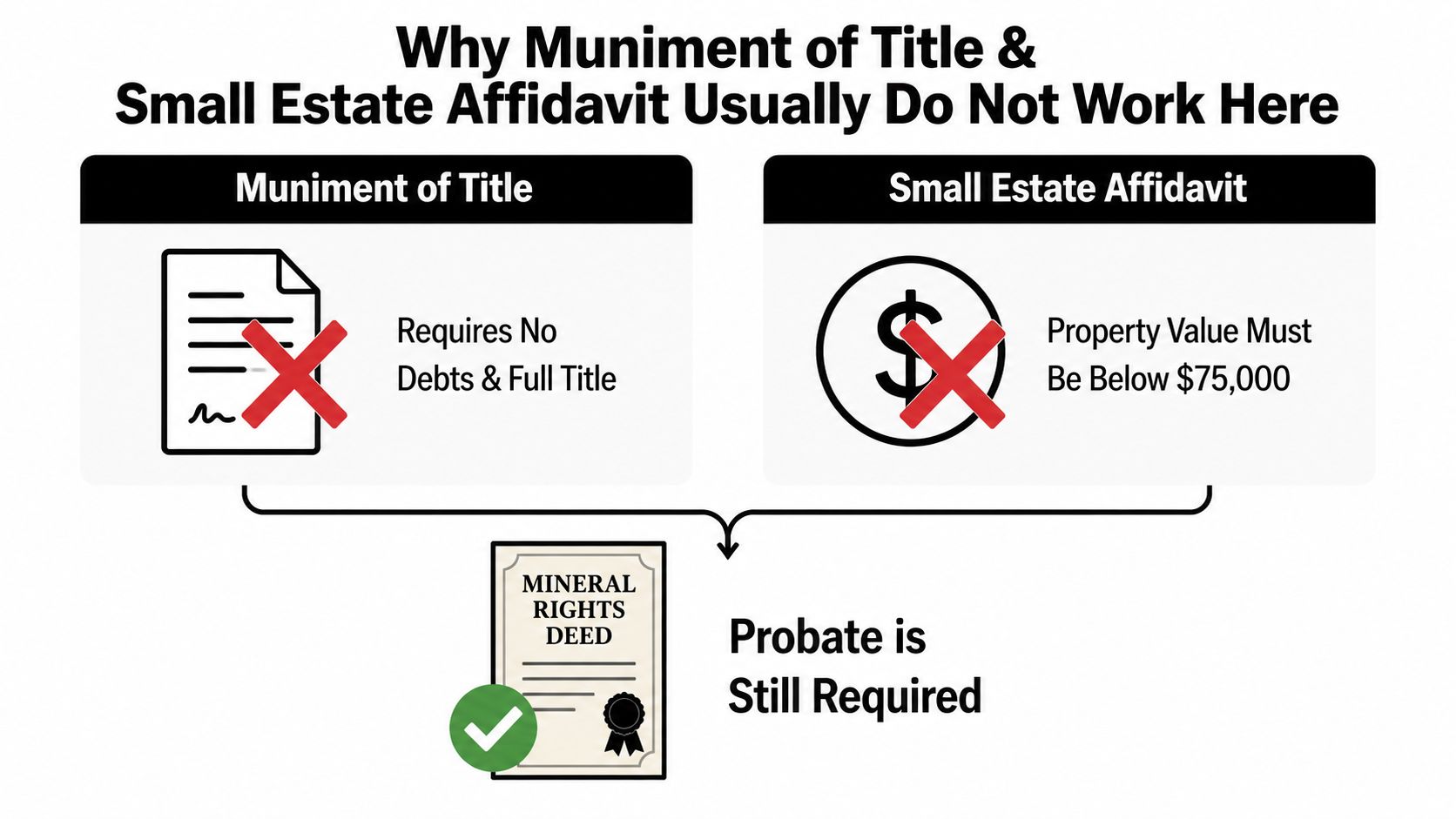
Why Muniment of Title and Small Estate Affidavit Usually Do Not Work Here
Families usually look for the fastest path first, and that's sensible. In Texas, the two shortcuts people ask about most are muniment of title and the small estate affidavit. Both can help in the right estate, but they usually fall short when the decedent was a non-resident and the only Texas asset was mineral rights.
Muniment of title has a narrow lane
Muniment of title is designed to record a will as a title-clearing instrument when the estate doesn't need a full administration. It can work when the will has already been handled properly and there's no need for ongoing estate management. But for a non-resident mineral estate, the issue is usually not just whether there's a will. It's whether Texas has a recordable proceeding that can be used in the county where the minerals sit.
That's where the Texas explanation of muniment of title is helpful, because it shows how narrow that shortcut really is. If the mineral interest is tied to Texas title records and the operator wants court-recognized authority, ancillary probate is often the safer route.
Small estate affidavits usually miss the mark
A small estate affidavit is often aimed at modest, simple estates. Mineral rights rarely fit neatly inside that box. Their value can be hard to determine, and operators usually want formal probate papers before they move the account out of suspense. Even when the family believes the interest is small, the legal process still treats it as a title-bearing asset, not a casual transfer item.
Affidavit of heirship is not the same as title clearance
An affidavit of heirship can sometimes help describe who the heirs are, but mineral operators often don't rely on it alone. They want a court order because it gives them more certainty. That's especially true when the decedent lived outside Texas and the family needs the Texas county record to line up with the home-state probate.
Bottom line: If the goal is to get royalties released, a document that only describes family history usually isn't enough. Operators want court-recognized title.
For this niche, ancillary administration is usually the practical path because it gives the county clerk and the operator something they can use.
The Filing Process Step by Step
A Texas ancillary probate case starts with a problem families often do not see until the royalty checks stop. The operator cannot change its records just because the family says who inherited the mineral interest. It wants Texas court paperwork it can trust, and the county recorder needs the same thing in the land records.
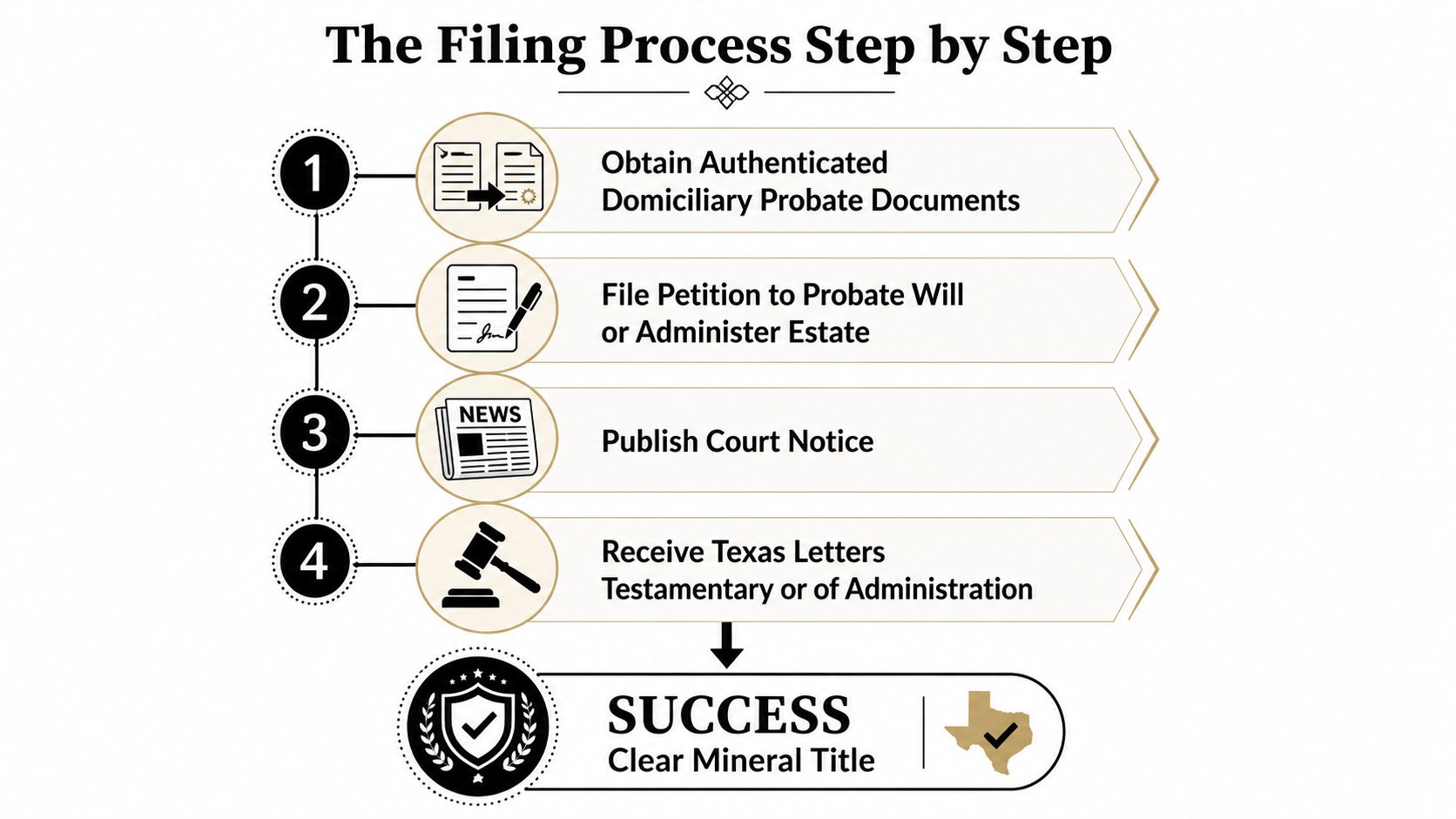
The first step usually begins in the home state, where the family or attorney gets authenticated copies of the domiciliary probate records. Those certified records are the Texas court's starting point, because they show that the estate was already opened or recognized where the decedent lived.
The Texas filing comes next. It must be filed in the Texas county where the mineral interest is located, since that is where the title record lives and where the order must eventually be recorded. Filing in the wrong county can leave the family with a valid-looking order that still does not clear title where the operator needs it.
The court then reviews the application and gives notice in the form the judge requires. If the paperwork is in order, the Texas court can recognize the foreign authority and issue the Texas letters that give the representative legal standing here. For the mechanics of that filing, families often start with the step-by-step guide to ancillary probate filing in Texas. Once the Texas court acts, Texas Estates Code Chapter 358 becomes important, because it allows the personal representative to execute division orders for mineral leases, pooling agreements, and unitization agreements without needing another court order, which is the kind of authority operators look for before they will change the payee record. The statutory language is in Texas Estates Code Chapter 358.
What usually happens at the clerk's office
At the clerk's office, the filing packet usually includes the petition, the authenticated home-state documents, and the county filing fee. If citation is required, it has to be issued or waived in the proper form. When the family is dealing with a foreign will, the Texas court relies on those authenticated records to decide whether it can recognize the will and appoint the Texas representative.
After that, the family may receive Letters Testamentary or Letters of Administration, depending on whether there was a will and how the estate is being handled. Those letters are the papers that tell the operator, in plain terms, that this person has authority to act for the estate in Texas.
Independent or dependent administration
Some Texas estates can use independent administration, which gives the representative more day-to-day control with less court oversight. Others require dependent administration, which is more supervised. In a mineral case, that choice affects how quickly the representative can sign paperwork, answer the operator's questions, and handle follow-up county recordings.
Remote families usually feel the delay at this stage. A missed county, a weak authentication packet, or the wrong Texas document can stall the file before it ever reaches the operator's division-order department. That is why the filing order matters so much, it is the path from the courthouse to the payee file.
A Realistic Scenario of a Non-Resident Mineral Estate
An Oklahoma daughter learns, months after her mother's death, that her mother owned a 1/8 royalty interest in a West Texas county. Nobody in the family had talked about it much, and the interest never showed up in the local probate file because the home-state probate was focused on Oklahoma assets. The first real clue was an old tax bill and a letter from the operator's division-order department asking for title documents.
The daughter assumes the existing probate order should be enough. It wasn't. The operator had suspended the royalty checks because it had no recorded Texas court order showing who now owned the mineral interest. That's the moment many families realize that the court process and the payment process are not the same thing.
The home-state file is only the beginning
The Oklahoma probate gave the family authority in Oklahoma. It did not, by itself, create a Texas record the county clerk or operator could rely on. So the family had to gather authenticated copies of the foreign probate documents and then open the Texas ancillary case in the county where the minerals were located.
That county-specific filing mattered because the title record had to be updated where the property sat. Once the Texas court recognized the foreign authority and issued the Texas order, the family finally had something recordable.
The operator still needed its own packet
Even after the Texas order was signed, the family wasn't finished. The operator's division-order desk needed the recorded order, the letters, and the other ownership paperwork before it would release the suspended account. The family also had to keep the records clean for the county and make sure the operator matched the legal names to the payee file.
That follow-up is the part families often underestimate. The courthouse can recognize the transfer, but the operator still has to update its internal records before the money moves.
The court order cleared the legal path. The operator packet cleared the payment path.
This is why mineral estates create so much confusion. Families think in terms of inheritance. Operators think in terms of title evidence and payment authority. Both have to line up before the checks start again.
In practical terms, the daughter's job wasn't just “finish probate.” It was to convert a dormant paper interest into a usable account record, county by county and operator by operator. That's what makes these cases feel slow, even when everyone is cooperating.
Timelines, Costs, and the Variables That Change Them
A clean ancillary mineral case can move in a few months when the foreign paperwork is already organized, the county is clear, and nobody disputes the heirs. That's the simple version. The timeline gets longer when the interest spans multiple Texas counties, when the home-state file is incomplete, or when the operator refuses to act until every recording is perfect.
What slows the case down
The biggest delay is usually documentation. If the family can't get authenticated copies from the home-state court right away, Texas can't move. A second delay appears when the mineral interests aren't all in one county, because each county may need its own recording trail.
Disputes also stretch the process. If heirs disagree about who owns what, the Texas court can't just wave that away. Missing signatures, unclear fractions, and stale owner records can turn a clean filing into a much longer administration.
What families usually pay for
The cost side is more than one line item. Families usually face Texas filing fees, recording fees, service of citation, certified copies, and attorney fees for the ancillary case. There can also be practical expenses if the family has to order records from another state, update title packets, or gather tax forms for each heir.
Practical rule: The cheapest case is the one with complete records before Texas is filed.
For families who are also thinking ahead for their own estate plans, a general guide like Edinhart's inherited house guide can be a useful reminder that inherited property often creates follow-up title work long after the death certificate is issued. Mineral rights have their own rules, but the title-closure problem is very similar.
The hidden cost is usually delay
When royalty checks sit in suspense, the family often spends more time chasing records than they expected. That doesn't always show up as a court fee, but it's still a real cost. Remote heirs may also end up spending money on travel, notary work, and repeated mailings because the operator won't accept an incomplete packet.
The safest approach is to assume the courthouse filing is only one part of the expense. The other part is getting the title recognized everywhere it needs to be recognized.
Tax and Title Implications Families Often Overlook
Mineral estates raise two kinds of questions at once. One is tax. The other is title. Families often focus on one and forget the other, even though both can affect whether the asset is settled.
Federal tax and Texas property records are separate issues
A mineral estate may or may not raise federal estate tax concerns depending on its overall size, but the tax question is not the same as the title question. Even when no federal estate tax issue is present, the family still has to get the Texas title recognized through the county record. In other words, tax clearance doesn't replace probate clearance.
Texas property records can also lag behind reality. If the mineral interest isn't recorded correctly in the county appraisal records, the family can get extra confusion later when notices show the wrong owner or the wrong mailing address. Keeping those records current helps prevent another round of paperwork after the probate is over.
Suspense money does not fix itself
Royalty payments can sit in suspense for a long time when no one gives the operator a usable title packet. That money doesn't automatically release just because the family knows who inherited the interest. Operators need the county record, the Texas order, and the right ownership documents in their file.
Record every county and notify every operator
If the minerals sit in more than one county, the ancillary order usually has to be recorded in each relevant county. Then the family or representative has to send the resulting packet to each operator's division-order department. One operator may respond quickly, while another wants a different format or a different certified copy.
When families are sorting out their broader property transfer issues, the title-closure problem often feels familiar. The process may look different from real estate, but the underlying point is the same, clear records are what let the transfer function.
Common Complications and When to Call a Texas Probate Attorney
The trouble usually starts with a paper gap that looks small from the family side and large from the courthouse side. A will may be missing a signature, the home-state probate may never have been opened, the mineral fraction may be unclear, or the operator may still be using an address that no longer reaches anyone. In a mineral-rights case, that kind of gap matters because the title has to be recognized by the county recorder and then accepted by the operator before suspended royalty checks can move.
The most common trouble spots
- Missing domiciliary probate records. Texas cannot rely on guesses or a family summary. If the home-state documents are incomplete, the Texas filing can stop before the court can treat the transfer as complete.
- Unknown mineral fractions. If nobody can show what was owned, the county filing may not give the operator enough information to update the payee file.
- Heir disputes. If siblings, step-relatives, or beneficiaries disagree, the problem stops being a recording issue and becomes a title dispute.
- No probate in the home state. If the foreign estate was never opened, Texas counsel has to decide whether an original probate path is available or whether the estate needs to be started elsewhere first.
- Dormant operator records. If the owner data is stale, the family may need follow-up with the division-order department before the suspense funds can be released.
When legal help becomes important
A Texas probate attorney becomes useful the moment the file stops looking like a simple recording job. That often happens before the Texas petition is filed, especially if the foreign documents need correction or the mineral title appears to touch more than one county.
A practical probate lawyer can also help the family avoid a common mistake, assuming the court order alone will fix the account. It will not. The order has to be turned into a title packet the county recorder and the operator can use, and that means getting the paperwork in the right order, in the right county, with the right certified copies.
Families often ask who can help them sort through that process. The answer is not a generic business resource, it is a lawyer who understands Texas mineral title and county recording practice, such as the team at Law Office of Bryan Fagan, PLLC.
Key insight and action plan
The key point is straightforward. A Texas court order is necessary, but it is only part of the job. The family still has to get the title recognized in the county records and accepted by the operator before the money starts flowing again.
- Gather the home-state probate records.
- Identify the Texas county tied to the mineral interest.
- File the ancillary case with the correct Texas documents.
- Record the order and send the operator packet until the payee file is updated.
If you are still comparing legal help, a weekly B2B newsletter service is not what solves a suspended royalty problem. Families need a lawyer who can work through the courthouse requirements, then follow the title packet until the operator updates the account.