 Skip to content
Two weeks after her husband's unexpected death, a Frisco widow sits at the kitchen table with a house deed, a brokerage statement, and a stack of unopened mail. She knows the family needs to move forward, but she doesn't know which assets belong to her, which debts must be paid, or who has legal authority to sign anything.
That uncertainty is common. Probate turns a death into a legal process, but it doesn't have to turn grief into confusion. The right probate attorney in Frisco can help identify the correct Texas procedure, protect the estate, meet court deadlines, and explain each decision in ordinary language.
What Probate Really Means for a Frisco Family
Probate is the court process used to establish a person's will, appoint someone to handle the estate, address debts and claims, and transfer property to the people legally entitled to receive it. Texas Estates Code Title 2, including Chapter 301, provides the framework for beginning probate and establishing the court's authority over the estate.
Probate isn't a tax, a punishment, or a finding that someone did something wrong. It's a legal doorway. A family may need to pass through it before a Frisco home can be transferred, a business interest can be handled, or certain financial accounts can be placed into the correct names.
Where the family lives doesn't change that definition. A home in Starwood, Phillips Creek Ranch, or near Main Street is still part of a Texas estate if the decedent owned it. The location can affect venue, however. Venue is the county and court where the case should be filed, often based on the decedent's residence or the location of estate property.
Why the first review matters
A will doesn't answer every practical question by itself. The attorney must also examine how assets are titled, whether beneficiary designations control certain accounts, whether debts remain unpaid, and whether family members agree about the proposed representative.
For example, a widow may believe the house automatically became hers because she was married to the decedent. The deed, community-property rules, mortgage, beneficiary documents, and will may all affect what must happen next. Until the estate is reviewed, signing a deed or distributing funds can create problems.
Texas probate practice has developed around a long-standing distinction between independent administration and dependent administration. The Texas Judiciary's 2023 annual statistical report records that nearly two-thirds of approximately 19,000 estate cases filed statewide involved an application for independent administration. In roughly 60,000 probate cases, almost 70% were independent administrations. The report also records a 5% decline in total probate cases from the prior year, while probate activity remained above earlier long-term levels.
That pattern helps explain why families often search for a Frisco probate lawyer who understands independent administration, inventories, creditor notice, title transfers, and final distribution as one connected process.
Practical rule: Don't assume the simplest-looking asset creates the simplest probate case. Start with the will, the asset titles, and the debts.
The Six Stages of Texas Probate From Filing to Final Distribution
Texas probate usually follows a recognizable sequence. The details vary depending on the will, the county, the assets, and whether the administration is independent or dependent.
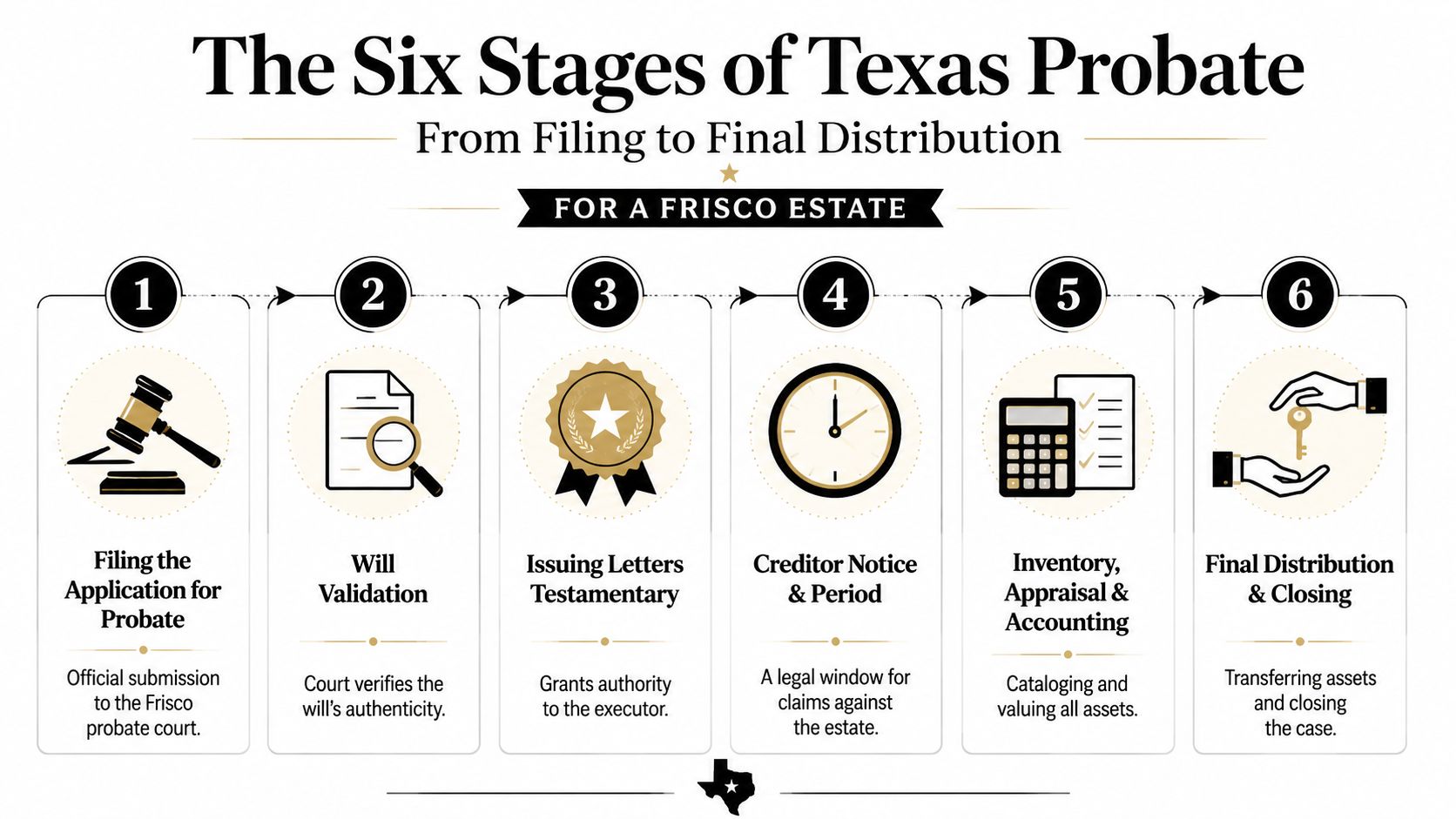
Stage one, filing the application
The process begins with an application to probate the will and appoint the named executor. If there is no will, the filing generally seeks an administration and appointment of an administrator. The application must identify the decedent, explain the applicant's relationship to the estate, identify the proper venue, and provide the information required by the Texas Estates Code.
A Frisco estate may require filing in Collin County or Denton County, depending on the facts. Correct venue and complete pleadings matter because a rejected or misdirected filing can delay the first hearing.
Stage two, proving the will and appointing the representative
At the probate hearing, the judge reviews the application, considers whether the will is valid, and determines whether the proposed executor or administrator may serve. If the court admits the will and grants the application, the representative receives Letters Testamentary when acting under a will, or Letters of Administration when serving without one.
Those letters are the practical proof of authority banks, title companies, investment firms, and other institutions often need before they'll recognize the representative's control over estate property.
Stage three, completing the inventory
After qualification, the representative must prepare the inventory, appraisement, and list of claims. Under Texas Estates Code Section 309.056, the filing is due within 90 days after qualification, meaning the deadline runs from issuance of the letters, not from the date of death. The Inventory, Appraisement, and List of Claims in Texas is the accounting of estate assets a representative must file.
The representative identifies assets, documents values, and lists known claims. Missing information early can create trouble later, particularly when the estate owns real property, business interests, vehicles, or accounts spread across institutions.
Stage four, notifying creditors and beneficiaries
The estate must address creditor claims through the notices required by Texas law. Some creditor procedures create a limited period for presenting claims, including a four-month claim period in applicable circumstances. Beneficiaries and interested persons may also need formal notice, depending on the proceeding.
Stage five, paying obligations and managing property
The representative gathers assets, protects the home and other property, pays valid debts, handles required tax filings, and keeps accurate records. Independent administration can reduce routine court involvement. Dependent administration generally requires more court approval before the representative can sell property, pay certain expenses, or distribute assets.
Stage six, distributing property and closing the case
Once debts and required obligations are resolved, the representative prepares the final accounting or other closing documents. The court can then authorize or confirm distribution and close the estate. A useful Texas probate timeline from start to finish can help an executor organize the work, but the actual schedule depends on the estate's circumstances.
The process is orderly, but it isn't automatic. Each stage builds the record needed for the next one.
Choosing the Right Texas Probate Path for a Frisco Estate
A Frisco family may have a valid will, a home, unpaid bills, and heirs who agree on most issues. Those facts can point to very different probate procedures. Texas probate is not one road. It is a set of routes, and the right choice depends on the will, assets, debts, and family circumstances.
Four paths, four different purposes
Independent administration fits an estate where the will or court permits self-directed administration. Texas Estates Code Chapter 401 provides the statutory structure. The personal representative can usually handle routine work with limited court supervision, while still following creditor rules, notice requirements, legal duties, and accounting obligations.
Dependent administration keeps more decisions under court supervision. The representative may need approval before selling property, paying certain expenses, or distributing assets. This route may fit a disputed or complicated estate, a will that does not authorize independence, or circumstances in which the court determines that closer oversight is appropriate.
Muniment of title can fit a valid will when continuing administration is unnecessary. Under Estates Code Section 257.001, the court must find that the estate has no unpaid debt other than debt secured by a lien on real estate, or that administration is unnecessary for another reason. The court recognizes the will, and its order can support title transfer without appointing an executor for ongoing administration. Unsecured debt, Medicaid recovery concerns, or unresolved obligations may make this option unsuitable.
A small estate affidavit is narrower. Under Estates Code Chapter 205, it applies when the decedent died without a will, no personal representative has been appointed or is pending, and the probate estate value does not exceed $75,000, excluding homestead and exempt property. The estate must also have enough assets to pay qualifying debts. It is not a general substitute for probate and may not resolve every real-property or title problem.
Frisco's location adds a practical question. Depending on the estate and the decedent's circumstances, the filing may belong in Collin County or Denton County. An out-of-state executor may also need a Texas resident agent. Those details can affect the application before the family reaches the question of distribution. As Frisco continues to grow, more local families will face these choices, making an accurate first classification increasingly useful.
| Probate Path | Best Fit | Court Involvement | Typical Time |
|---|---|---|---|
| Independent administration | Estate where the will or court permits self-directed administration | Limited supervision | Typically faster due to fewer court approvals |
| Dependent administration | Disputed, complex, or closely supervised estate | Approval commonly required for major actions | Usually more involved |
| Muniment of title | Valid will, debt-light estate, and no ongoing administration need | Court order focused on title | Often shorter than administration |
| Small estate affidavit | Will-less estate meeting Chapter 205 requirements | Affidavit and statutory process | Often simpler, if requirements are met |
The comparison of independent and dependent administration in Texas explains the supervision difference. A lawyer should review the will, property, debts, beneficiary arrangements, county venue, and family relationships together. That review can prevent a family from preparing an application for a procedure that cannot address the estate's actual problems.
What a Probate Attorney Actually Does for Frisco Families
A probate lawyer's work begins before the first document reaches the clerk. The attorney turns a collection of papers and family concerns into a legally appropriate plan.
Selecting the procedure
The first task is classification. The attorney examines whether the estate calls for independent administration, dependent administration, muniment of title, a small estate affidavit, or an affidavit of heirship. Each option addresses a different problem. A valid will with a paid-off home may point toward muniment, while unpaid debts or unresolved claims may require administration.
The lawyer also checks whether accounts pass outside probate through beneficiary designations, joint ownership, or other transfer arrangements. That review keeps the family from treating every asset as though it follows the same rules.
Preparing and managing the case
The attorney can draft and file the probate application in the appropriate Collin or Denton County court, prepare hearing materials, and help the proposed representative obtain Letters Testamentary or Letters of Administration. After qualification, the lawyer tracks the 90-day inventory deadline, helps collect valuations, and prepares required notices to creditors and beneficiaries.
The work continues after appointment. Counsel may assist with:
- Asset collection: Locating bank accounts, investment accounts, vehicles, real property, and business interests.
- Debt review: Separating valid estate obligations from disputed or unsupported claims.
- Tax coordination: Helping establish a federal EIN when needed and coordinating tax filings with the estate's accountant.
- Title transfers: Working with title companies to transfer a Frisco residence, vehicle, or other property correctly.
- Records and accounting: Maintaining documentation so beneficiaries can understand what came into the estate and what went out.
Handling family complications
An out-of-state executor may need a Texas resident agent. Local probate guidance explains that a non-Texas applicant, executor, or administrator must designate a Texas resident agent. The attorney can address the designation, remote qualification, and filings so the representative doesn't have to treat every court task as a reason to travel.
Minor children create another layer. A guardianship may be needed when a child's property or personal care requires court involvement, although guardianship and probate are separate legal matters. If someone challenges the will, disputes a creditor claim, or contests the representative's conduct, probate litigation may become necessary.
The Law Office of Bryan Fagan, PLLC handles probate administration, guardianship applications, wills and trusts, affidavits of heirship, and probate litigation. A local attorney can also coordinate with accountants, realtors, financial advisors, and title professionals, giving the family one organized point of contact instead of a long list of disconnected calls.
Timelines, Costs, and Collin and Denton County Court Specifics
A family may find a valid will, a Frisco home, and relatives ready to help, then still face a basic question: which court handles the case, and how much work will it require? The answer depends on the probate path, the court's schedule, the estate's assets, creditor issues, tax work, and whether anyone contests the case.
The four common paths do not operate alike. Muniment of title can transfer title under a valid will without ongoing administration when the facts fit. A small estate affidavit may simplify a will-less estate, but every statutory condition must be satisfied. Independent administration gives the representative more authority with less routine court supervision. Dependent administration requires court approval for more actions, so it usually involves more steps and continuing oversight.
| Probate Path | Typical Timeline | Estimated Cost Range | Best Fit |
|---|---|---|---|
| Independent administration | Varies with assets, claims, and court requirements | Depends on the estate and legal work | Estate with limited court supervision |
| Dependent administration | Often more involved because approvals are required | Depends on the estate and continuing supervision | Estate needing close court oversight |
| Muniment of title | Often shorter when uncontested and debt-light | Depends on filing and legal complexity | Valid will and no ongoing administration need |
| Small estate affidavit | Can be simpler when every statutory condition is met | Depends on document preparation and property issues | Qualifying will-less estate |
There is no reliable universal fee or fixed timeline for every Texas estate. A Texas probate cost guide can help a family prepare questions, but an attorney must review the estate before giving useful case-specific guidance.
Venue and local filing questions
Frisco's city limits reach into both Collin and Denton counties. The correct venue cannot be chosen from the city name alone. The decedent's residence, the location of real property, and other venue facts may determine whether the case proceeds through a Collin County or Denton County court.
The county affects practical details, including e-filing requirements, clerk procedures, hearing availability, and submission methods. Some tasks may be handled remotely, while others still require a hearing, an original document, or a specific filing process. Remote online notarization has been available in Texas since 2018, but it does not make every probate filing or court appearance remote.
An out-of-state executor also needs to address the Texas resident-agent requirement. The resident agent receives legal notices in Texas, while the executor remains responsible for the estate's administration. Setting this up early can prevent a representative who lives elsewhere from treating every court task as a reason to travel.
Court time is only one part of the schedule. Finding assets, confirming debts, preparing required documents, resolving questions about property, and obtaining approvals can determine when beneficiaries receive property.
What matters most: The shorter process is not automatically the better process. The right path protects creditors, beneficiaries, and the representative while limiting court work to what the estate actually requires.
Common Probate Pitfalls Frisco Families Should Avoid
The most expensive probate mistakes often begin with a reasonable assumption. A grieving family may believe it can wait, distribute a few items, or file a standard form without understanding the legal consequences.
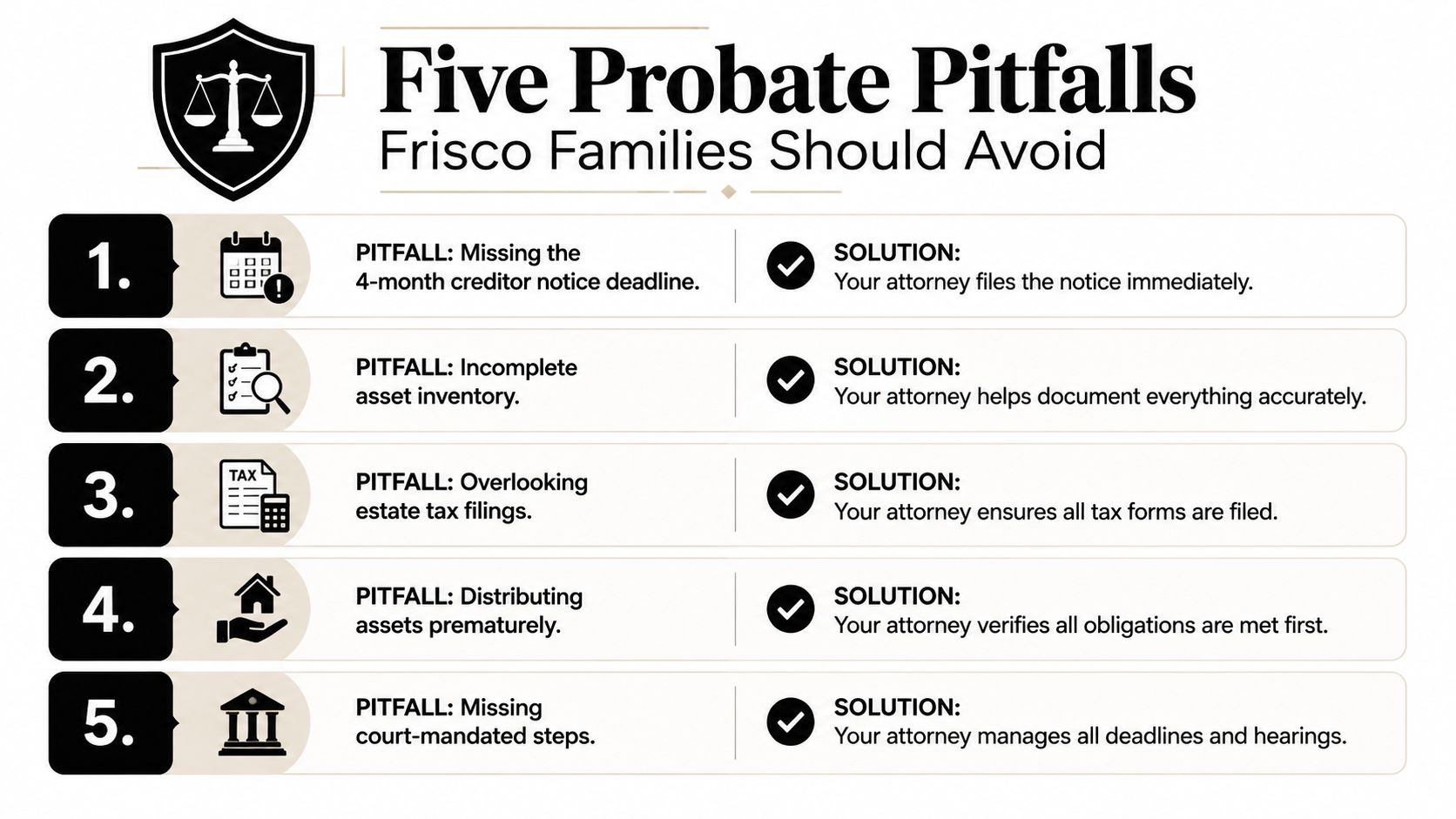
Five problems that deserve early attention
Missing creditor notice requirements. After letters are issued, the representative must follow the applicable creditor-notice procedures. Ignoring the four-month claim period in a situation where it applies can complicate later distributions. The fix is a written notice calendar that starts at qualification.
Skipping beneficiary notifications. Beneficiaries and other interested persons may have legal notice rights. If the representative distributes property without proper notice, the distribution may be challenged. An attorney identifies who must receive notice and keeps proof of service.
Using unsupported property values. A Frisco home, vehicle, or business interest must be listed and valued carefully in the inventory. A casual estimate can create disputes among heirs and problems with later accounting. The practical solution is to document the valuation method and preserve supporting records.
Choosing the wrong administration. Independent administration may reduce routine court involvement when authorized and appropriate. Dependent administration may be safer when heirs disagree or the estate needs supervision. The will, debts, family relationships, and property should guide that decision, not a desire to finish quickly.
Filing without checking the documents. DIY filings can fail because of missing signatures, an absent self-proving affidavit, incomplete information, or incorrect venue. A lawyer reviews the will and filing requirements before submission, reducing avoidable clerk rejections.
The Texas Estates Code assigns different duties to representatives at different points. A lawyer's value isn't limited to appearing at the hearing. It includes matching each action to the estate's legal posture and documenting what happened.
Next Steps and How the Law Office of Bryan Fagan Can Help
The first month after a death can feel impossible, but a short, organized checklist gives the family somewhere to begin.
- Find the original will. Don't rely only on a photocopy or an informal statement that a will exists.
- Gather death certificates and key records. Collect deeds, account statements, insurance information, vehicle titles, business records, and known debts.
- List the people involved. Identify beneficiaries, heirs, minor children, potential creditors, and anyone named as executor or alternate executor.
- Separate asset types. Mark property that may pass by beneficiary designation or joint ownership instead of assuming everything requires the same probate procedure.
- Compare the four paths. Ask whether independent administration, dependent administration, muniment of title, or a small estate affidavit fits the actual facts.
- Speak with counsel before filing. A Collin or Denton County probate attorney can identify venue, prepare the application, and create a deadline plan.
Frisco's continued growth makes careful planning increasingly important. The City of Frisco reported a population estimate of 233,200 in April 2024, with year-over-year growth of 3.1% from 2023 to 2024 and 3.6% from 2022 to 2023. The city also reports a current build-out population estimate of 330,000±, pointing to continued household and property growth. As more families own homes, retirement assets, and business interests, more families will need clear instructions for transferring those assets.
Texas probate law has also evolved over time. The Texas Probate Code was approved on April 4, 1955, became effective on January 1, 1956, and was later replaced by the Texas Estates Code effective January 1, 2014. That history explains why current counsel must work with the Estates Code while understanding the older documents and procedures families may still encounter.
Key Insight: Early legal review can help shorten the path, reduce an executor's risk, and keep a family disagreement from becoming a larger dispute.
If you're facing probate in Texas, our team can help guide you through every step, from filing to final distribution. Schedule your free consultation today.
The Law Office of Bryan Fagan, PLLC helps Frisco-area families evaluate probate options, prepare filings, manage inventories and notices, and address guardianship or contested estate issues in Texas. Visit Law Office of Bryan Fagan, PLLC to request a free consultation and discuss whether Collin or Denton County is the appropriate venue for your estate.


