 Skip to content
The morning after a father's death, a Montwood family may find itself gathered around the kitchen table with a stack of unopened mail, a safe-deposit-box key, and a 2008 pickup that still carries his name on the title. The funeral is planned for Saturday. The family is grieving, yet ordinary responsibilities keep arriving. Someone has to find the will, protect the house, handle bank accounts, and determine who has authority to act.
Probate is the court process that gives a person legal authority to step into the deceased person's shoes. Without that authority, a bank may restrict access to accounts, a title company may refuse to transfer or sell real estate, and even routine bills can become difficult to manage. Probate isn't a punishment or a tax. It's the legal process for identifying property, addressing debts, and transferring what remains to the proper heirs or beneficiaries.
El Paso County has two probate courts, Probate Court No. 1 and Probate Court No. 2. The county's Probate-Civil Division manages probate records and handles requests for letters testamentary and guardianship letters, reflecting a court system organized around supervised estate transfers and official records (El Paso County Probate Courts).
If your family is in those first difficult days, a practical starting point is this legal checklist for what to do immediately after a loved one dies in Texas. The first questions are usually simple but important: Was there a will? Where is the original? Does the estate include real estate? Are there unpaid debts? The answers shape the path ahead.
When a Loved One Dies in El Paso
The family at that Montwood kitchen table doesn't need a lecture filled with legal terms. They need to know what happens next. A probate attorney El Paso families trust should begin by identifying the immediate practical issues, protecting property, and explaining which decisions can wait.
Start with the original will, if one exists. A photocopy can help an attorney understand the deceased person's wishes, but the court may require the original document for probate. Look for codicils, trust documents, beneficiary designations, deeds, vehicle titles, bank statements, insurance policies, and recent tax records. Don't discard papers just because they appear outdated. An old deed or account statement may help establish ownership.
The pickup is a useful example. The family may know who drove it, paid for repairs, and expected to inherit it. That doesn't necessarily give anyone immediate legal authority to sell or retitle it. The probate process helps establish who can act for the estate and who should ultimately receive the vehicle.
A helpful first question is not “Who gets everything?” It's “Who has legal authority to protect and manage the property right now?”
El Paso County's probate courts provide the formal setting for that process. The court may admit a will, appoint an executor or administrator, issue authority documents, and maintain records connected to the estate. The county's probate reporting also shows a substantial and continuing workload. El Paso County has a population of 840,410, with annual probate activity figures including 980 and later 1,173 in successive reports, along with tracked categories such as guardianships and heirship matters (Texas Courts probate activity reporting).
That volume doesn't tell you exactly how long your case will take. It does show why local probate practice is structured, document-driven, and familiar to lawyers who regularly work with the county's courts. Families don't have to understand every filing before asking for help. They need an organized review of the will, property, debts, family relationships, and deadlines.
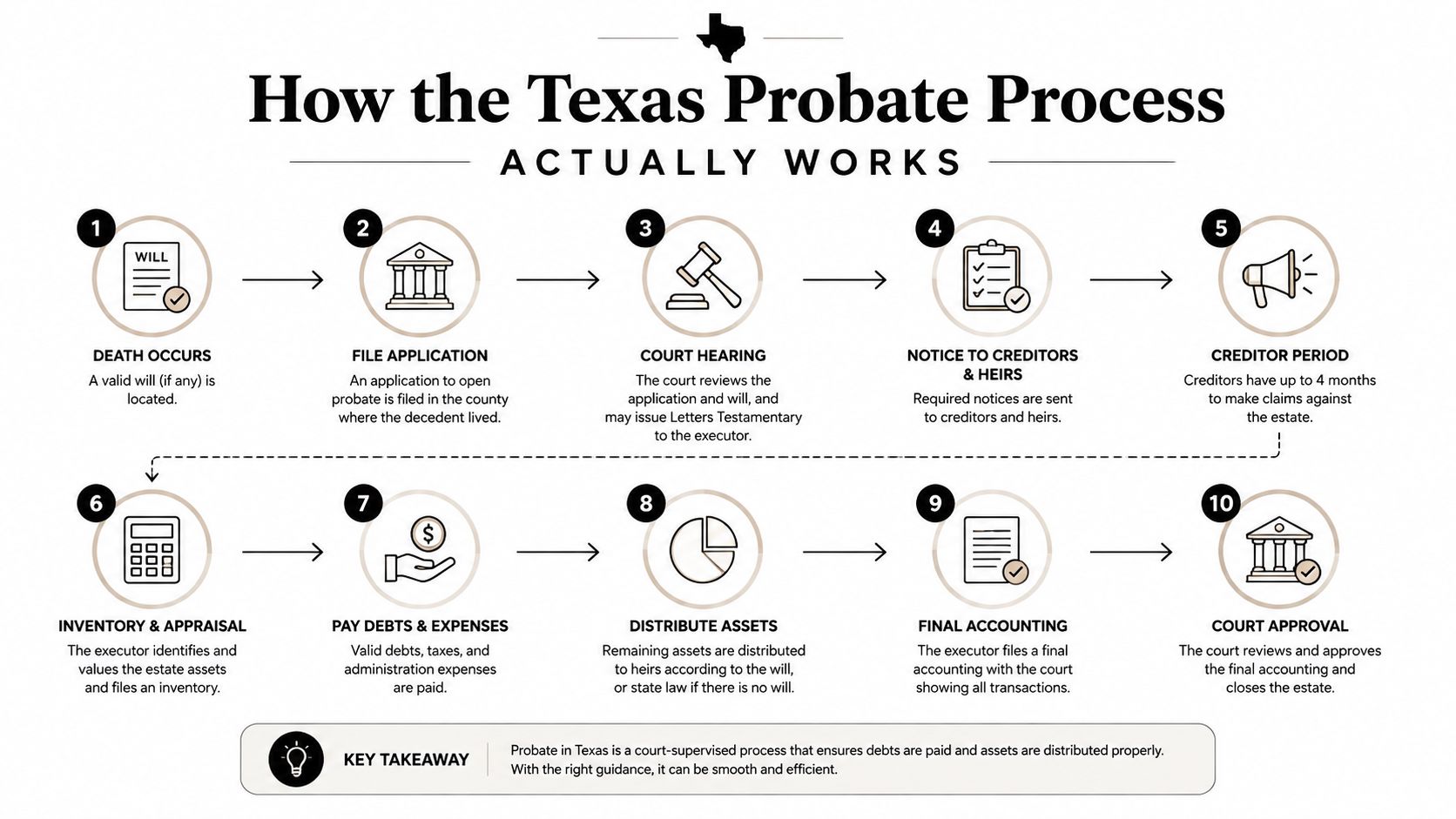
How the Texas Probate Process Works
A family in El Paso may begin with a simple question: who can access a bank account, protect a home, or handle a vehicle after a loved one dies? Probate answers that question through a court-supervised sequence. The details depend on the will, family agreement, debts, and possible disputes, but the main steps follow a recognizable order.
Starting the court case
The proposed executor or another interested person files an application or petition in one of El Paso County's two dedicated probate courts. Local filings commonly begin a few weeks after death, once the family has located the will and gathered basic information. The county clerk's office processes filings and maintains records. The probate judge reviews the case, signs orders, and resolves questions that require a judicial decision.
The application asks the court to recognize the death, determine whether the will is valid, identify the proper heirs or beneficiaries, and appoint the person authorized to administer the estate. In practical terms, it opens the court file and gives the family's legal questions a formal place to be answered.
Proving the will and appointing the representative
Under Texas Estates Code Chapter 304, the court considers proof of the will and the qualifications of the proposed executor. If the court appoints an executor under independent administration, that person generally has more freedom to manage estate affairs without seeking approval for every ordinary transaction.
If the named executor cannot serve, or if the estate is intestate, meaning there is no valid will, the court may appoint an administrator. A dependent administration brings closer judicial supervision. The right appointment matters because it determines who may act for the estate while property, debts, and beneficiary questions are being addressed.
The court then issues Letters Testamentary when an executor serves, or letters of administration when an administrator is appointed. These letters function like the representative's permission slip. They provide proof that the person has authority to deal with banks, insurers, government offices, and other parties. Texas Estates Code Chapter 31 identifies letters as a core probate function, while venue rules for probating wills and granting letters appear in Title 2, Chapter 33, Section 33.001.
Giving notice and creating the estate snapshot
Creditors receive notice under Texas Estates Code Chapter 308. A claim is an outstanding debt, such as a valid bill, loan balance, or other obligation. Notice gives people and businesses with legitimate claims a way to present them to the estate.
The executor also prepares the inventory, appraisement, and list of claims. This document works like an estate snapshot. It identifies property, assigns values, and records known claims so the court and interested parties can see what the estate contains. Texas law requires the inventory to be filed no later than 90 days after the judge signs the order admitting the will to probate, unless an affidavit in lieu is accepted, as explained in Texas Law Help guidance on estate administration.
Paying obligations and distributing property
After the estate identifies its property and debts, the representative handles valid expenses, creditor matters, and required tax work. Once those responsibilities are addressed, assets may be distributed under the will or Texas inheritance law. Texas Estates Code Chapter 405 addresses distribution and the representative's duties during that stage.
A Texas Probate Lawyer may represent a family through the filings and administration tasks that connect these steps, from opening the case in El Paso County to preparing for closure.
Choosing the Right Probate Path in El Paso
At an El Paso County kitchen table, one family may be holding a signed will, while another is trying to identify heirs and property without one. Those cases do not belong on the same legal track. The appropriate path depends on the will, the property, unpaid debts, family agreement, and whether anyone challenges the proposed transfer. El Paso's two dedicated probate courts may handle these filings, but the court's level of involvement changes with the path selected.
Independent administration
Independent administration often fits an estate when the will authorizes it or the interested parties provide the required consent. After the independent executor is appointed and the required inventory or affidavit in lieu is addressed, the court generally stops supervising ordinary administration. Further court action is barred unless the Estates Code specifically requires it, as provided by Texas Estates Code Section 402.
The executor can generally collect assets, address valid creditor matters, and distribute property without asking a judge to approve each routine transaction. It works much like giving a trusted person the keys to manage an estate while the court remains available for matters the law reserves for judicial review. This structure may reduce delay when the family agrees and the assets are easy to identify.
Dependent administration
Dependent administration keeps the court involved throughout the case. The representative may need approval for significant decisions involving estate property, sales, expenses, and distributions. The process can fit an estate with no will, family disagreement, creditor concerns, or property that requires closer oversight.
Court supervision does not automatically mean someone acted improperly. It can provide guardrails when independent decision-making could create a dispute or expose the estate to avoidable risk. In El Paso County, that usually means more filings and more points at which the representative must wait for court action.
Muniment of title
A muniment of title may fit when a will establishes ownership of real estate, the estate has no debts requiring full administration, and the family does not need a continuing estate administration. The court proves and records the will so the property can pass under its terms.
The process is focused on proving and recording title without full administration. It does not provide a general substitute for handling an estate with unpaid debts, complicated assets, or unresolved disputes.
Affidavits and smaller estates
An affidavit of heirship may help establish who inherited real estate when there is no will and a full administration is unnecessary. It can clarify ownership of property that has remained in a family for years without a formal probate case. Title companies and other parties may still require supporting family history and documentation.
A small estate affidavit has narrower requirements. It applies to an intestate estate with no pending administration, at least 30 days after death, and personal property worth $75,000 or less, excluding homestead and exempt property. The estate must have enough assets to pay debts other than a mortgage or debts secured by exempt property. Real property is generally excluded, except for a homestead passing to a surviving spouse or minor children, as described by the Texas State Law Library informal probate methods.
| Path | Best When | Estates Code Chapter | Typical Speed | Court Supervision |
|---|---|---|---|---|
| Independent administration | A valid will or agreement supports an independent executor | Chapter 401 | Often efficient for an uncontested estate | Limited after appointment and required filings |
| Dependent administration | No will, disagreement, creditor concerns, or need for close oversight | Title 2 administration provisions | More involved | Continuing supervision |
| Muniment of title | Real estate needs to pass under a will and full administration isn't needed | Chapter 257 | Focused on proving and recording title without full administration | Focused on proving and recording title |
| Affidavit of heirship | No will and real estate ownership can be established without full administration | Chapter 203 | Depends on title and family documentation | Limited probate involvement |
| Small estate affidavit | Intestate estate meeting the statutory conditions | Chapter 205 | Limited formal process when statutory conditions are met | Limited, if accepted |
A practical guide is will and agreement often point toward independent administration; no will and no dispute may point toward an affidavit of heirship; only real estate and no debts may support a muniment; a qualifying modest intestate estate may fit a small estate affidavit. The differences between Texas independent and dependent administration can affect filing requirements, court involvement, and timing. A probate attorney can review the family's facts before anyone selects a path.
Documents and Deadlines Every Executor Should Know
A grieving family may find the original will in a desk drawer, a safe-deposit box, or an attorney's file. Start one organized estate folder. Protect the original documents, make working copies, and record each filing, notice, payment, and conversation involving estate property. That record helps your attorney and the El Paso County probate court follow the case.
The first part of the process
Gather the original will and any codicils, which are later documents that change or add to a will. If the will is in a safe-deposit box, ask the bank how an executor can access it for probate purposes. Keep multiple death certificate copies available for institutions that require proof of death.
Notify agencies and account providers that need notice. These may include the Social Security Administration, the Texas Department of Public Safety, insurance companies, banks, retirement-plan administrators, and utilities. Each notice has a practical purpose, such as stopping payments, protecting accounts, or identifying benefits.
The 90-day working plan
The inventory deadline deserves close attention because it gives the administration a firm early task. The inventory, appraisement, and list of claims are generally due no later than 90 days after the judge signs the order admitting the will to probate, unless an affidavit in lieu is accepted. That affidavit is available only when no unpaid debts exist other than secured debts, taxes, and administration expenses.
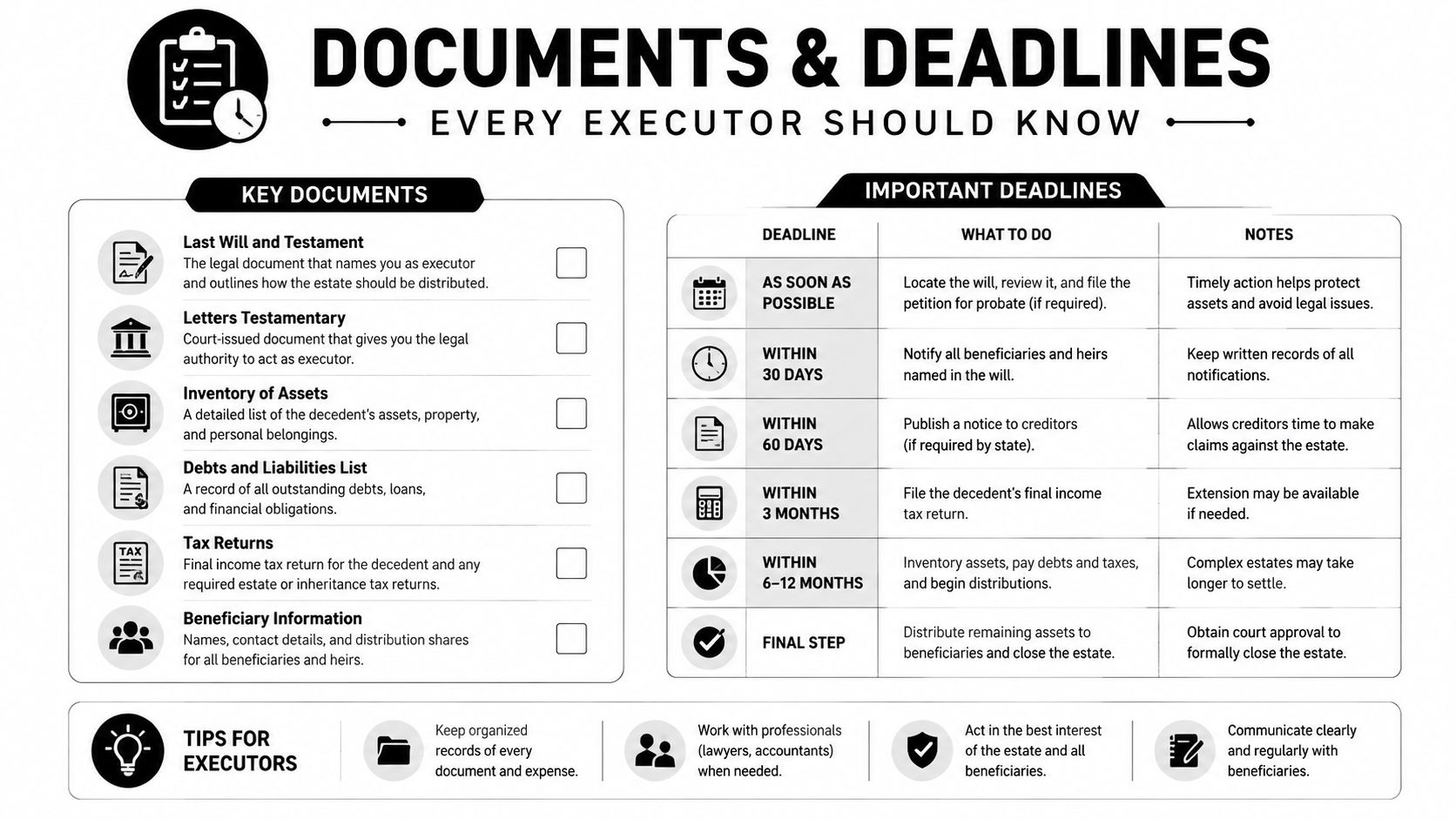
During the early administration period, locate accounts, identify real estate, confirm vehicle ownership, obtain appraisals when needed, and review possible debts. Track creditor notices, beneficiary notices, and court-specific filing requirements for El Paso County Probate Court No. 1 or Probate Court No. 2. The court clerk or your attorney can confirm how and where each document must be filed.
What a Probate Attorney in El Paso Really Costs
Families often want a number before they know the estate's shape. That's understandable, but probate fees depend on facts such as the administration type, the number of assets, real estate locations, creditor problems, family agreement, and whether litigation develops.
A routine independent administration may be handled through a flat-fee arrangement. This approach can make budgeting easier when the estate has a valid will, identifiable assets, cooperative heirs, and no serious dispute. A lawyer may instead bill hourly when the work is unpredictable, especially in dependent administration or contested probate.
Texas law also provides a statutory compensation framework for some estate administration services. A lawyer should explain whether that method applies, how the calculation works, and whether the engagement agreement uses a different lawful fee structure. Don't assume the attorney's fee includes every expense.
Costs beyond legal fees
Court filing charges, publication expenses for required notices, appraisal work, certified copies, recording charges, and special services may be separate. The estate may also incur costs connected to securing property, maintaining insurance, addressing repairs, or obtaining professional tax advice.
| Cost Item | Typical Range / Method |
|---|---|
| Attorney representation | Flat fee, hourly billing, or another agreed lawful structure |
| Court costs | Charged according to the applicable El Paso County filing |
| Creditor notice publication | Separate publication expense when required |
| Appraisals | Depends on the type and complexity of property |
| Certified copies | Charged per copy by the issuing office |
| Probate litigation | Usually handled under an hourly or litigation-specific agreement |
A useful fee discussion asks what work is included, which expenses are separate, how contested matters are billed, and what happens if new property appears. The Texas probate attorney fees guide can help families prepare questions before a consultation.
Common Complications and How Families Handle Them
A will can be clear to the person who wrote it and still create confusion after death. Consider a blended family in northeast El Paso. Three adult children discover that their father's handwritten will leaves the family home to only one sibling. The other two believe the document doesn't reflect his true wishes and question whether he understood what he signed.
The disagreement becomes a will contest in El Paso County Probate Court. Instead of allowing every family conversation to become a courtroom fight, the parties gather medical records, messages, witness information, and property documents. With counsel, they participate in mediation and reach a resolution that addresses the house and the competing claims.
The legal tools depend on the facts. A temporary injunction may help preserve property or prevent an action that could harm the estate while the court considers the dispute. A court may also authorize an independent administration with full power of sale when that structure is legally available and appropriate. These tools don't erase grief, but they can protect the estate while the disagreement is addressed.
A different problem arises when an adult child in California learns that her grandmother named her executor of an estate involving a home in Segundo Barrio. She's willing to serve, but she can't appear at every local appointment, inspect every document in person, or coordinate repairs from another state.
Remote administration requires careful organization. The executor may need out-of-state notarization, reliable document delivery, local assistance with property, and timely communication with the El Paso probate court and institutions holding estate assets. A local attorney can help coordinate the Texas filings while the executor makes decisions from California.
Distance doesn't remove an executor's duties. It makes communication, recordkeeping, and local coordination more important.
Questions El Paso Families Ask Most
| Question | Plain-English Answer |
|---|---|
| How long do we have to probate a will? | A will generally must be offered for probate within four years after death. El Paso's probate FAQ also notes that will contests can arise up to two years after admission, so families should address the timing promptly (El Paso County probate FAQ). |
| Can an heir attend remotely? | Some Texas courts use Zoom or submission dockets for uncontested matters, but families shouldn't assume a particular El Paso hearing will be remote. Confirm the format with the court and prepare documents, identification, testimony, and exhibits as required. |
| Can property pass without probate? | Sometimes. A qualifying small estate affidavit, a beneficiary designation, or property held with a right of survivorship may transfer property outside a full administration. Each method has its own requirements, and one account passing automatically doesn't necessarily resolve the rest of the estate. |
| When should we hire a lawyer? | Legal guidance is especially valuable when there's real estate, a missing or disputed will, creditor pressure, blended-family conflict, an out-of-state executor, or uncertainty about the correct procedure. An organized family with a simple independent administration may handle more tasks itself, but it still must meet court and statutory requirements. |
The four-year rule is not a reason to wait. If the deadline is approaching, gather the will and death records and obtain legal advice immediately. A missed deadline can affect the available probate options and may make title or inheritance problems harder to resolve.
A Compassionate Next Step for Your Family
Probate is a court-supervised process, but it doesn't have to feel like an unknowable maze. The appropriate path depends on the will, the estate's assets, unpaid debts, real property, family relationships, and the presence or absence of disagreement. In El Paso, the two probate courts and the Probate-Civil Division provide the institutional framework, while the executor handles the practical work of gathering, protecting, and accounting for property.
Takeaway
- Find the original will: Look for codicils, deeds, account records, and beneficiary information.
- Identify the right path: Independent administration, dependent administration, muniment of title, heirship procedures, and small estate affidavits serve different situations.
- Protect the 90-day window: Asset identification, valuation, and creditor review should begin early.
- Ask for help when facts are complicated: Disputes, real estate, remote executors, and unclear ownership deserve careful legal review.
- Keep communication clear: Family members usually cope better when they understand who has authority and what happens next.
The Law Office of Bryan Fagan can help turn a difficult estate into a manageable list of decisions, filings, and deadlines. A free consultation gives your family a chance to explain what happened, identify the likely probate route, and discuss the next responsible step without pressure.
If you're facing probate in Texas, our team can help guide you through every step, from filing to final distribution. The Law Office of Bryan Fagan, PLLC offers guidance with Texas probate, estate administration, wills, trusts, guardianship, and probate disputes. Schedule your free consultation today.


