 Skip to content
Maria and Carlos had spent years building a quiet, ordinary life in San Antonio. Their home was titled in both names, their community checking account paid the monthly bills, and the family SUV carried them everywhere. When Carlos died unexpectedly, Maria discovered that ownership on paper didn't always mean immediate access. The mortgage servicer wanted probate letters before removing Carlos's name, the bank froze the joint account until it received a death certificate and affidavit, and the SUV sat unused because his name remained on the title.
For a grieving spouse, that uncertainty can feel overwhelming. A Texas community property survivorship agreement can help married couples decide during life that covered community property will pass automatically to the surviving spouse at death. The agreement doesn't solve every estate issue, but it can prevent certain assets from becoming part of the probate process and give the survivor a clearer path to control.
When a Surviving Spouse Gets Locked Out
Maria's immediate problem wasn't a complicated investment portfolio. It was access to the assets her household used every day. She still had bills to pay, a home to maintain, and transportation needs, yet each institution treated Carlos's death as a title and documentation problem.
A joint bank account may look as though it should belong automatically to the surviving spouse. A jointly owned house may create the same expectation. But ordinary community property and community property with a right of survivorship aren't identical. Without valid survivorship language, the deceased spouse's interest may remain part of the estate and require administration through a will, intestacy proceeding, or another probate procedure.
Practical rule: Joint ownership by itself doesn't always answer what happens to a deceased spouse's interest.
That distinction matters most during the period immediately after death. Maria might need probate guidance about spousal rights, including the issues discussed in this Texas explanation of a surviving spouse's claim in probate, while also trying to persuade banks, lenders, and title companies to recognize her ownership.

A properly prepared survivorship agreement can change the result for the property it covers. Instead of directing Carlos's interest through his will or the intestacy laws, the agreement states that the property will become Maria's by survivorship. Texas Estates Code Chapter 112 makes a qualifying agreement effective and enforceable without adjudication, although a bank or title company may still request supporting documents.
That doesn't mean Maria's entire estate administration disappears. Carlos could still have separate property, uncovered community assets, debts, or other matters requiring probate. The agreement's value lies in separating covered assets from those remaining issues, so the surviving spouse has a more direct route to the home, account, vehicle, or other specifically included property.
What a Community Property Survivorship Agreement Actually Does
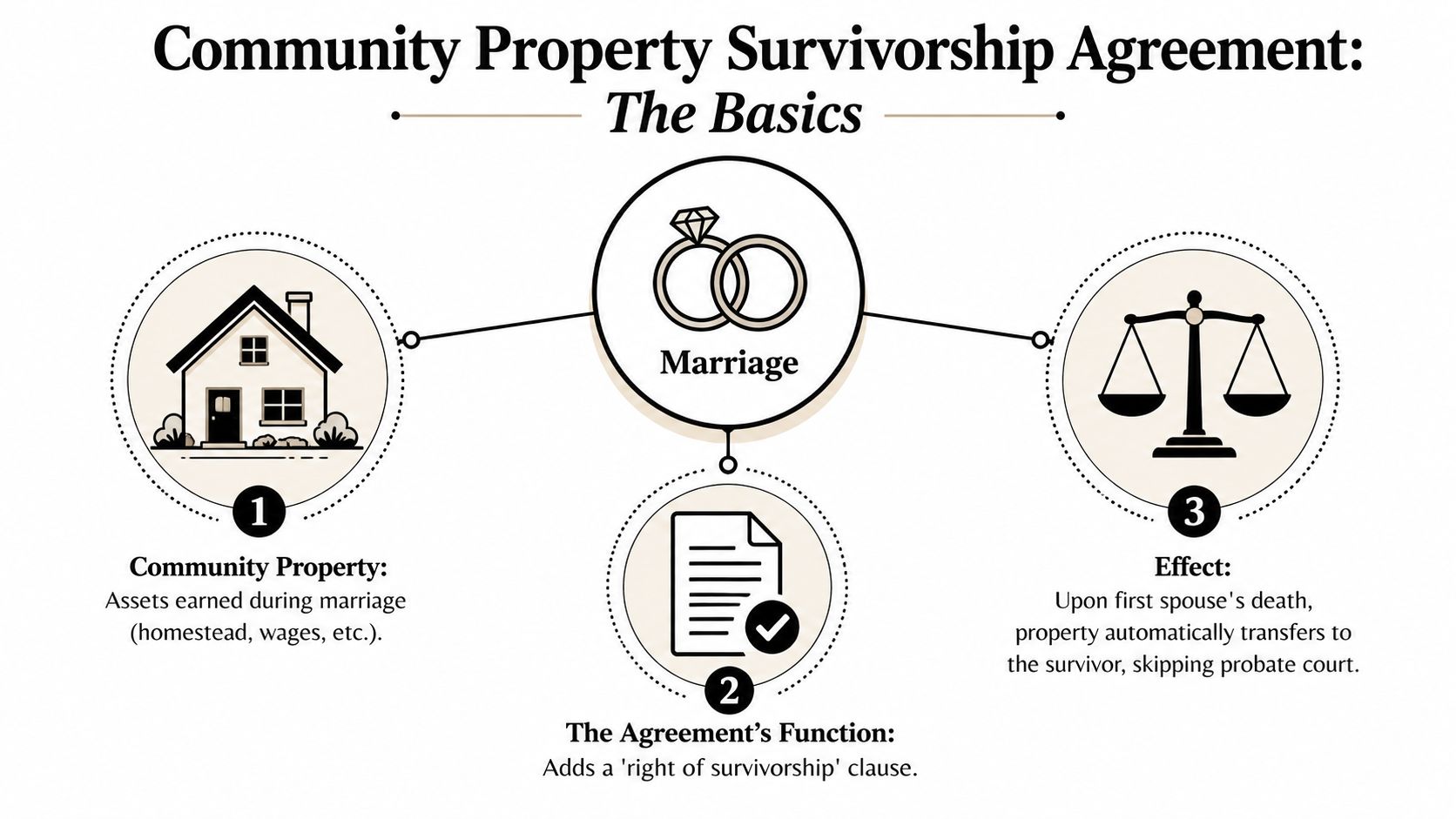
Start with the basic property concept. Under Texas community-property principles, property earned or acquired during marriage generally belongs to the community unless an exception makes it separate property. Community property can include a residence, wages, bank funds, investment accounts, business interests, and personal property, depending on how the asset was acquired and maintained.
Ordinary community property doesn't automatically give the surviving spouse the deceased spouse's half at death. The deceased spouse's interest may pass under a will or under intestacy rules, which are the legal rules used when someone dies without a will. A survivorship agreement changes that result for the property identified in the agreement.
The agreement's central function
A CPSA is a written contract between spouses. It says that all or part of their community property will pass to the survivor when the first spouse dies. Texas Estates Code Chapter 112 recognizes this arrangement and supplies the formal requirements that make the transfer legally operative.
The agreement doesn't convert the property into separate property while both spouses are alive. The property remains community property, and, unless the agreement provides otherwise, the spouses' management, control, and disposition rights remain unchanged during marriage. The significant change occurs at death, when qualifying property passes to the surviving spouse outside probate. These effects are reflected in Texas Estates Code provisions governing survivorship property.
Texas's modern framework has a specific history. Texas voters approved a constitutional change on November 3, 1987, allowing spouses to create survivorship rights in community property. Before that change, survivorship could be created only indirectly. The amendment to Article XVI, Section 15 established the constitutional foundation later reflected in Chapter 112.
Why this differs from ordinary joint ownership
A survivorship agreement focuses on the spouses' community-property relationship and can cover property described in one instrument. That's different from assuming that a deed, account label, or shared title automatically transfers every ownership interest at death.
The arrangement can also preserve the property's community character during life. That distinction may matter for tax and family planning, but a lawyer should review the couple's complete plan before promising a particular tax result. A Texas Probate Lawyer may provide representation through Texas probate and estate administration when a survivorship agreement covers only some of the estate.
Texas Estates Code Requirements for a Valid Agreement
Texas law treats a community property survivorship agreement as a formal legal instrument, not an informal promise between spouses. Under Estates Code §§ 112.051, 112.052, and 112.053, the agreement must be written and signed by both spouses. A conversation at the kitchen table, an unsigned draft, or one spouse's unilateral instruction won't satisfy that core requirement.
The document should identify the property with enough precision that a bank, title company, court, or future buyer can determine what the spouses intended to cover. For real estate, that generally means using the property's legal description. For a financial account, the account information should distinguish it from other accounts. The more carefully the document identifies the asset, the less room there is for a later dispute.
The language matters
Texas Estates Code § 112.052 recognizes phrases such as “with right of survivorship,” “will become the property of the survivor,” “will vest in and belong to the surviving spouse,” or “shall pass to the surviving spouse.” The wording should connect the survivorship promise to the community property being covered.
Both spouses must sign the same agreement or instrument establishing the arrangement. One spouse can't unilaterally create a survivorship right that binds the other spouse's interest. A notary acknowledgment is also important when real property is involved because recording requirements and later title review demand reliable proof that the signatures are genuine.
The agreement is effective and enforceable without a court adjudication when it satisfies Chapter 112. That rule is stated in Texas Estates Code § 112.053. Still, an institution may request a certified death certificate, a recorded agreement, an affidavit, or a court order before changing its records.
| Requirement | Estates Code Section | Drafting Action |
|---|---|---|
| Written instrument | § 112.051 | Put the agreement in a complete written document. |
| Signatures from both spouses | § 112.051 | Have both spouses execute the same instrument. |
| Clear survivorship language | § 112.052 | Use “with right of survivorship” or substantially similar language. |
| Specific property identification | §§ 112.051 and 112.052 | List legal descriptions, account details, or other identifying information. |
| Effect without adjudication | § 112.053 | Preserve the executed original for later title or account work. |
A useful starting point for reviewing the statutory framework is the firm's guide to the Texas Estates Code. Missing a spouse's signature or using vague language can undermine the intended transfer, so drafting should be handled with the same care as a will or deed.
Comparing Survivorship Agreements to Other Texas Transfer Tools
No single transfer method fits every asset or family. A survivorship agreement may be useful for a homestead and selected community accounts, while a pay-on-death designation may be easier for one bank account. A will remains important for property that isn't covered by another arrangement.
A pay-on-death account names a beneficiary through the financial institution. A transfer-on-death securities registration serves a similar function for qualifying investments. These tools can be simpler for an individual account, but they don't create one coordinated arrangement for every type of community property.
A beneficiary deed under Texas Property Code § 114.001 addresses real property through a recorded transfer-on-death instrument. It may be appropriate for certain real estate plans, but it isn't the same as a community property survivorship agreement. Couples should also review the Texas transfer-on-death deed process before selecting a deed-based solution.
| Tool | Probate Avoidance | Creditor Exposure | Spousal Signature Required | Post-Death Filing |
|---|---|---|---|---|
| Community property survivorship agreement | Covered property generally passes outside probate | Doesn't eliminate applicable creditor claims | Yes, both spouses sign | Institutions may request documents or a confirmation order |
| Pay-on-death account | Account passes by beneficiary designation | Depends on applicable account and creditor rules | Account owner controls designation | Bank's transfer paperwork is commonly required |
| Transfer-on-death securities registration | Securities pass by registration | Doesn't create broad creditor protection | Account owner controls registration | Brokerage documentation is commonly required |
| Joint tenancy with survivorship | Depends on valid title language and asset type | Doesn't eliminate applicable creditor claims | Depends on the title arrangement | Title or institution review may be required |
| Beneficiary deed | Real property can pass outside ordinary probate | Doesn't eliminate applicable creditor claims | Grantor executes the deed | Recording and title documentation may be required |
| Will or intestacy | Requires probate for assets controlled by the estate | Probate addresses estate debts and claims | No survivorship contract required | Probate administration is required |
The survivorship agreement has a distinctive planning feature. It can preserve community-property treatment during marriage instead of changing the asset into separate property merely because the survivor receives it at death. That may be important for tax-basis planning, but the result depends on the asset and the family's broader circumstances.
For a simple account, a POD designation may be enough. For a family home, multiple assets, or a blended family, the spouses should coordinate deeds, beneficiary designations, wills, trusts, and the survivorship agreement rather than treating one document as a complete estate plan.
How to Draft, Sign, and Record the Agreement
A careful process reduces confusion after death. Begin by deciding whether the agreement should cover all community property or only selected assets. Many couples consider a homestead, bank accounts, brokerage accounts, mineral interests, business interests, or valuable personal property, but the document should reflect the couple's actual goals rather than use a broad list without analysis.
A practical creation checklist
Inventory the assets. Gather deeds, account statements, vehicle titles, mineral records, and business documents. Separate assets acquired during marriage from assets that may be separate property.
Choose the scope. Decide whether the agreement covers a particular residence, identified accounts, or a broader category of community property. A specific schedule can make later administration easier.
Draft clear language. Under Estates Code § 112.052, include language such as “with right of survivorship” and state what happens when the first spouse dies. Identify both spouses by their full legal names.
Describe each asset accurately. Use the real estate legal description rather than only a street address. For accounts, include enough information to distinguish the account without creating unnecessary privacy concerns in a public record.
Sign together or through properly acknowledged execution. Both spouses must sign. A notary acknowledgment is especially useful when the agreement includes real property and will be recorded.
Record real estate documents. File the signed agreement, or an appropriate memorandum when advised, in the county real property records where the property is located. Keep the original in a secure place.
Coordinate financial institutions. Give the bank or brokerage a copy and ask what internal forms it requires. An account's own agreement may need to match the estate plan.

What happens after the first death
The surviving spouse should locate the original agreement and obtain the death certificate. For real estate, the survivor may need to provide those documents to a title company before selling or refinancing. For financial accounts, the institution may have its own review process.
Texas Estates Code § 112.101 provides a court-confirmation path if uncertainty or a dispute develops. The surviving spouse, or the surviving spouse's personal representative, can apply for an order confirming that the agreement satisfies Chapter 112, and the original agreement must be attached to the application. The process is a targeted confirmation procedure, not necessarily a full probate of every asset.
After-death checklist: Find the original agreement, obtain the death certificate, contact each institution, record any required document, and seek a confirmation order if a title company or financial institution refuses to recognize the survivorship right.
Benefits and Risks Every Texas Family Should Weigh
Consider a blended family. Denise and Robert have a Texas home and investment accounts acquired during their marriage. Denise wants Robert to have uninterrupted use of the home if she dies, but she also wants children from a prior marriage to receive meaningful assets. A survivorship agreement covering everything may protect Robert's immediate ownership while leaving Denise's children without a direct interest in those covered assets.
That result may be exactly what a couple wants. It may also conflict with promises in a will, trust, or family agreement. The document's simplicity makes the decision more important, not less.
What families may gain
A valid agreement can keep covered property outside the deceased spouse's probate estate. The surviving spouse may obtain full ownership without waiting for a probate adjudication, which can simplify access to a home or account during an emotionally difficult time.
Federal tax rules can also matter. Transfers between spouses may receive favorable treatment under the unlimited marital deduction, and Internal Revenue Code § 1014 may provide basis consequences for inherited property. Because tax outcomes depend on the asset, ownership, and future sale, a tax professional or estate-planning attorney should review the plan before anyone relies on a promised result.
The agreement also leaves the property as community property during marriage. That can matter for basis planning, but it doesn't create a shield against debts, lawsuits, or every claim involving the spouses or the estate.

Where the plan can create trouble
Creditors may still reach property under applicable law. A survivorship agreement isn't a creditor-protection trust, and it doesn't remove community debts from consideration. Medicaid and long-term-care planning require separate analysis, especially when the family is reviewing eligibility, transfers, and available resources.
Homestead tax treatment also deserves attention. A designation or change involving a homestead may affect available tax protections under Texas Tax Code § 11.13, depending on the facts. Families shouldn't sign a broad agreement solely because they've heard that probate avoidance is always the best outcome.
Children from a prior relationship may challenge the agreement if they believe the document is invalid, the signing process was defective, or the transfer contradicts other evidence of intent. A blended family should decide deliberately whether the agreement covers the whole home, selected accounts, or only assets intended for the surviving spouse.
Common Pitfalls and When to Call a Texas Estate Attorney
Small drafting choices can produce large consequences. A McAllen ranch document that identifies only a street location instead of the legal description may create title questions. A San Antonio rental agreement that omits a later refinancing or replacement deed may no longer match the asset the owners think they covered.
Houston families can face a different problem. A blended-family condo may pass entirely to the surviving spouse under a valid agreement even though the deceased spouse's will promised an interest to children from a prior marriage. The survivorship document generally controls the covered property, so the couple must coordinate every part of the estate plan before signing.
Landmines to identify early
- Missing survivorship words: The document should clearly state that the property is subject to a right of survivorship or use substantially similar statutory language.
- One spouse's signature: Both spouses must sign. A unilateral deed or letter can't replace the required spousal agreement.
- Wrong recording location: Real property documents should be handled through the county records connected to the property.
- Unchanged documents after refinancing: A new loan, deed, account, or ownership structure may require review and updated planning.
- Commingled property: Moving separate property into a community account can create characterization disputes that a survivorship agreement won't automatically resolve.
- Missing original after death: Section 112.101 requires the original agreement to accompany an application for a confirmation order.
- Ignoring the rest of the estate: A survivorship agreement doesn't replace wills, trusts, powers of attorney, medical directives, or a plan for uncovered property.
The revocation rules deserve attention as well. If the agreement doesn't contain its own revocation method, Texas law permits revocation through a written instrument signed by both spouses, or by one spouse when the writing is delivered to the other spouse, as described in Texas Estates Code § 112.054. Families should preserve copies of signed revocations and review recorded documents so the public title history matches their current intentions.
Takeaway
A community property survivorship agreement can be a practical way for Texas spouses to transfer selected community assets to the survivor without ordinary probate administration. Its protection depends on clear property descriptions, statutory survivorship language, signatures from both spouses, careful recording, and coordination with the broader estate plan.
If you're considering an agreement, review the home, accounts, vehicles, business interests, separate property, creditor concerns, Medicaid planning, and family relationships together. The Law Office of Bryan Fagan, PLLC offers Texas probate and estate-planning guidance, including help reviewing Chapter 112 agreements, coordinating wills and trusts, and addressing title or family disputes. Contact the firm to arrange a free consultation focused on your family's specific assets and goals.
If you're facing probate in Texas, our team can help guide you through every step, from filing to final distribution. Schedule your free consultation today.


